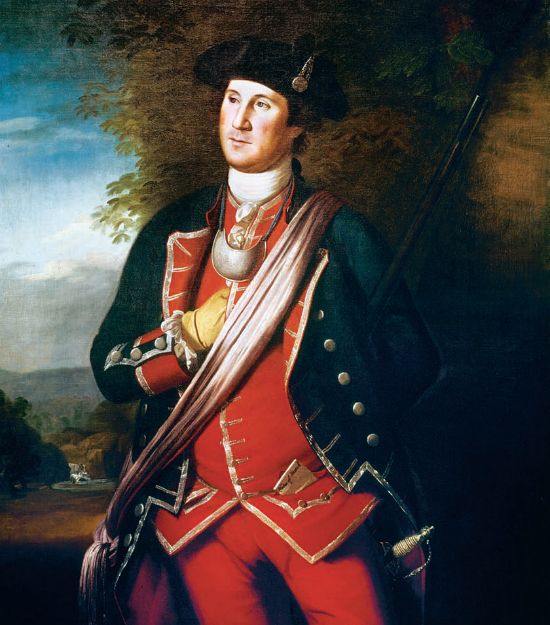
Portrait of George Washington (1732- 1799)
Date Painted: 1772
Artist: Charles Willson Peale (1741 – 1827)
Oil on canvas
The earliest authenticated portrait of George Washington shows him wearing his colonel's uniform of the Virginia Regiment from the French and Indian War. The portrait was painted about 12 years after Washington's service in that war, and several years before he would reenter military service in the American Revolution [Source].
-------------------------------------------------------------------------------------------------------------------------------------------------------------
I'm finding notes I wrote down, and haven't yet transcribed, of various items on view at the Morgan Library (here is my last
post on the Morgan, which also includes a photograph I took of the ceiling).
Here is what I scribbled from the label I found below a
manuscript of George Washington at the Morgan:
Washington requests "some additional aids." Letter to Elbridge Gerry, 25 Dec. 1777
With a bit of a search (I should have written better notes) I found the full, transcribed letter
here, from the manuscript
The Writings of George Washington from the Original Manuscript Sources, 1745-1799. John C. Fitzpatrick, Editor. (To find the letter, type in "additional aids" in your server's search/find box at the
manuscript website - without quotations marks.)
Here is the letter:
Valley Forge, December 25, 1777
Dear Sir: Notwithstanding my last Letters to Congress were very explicit, and expressive of the wants of this Army, the necessity of arranging many matters in it, and making the necessary appointments without a moments loss of time, yet, when I consider the advanced Season, and consult my past experience of delay, I am induced to take the liberty of claiming your particular attention to this business; hoping thereby, that the method suggested by you, of having a Comee. of Congress, or from the board of War, sent to Camp to consult with me, or a Comee. of my appointing (for it would be impossible for me to give that close attention which the nature of the thing would require) on the best regulations, arrangements, and Plans for the next Campaign will be approved.
If this method should be adopted by Congress, I would feign hope that the powers of their Comee. might not be confined to particular matters, but generl. and extensive; Congress reservg. to themselves the right of approving or disapproving the proceedings. Our whole Military system might then be considered, and such alterations as should be found necessary and beneficial, and that circumstances would admit of, be adopted.
If this Comee. should happen to be composed of Members from the board of War, they could fix many matters at the sametime with Genl. Knox in the Ordnance department, which requires as close attention and dispatch; as any thing whatever; in short I can foresee many great advantages which would result from it, without one possible evil.
I shall be obliged to you for recollecting what I mentioned respecting some additional Aids; I find, especially at times; the multiplicity of writing, and other business too great for those I have. Congress may be assured I do not want to run the public to any unnecessary expence on this Acct. and that I shall be as sparing as possible in my appointments under the Indulgence they may give. I am, etc.
P.S. If Congress mean to adopt the half pay establishment. &c. much good would result from anouncing it soon; that all Officers who should be retaind, under the New regulations, may know at once what they have to trust to; this would, probably, begin the desired reformation in the Army whereas, under uncertainty and doubt, things at best, will jog on as usual.
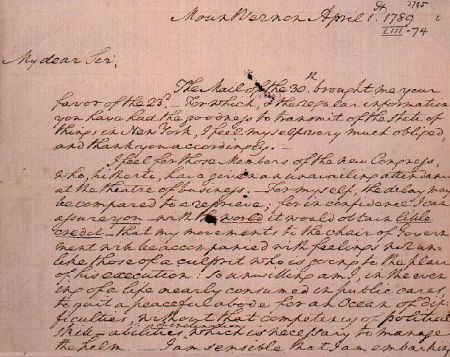
I've tried to find the image of the manuscript to show Washington's handwriting (rather than the transcribed, typed form above). I was intrigued by the manuscripts at the Morgan, which showed me the personality behind the important figures. I found Washington's writing neat and meticulous, but with a certain flair. I liked the script style. I was surprised by (and disliked) Brahms' script in his music manuscripts which I describe in my notes as "drama - also in manuscript" - as in drama in music, and drama in musical manuscript.
Here is part of a letter that Washington wrote (not the manuscript of the letter I describe above - this letter can be found
here - small pdf file):
 George Washington (1732–1799)
Autograph letter to Henry Knox, April 1, 1789 (detail)
Gilder Lehrman Collection, on deposit
Morgan LibraryAnd below is Brahm's music manuscript:
 Brahms, Johannes, 1833-1897
Score, p. [3] (3 of 4)
Lieder und Gesänge, op. 59
Dämmrung senkte sich von oben
Autograph manuscript, 1871?
Morgan LibraryBelow is a recording of the song "Dämmrung senkte sich von oben" (upto the 3:38 point in the youtube recording, another song follows it - "Mein Wundes Herz")
Dämmrung senkte sich von oben (starts at the 0:26:22 point, ends at 0:30:14)
Angelika Kirchschlager, mezzo-soprano
Graham Johnson, pianoDämmrung senkte sich von oben
Dämmrung senkte sich von oben,
Schon ist alle Nähe fern;
Doch zuerst emporgehoben
Holden Lichts der Abendstern!
Alles schwankt ins Ungewisse,
Nebel schleichen in die Höh’,
Schwarzvertiefte Finsternisse
Widerspiegelnd ruht der See.
Nun am östlichen Bereiche
Ahn’ ich Mondenglanz und -glut,
Schlanker Weiden Haargezweige
Scherzen auf der nächsten Flut.
Durch bewegter Schatten Spiele
Zittert Lunas Zauberschein,
Und durchs Auge schleicht die Kühle
Sänftigend ins Herz hinein. | Dusk has fallen from on high
Dusk has fallen from on high,
All that was near now is distant;
But there the evening star appears
Shining with its lovely light!
All becomes an uncertain blur,
The mists creep up the sky;
Ever blacker depths of darkness
Are mirrored in the silent lake.
Now in the eastern reaches
I sense the moon’s light and glow,
The branching hair of slender willows
Frolics on the nearby water.
Through the play of moving shadows,
The moon’s magic light quivers down,
And coolness steals through the eye
Soothingly into the heart. |
-------------------------------------------------------------------------------------------------------------------------------------------------------------
While searching for the manuscript I mention above, I found
this document on "Rules of Civility." It was a copy that Washington made from a 16th century French etiquette manual as part of a classroom exercise at age sixteen or so of
Rules of Civility (and Decent Behavior in Company and Conversation) (seen notes below). This document, and the exercise, must have influenced his adult, and presidential, years. We underestimate the importance of memorization and rote learning (there are many lines of Shakespeare I still remember after those arduous memorization tests I had to take in high school). As Washington meticulously (that is his character, after all) copied those lines on civility and decent behavior, he must have had them engraved in the back of his head, later to be useful when he was running a country, and a very new one at that. The American people are lucky in their first leader, that he was wise, humble and decisive. His education surely had a part to play in his leadership.
From his meticulous script, I would think he also found daily etiquette as an important aspect of civility, and that he had a regard for morality.
I've posted below rules 54-67 of the young George Washington's
Rules of Civility (and Decent Behavior in Company and Conversation), along with an introduction on these rules.
Here is the background behind these Rules:
Washington's concern for morality can be dated back at least to a list of “Rules of Civility and Decent Behavior” that he copied into his school writing book when he was 16. Most of these 110 rules, which have been traced to a late-16th century French etiquette manual, concern manners in both speech ("Mock not nor jest at anything of importance") and deed ("When in company, put not your hands to any part of the body not usually discovered"). But several address also the habits of the mind ("Be not hasty to believe flying reports to the disparagement of any"). The last rule reads: "Labor to keep alive in your breast the little spark of celestial fire called conscience." Conscience here refers to man's innate grasp of, or ability to reason about, moral right and wrong. When the American Founders would later declare independence from Great Britain in 1776, it was by virtue of this "spark of celestial fire" that they would establish the principles of human equality, unalienable rights, and government by consent as the foundations of American constitutional government.[Source: PBS.org]
Below are the rules 34-67:
George Washington's Rules of Civility (and Decent Behaviour in Company and Conversation)
[Source: The Papers of George Washington]
No 54-67
These maxims originated in the late sixteenth century in France and were popularly circulated during Washington's time. Washington wrote out a copy of the 110 Rules in his school book when he was about sixteen-years old.
This exercise, now regarded as a formative influence in the development of his character, included guidelines for behavior in pleasant company, appropriate actions in formal situations, and general courtesies, such as: "Superfluous Complements and all Affectation of Ceremonie are to be avoided, yet where due they are not to be Neglected" (no. 25); "Think before you Speak" (no. 73); and "Rince not your Mouth in the Presence of Others" (no. 101).
-----------------------------------------------------------------------------------------------------------------------------------------
54th Play not the Peacock, looking every where about you, to See if you be well Deck't, if your Shoes fit well if your Stokings sit neatly, and Cloths handsomely.
55th Eat not in the Streets, nor in the House, out of Season.
56th Associate yourself with Men of good Quality if you Esteem your own Reputation; for 'tis better to be alone than in bad Company.
57th In walking up and Down in a House, only with One in Compan[y] if he be Greater than yourself, at the first give him the Right hand and Stop not till he does and be not the first that turns, and when you do turn let it be with your face towards him, if he be a Man of Great Quality, walk not with him Cheek by Joul but Somewhat behind him; but yet in Such a Manner that he may easily Speak to you.
58th Let your Conversation be without Malice or Envy, for 'tis a Sig[n o]f a Tractable and Commendable Nature: And in all Causes of Passion [ad]mit Reason to Govern.
59th Never express anything unbecoming, nor Act agst the Rules Mora[l] before your inferiours.
60th Be not immodest in urging your Freinds to Discover a Secret.
61st Utter not base and frivilous things amongst grave and Learn'd Men nor very Difficult Questians or Subjects, among the Ignorant or things hard to be believed, Stuff not your Discourse with Sentences amongst your Betters nor Equals.
62nd Speak not of doleful Things in a Time of Mirth or at the Table; Speak not of Melancholy Things as Death and Wounds, and if others Mention them Change if you can the Discourse tell not your Dreams, but to your intimate Friend.
63rd A Man ought not to value himself of his Atchievements, or rare Qualities of wit; much less of his riches Virtue or Kindred.
-------------------------------------------------------------------------------------------------------------------------------------------------------------
Posted By: Kidist P. Asrat