Monday, March 11, 2013

An Etiquette Guide by a Future President


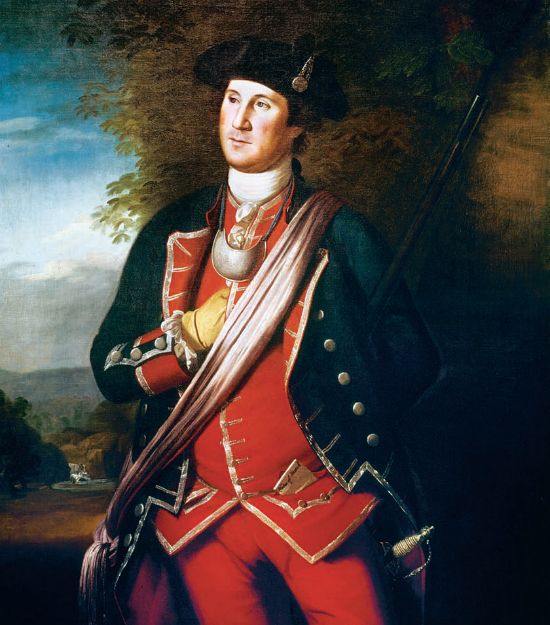
Portrait of George Washington (1732- 1799)
Date Painted: 1772
Artist: Charles Willson Peale (1741 – 1827)
Oil on canvas
The earliest authenticated portrait of George Washington shows him wearing his colonel's uniform of the Virginia Regiment from the French and Indian War. The portrait was painted about 12 years after Washington's service in that war, and several years before he would reenter military service in the American Revolution [Source].
-------------------------------------------------------------------------------------------------------------------------------------------------------------

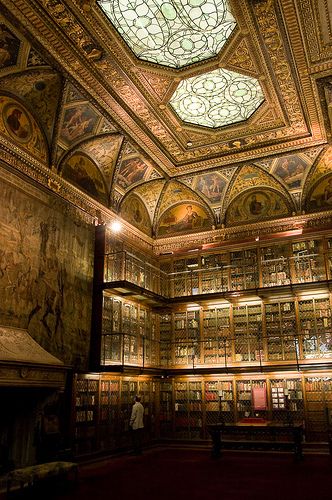
I'm finding notes I wrote down, and haven't yet transcribed, of various items on view at the Morgan Library (here is my last post on the Morgan, which also includes a photograph I took of the ceiling).

Here is what I scribbled from the label I found below a manuscript of George Washington at the Morgan:
Washington requests "some additional aids." Letter to Elbridge Gerry, 25 Dec. 1777
With a bit of a search (I should have written better notes) I found the full, transcribed letter here, from the manuscript The Writings of George Washington from the Original Manuscript Sources, 1745-1799. John C. Fitzpatrick, Editor. (To find the letter, type in "additional aids" in your server's search/find box at the manuscript website - without quotations marks.)

Here is the letter:
Valley Forge, December 25, 1777

Dear Sir: Notwithstanding my last Letters to Congress were very explicit, and expressive of the wants of this Army, the necessity of arranging many matters in it, and making the necessary appointments without a moments loss of time, yet, when I consider the advanced Season, and consult my past experience of delay, I am induced to take the liberty of claiming your particular attention to this business; hoping thereby, that the method suggested by you, of having a Comee. of Congress, or from the board of War, sent to Camp to consult with me, or a Comee. of my appointing (for it would be impossible for me to give that close attention which the nature of the thing would require) on the best regulations, arrangements, and Plans for the next Campaign will be approved.

If this method should be adopted by Congress, I would feign hope that the powers of their Comee. might not be confined to particular matters, but generl. and extensive; Congress reservg. to themselves the right of approving or disapproving the proceedings. Our whole Military system might then be considered, and such alterations as should be found necessary and beneficial, and that circumstances would admit of, be adopted.

If this Comee. should happen to be composed of Members from the board of War, they could fix many matters at the sametime with Genl. Knox in the Ordnance department, which requires as close attention and dispatch; as any thing whatever; in short I can foresee many great advantages which would result from it, without one possible evil.

I shall be obliged to you for recollecting what I mentioned respecting some additional Aids; I find, especially at times; the multiplicity of writing, and other business too great for those I have. Congress may be assured I do not want to run the public to any unnecessary expence on this Acct. and that I shall be as sparing as possible in my appointments under the Indulgence they may give. I am, etc.

P.S. If Congress mean to adopt the half pay establishment. &c. much good would result from anouncing it soon; that all Officers who should be retaind, under the New regulations, may know at once what they have to trust to; this would, probably, begin the desired reformation in the Army whereas, under uncertainty and doubt, things at best, will jog on as usual.
I've tried to find the image of the manuscript to show Washington's handwriting (rather than the transcribed, typed form above). I was intrigued by the manuscripts at the Morgan, which showed me the personality behind the important figures. I found Washington's writing neat and meticulous, but with a certain flair. I liked the script style. I was surprised by (and disliked) Brahms' script in his music manuscripts which I describe in my notes as "drama - also in manuscript" - as in drama in music, and drama in musical manuscript.

Here is part of a letter that Washington wrote (not the manuscript of the letter I describe above - this letter can be found here - small pdf file):
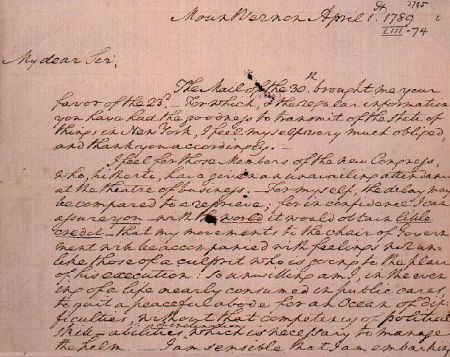

George Washington (1732–1799)
Autograph letter to Henry Knox, April 1, 1789 (detail)
Gilder Lehrman Collection, on deposit
Morgan Library


And below is Brahm's music manuscript:


Brahms, Johannes, 1833-1897
Score, p. [3] (3 of 4)
Lieder und Gesänge, op. 59
Dämmrung senkte sich von oben
Autograph manuscript, 1871?
Morgan Library


Below is a recording of the song "Dämmrung senkte sich von oben" (upto the 3:38 point in the youtube recording, another song follows it - "Mein Wundes Herz")


Dämmrung senkte sich von oben (starts at the 0:26:22 point, ends at 0:30:14)
Angelika Kirchschlager, mezzo-soprano
Graham Johnson, piano


Dämmrung senkte sich von oben

Dämmrung senkte sich von oben,
Schon ist alle Nähe fern;
Doch zuerst emporgehoben
Holden Lichts der Abendstern!
Alles schwankt ins Ungewisse,
Nebel schleichen in die Höh’,
Schwarzvertiefte Finsternisse
Widerspiegelnd ruht der See.
Nun am östlichen Bereiche
Ahn’ ich Mondenglanz und -glut,
Schlanker Weiden Haargezweige
Scherzen auf der nächsten Flut.
Durch bewegter Schatten Spiele
Zittert Lunas Zauberschein,
Und durchs Auge schleicht die Kühle
Sänftigend ins Herz hinein.
Dusk has fallen from on high

Dusk has fallen from on high,
All that was near now is distant;
But there the evening star appears
Shining with its lovely light!
All becomes an uncertain blur,
The mists creep up the sky;
Ever blacker depths of darkness
Are mirrored in the silent lake.
Now in the eastern reaches
I sense the moon’s light and glow,
The branching hair of slender willows
Frolics on the nearby water.
Through the play of moving shadows,
The moon’s magic light quivers down,
And coolness steals through the eye
Soothingly into the heart.

-------------------------------------------------------------------------------------------------------------------------------------------------------------

While searching for the manuscript I mention above, I found this document on "Rules of Civility." It was a copy that Washington made from a 16th century French etiquette manual as part of a classroom exercise at age sixteen or so of Rules of Civility (and Decent Behavior in Company and Conversation) (seen notes below). This document, and the exercise, must have influenced his adult, and presidential, years. We underestimate the importance of memorization and rote learning (there are many lines of Shakespeare I still remember after those arduous memorization tests I had to take in high school). As Washington meticulously (that is his character, after all) copied those lines on civility and decent behavior, he must have had them engraved in the back of his head, later to be useful when he was running a country, and a very new one at that. The American people are lucky in their first leader, that he was wise, humble and decisive. His education surely had a part to play in his leadership.

From his meticulous script, I would think he also found daily etiquette as an important aspect of civility, and that he had a regard for morality.

I've posted below rules 54-67 of the young George Washington's Rules of Civility (and Decent Behavior in Company and Conversation), along with an introduction on these rules.

Here is the background behind these Rules:
Washington's concern for morality can be dated back at least to a list of “Rules of Civility and Decent Behavior” that he copied into his school writing book when he was 16. Most of these 110 rules, which have been traced to a late-16th century French etiquette manual, concern manners in both speech ("Mock not nor jest at anything of importance") and deed ("When in company, put not your hands to any part of the body not usually discovered"). But several address also the habits of the mind ("Be not hasty to believe flying reports to the disparagement of any"). The last rule reads: "Labor to keep alive in your breast the little spark of celestial fire called conscience." Conscience here refers to man's innate grasp of, or ability to reason about, moral right and wrong. When the American Founders would later declare independence from Great Britain in 1776, it was by virtue of this "spark of celestial fire" that they would establish the principles of human equality, unalienable rights, and government by consent as the foundations of American constitutional government.[Source: PBS.org]
Below are the rules 34-67:
George Washington's Rules of Civility (and Decent Behaviour in Company and Conversation)
[Source: The Papers of George Washington]
No 54-67

These maxims originated in the late sixteenth century in France and were popularly circulated during Washington's time. Washington wrote out a copy of the 110 Rules in his school book when he was about sixteen-years old.

This exercise, now regarded as a formative influence in the development of his character, included guidelines for behavior in pleasant company, appropriate actions in formal situations, and general courtesies, such as: "Superfluous Complements and all Affectation of Ceremonie are to be avoided, yet where due they are not to be Neglected" (no. 25); "Think before you Speak" (no. 73); and "Rince not your Mouth in the Presence of Others" (no. 101).
-----------------------------------------------------------------------------------------------------------------------------------------

54th Play not the Peacock, looking every where about you, to See if you be well Deck't, if your Shoes fit well if your Stokings sit neatly, and Cloths handsomely.

55th Eat not in the Streets, nor in the House, out of Season.

56th Associate yourself with Men of good Quality if you Esteem your own Reputation; for 'tis better to be alone than in bad Company.

57th In walking up and Down in a House, only with One in Compan[y] if he be Greater than yourself, at the first give him the Right hand and Stop not till he does and be not the first that turns, and when you do turn let it be with your face towards him, if he be a Man of Great Quality, walk not with him Cheek by Joul but Somewhat behind him; but yet in Such a Manner that he may easily Speak to you.

58th Let your Conversation be without Malice or Envy, for 'tis a Sig[n o]f a Tractable and Commendable Nature: And in all Causes of Passion [ad]mit Reason to Govern.

59th Never express anything unbecoming, nor Act agst the Rules Mora[l] before your inferiours.

60th Be not immodest in urging your Freinds to Discover a Secret.

61st Utter not base and frivilous things amongst grave and Learn'd Men nor very Difficult Questians or Subjects, among the Ignorant or things hard to be believed, Stuff not your Discourse with Sentences amongst your Betters nor Equals.

62nd Speak not of doleful Things in a Time of Mirth or at the Table; Speak not of Melancholy Things as Death and Wounds, and if others Mention them Change if you can the Discourse tell not your Dreams, but to your intimate Friend.

63rd A Man ought not to value himself of his Atchievements, or rare Qualities of wit; much less of his riches Virtue or Kindred.
-------------------------------------------------------------------------------------------------------------------------------------------------------------
Posted By: Kidist P. Asrat
Vladimir Horowitz Plays Mozart; Who Does Bach Justice?

I got this comment from Rick at Reflecting Light on my earlier post on Mozart's Piano Sonata in A Major, K331, Andante Grazioso:
I have been listening to Mozart recordings quite a bit in the past few days. All symphonies from his "middle period" -- starting with no. 30, up to 35. I've enjoyed the performances although they're quite different.

Charles Mackerras and the Prague Chamber Orchestra: Mackerras was going through his horse-race period, no doubt influenced by the so-called "authentic" performance style. Most tempos way too fast, brash accents ... but Mackerras was a genius, and the rowdiness was tempered by a sensitivity to melody and phrasing. (He later got over that style, and some of his last recordings were of Mozart with the Scottish Chamber Orchestra, wonderful readings.)

Colin Davis and the Staatskapelle Dresden: From the '70s but in typically excellent Decca sound. I cannot praise these recordings highly enough. Davis saw the light and imparted his vision to the fine orchestra in the city that was a smoking ruin only 30 years earlier.

Rick
I agree with Rick. There is a "horse-race" tendency in musicians today, and not just in Mozart. Bach's violin concertos are case in point. Performers compensate for this flight from the piece in different ways. Rick observes the brash accents; I notice a "prettification" of the music.

One of the things I was trained in as a choir performer and while studying piano, is how not to gallop off - it is apparently a natural tendency. It is not simply a matter of giving each note its due, but of controlling our internal rhythm, so we don't allow it to accelerate while singing or playing a piece of music. I think that there are also those with natural musical ability for whom this reining-in is easier. Not every-one can be a musician.

Here is perhaps my favorite piece of music: Bach's violin concerto in A minor, and specifically the first movement. There are performances where the movement is played too fast, bolting aggressively off into some far horizon.

Isaac Stern, in the video below, does it full justice, giving it a delicate grandeur. I love the stretches of yearning by the violin solo.


Bach violin concerto in A minor, First Movement, given an Allegro or an Allegro Assai tempo
Isaac Stern & the English Chamber Orchestra


Probably a composer who can be played in this "horse-race" manner is Vivaldi.

I wrote here about a choral concert by a "Korean-American" concert choir I attended in New York. One thing that struck me was the accelerated speed at which the choir (and the soloists) sang.

This seems to be a contemporary phenomenon. I don't think it is simply a display of virtuoso. I think people are bored with the music, and they don't spend the required time to play the notes, but rather gallop on to finish the pieces. Sitting and listening (like sitting and reading) requires a certain patience, a certain ability to leave the galloping world alone for a while. The world now is full of gallopers, from the fast car highways to the instant connections on the internet highway. Speech (conversation) is also becoming more jumbled and faster, as though people cannot string together words fast enough. So if the audience is based on the galloping type, I suppose the orchestra is also of the same ilk, not just because they want to deliver what they audience wants, but because they really are in tune (in the same wave length) as the modern concert-goer. Speed, expediency (the psychologists have a term for it - Attention Deficit Disorder) is part of contemporary man's make-up.

I also think this is why the Korean choral group performed in the manner it did. It is not "in tune" with Western music, so its interpretation is to get through - virtuoso manner - the musical piece. I wrote about this same lack of sensitivity in the Toronto Symphony Orchestra, an Asian-dominated orchestra group, in the same blog post Asians Playing Western Music.

I wrote in the post:
As the [choral] concert progressed, I began to realize a certain "prettiness" in the performance, a lack of force, drive and even drama. I don't think this is simply a cultural phenomenon (as in misunderstanding the Messiah's content, message, meaning, etc...). I think it is a physio/cerebral problem. I've seen it happen in art and design, and even in science... At some level, I think Asians demonstrate some ability (i.e. memorization, or fast, scale-like exercises). But there seems to be an inability to create a synthesized beauty, which is what much of art (and order in Science) is about.
Perhaps this galloping-off by white members of orchestra and other musical ensembles is also influenced by this multicultural environment, where the deep study of the Western music is being overshadowed by other things like audience appeasement, and non-white (and specifically East Asian) dominance in classical music.
-------------------------------------------------------------------------------------------------------------------------------------------------------------
Posted By: Kidist P. Asrat

Saturday, March 9, 2013

Beauty: by Roger Scruton. Pp. 167-176


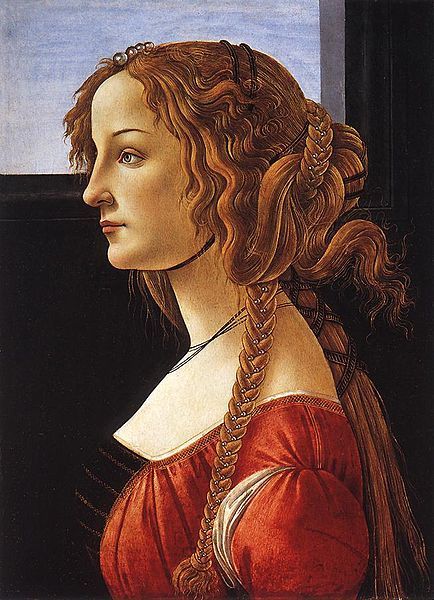
Portrait of a Young Woman, c. 1480
Sandro Botticelli, 1445-1510
Staatliche Museum, Berlin

[Painting on the front cover of Scruton's Beauty, albeit the book cover
has cropped the painting, and the hue is more golden than reddish]


-------------------------------------------------------------------------------------------------------------------------------------------------------------

Below, I have reprinted most of Flight from Beauty, Roger Scruton's eighth chapter on Beauty. This book was an important (perhaps I can be more dramatic and say it was a seminal) influence on the development of this site.

Beauty
Roger Scruton
pp 167-176
In the first chapter I distinguished two ideas of beauty - one denoting aesthetic success, the other a specific form of it, the form in which we delight, and are at one with, the presented aspect of the world. Throughout this book I have pointed to aesthetic objects that succeed without necessarily being beautiful in this idealizing sense - either because they are too ordinary, like clothes, or because they attract our attention by disturbing us, like the novels of Zola or the operas of Berg.

Even in Zola and Berg, however, beauty shows its face - as in the lovely invocation of the young Francoise and her cow at the opening of La Terre or the equally lovely music with which Berg's orchestra sorrows over Lulu. Zola and Berg, in their different ways, remind us that real beauty can be found, even in what is seedy, painful and decayed. Our ability to tell the truth about our own condition, in measured words and touching melodies, offers a kind of redemption from it. The most influential work of twentieth-century English literature, T. S. Eliot’s The Waste Land, describes the modern city as a soul-less desert: but it does so with images and allusions that affirm what the city denies. Our very ability to make this judgement is the final disproof of it. If we can grasp the emptiness of modern life, this is because art points to another way of being, and Eliot's poem makes this other way available.

The Waste Land belongs to the tradition of Baudelaire's Les Fleurs du Mal, Flaubert's Madame Bovary, and James's The Golden Bowl. It describes what is seedy and sordid in words so resonant of the opposite, so replete with the capacity to feel, to sympathize and to understand, that life in its lowest forms is vindicated by our response to it. This 'redemption through art' occurs only because the artists aims at beauty in the narrow sense. And this is the paradox of fin-de-siecle culture: that it continued to believe in beauty, while focusing on all the reasons for doubting that beauty is obtainable outside the realm of art.

Since that time art has taken another turn, refusing to bless human life with anything like a vision of redemption. Art in the tradition of Baudelaire floats like an angel above the world beneath its gaze. It does not avoid the spectacle of human folly, malice and decay; but it invites us to another place, telling us that 'là tout n'est qu’ordre et beauté: | Luxe, calme et volupté'. More recent art cultivates a posture of transgression, matching the ugliness of the things it portrays with an ugliness of its own. Beauty is downgraded as something too sweet, too escapist and too far from realities to deserve our undeceived attention. Qualities that previously denoted aesthetic failure are now cited as marks of success; while the pursuit of beauty is often regarded as a retreat from the real task of artistic creation, which is to challenge comforting illusions and to show life as it is. Arthur Danto has even argued that beauty is both deceptive as a goal and in some way antipathetic to the mission of modern art.

This movement of ideas can be seen as in part a recognition of the ambiguous nature of the term 'beauty'. But it also involves a rejection of beauty in its narrow sense, an affirmation that the old invocations of home, peace, love and contentment are lies, and that art must henceforth devote itself to the real and unpleasant truth of our condition.

The modernist apology

The repudiation of beauty gains strength from a particular vision of modern art and its history. According to many critics writing today a work of art justifies itself by announcing itself as a visitor from the future. The value of art is a shock value: art exists to awaken us to our historical predicament and to remind us of the ceaseless change which is the only permanent thing in human nature.

Historians of painting therefore constantly remind us of the Salon Art of the mid-nineteenth century - art that was not art at all, precisely because it was derived from a repertoire of exhausted gestures - and of the resistance at first encountered by Manet, whom Baudelaire extolled as 'le peintre de la vie moderne'. They remind us of the great force that was released into the world by Manet's iconoclasm, and of the successive shocks to the system as one by one the experiments proceeded, until figurative painting came to be seen by many as a thing of the past.

Historians of music remind us of the last symphony and late quartets of Beethoven, in which the constraints of form seem to be burst asunder by a titanic power; they dwell on the case of Tristan mid Isolde, whose shifting chromatic harmonies seem to stretch tonality to the very limit, and on the music of Stravinsky, Bartok and Schoenberg - music which at first shocked the world, and which was justified in terms used to justify the abolition of figurative painting. The old language, the historians say, was exhausted: only clichés could result from the attempt to prolong its use. The new language was designed to place music in its historical context, to recognize the present as something detached from the past, a new experience which we seize only by understanding it as 'other' than what has gone before. But in the very moment of seizing the present we become aware of it as past and superseded.

Tradition and Orthodoxy

In architecture and literature we find the same story, of art at war with its past, forced to challenge the rule of clichés, and to set off on a path of transgression. However, the story is fed on a one-sided diet of examples. At the moment when Rothko, de Kooning and Pollock were engaged in their (to my mind highly repetitive) experiments, Edward Hopper was producing figurative paintings that showed him to be as much the painter of modern American life as Manet had been the painter of life in nineteenth-century Paris. At the moment when Schoenberg was jettisoning tonality for the twelve-tone serial method, Janacek was composing Katya Kabanova and Sibelius beginning his great series of tonal symphonies.

Moreover, there is another, truer, history of the modern artist which is the story told by many of the great modernists themselves. It is the history told by T.S. Eliot, in his essays and in Four Quartets, by Ezra Pound in the Cantos, by Schoenberg in his critical writings and in Moses und Aron, and by Pfitzner in Palestrina. And it sees the goal of the modern artist not as a break with tradition, but as a recapturing of tradition, in circumstances for which the artistic legacy has made little or no provision. This history does not see the pastness of the present moment, but its present reality, as the place we have got to, and whose nature must be understood in terms of a continuum. If, in modern circumstances, the forms and styles of art must be remade, this is not in order to repudiate the old tradition, but in order to restore it. The effort of the modern artist is to express realities which have not been encountered before, and which are especially hard to encompass. But this cannot be done, except by bringing the spiritual capital of our culture to bear on the present moment and to show it as it truly is. For Eliot and his colleagues, therefore, there could be no truly modern art which was not at the same time a search for orthodoxy: an attempt to capture the nature of the modern experience, by setting it in relation to the certainties of a live tradition.

You may find the result impenetrable, unintelligible or even ugly – as many do in the case of Schoenberg. But that is certainly not the intention. Schoenberg, like Eliot, sought to renew the tradition, not to destroy it, but to renew it as a vehicle in which beauty, rather than banality, would once more be the norm. There is nothing absurd in the view that the gossamer lines of Schoenberg’s Erwartung have more of real melody than the thick textures of a Vaughan Williams symphony. True, this little melodrama has a nightmarish quality that is far from the consoling beauties of a song by Schubert. But Schoenberg’s idiom can be understood as an attempt both to understand the nightmare, and to rein it in – to confine it in a musical form which gives meaning and beauty to catastrophe in the way that Aeschylus gave meaning and beauty to the avenging furies, or Shakespeare to the dreadful death of Desdemona.

The modernists feared that the aesthetic endeavour would detach itself from the full artistic intention, and become empty, repetitious, mechanical and cliché-ridden. It was self-evident to Eliot, Matisse and Schoenberg that this was happening all around them, and they set out to protect an endangered aesthetic ideal from the corruptions of popular culture. This ideal had connected the idea of beauty with the impulse to consecrate human life and endow it with a more than worldly significance. In short, the modernists set out to reunite the artistic enterprise with its underlying spiritual aim. Modernism was not conceived as a transgression but as a recuperation: an arduous path back to a hard-won inheritance of meaning, in which beauty would again be honoured, as the present symbol of transcendent values. This is not what we see in the consciously 'transgressive' and 'challenging' art of today, which exemplifies a flight from beauty, rather than a desire to recover it.

The Flight from Beauty

One of Mozart’s most endearing works is the comic opera, Die Entführung aus dem Serail, which tells the story of Konstanze, shipwrecked and separated from her fiancé Belmonte, and taken to serve in the harem of the Pasha Selim. After various intrigues, Belmonte rescues her, helped by the clemency of the Pasha, who respects Konstanze’s chastity, declining to take her by force. This implausible plot permits Mozart to express his Enlightenment conviction that charity is a universal virtue, as real in the Muslim empire of the Turks as in the Christian Empire of the enlightened Joseph II (himself hardly Christian). The faithful love of Belmonte and Konstanze inspires the Pasha’s clemency. And, even if Mozart’s innocent vision is without much historical basis, his belief in the reality of disinterested love is everywhere expressed and endorsed by the music. Die Entführung advances a moral idea, and its melodies share the beauty of that idea and persuasively present it to the listener.

In the 2004 production of Die Entführung at the Comic Opera in Berlin, the producer Calixto Bieito decided to set the opera in a Berlin brothel, with Selim as pimp, and Konstanze one of the prostitutes. Even during the most tender music, the stage was littered with couples copulating, and every excuse for violence, with or without a sexual climax, was taken. At one point a prostitute is gratuitously tortured, and her nipples bloodily and realistically severed before she is killed. The words and the music speak of love and compassion, but their message is drowned out by the loudly orchestrated scenes of murder and narcissistic sex that litter the stage.

That is an example of a phenomenon with which we are familiar from every aspect of our contemporary culture. It is not merely that artists, directors, musicians and others connected with the arts are in flight from beauty. There is a desire to eliminate beauty, to rub it out. Wherever beauty lies in wait for us, the desire to pre-empt its appeal can intervene, ensuring that its still small voice will not be heard behind the scenes of desecration. For beauty makes a claim on us: it is a call to renounce our narcissism and look with reverence on the world. (Cf. Iago of Cassio: ‘He hath a daily beauty in his life/ Which makes me ugly’, and the soliloquy of Claggart in Britten's Billy Budd, raging against the beauty that shines its light on his own moral worthlessness.)

I have used the word 'desecration', thereby recalling the discussion of the sacred in Chapter 2. To desecrate is to spoil what might otherwise be set apart, in the sphere of consecrated things. We can desecrate a church, a mosque, a graveyard, a tomb; and also a holy image, a holy book or a holy ceremony. We can also desecrate a corpse, a cherished image, even a living human being – in so far as these things contain (as they do) a portent of some original ‘apartness’. The fear of desecration is a vital element in all religions. Indeed, that is what the word religio originally meant: a cult or ceremony designed to protect some sacred place from sacrilege.

Our need for beauty is not something that we could lack and still be fulfilled as people. It is a need arising from our metaphysical condition, as free individuals, seeking our place in a shared and objective world. We can wander through this world, alienated, resentful, full of suspicion and distrust. Or we can find our home here, coming to rest in harmony with others and with ourselves. The experience of beauty guides us along this second path: it tells us that we are at home in the world, that the world is already ordered in our perceptions as a place fit for the lives of beings like us. But - and this is again one of the messages of the early modernists - beings like us become at home in the world only by paying tribute to our 'fallen' condition, as Eliot acknowledged it in The Wast Land. Hence the experience of beauty also points us beyond this world, to a 'kingdom of ends' in which our immortal longings and our desire for perfection are finally answered. As Plato and Kant both saw, therefore, the feeling for beauty is proximate to the religious frame of mind, arising from a humble sense of living with imperfections, while aspiring towards the highest unity with the transcendental.

Look at any picture by one of the great landscape painters – Poussin, Guardì, Turner, Corot, Cézanne – and you will see that idea of beauty celebrated and fixed in images. Those painters do not turn a blind eye to suffering, or to the vastness and threateningness of the universe, of which we occupy so small a corner. Far from it. Landscape painters show us death and decay in the very heart of things: the light on their hills is a fading light; the walls of their houses are patched and crumbling like the stucco on the villages of Guardì. But their images point to the joy that lies incipient in decay, and to the eternal that is implied in the transient.

Even in the brutal presentations of thwarted and malicious life that fill the novels of Zola we find, if not the reality of beauty, at least a distant glimpse of it — recorded in the rhythm of the prose, and in the invocations of stillness amid the futile longings which drive the characters to their goals. Realism, in Zola as in Baudelaire and Flaubert, is a kind of disappointed tribute to the ideal. The subject matter is profane; but profane by nature, and not because the writer has chosen to desecrate the few scant beauties that he finds. The art of desecration represents a new departure, and one that we should try to understand, since it lies at the centre of the post-modern experience.
-------------------------------------------------------------------------------------------------------------------------------------------------------------
Posted By: Kidist P. Asrat
Wednesday, March 6, 2013

Peppy Christianity: Christianity Without Responsibility


[Image from cover of the Study Guide: It's Not That Complicated" from the website
Western Conservatory of the Arts and Sciences.]

A reader sent me a link to this site [Western Conservatory of the Arts and Sciences], with this comment:
...when I googled “reclaiming beauty,” the first item was something I think you would actually find amazingly agreeable: a Christian site emphasizing beauty in feminine comportment (and in the arts) as an intentional expression of, and agreement with, the Logos.
I replied:
Yes, I actually saw the site.

I thought it was too "religious" focused.

There is a time for religion, but now we need to focus on all aspects of culture.

Also, they seem too peppy with their "reasons for optimism" sections. I think reality now is far harsher, and we probably may have to expect the worst.

I will write on this!
My mundane, instinctive, reaction to overzealous religious people is that they are hiding something, or not understanding something, or just over-controlling.

The actual world, the material world, is very important. We have to be able to enter into it without "Christianity" shadowing everything.

For example, we have to be able to make works of art without the entire focus of that art being God, or Christ.

I think that is what Islam does: make God (their Allah) the focus of everything. Idiosyncratic humanness is lost in Islam. Its followers become a mass of flowing specimens, all faced towards Allah.

I think the phenomenal success of Christianity, and specifically Western Christianity, is the individuality of God's followers. The whole history of the evolution of Western society is based on idiosyncratic individual leaders, some who were killed for their originality, who led their societies and cultures into new, and I would say better, directions. Even the more modest idiosyncrats, the teacher, the housewife, the policeman, put their stamp on the world in the way they follow their tasks. No two teachers are the some, but some are better, and quietly revolutionary, than others.

In Christianity, culture is made to matter. The world we live here, on earth, matters, as a separate, but connected, entity to the world that God plans for us after we leave this one. As C. S. Lewis wrote in Mere Christianity: "Men are mirrors, or carriers of Christ to other men." Men are not God, or even gods (in the antiquity sense), although they might like to be both. They are mere human, but with a God-given license to build and expand on the world that God has given them. And some are more Christ-like than others.

I think God didn't want to be a dictator. He wanted us to participate in, and complete, the world he created. If we were to land in a ready-made universe, then all we would do is genuflect to a God, who would even tells us how to genuflect, like Allah does to Muslims.

Culture, the manifestation of man's ideas on how to build and form his society, is the tool that God has given us to paint this palette of a world. We can use it well, or use it to our determent and destruction. The choice is ours.

I think related to this is the "peppiness" of the site I've mentioned above. In a subtle way, this peppiness, or cheerfulness, is the abrogation of the author's (or authoress') responsibility in building this world: they've passed it all on to God.

They have a series of study guidelines which they title "Reclaiming Beauty."

Here is a section of their introduction:
[W]e can sometimes forget that the world did not create beauty – God did
In a generalized way, of course God created beauty. But I will go one step further and say that God created the idea of beauty, as I explain above, and let man create the specifics: the cathedrals, the paintings, the foods, the language, the literature, and so on (see the "Topics" on the side panel to see the infinite number of specifics we have at our disposal).

The peppiness these women have is like saying: "God will fix all this."

If stretched further, it can mean to say: "I can do what I want, I can then repent if I err, and then God will fix that error for me."

At its furthest from the truth, this can lead men (and these good women) to say: I can sin. There is nothing wrong with sinning. God will forgive me and send me to heaven.

Those who have lost all track, or relation with God, who are often those who say they can withoutconsequence, will finally say: I don't believe in God. But he will not send me to Hell. He will find a place for me, next to him, in Heaven, for eternal life."

Everyone wants to go to heaven.

Christianity without responsibility.

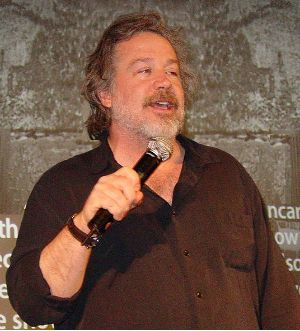
An Idiot Playing at Genius


Actor Tom Hulce, aging adolescent hippy at age 53.
Mozart looked nothing like this in later years.


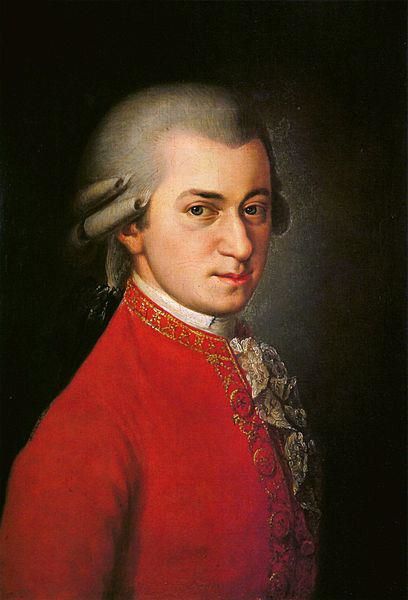
There is silly film on Mozart, called Amadeus, where he is made out to be a bumbling idiot. The portraits of Mozart show him to be a serious, observant man. He has to be, to write the kind of music he wrote.


Posthumous Mozart portrait painted by Barbara Kraft in 1819,
under the supervision of Nannerl Mozart
(Here is more information on the authenticity of the portrait - pdf)


One theory about the above portrait is that its model is a Mozart family portrait by Johann Nepomuk della Croce painted in 1780. Mozart would have been about twenty-four then. Men were mature and serious in their early twenties. Now, we have immaturity all the way to the grave.


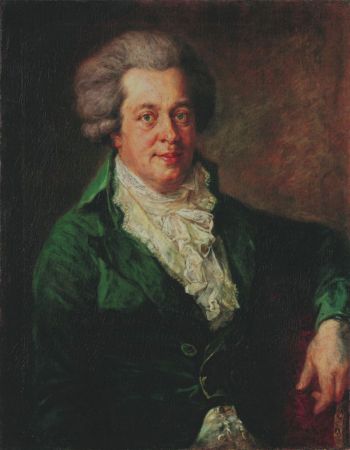
Mozart
Date Painted: 1790 (a year before Mozart's death, at age 34)
By: Johann Georg Edlinger, 1741-1819
Oil Painting
31.5 x 24.5 inches


This is a more relaxed pose than the one above, with Mozart's hand casually on the back of a chair. Probably by then, Mozart was more confident about his talent, and his role and position in German society.

The actor who plays Mozart in Amadeus looks nothing like him. Why wouldn't a director try to find an actor with as close a resemblance to the character as possible? And if that wasn't possible, why not use film props (make-up, costume, hair, weight gain/ weight loss, etc.), to make him look like his character?

One reason, I think, is that a Hollywood film on a classical musician is difficult to sell to the general public. It might work for a serious production like the BBC, or as a documentary, but for the popcorn popping audience, we need something more FUN. And the idiot the filmmakers chose to play Mozart certainly has that fun credential.

His call to fame, besides his Mozart role, is acting in National Lampoon Animal House as a freshman in college trying to get into a fraternity. The only one that would consider him are The Deltas, who:
...are a motley fraternity of rejects and maladjusted undergraduates whose main goal is disrupting the staid, peaceful, rigidly orthodox, and totally hypocritical social order of the school. The Deltas, oblivious to the danger they're in, are having a great time, steeped in irreverence, mild debauchery, and occasional drunkenness, led by the seniors and pledge master John "Bluto" Blutarsky (John Belushi). They're given enough rope to hang themselves, but even then manage to get into comical misadventures, culminating in the commission of one last, utterly senseless (and funny) act of rebellion.
Roger Ebert, the film critic, says of the film:
The movie is vulgar, raunchy, ribald, and occasionally scatological. It finds some kind of precarious balance between insanity and accuracy, between cheerfully wretched excess and an ability to reproduce the most revealing nuances of human behavior.
Roger Ebert, for some reason, writes affectionately about these brothers, calling their debauchery mild and their drunkenness occasional. The film is one long drunken debauchery, not by maladjusted undergraduates, but mentally deficient young men who had no reason being in college. (I myself saw it in college, as a hard-working college student. My degree was in biology. There was no time to fool around.)

Wikipedia says that Hulce is "openly gay." Trust Hollywood to cast a homosexual in the role of Mozart, who then portrays him like some kind of fairy. Even Mozart's relationship with his wife Constanze, whom he called "Dearest, most beloved little wife," is depicted as some kind of adolescent frolic.


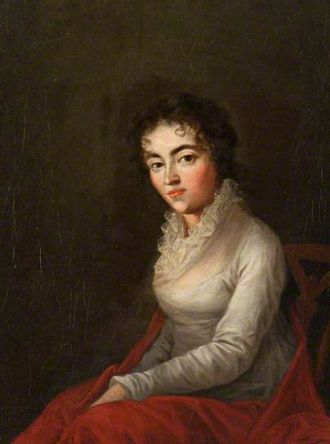
Constanze Mozart
Date Painted: c.1789
By: Joseph Lange, 1751–1831
Oil on canvas
12.7 x 9.8 inches


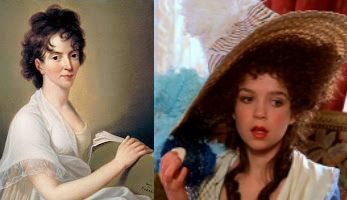
Left: Portrait of the widowed Constanze Mozart
Date Painted: 1802 (she would be forty years old)
By: Hans Hansen, 1769-1828
Oil on Canvas
[I cannot yet find the dimensions of the original]
Right: The girlish actress who portrays Constanze in Amadeus in 1984


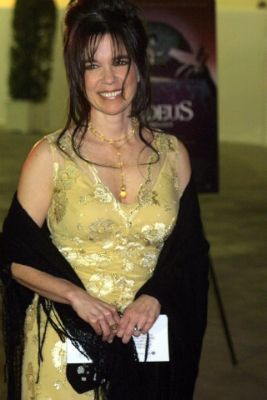
Can the Hollywood actress who played Constanze ever look like the mature widow?

Here is the answer:


Elizabeth Berridge, who played Constanze in 1984,
fifty and still girlish in 2012.


Mozart's music is everywhere. I am sure most people would recognize some melody or piece, which they may have heard in some elevator muzak, in a commercial, or in a restaurant. Many films also use classical music, and I'm sure Mozart's fills in many a background soundtrack. Thus, directors could try a little harder to bring Mozart to the public. Not by making him into a bumbling idiot, but by bringing out the inherent joy of life that Mozart had (as I write here about Mozart's twists and turns, almost joking with us, in his music).

But Amadeus isn't even using comedic artistic licence. It is something much more nefarious than that.

Amadeus demonstrates the general desecration of beauty by a small elite of sophisticated people. They know what they're doing. Demeaning Mozart and destroying his music is like destroying beauty. Destroying beauty is destroying God, the good, and our land and civilization. What they want is to form something else out of the rubble of their destruction, something which they can recreate to their own desires and specifications. Their ambition is nothing short of god-like. They are the Nazis of our era, but even more sophisticated, more patient, and less overtly violent.
------------------------------------------------------------------------------------------------------------------------------------------------------------
Posted By: Kidist P. Asrat
Monday, March 4, 2013

On Call Queries : Let's Start With Joseph Haydn


"Bucolic French Horns" in Joseph Haydn's Symphony No.7, In C Major
Also called 'Noon'


Thoma Bertonneau has generously offered his expertise for "on call queries."

He emailed me to list the topics he can help with:
One service that I could perform for you on an “on call” basis would be to respond briefly to queries. My range of literary competency extends from the Greek and Roman classics through to Nineteenth Century prose and poetry and on to Twentieth Century literature in English, French, and the Scandinavian languages. I have good backgrounds in anthropology and philosophy and have written quite a bit about music.
Below is an article by Bertonneau published at The Brussels Journal on music, Haydn, Conservatism, and Western civilization:

-------------------------------------------------------------------------------------------------------------------------------------------------------------


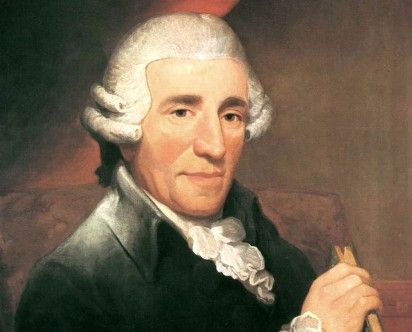
A Conservative Obligation: Joseph Haydn (1732-1809)
Thomas F. Bertonneau
May 26, 2009

The Year of Our Lord 2009 is the bicentenary of the death of Franz Joseph Haydn (d. May 31, 1809), known in the last two decades of his long life by the affectionate moniker of “Papa Haydn.” In the aftermath of the most recent American presidential election, just before Barack Obama’s inauguration, I wrote that sane people might do themselves a favor to withdraw their attention from the sordidness of contemporary politics and reacquaint themselves with J. S. Bach’s great work The Art of the Fugue. I have a similar purpose in mind in recommending to the contemporaneously anguished a healing visitation to the richness of Haydn’s large and varied compositional catalogue. Wolfgang Mozart and Ludwig van Beethoven shot up and fell back like glorious meteors. Both owed an artistic debt to the older man. Haydn, the most important Western composer after Bach, established his career early and, by gradual self-emancipation from service to the aristocracy, became a public composer, writing steadily for a bourgeois audience, who responded with gratitude. Haydn, in contrast to Mozart and Beethoven, lived long, lived well, and managed to integrate himself securely in the middle-class world of late Eighteenth Century Europe.

Haydn’s Titanic productivity can only humble ordinary people. Having more or less invented the string quartet and the symphony, Haydn supplied them almost wholesale, without ever lowering his standard. His late-in-life oratorios, The Creation and The Seasons, made him a London celebrity, and consummated his long relation with a genial English following. One can sometimes entertain the impression that Haydn – pardoning the artistic blasphemy – is a greater composer than Beethoven. I once guiltily confessed this disposition to my friend Steve Kogan, one of the most cultured men I have ever known, who answered with a laconic but telling, “So, you too?”

Haydn’s earliest work bespeaks the artistic ambiguity of its time. Musically, Haydn started in the shadow of the Baroque, sharing an idiom, not exactly with Bach, but with the sons of Bach. This idiom reflected, in part, the taste of Haydn’s employer, Prince Esterhaus, who, maintaining a professional court orchestra, had the wisdom to put Haydn in charge of it. From Haydn’s pen in 1760s and 70s come any number of cassations, divertimenti, scherzandi, serenades, and symphonies, employing a diversity of names for a plethora of similar multi-movement works in the gallant style that served as a kind of musical accompaniment to courtly life. Among the youngest “children” of the “Father of the Symphony” is a set of triplets (Nos. 6, 7, and 8 in the conventional ordering) that bear the composer-bestowed programmatic names of Morning, Noon, and Night. These symphonies use an instrumentation that derives audibly from Bach’s “Brandenburg” concertos, giving many prominent solo parts to the first-chair players; but, at the same time, they adopt the new sonata formula of contrasting themes, motivic development, and dramatic recapitulation to emphasize the mood or flavor of the home key.

One odd characteristic of these Esterhaus works is that, coming right at the beginning of musical Classicism, whose syntax and lexicon their composer consolidates, they foreshadow the inflections of a much later Romantic language. This is particularly so in Haydn’s inventive use of the French horns. Listen to the bucolic, echoing figurations in the fourth-movement Menuetto of the Noon Symphony. On the other hand, the same symphony’s unusually designated second-movement “Recitative” resembles a Baroque operatic number – by Handel, perhaps – with what would be the vocal line in a dramatic composition given here to the violin solo. The variety of effects and textures in these extraordinary works makes their pleasure for the listener nearly inexhaustible.

For a long time after his death, Haydn’s music, if not exactly his reputation, existed in something of an eclipse. Concertgoers knew the Haydn of the late “Paris” and “London” Symphonies, and of The Creation, but remained oblivious to the early- and middle-period symphonies, as they did also to the operas and the symphonic masses. Occasionally, the concert programmers would schedule the Farewell Symphony (No. 45, from 1772), during the slow finale of which the musicians leave the stage one by one until only two violinists, both playing with mutes, are left to play the last bars. In the 1940s, Paramount Studios made a short film of the Farewell, costuming the studio musicians in Eighteenth-Century court-dress and powdered wigs. (I once interviewed violist Sven Reher, one of the participants, who recalled that his appearance in the film impressed his friends and relatives more than his musicianship did – and he was a member of the Los Angeles Philharmonic string section under Otto Klemperer!)

The stagecraft associated with the Farewell Symphony obscured its musical brilliance, including the formal anomaly of bringing a symphony to its conclusion with a slow movement, the movement itself expiring in an eerie morendo descent into silence. The gesture signified a labor-dispute between the composer and his boss, but after the war it acquired a new, more poignant meaning.

Big-name conductors before World War Two, like Wilhelm Furtwängler or Carl Schuricht, showed interest in only a few works. Furtwängler returned obsessively to Symphony No. 88, ignoring the rest. Carl Schuricht liked Symphony No. 86. Sir Thomas Beecham perhaps promoted Haydn’s most broadly in the mid-century, but overall the sense of Haydn as an archaic composer, whose work appealed mainly to historians of music, persisted. Only after the war did concert programs and recordings begin to catch up with musicology, with the recording studio making inroads difficult to match in the concert hall.

A revival began in the late 1940s when the Haydn Society began to sponsor the systematic recording of Haydn’s music, centering on the quartets and symphonies. The Haydn discography of the late 1940s and early 1950s, much of it for the Society’s label, represents a Golden Age of musical advocacy and intrepidity. The Society’s producers recruited the many of the radio orchestras and new, “chamber” orchestras that sprouted up while Europe struggled to re-civilize itself after the conflict. Mogens Wöldike led the Danish State Radio Chamber Orchestra in spirited performances of Symphonies Nos. 43 (Mercury) and 50. Szymon Goldberg, who had served as Furtwängler’s concertmaster in Berlin until the Nuremburg Laws forced him out, led the Netherlands Chamber Orchestra in Symphonies Nos. 44 (Trauer) and 57. Paul Sacher, founder of the Lausanne Chamber Orchestra, led the Vienna Philharmonic in Symphonies Nos. 53 and 67 (l’Imperiale). The readings can be rough, but the excitement of discovery and the robustness of the attack redeem the flaws. Wöldike’s Danish Haydn in particular retains its infectiousness, as the Copenhagen musicians cut into the music with a type of liberated glee.

These endeavors – Wöldike’s, Goldberg’s, Sacher’s – predate the fussy, old-maidish concern for so-called historical (or period-based) performance practice that compromises the vitality of so many recent sallies into this repertory. So likewise do those of Hermann Scherchen, who undertook a multi-volume survey of the middle-period symphonies for the enterprising Westminster label, a project that spilled over into stereo recording with a number of remakes. Scherchen’s efforts proved particularly effective in demonstrating that this supposedly esoteric music, pre-Mozart and pre-Beethoven, could attract a significant clientele and so qualify as commercially viable. Scherchen understood that Haydn, on his own terms and in his historical context, was a modern, not an archaic, composer. Haydn’s trademark flouting of standard musical expectation, which lies at the heart of his ever-renewing glamour, has a disconcerting but pleasant effect, which is as odd, in its way, as Stravinsky’s syncopated rhythms or Schoenberg’s scrambled tonality.

In the 1960s, conductor Leslie Jones formed The Little Orchestra of London, with which he recorded the “Paris” and “London” symphonies. Jones was an early advocate of period performance practice (although that designation did not yet exist) and, because he was not fanatical about it, one of the best. His performances revived the use of harpsichord continuo in the symphonies, used with reticence and discretion. Jones manages to outdo Scherchen in delivering these scores with a maximum of verve, almost as though he thought of himself as competing with the popular music of the day. Like Scherchen, he recognizes that Haydn was an instrumental colorist, a trait already present in the Morning-Noon-and-Night trio, whose textures were integral to his formal plan. Jones has exercised essential and lasting influence on the subsequent decades of Haydn performance. The Haydn interpretations of Trevor Pinnock, Roy Goodman, Sigiswald Kuijken, Sir Roger Norrington, and John Eliot Gardiner stand indebted to those of Jones. Of course it is the richness of Haydn’s music that permits such splendid variegation of approaches and readings.

Writing in Volume I of Robert Simpson’s 1972 symposium on The Symphony, Harold Truscott suggests why Haydn seems to give so generously:
Haydn’s music shows him to have led an intense inner or spiritual life; he was a modest man, and it is natural that he should have hidden this as much as possible from the world under a guise of cheerfulness and high spirits; but his music could not hide it. There is in all the symphonic writing (and in a number of the string quartets) of the late seventeen-sixties, seventies and early eighties a dark, brooding, even fiercely burning passion. No one can know what spiritual experiences this music commemorates, but it is understandable that the prevailing happiness of the later symphonies is an expression of the gratitude Haydn felt towards his Maker for the life of grace he had been permitted to live.
The response to abundant grace is a débordement of thanksgiving, which we hear in the exuberant molto allegro and prestissimo final-movements, as in L’impériale (No. 53), La chasse (No. 73), and L’ours (No. 82); but the same overflowing, or maybe its source, is audible in the meditative piety of the famous slow introductions to so many of the symphonic first movements, where the large seriousness seems a necessary prerequisite to the actual presentation of the themes and their energetic development.

Let us not forget Haydn the jokester, as in the unexpected fortissimo chord in the relaxed second movement of le surprise (No. 94), or in the introduction of “Turkish” elements into the otherwise equally relaxed second movement of the Militär-Sinfonie (No. 100). The latter, surprisingly, began as the middle movement of a little concerto for portable organ (lyra organizzata) that Haydn wrote for that musical amateur the King of Naples. An economist of his art, Haydn never hesitated to reuse good material.

In the matters of grace and thanksgiving, we should remember that, as one of his duties to his Esterhaus employers, Haydn provided on a regular basis liturgical compositions for the princely chapel. Masses, requiems, psalms, and vespers can sometimes inflict on the concertgoer dilatory solemnities requiring an expenditure of considerable patience. In his liturgical scores, Haydn rarely inflicts such ennui. Indeed, the masses (a dozen or more) correspond to a symphonic plan, adding voices, solo and choral, to the procedural business of the symphonies. Now in the symphonies, Haydn reminds us that his birth had occurred within the lifetimes of Bach and Handel by incorporating devices like canon and fugue in the developmental sections. In the masses, Haydn reverts to baroque procedure even more liberally. But here, as in the symphonies, the fugues and stretti serve subordinately to the emotional-dramatic strategies of the sonata principle.

Although written for private performance, the masses sound just as public as the great, late-period symphonies, none more so than the honorifically entitled Nelson Mass (1798), in D-Minor, also called Missa in Angustiis. Haydn trumps Beethoven in making the minor key the basis for music of pure exaltation and joy. The occasion, Admiral Nelson’s defeat of Napoleon in Egypt, reminds us that Haydn had political good sense. A Free Mason, like his young friend Mozart, Haydn inclined to moderate liberalism, but never to revolutionary sympathies, in his temperament. As the pageantry-requirements of the European Union will henceforward and insistently flog the life out of Beethoven’s “Ode to Joy,” it will be good to have the Nelson Mass on hand; it will perhaps come into its overdue rights while the Ninth Symphony loses its freshness from politicized overexposure and odious associations. (What a pity…)

The Harmonie Mass (1802) also deserves attention, not only for its largeness of scale, but also for the minimal character of its wind-band accompaniment to the chorus. The textures of the Harmonie Mass return in, of all places, the late liturgical works of Igor Stravinsky, such as his Canticles and Threni; Stravinsky’s Symphony in C is also quite “Haydnesque.”

Any discussion of the liturgical works must mention The Seven last Words of Christ on the Cross (1796), which began life as seven slow movements for string quartet, then acquired orchestral garb, until finally Haydn reworked it with orchestra and chorus. The Seven last Words is perhaps the most solemn of all post-Baroque liturgical compositions.

In the last decade of his life, Haydn’s profound experience in the choral vernacular found its ultimate expression in his two secular oratorios, The Creation (1798) and The Seasons (1801), which garnered success for him – and real public acclaim – as his operas never, to his disappointment, had. In both works, so replete with happiness and color, we can hear Eighteenth Century classicism reformulating itself in a new, grander style that is as audacious as Beethoven’s while also being less forced or maniacal. The Prelude to The Creation, as many a musicologist has observed, is so far ahead of its time in its exploitation of chromatic ambiguity, that, isolated from its context, it might fool an uninformed listener into thinking that the composer was Schoenberg. Characteristically, Haydn intended these generous scores for his beloved London audience, his bourgeois audience par excellence. In Wilfrid Mellers’ summation: “Haydn, in The Creation, fuses Handelian oratorio with the dramatic thrust of his own symphonic style” and in doing so “celebrates ethical humanism and the glory of God in Nature.” “Life,” for Haydn, writes Mellers, “is perpetual renewal” – creation and re-creation, through art and morality.

If Haydn conjured forth a new type of humanistic music in symphony, mass, and oratorio, he did so too in that most intimate of Eighteenth-Century musical innovations, the string quartet. It is useful to recall the fondness of Eighteenth Century narrative for dialogue. A story like Dr. Johnson’s Rasselas is almost all dialogue. The String Quartet is dialogic, and nowhere more so than under the mastery of Haydn. According to Mellers, Haydn “wanted to give the string quartet dignity and coherence.” In his early quartets, he uses Bach-like counterpoint to achieve his goal; but, as Mellers remarks, “the counterpoint he wanted to evolve was not baroque, but symphonic.” Haydn’s diligence led to the sublimity of his late quartets, which Beethoven’s might equal but never surpass.

I should like to conclude by making a few, necessarily idiosyncratic, recommendations concerning discography. I am not a musicologist, but merely a music-lover. A real expert would be able, no doubt, to provide a more complete list with better justification than mine. I can say that I have been a disciplined listener to Haydn, mainly through recordings, since I was a teenager in the late 1960s, and that I have often listened to Haydn in company with real musicians who knew the genuine article and were willing to mentor me in how to discern musically to what was going on.

For the symphonies, as long as one is not hung up on the latest digitally revolutionary super-stereo production, Hermann Scherchen’s “Westminster” Haydn (from the 1950s) seems a good place to begin. The sampling in the set, economically boxed by Universal as one of its “Original Masters” offerings, is wide, covering middle-period and late-period, the “Paris” and “London,” symphonies. The six discs comprehend Symphonies Nos. 44, 45, 49, 55, 80, 88, and Nos. 92 – 102, as recorded between 1951 and 1958. All are in detailed monophonic sound except for No. 45, a stereo remake. Scherchen’s stereo remake of No. 100 (Militär-Sinfonie) has been issued, again by universal, as part of a two-CD program in its “Great Conductors” series.

A good, non-period-performance-practice traversal of the “Paris” and “London” Symphonies comes courtesy of the Philips archives, with Sir Colin Davis conducting, who leads the Academy of St. Martin-in-the-Fields (“Paris”) and the Royal Concertgebouw Orchestra (“London”). The recordings (from the 1970s) come in two, two-CD sets.

Shamefully, the Leslie Jones / Little Orchestra of London Haydn-sessions seem never to have made the leap from long-playing vinyl to silver disc, at least not for commercial vending. Enterprising investigators might be able to track down CD-transfers of these recordings – or even the original LPs – by patient Internet diligence. They are worth the effort, matching, as they do, modern instrumentation with a kind of bawdy, if speculative, pre-Romantic style, and restoring the continuo. Steady Internet sleuthing may also locate some of Haydn Society recordings by Wöldike and Goldberg, even when no commercial issue exists.

Of the contemporary, period-performance-practice conductors, I like the work of Sigiswald Kuijken, who leads his Orchestra of the Age of Enlightenment in the “Paris” Symphonies with a verve that does homage to Jones. Roy Goodman and The Hanover Band, and Thomas Fey and The Heidelberger Sinfoniker, have been steadily traversing Haydn’s entire symphonic output in their respective convincing ways; Goodman for Hyperion, who are re-releasing the individual volumes at mid-price, and Fey for Hänssler, who is now about a third of the way through the complete cycle.

For the masses, I have one recommendation: the late Richard Hickox on “Chaconne,” the baroque-and-classical specialty label of Chandos Records. Hickox offers performances in a hybrid of standard and “p-p-p” styles; he has terrific vocal soloists, a lusty chorus, and a responsive, vivacious band in his Collegium Musicum 90. The open-minded explorer who begins anywhere in this series will ultimately crave familiarity with the whole of it.

For The Creation and The Seasons, I again have one recommendation: Sir Thomas Beecham, as served up by EMI from their archives. The recordings are stereophonic – Beecham set them down late in his life – and the re-mastering is superb. The style is big, no vibrato-less gut-strings or toy like calfskin tympani here. The chorus barks out the words in Anglican church-choir fashion and the energy is, as one says, “off the scale.”

The question of the string quartets is more difficult than those of the other genres. My primary suggestion is a remarkable DVD on offer from Opus Arte. The performers are the members of the Lindsay Quartet (Peter Cropper, Violin – Ronald Birks, Violin – Robin Ireland, Viola – and Bernard Gregor-Smith, Cello); they play a program of seven quartets drawn from Opus 20, Opus 33, Opus 42, Opus 54, and Opus 76. The performances took place at the Kuhmo Chamber Music Festival in Arctic Finland in 2004. The producers thought to preface each performance with a short discussion of the work by the players, who give a musical summary in addition to remarking on the emotional and formal characteristics of each item. Watching the entire program is rather like sitting through a university extension course on musicology, except that it costs a good deal less and is probably more edifying.

Andrew Rose, proprietor of Pristine Audio (see his website), offers CD transfers and MP3 downloads of the complete Haydn Society string quartet recordings from the 1930s through the late 1940s. Rose also offers one of his signature “ambient stereo” restorations of a January 1949 NBC Symphony concert under Guido Cantelli, whose first half is Haydn’s Symphony No. 93, one of the most towering, colossal Haydn interpretations that I have ever heard. Rose’s acoustic reconstructions make the archival sources superlatively listenable. His website allows an investigator to sample his wares.

Record companies now delete their offerings swiftly (one hardly knows what is “available”), but the market, through the Internet, has created an effective bazaar for second-hand goods of this sort. It is fitting to end an essay on Haydn with an invocation of the market, for Haydn knew and approved of the market. He wrote for it, and those who purchased his goods did so enthusiastically.

Thomas F. Bertonneau teaches English at SUNY Oswego.
-------------------------------------------------------------------------------------------------------------------------------------------------------------
Posted By: Kidist P. Asrat
More on the Paintings of Frank Owen Salisbury

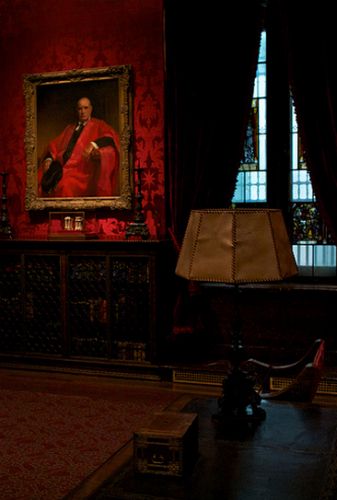
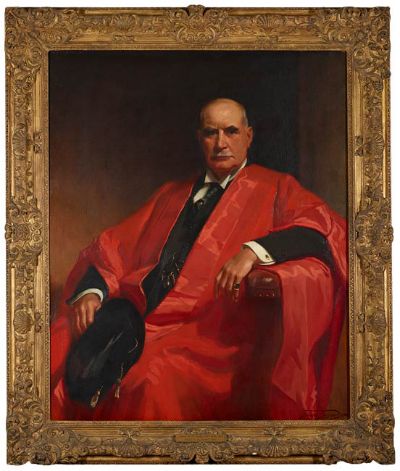
I don't know how I missed these paintings by Frank Owen Salisbury (posted below), whose portrait of philanthropist and financier J. P. Morgan Jr. I posted here in my article on the Morgan Library.

Mark Richardson has more paintings by Salisbury on his site.

He writes:
It's surprising that he's not better known now as he painted the portraits of six American presidents, 25 members of the royal family, a pope and many other prominent figures of his time.
It is interesting that Salisbury apprenticed as a stained glass designer in his brother's workshop. Such an exacting craft, which takes many years to learn, must have guided the direction of his art (painting) education: that one has to learn the skills; that it takes time; that an artist develops over time and work; and although he will have the necessary talents due to his particular character, he can learn to develop them over the years until he becomes a confident and sure artist.


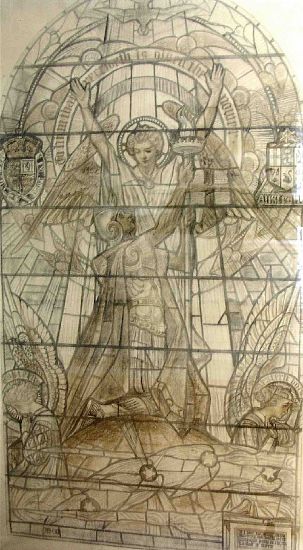
Commemorative Cartoon for Stained Glass Window for
Wesley Chapel, London
c. 1915
Frank O. Salisbury.
[Detailed description of the drawing here]

In fact, that is what one of the commentators at Richardson's site says:
I'm currently in my third year at the Dunedin Art School in New Zealand, and I now believe that it's no coincidence that it's almost impossible for me to imagine any of the students here approaching this kind of expression. They wont even teach drawing here in any serious way - offering only some token life drawing 'classes' once a week on a semi-regular basis. Here the regurgitation and expression of the nebulous ideas of the post-modern art world and pseudo-intellectualism are much more important (actually necessary) than the work and dedication required to acquire the skills necessary for the creation of a beautiful thing. And the scope and nature of ideas present in the institution are shaped by the Art History section of the course, which is unashamedly left leaning in its perspectives on reality.
Here is one beautiful painting which Richardson has posted, which I'm posting in a larger size to better see the details and the ephemeral quality of the painting. I found this large sized image at the BBC online site "Your Paintings."


Date painted: 1933
Oil on canvas, 104 x 184 cm
Collection: Southend Museums Service
© estate of Frank O. Salisbury. All rights reserved, DACS 2013
Photo credit: Southend Museums Service

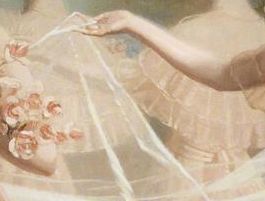
It is very difficult to paint something translucent, or transparent (like the bridal veil). The form is developed purely through contrasting shadow and light and the images that can be seen through the object (which are painted a slightly darker shade), since the veil essentially has no shade or "color." [See here for a good explanation on properties of color].

This is why paintings, and other works of art, should be viewed "live" in their settings, so we can see such fine details, which add to the beauty of a piece.

Below is the delicate pink of the bridesmaid's dress showing through the translucent veil.


And below is delicate floral embroidery on the veil, adding a thicker layer of form and color to "ground" the translucent veil.


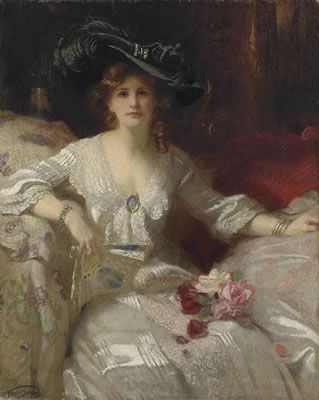
Finally, here is what Mark posted: "The Fair Lady."


The full title for the painting, as described by the auction site Christie's, is:
The Fair Lady, the Bridal Dress
Francis Owen Salisbury (1874-1962)
Oil on canvas
50 x 40 in. (127 x 101.6 cm.)

[Calculated date of painting - see below: 1901-02]

I've looked for the date of the painting, but could find nothing. If we go by the subject, a possible wedding portrait, he married Maude in 1901, so this would make date he painted the work 1901 or even 1902 (as newly-weds).

The painting sold for $34,134 USD, or £22,500, at Christie's on May 31, 2012, according to this arts sales index website.

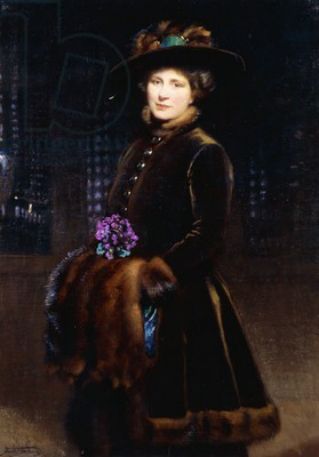
The fair lady of the painting clearly resembles Alice Maude, who became Salisbury's wife.


Maude, The Lady in Brown
Frank O. Salisbury (1874-1962)
Oil on canvas. 142.2 x 104.1cm.
Alice Maude Greenwood later became the artist's wife.

[Calculated date of painting: 1899-1900]

Again, there is no date for the painting above. But the caption says that "she later became the artist's wife" so I would assume this was a pre-marriage photo. People didn't have long pre-marriage relationships in that era, otherwise the man's intentions would be questioned by all parties, and especially protective mothers. They married in 1901, so I would date this photo around a year before (two at the most) from 1899-1900.

[If anyone has specific information, please let me know. I will also look in various library sources for more information.]

I could picture J.P. Morgan Jr's wife looking like Maude.

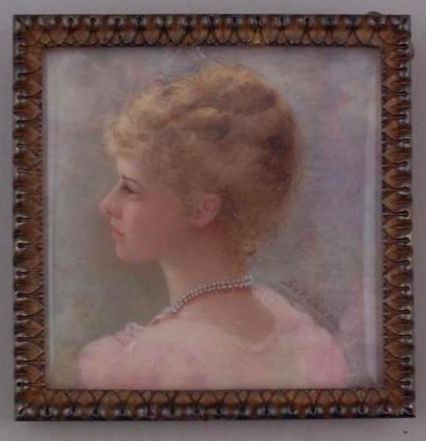
I found the painting below of his wife, Jane Norton Grew, later Mrs. J. P. Morgan Jr. She has that same ephemeral quality as Salisbury's fair lady. She was the daughter of a prominent Boston banker and mill owner Henry Sturgis Grew.


Mrs. J. Pierpont Morgan, Jr. (ca. 1870-1925)
Date: 1895
Artist: Katherine Arthur Behenna
Medium: Watercolor on ivory
Dimensions Overall: 2 3/8 x 2 3/8 in. ( 6 x 6 cm )
Gift of the Estate of Peter Mari

Gallery Label:
Jane Norton Grew was the daughter of Henry Sturgis Grew, a Boston banker and mill owner. She married
J. Pierpont Morgan, Jr. (1867-1943) in 1890. They resided at Glen Cove, Long Island, where Mrs. Morgan took a special interest in gardening and horticulture. She was also an authority on the Morgan
collection of books, manuscripts, and works of art.
[Image from the New York Historical Society]


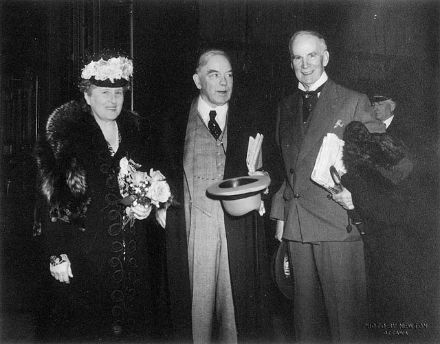
Frank Owen Salisbury (right) with MacKenzie King, Prime Minister of Canada from 1935 – 1948
[Image source: Library and Archives Canada]

The above photograph was taken in 1947.The lady on the left must be Alice Maude, since MacKenzie King never married. And she does have a resemblance to the portraits of the ladies. In 1947, she would have been in her late sixties. Salisbury was seventy-three then. Both husband and wife have a jovial youthfulness about them.
-------------------------------------------------------------------------------------------------------------------------------------------------------------
Posted By: Kidist P. Asrat
Saturday, March 2, 2013

"Europe, Globalization, and the Coming of the Universal Caliphate"


I contacted Bat Ye'or to review this site. I also sent her two links to articles I wrote on her books and presentations. One posting is at my dormant blog Our Changing Landscape, the blog I dedicated mostly to Islam and Muslims, where I posted The Spiritual Source of the Israeli-Palestinian Conflict: Allah vs. God in June, 2010.

The second article I wrote was a review of Bat Ye'or's 2011 book: Europe, Globalization, and the Coming of the Universal Caliphate at my cultural blog Camera Lucida.

Since then, I have consolidated the ideas behind these two blogs: the destruction of our culture, and the achievements of our culture, under this one blog: Reclaiming Beauty.

As I wrote to Bat Ye'or in my email:
One of the primary destroyers, or potential destroyers, of our Western civilization, and its beauty, is Islam. It is slowly and progressively becoming more forceful, since its aim is the Ummah, or the total Islamization of the world.

I hope to make a small dent in providing a link with...like-minded anti-Jihad[ists], with my larger vision of preventing the many other things set to destroy our civilization.

I received a cordial email back from Bat Ye'or with this message:
Dear Kidist,

I read with great attention your two review on me and I thank you heartedly for having written them. I saw also your site reclaiming beauty and exposing its splendor. I was saddened by the Eritrean tragedy. For centuries the African Christians were carried as slaves to Egypt.

Thank you for sending me your review, most cordially

Bat Ye’or
Although Islam is forceful and aggressive, there are many other elements which also wish to destroy our civilization. But, accepting Islam as part of our Western world only accelerates and emboldens those other aggressive forces (e.g. liberalism, feminism, multiculturalism, etc.)

If there was ever a litmus test for the potential destruction of a civilization, one need only to look at Islam's presence and influence in that society, as I write here:

Ethiopian Christian Tolerance, Ethiopian Islamic Jihad

------------------------------------------------------------------------------------------------------------------------------------------------

Europe, Globalization, and the Coming of the Universal Caliphate
By: Kidist P. Asrat
Published in Camera Lucida.

Bat Ye’or, author of Eurabia: The Euro-Arab Axis, has published a new book titled Europe, Globalization, and the Coming of the Universal Caliphate. It is a concise, five-chapter book, and the contents mince no words. "The Destruction of the Nations of Europe" is ominously the final chapter. And the link between Europe and Islam is under the chapter "The European Union and the Organization of the Islamic Conference: A Common Struggle." There are two chapters on multiculturalism, one simply titled "Multiculturalism," and the other "Multiculturalism, the OIC and the Alliance of Civilizations."

The general theme of the book is the European link with Islam, and how many stages of Islam’s presence in Europe were aided and abetted by the policies and directions of European governments and leaders.

Eurabia is a term coined by Bat Ye’or, and she explains this concept fully in her book. Under the subtitle: "The Origin of Eurabia," Ye’or paints a frightening picture of former Nazis collaborating with Muslim leaders to enter and influence the infrastructures of European society and politics under a Muslim and Arab body. One of these earliest associations was initiated in 2002 under The Euro-Arab Dialogue, which formalized agreements between the European Economic Commission and countries in the Arab League that were made as far back as 1973. But, the history goes further than that, when Nazi antisemitism was supported by the Arab world, and Hitler actively sought the alliance of Muslim countries in his (and their) quest to annihilate the Jews.

Bat Ye’or writes in Europe, Globalization, and the Coming of the Universal Caliphate:
...in Islam peace only exists between Muslims, and not between Muslims and non-Muslims5. The word “peace” applied to non-Muslims requires conversion or submission (dhimmitude)…striving in the path of Allah to spread Islam in the world is not war but a pious, just action and a religious duty.
Islam is not only a religious concept, but a warrior one as well, where the world’s non-believers (non-Muslims) are brought to Allah through armed jihad. The world has always belonged to Allah, and those parts that were taken away over the centuries have to be returned to him, hence the argument for violent wars against “infidel” territories, who blaspheme against Allah but who can receive eternal blessing and salvation once they and their people return to Islam.

Under the heading "The Centrality of Israel in Islamic-Christian Relations" Bat Ye’or clarifies what is the common bond that binds Muslims and Christians and of course Europeans: the hatred of Jews and of Israel. The tactic Muslims have used to bring Christians to their fold is through the dejudaization the Bible. There is no tactic for Jews, as Mohammed has clearly delineated, only death. Bat Ye’or once again references Europe’s darkest hour, Nazism, to show this bond between Islam and a Europe without its Christian roots. She writes:
The policy of dejudaization of Christianity is not new. Based on prejudice and ignorance of Judaism, it reached in paroxysm in Nazism and served as a binding force between, on the one hand, Nazis and antisemites in Europe, and on the other hand, their faithful allies in the Muslim world – including the Arab Churches and Christian Arabs, particularly Palestinians.
Modern Europe continued with this antisemitism and Muslim collaboration through a clever strategy of immigration. Hypocritical leaders chastised, and won over, their populations by labeling aversion to immigration as racism, and that it is equal to the evil of the antisemitism that led to the death of thousands of Jews only a few decades ago.

Europe’s pact with Arabs was sealed in 1973 through the European Community (precursor to the European Union). Persistent terrorist attacks in European cities by Palestinians, and the OPEC oil boycott broke the European front, and the leaders made a deal with the Muslim world to recognize the PLO, to side with the Arab world against Israel and the United States, and to allow unrestricted Muslim immigration into Europe to dampen European nationalistic movements. The Muslim lands would in turn quell the terrorist attacks and give Europeans access to their oil. The Iraq war in 2003, President Bush’s "war on terror" campaign, prompted fresh anti-American and anti-Israeli sentiments, with renewed Euro-Arab pacts, including strengthening ties with the PLO.

One of the most frightening revelations of the book is the collaboration of European nations with former Nazi Germany officials who had "recycled themselves in influential positions in postwar European society...The war against the Jews waged in World War II did not stop in 1945, for its ideology and tactics continued through other channels converging in Palestine," writes Bat Ye’or.

The policy of open immigration of Muslims into European countries led to the most amorphous effect of the Arab-European pact, which manifested itself into a policy of multiculturalism. But, Muslims and Arabs refused to be integrated into European society, creating pockets of their culture within the cities they inhabited. Rather than confront this, the history of multiculturalism in Europe has been to find ways to circumvent this refusal and still allow such alien cultures to live in their societies. Islamic customs, holidays, dress-codes and law were accorded an equal footing with those of their host countries. “Diversity” was coined to accommodate these cultural impasses. This precipitated “The destruction of the nations of Europe” as Bat Ye’or titles her penultimate chapter, which amongst other elements, has allowed totalitarian, anti-diverse, anti-multicultural Islam to flourish, and the ever-growing Muslim population, now several generations old, to expand and destroy the centuries-old European civilizations.

The "networks of global governance" – the Islamic Caliphate – are now in place. Bat Ye’or concludes:
In the twenty-first century we are reliving a replica and restoration of the Islamic Caliphate of the seventh century, through approval and pliability of Western leaders. One might compare these demands on the West with Article 23b of the Cairo Declaration on Human Rights in Islam, which stipulates:
Everyone shall have the right to participate directly or indirectly in the administration of his country’s public affairs. He shall also have the right to assume public office in accordance with the provisions of shari’a.
-----------------------------------------------------------------------------------------------------------------------------------------------------
Posted By: Kidist P. Asrat

Friday, March 1, 2013

Over-Compensating for Beauty


The Ceiling in the East Room of the Pierpont Morgan Library
[Image by Kidist P. Asrat]


The East Room of the Pierpont Morgan Library
Image from The Most Beautiful Libraries in the World
(scroll down at the linked site for the image)


-----------------------------------------------------------------------------------------------------------------------------------------------------

I posted about a recent trip to New York, and made a list which I titled: Kidist's Best Of in New York City.

One of the places I listed was the Morgan Library.

I took my camera into the library, hoping to take photos of the images I had seen in guide books, but the museum guard told me I couldn't use a flash. The only picture I could take which didn't require extra lighting was the ceiling stained glass window.

I forgot about this photo, and found it while I was organizing my online files.

Although the image came out over-exposed, I was able to use some digital photo editing techniques to make it as much like the original as I could.

It could be that I over-compensated, and the colors are not as saturated as I make them out to be in my final rendition. Nonetheless, the basic outline is as it is, and why not use a bit of fantasy to make something more beautiful? It could just be that the glass needs a bit of cleaning, like the renovations in the Plaza Hotel (which also included replacement of some of the stained glass).

I went to the library with a friend. When we entered the West Room, or Pierpont Morgan's study, we saw a number of portraits of Morgan and his descendants, stern and serious, looking down at us. "These are the white men of yonder years," I quipped: "We don't see them like this anymore, confident, sure and authoritative. Creating our Western civilization. Now, if white men ever had the same amount of zeal and commitment to their culture and society, they would be called racist. Now, they have to aspire to the lowest common denominator, rather than the highest. They cannot anger and cause resentment, or instill feelings of inferiority, to those many races and nations that cannot achieve, and have not achieved, the same brilliance."


Portrait of J. P. Morgan, Jr. (1867–1943) in a Cambridge Robe, 1934
Artist: Frank Owen Salisbury (British, 1874–1962)
Oil on canvas
48 5/8 x 39 3/8 inches
Commissioned by J. P. Morgan, Jr., 1934
West Room, Pierpont Morgan Library


Here is information on the portrait:
This portrait depicts J. P. Morgan, Jr., Pierpont Morgan's son and founder of this institution, wearing the robes of a Doctor of Laws, an honorary degree conferred by Cambridge University in 1919. The degree was a gesture of gratitude to the younger Morgan, who, as head of the firm J.P. Morgan & Co., provided financial support to the Allies during the First World War.[source: Pierpont Morgan Library]

A closer look at the portrait

Here is information on the artist, Frank Owen Salisbury:
Francis ("Frank") Owen Salisbury (born Harpenden[1] in Hertfordshire, 18 December 1874[1] died Hampstead, London, 31 August 1962[1]) was an English artist who specialised in portraits, large canvases of historical and ceremonial events, stained glass and book illustration. In his heyday he made a fortune on both sides of the Atlantic and was known as “Britain’s Painter Laureate”. His art was steadfastly conservative and he was a vitriolic critic of Modern Art – particularly of his contemporaries Picasso, Chagall and Mondrian. His father, Henry Salisbury, described himself as a “plumber, decorator and ironmonger” (his mother was Susan Hawes[1]), yet his son Frank would become one of the greatest society artists of his generation. [Source: Wikipedia]
And more detailed biographical information on J. P. Morgan:
John Pierpont "Jack" Morgan, Jr. (September 7, 1867 — March 13, 1943) was an American banker and philanthropist. He was born on September 7, 1867 in Irvington, New York to J. P. Morgan and Frances Louisa Tracy. He graduated from Harvard in 1886, where he was a member of the Delphic Club, formerly known as the Delta Phi, and Delta Kappa Epsilon. In 1890 Jack married Jane Norton Grew (d. 1925), daughter of Boston banker and mill owner Henry Sturgis Grew. She was the aunt of Henry Grew Crosby. The couple raised four children: Junius Spencer Morgan III; Henry Sturgis Morgan, a founding partner of Morgan Stanley; Jane Norton Morgan Nichols and Frances Tracy Pennoyer. A fifth child, Alice (d. 1918?), died at a young age of typhoid fever. He resembled his father in his dislike for publicity and continued his father's philanthropic policy. In 1905, his father acquired the bank Guaranty Trust as part of his efforts to consolidate New York City banking. After his father died in 1913 the bank became Jack's base. Morgan played a prominent part in financing World War I. Following its outbreak, he made the first loan of $12,000,000 to Russia. In 1915, a loan of $50,000,000 was made to France.
-----------------------------------------------------------------------------------------------------------------------------------------------------
Posted By: Kidist P. Asrat

A Being Which Shares God's Power, Joy, Knowledge and Eternity


High Park, Toronto
[Photo By Kidist P. Asrat]


I took the notes below while reading C. S. Lewis' Mere Christianity.

The sections in blue are direct quotes from the book.

The gold font are my notes.

The black print is my commentary (analysis, if you will) which I'm typing on this blog after having read and made notes on these pages.

-----------------------------------------------------------------------------------------------------------------------------------------------------
P. 190:
You might say that when two Christians are following Christ together there is not twice as much Christianity as when they are apart, but sixteen times as much.
------------------------------------------------
God's numbers:
- 1 man = 1
- 2 men = double
- But in God's world 2 men can be 16
- One man - like Jesus - no limit
The last two points seem contradictory, but I made them after having also read this section:
P. 190:
Men are mirrors, or "carriers" of Christ to other men...[U]sually it is those who know Him that bring Him to others. That is why the Church, the whole body of Christians showing Him to one another, is so important.
This continues with the section I posted above that starts with "You might say..."

I think the point here is that followers of Christ are not one mass of cult followers. They are individuals who have come to their decision to follow Christ as individuals.

But, it is the combination of individuals, the number of individuals, which give a strength to the power of sixteen (not two, not three, but a much higher, and much more powerful, number).

A couple of things:

- Christians come to their belief, independently and consciously, as individuals. But they work in a society, in a community. The work that sixteen Christians perform is much greater than that of a single Christian.

This ability to choose between right and wrong (we can go either way, and often do go the "wrong" way), also enables Christians to choose God, as an independent decision, apart from God's influence.

I think this is where morality comes in. Christians, because we are forced to think about our religion, have to think their own, independent, way through good and evil, right and wrong.

- I contrast this with Islam, where the individual is submerged in the all encompassing, Allah. So how can an individual Muslim learn to differentiate between good and evil? How can he choose between good, or evil? How can he consciously choose Allah, since all he knows, according to the tenets of Islam, is that he has no choice but to believe in, and to follow Allah. Also, if Allah were to bring people to his fold in this manner, how can he be certain of their loyalty? What other than his will, is keeping them near/with him?

Finally, here is the trust that Christ has in us:
Pp. 191-192:
Finally, if all goes well, turning you permanently into a different sort of thing; into a new little Christ, a being which in its own small ways, has the same kind of life as God; which shares in His power, joy, knowledge and eternity.
And my comment on this passage:
What a great responsibility, and what a great gift.
-----------------------------------------------------------------------------------------------------------------------------------------------------
Posted By: Kidist P. Asrat