Wednesday, May 8, 2013

"On to Restoration!"


Raffaello Sanzio da Urbino (1483 – 1520)
The School of Athens
Fresco, Apostolic Palace, Vatican City
200 in × 300 in
1509-1511


James Kalb, on his site Turnabout, has a long treatise which he titles, "On to Restoration!"

I wasn't aware of this page for some reason, but it was written in 2004. I will humbly say that its objectives resemble much of what is on Reclaiming Beauty.

-------------------------------------------------------------

On to Restoration!
By: Jim Kalb
February 20, 2004

Welcome to On to Restoration!, the center on the web for counterrevolutionaries, restorationists, and the unreconstructed. We include reflections on what it’s about and links to discussions, projects and resources. You may also listen to a spoken introduction to our site (requiring RealPlayer).

What is “restoration”?

Bringing back what has been lost, when what has been lost is necessary to a fully human life.

What has been lost that is so important?

Recognition that what we can see here and now is not self-sufficient, that at the center of things is something that goes beyond the merely human, that we live by what is transcendent.

What does that have to do with anything?

What doesn’t it have to do with? The whole of life depends on what man and the world are.

So get to the point.

The point is that today’s public order, the one all respectable public institutions and authorities support, is antihuman because it denies fundamental aspects of human nature. It tells us that safety, comfort, and the satisfaction of desire are the point of life; that increasing and equalizing such things is the noblest goal conceivable; that love, loyalty and sacrifice are personal tastes like any other. Such a view cannot last or long remain tolerable. It must and will change.

Why so combative?

Whoever fails to toe the line liberal sectarians draw is now defined as an extremist and bigot, if you want to discuss things with the world you have to use the world’s language. Rather than argue the point it is better to accept that we are extremists or whatever and get on with the substance.

And that substance is …

- The traditional American polity, rooted in ordinary experience and in Greece, Rome, Jerusalem and the European Middle Ages, has disappeared, destroyed by the technological and egalitarian hedonism of the modern outlook in general and liberal thought in particular.

- The liberal and technocratic drive for absolute dominion has resulted in a culture war in which the victors are imposing a suffocating political correctness in the guise of tolerance. Our Culture Wars—Discussion and Resources, which includes links to other resources, and our essays on “The Tyranny of Liberalism”, “PC and the Crisis of Liberalism”, “Liberalism: Ideal and Reality”, and “Liberal Tolerance” describe the process and its consequences.

- The new order makes “inclusiveness”, which destroys the distinctions and ways of thought that moral and social order require, the supreme moral principle. Our Anti-Inclusiveness FAQ, with links to resources, and our essay on “Vindicating Stereotypes and Discrimination” may help clarify the issues.

- In particular, attempts to abolish gender and traditional sexual morality in the interests of liberal monism have led to social and moral catastrophe by radically disordering the most fundamental human institutions and relationships. For discussion, see our page on Anti-Feminism—Discussion and Resources and our Sexual Morality FAQ, including resources.

- The attempt to abolish ethnicity under the banner of anti-racism has also been catastrophic, because it results in the abolition of all cultural particularity and therefore the very possibility of standards other than money and power. Our essays on “Freedom, Discrimination and Culture” and “Anti-racism” lay out the problems as we see them.

So what do you propose to do about it?

A fundamental part of the answer is restoration of contact with tradition and the transcendent. Our Conservatism FAQ, “Understanding Tradition and Conservatism”, and “Radical Traditionalism and the New World Order” point to some of the issues and possibilities. We are not the first to call for restoration, and our Traditionalist Conservatism Page includes a large collection of links suggesting a variety of approaches.

The problems are deeply rooted, and have even affected conceptions of what is rational. Some new conception of rationality, or reversion to older and broader conceptions, is therefore necessary. In opposition to technocratic tyranny, the transcendent order known through tradition must somehow be combined with freedom.

For us the two necessary poles of traditional order and freedom are symbolized by Confucius and the Icelandic sagas. Our Questions and Answers on the Establishment of Religion consider some of the institutional issues, while our essay Liberalism, Tradition and the Church and our lecture Awakening from reason’s sleep are attempts at a comprehensive treatment. Others no doubt have their own way of articulating the situation; those caught in the modern world can only explore the possibilities and do their best.

Lots of luck. You’ll need it.

The situation looks bad, but if we’re right about human life we’ll win in the end because the liberal order is antihuman and will not last. Of course, the Restoration will no doubt be very different from the Ancien Regime, and from our standpoint may look less appealing. Our essays on “Ibn Khaldun and Our Age” and “The Amish, David Koresh, and a Newer World Order” suggest some of the possibilities. Still, one can try to live well oneself while laying a general groundwork for a better world; consider, for example, our page on human rights. Life can be hard, but it is full of unexpected turns, and while it remains there is hope.

So if I’m interested, what do I do?

Check out the links on this page, look at our resource lists, and join our forum. Educate yourself, and confront the hegemons wherever you can. Such things are just a beginning, though. The point is to change your life and the world!

And in the meantime,

The Battle Goes On!

For continuing coverage, see our weblog, Turnabout.

-------------------------------------------------------------------------------------------------------------------------------------------------------------
Posted By: Kidist P. Asart
-------------------------------------------------------------------------------------------------------------------------------------------------------------

Dionysus' Fury


Vista Point Pinot Grigio, which my local
restaurant sells for $6.5/glass (half price on Tuesdays)


I describe the red California wine Vista Point Cabernet Sauvignon here, where I also discuss Dionysus, the God of Wine.

Vista Point wineries in southern California also have a white wine. Their Vista Point Pinot Grigio is: "Light, crisp & refreshing with citrus & apple notes & pleasant acidity."

When I had it, I could taste the light and crisp notes, but there was some substance to the wine. Many inexpensive whites tend to have an insipid, watery taste, or an acrid aftertaste. This is actually pretty perfect. I think it is the apple that gives it substance. It tastes like a green apple, perhaps a Granny Smith.

I took my C. S. Lewis Mere Christianity along. I will write a short report in my next post on my reading. Lewis is surprisingly original, and generously optimistic in his book.

I asked the waitress to give me the name of the wine (they just wrote it as "Vista Point White" in the menu). She brought the bottle to show me. Later, while I was busy reading and writing notes, she showed up with a bottle of red wine and another glass. "I wanted to have you taste our new red," she says.

How am I supposed to "taste" another wine while I have one already before me? This is the crassness of our current civilization. First, this waitress showed no respect for me, interrupting me while I was occupied. Second she brings another wine, mostly as a sales gimmick. Third, the level of her voice was so high, that I actually jumped when she spoke. Fourth, she is from another culture (she looks Chinese, although she speaks with a fluent English and with no accent). Her lack of understanding of wine, wine culture, and table etiquette arises from this alien culture of which she is a part. I doubt she is really interested in wine (or the food in the restaurant, for that matter), because they don't relate to her background and how she lives (and plans to live) her life in Canada. Multiculturalism, rather than bring people together, has actually pulled them apart, with each culture living in its own cocoon, and ignoring or even maligning the historical white culture.

I just waived my hand to say no, and for her to leave. I could feel the fury of Dionysus, who I felt was protecting me during this unpleasant interlude. The manager of the restaurant, a Scots/Irish (I asked him if his name was English, and he adamantly told me that it was Scots/Irish), is pleasant to me after I emailed him and the restaurant's head office about these unschooled waitresses. It's not making much of a difference. Now, I simply ask for the Caucasian waitresses, who are calmer and more attentive. I don't think that is simply a matter of training, but of culture as well.

For background on multiculturalism, see Lawrence Auster's book Path to National Suicide [pdf file].

And his 2004 article at Frontpage Magazine : How Multiculturalism Took Over America.

-------------------------------------------------------------------------------------------------------------------------------------------------------------
Posted By: Kidist P. Asrat
-------------------------------------------------------------------------------------------------------------------------------------------------------------

Tuesday, May 7, 2013

Book Project: The Neglected Beauty of the Dandelion

This will probably go under a new chapter I will call Neglected Beauty.


Dandelion

Pierre-Joseph Redoute (1759 - 1840)
Pissenlit Dent-De-Lion.
10 1/2 by 14 1/2 inches
This plate is by Redoute from the first illustrated edition of Jean Jacques Rousseau's "La Botanique de J.J. Rousseau, ornee de soixante-cinq planches, imprimes en couleurs d' apres les peintures de P.J. Redoute." Published in Paris in 1805, the plates are Stipple-engraved , printed in color and finished by hand. [Todd Cooper Antique Maps & Prints]
-------------------------------------------------------------------------------------------------------------------------------------------------------------

The Neglected Beauty of the Dandelion

Lawns and grassy patches are now covered with dandelions. The dark, mustard yellow flower brightens up the outdoors, and shows us that we are in the full swing of spring. The name dandelion comes from the French dent de lion (lion's tooth), which became the anglicized dandelion we call it. The name refers to the jagged leaves. But I think the petals also look like the long, sharp canine teeth of a wild animal.

The dandelion is a bright, but ungainly flower. Perhaps that is why no-one has written an ode to this plant (unlike the daffodil, which competes for space and attention with this neglected weed in the over-crowded lawns of spring).

Walt Whitman wrote The First Dandelion, but it is a mere four lines compared to the four verses of William Wordsworth's Daffodils.
The First Dandelion
By Walt Whitman

Simple and fresh and fair from winter's close emerging,
As if no artifice of fashion, business, politics, had ever been,
Forth from its sunny nook of shelter'd grass--innocent, golden, calm as the dawn,
The spring's first dandelion shows its trustful face.
[Source: The Walt Whitman Archive]
William Wordsworth does mention the dandelion (and not even its flower but its seed) in his poem A Narrow Girdle of Rough Stones and Crags
Not seldom did we stop to watch some tuft
Of dandelion seed or thistle's beard,
That skimmed the surface of the dead calm lake,
Suddenly halting now--a lifeless stand!
Emily Dickenson wrote two verses, more a loud proclamation of the coming spring rather than a subtle ode to its beauty:
The Dandelion's pallid tube
By: Emily Dickenson

The Dandelion's Pallid Ttube
Astonishes the Grass,
And Winter instantly becomes
An infinite Alas --

The tube uplifts a signal Bud
And then a shouting Flower, --
The Proclamation of the Suns
That sepulture is o'er.
[Source: American Poems]
The dandelion's crowning glory is its seed head, ready to be dispersed by a small gust of wind, or the puff of a child ever enchanted by this unexpected surprise.

Dandelions are considered weeds, yet they have numerous positive qualities.

The University of Maryland Medical Center has the following on the dandelion:
Overview:

While many people think of the dandelion (Taraxacum officinale) as a pesky weed, herbalists consider it a valuable herb that can be used as a food and medicine. Dandelion is a rich source of vitamins A, B complex, C, and D, as well as minerals such as iron, potassium, and zinc. Dandelion leaves are used to add flavor to salads, sandwiches, and teas. The roots are used in some coffee substitutes, and the flowers are used to make wines.

Traditionally, dandelion roots and leaves were used to treat liver problems. Native Americans also boiled dandelion in water and took it to treat kidney disease, swelling, skin problems, heartburn, and upset stomach. In traditional Chinese medicine, dandelion has been used to treat stomach problems, appendicitis, and breast problems, such as inflammation or lack of milk flow. In Europe, it was used in remedies for fever, boils, eye problems, diabetes, and diarrhea.

So far, there have not been any good quality scientific studies on dandelion. Today, the roots are mainly used as an appetite stimulant, and for liver and gallbladder problems. Dandelion leaves are used as a diuretic to help the body get rid of excess fluid.

Plant Description:

Hundreds of species of dandelion grow in the temperate regions of Europe, Asia, and North America. Dandelion is a hardy perennial that can grow to a height of nearly 12 inches. Dandelions have deeply notched, toothy, spatula-like leaves that are shiny and hairless. Dandelion stems are capped by bright yellow flowers. The grooved leaves funnel rain to the root.

Dandelion flowers open with the sun in the morning and close in the evening or during gloomy weather. The dark brown roots are fleshy and brittle and are filled with a white milky substance that is bitter and slightly smelly.

Parts Used:

Dandelion leaves act as a diuretic, increasing the amount of urine the body produces. The leaves are used to stimulate the appetite and help digestion. Dandelion flower has antioxidant properties. Dandelion may also help improve the immune system.

Herbalists use dandelion root to detoxify the liver and gallbladder, and dandelion leaves to support kidney function.

Medicinal Uses and Indications:

Traditionally, dandelion has been used a diuretic, to increase the amount of urine the body produces in order to get rid of excess fluid. It has been used for many conditions where a diuretic might help, such as liver problems and high blood pressure. However, there is no good research on using dandelion as a diuretic in people.

Fresh or dried dandelion herb is also used as a mild appetite stimulant and to improve upset stomach. The root of the dandelion plant may act as a mild laxative and has been used to improve digestion. There is some very preliminary research that suggests dandelion may help improve liver and gallbladder function, but the study was not well designed.

Some preliminary animal studies also suggest that dandelion may help normalize blood sugar levels and lower total cholesterol and triglycerides while raising HDL, "good," cholesterol in diabetic mice. But not all the animal studies have found a positive effect on blood sugar. Human studies are needed to see if dandelion would work in people.

A few animal studies also suggest that dandelion might help fight inflammation.

Alternative Names:

Lion's tooth; Priest's crown; Swine's snout; Taraxacum officinale. [More information at the University of Marylyand's website]
Lions, priests and crowns. This small flower does keep good company.
-------------------------------------------------------------------------------------------------------------------------------------------------------------
Posted By: Kidist P. Asrat
-------------------------------------------------------------------------------------------------------------------------------------------------------------

Larry Auster on Women in Politics: Yeats' Views


Sarah in stilettos while running for office

In my post on Pamela Geller, I wrote under a collage of her head shots titled Glamour Woman for the Anti-Jihad movement:
[T]he Sun News graphics team shows a thirty-five second animated slideshow of Geller in various poses, from glamour shots to dramatic gestures. Thirty-five seconds is a long time especially if the images are head shots of one person. But there is no lack of photos of Geller to fill the time.
I conclude my commentary with:
These are examples of how women are unsuited to public and political lives.
In a similar vein, Lawrence Auster corresponded with me last December 2012, linking to a post he had written on Yeats at View From the Right:
This may be of interest. It is from A Commentary on the Collected Poems of W.B. Yeats, by A. Norman Jeffares, p. 246. (However, that's a ridiculous title, it's not a commentary on the poems at all, it's an explanation of the references in the poems.)

The poem being discussed is "A Prayer for My Daughter," the line being explained is "An intellectual hatred is the worst, / So let her think opinions are accursed."

Here is the whole passage from Jeffares, quoting Yeats:

Yeats wrote in a diary in 1910:
Women because the main event of their lives has been a giving of themselves give themselves to an opinion as if it were a stone doll ... women should have their play with dolls finished in childhood for, if they play with ideas again, it is with hatred and malice.

In 'The Death of Synge' this appears in a different guise:
F____ is learning Gaelic. I would sooner see her in the Gaelic movement than in any Irish movement I can think of. [LA notes: What Yeats means is he approves of efforts to bring back old Irish language and literature, not of the demagogic political movements for Irish nationalism. He consistently opposed such movement for his whole life, feeling that involvement with them had ruined friends of his such as Maud Gonne and Constance Markewitz by turning them into fanatics.] I fear some new absorption in political opinion. Women, because the main event of their lives has been a giving themselves and giving birth, give all to an opinion as if it were some terrible stone doll ... to women opinions become as their children or their sweethearts, and the greater their emotional capacity the more do they forget all other things. They grow cruel, as if in defence of lover or child, and all this is done for 'something other than human life'. At last the opinion is so much identified with their nature that it seems a part of their flesh becomes stone and passes out of life.... Women should have their play with dolls finished in childish happiness, for if they play with them again it is amid hatred and malice. (Autobiographies, 504)
I don't remember the context of this discussion. I think it was related to my general critique of women in politics, and specifically regarding Sarah Palin, about whom I wrote an article which was published in American Thinker as Sarah Palin: Whose Family Values?

My original article, which I posted at Camera Lucida, Sarah Palin's Lost Opportunity, was slightly harsher towards Palin. The lost opportunity is not her loss of the Vice Presidency, but that of getting closer to her family as she bulldozed through with her political agenda. I concluded in my article:
[R]ather than face up to her failures as a mother, Palin readily took on the “victim’s” role, and entered the world of new wave feminism. She took no responsibility for her daughter’s condition, a situation which only a few decades ago would have brought shame to such a family, and especially the mother. She sacrificed the harmony of her family for an ambitious political life, with no guarantees that she will get the prize of presidentship. After all, her RNC debacle didn’t earn her anything but the airing of her family’s secrets.
To give her credit, Palin didn't glamorize herself, except with her trade-mark eyeglasses and school-marmish/movie star hairstyle which got a lot of attention. And these red shoes which she wore when John McCain announced her as his Vice Presidential running mate didn't hurt.


But Larry's take goes further than mere appearances. More from his quote from Yeats:
...to women opinions become as their children or their sweethearts, and the greater their emotional capacity the more do they forget all other things. They grow cruel, as if in defence of lover or child, and all this is done for 'something other than human life'.
There was a line in Palin's 2008 Repubican National Convention speech which spread like wildfire in the media:
What’s the difference between a hockey mom and a pit bull? Lipstick!
Palin brought her whole family on the stage after her speech: husband Todd; daughter Willow carrying Sarah Palin's infant Down Syndrome son Trig; unmarried, pregnant Bristol; and fearless little Piper. She showed us a glimpse of how she would be as relentless as a pit bull to defend her dysfunctional family. Here is the glamorized, feminized, Palin, defending her position with the viciousness that Yeats described.

There was a brief moment when Palin was rumored to run in the 2012 presidential race, and she recently entered the political news through her defense of the National Rifle Association. She make a speech at the 2013 Conservative Political Action Conference. That looks like the extent of her political career. Our only contact with her now is through her twitter page, which is more of an embarrassment than anything else, coming from a former Vice Presidential candidate. Perhaps one can say of the varied and haphazard life of Sarah Palin: such is the frivolity of women who think they can do whatever they want.
-------------------------------------------------------------------------------------------------------------------------------------------------------------
Posted By: Kidist P. Asrat
-------------------------------------------------------------------------------------------------------------------------------------------------------------

Monday, May 6, 2013

A commentator at Oz Conservative writes:
Liberalism is a total belief system that brooks no competitors. It cannot be partially resisted. It must be totally destroyed.
These are fighting words, but I think

Sunday, May 5, 2013

Working Chapter Titles for Reclaiming Beauty


Here are the working chapter titles for Reclaiming Beauty:

Chapter One
An Introduction to Beauty
- Seek and Ye Shall Find
- Beauty, Truth and Goodness
- Synthesis of Beauty
- Beauty in the Worship of God
- Beauty and the Transcendent
- Beauty and Humanity
- Beauty and Femininity
- Beauty and Masculinity
- How to be a Beautiful Movie Star
- Beauty: I will be your mirror
- Rejecting Beauty
- Elimination of Beauty

Chapter Two
Beauty in Art
- Architecture
- Painting
- Drawing and Illustrations
- Film
- Photography
- Dance
- Design and Fashion
- Art Criticism

Chapter Three
Beauty in Language
- Literature
- Poetry
- Writing
- Books
- Blogging
- Humor

Chapter Four
Beauty in Culture and Society
- Religion
- Christianity
- Islam
- Myths and Legends
- History
- Traditions
- Conservatism
- Politics
- Immigration
- Multiculturalism

Chapter Five
Beauty in Nature

Chapter Six
Beauty in Science

Chapter Seven
Desecration of Beauty

Chapter Eight
Reclaiming Beauty

-------------------------------------------------------------------------------------------------------------------------------------------------------------
Posted By: Kidist P. Asrat
-------------------------------------------------------------------------------------------------------------------------------------------------------------

Saturday, May 4, 2013

Book Project An Introduction to Beauty: Seek and Ye Shall Find

The introduction for Reclaiming Beauty is a compilation of various posts from Camera Lucida and other sources (see below for references).

From Camera Lucida:
- Beauty and the Transcendent
- The Sistine Chapel
- He who seeks beauty will find it
- The Destruction of Art by Artists

-------------------------------------------------------------------------------------------------------------------------------------------------------------



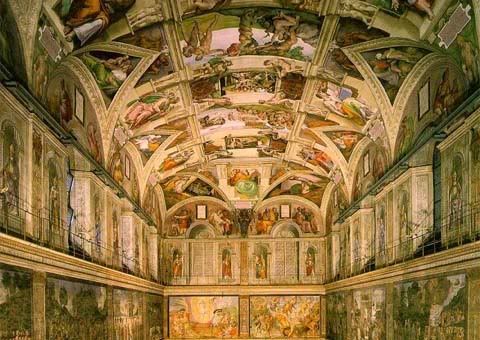
The Sistine Chapel

Pope Benedict XVI said when addressing a group of artists assembled at the Sistine Chapel:
Beauty, whether that of the natural universe or that expressed in art, precisely because it opens up and broadens the horizons of human awareness, pointing us beyond ourselves, bringing us face to face with the abyss of Infinity, can become a path towards the transcendent, towards the ultimate Mystery, towards God. [1]
Or to put it in reference to beauty:
God points us towards Beauty.
In our age of spiritual drought, these words from Matthew Chapter 7, verse 8 give encouragement:

Seek, and ye shall find.

What I am seeking in these chapters of Reclaiming Beauty is beauty itself. But my task is bigger than mere seeking. My task is to recover the beauty that our modern world has so meticulously and furtively discarded. This elimination of beauty has to be furtive because an attack on beauty is an attack on the way people live, or aspire to live, and any direct attack would ignite the wrath of citizens who are accustomed to having beauty around them. It is meticulous because a haphazard sweep would not be able to remove the overwhelming presence of beauty, and every corner has to be swept clean of this beauty that has become the fabric of society.

Aleksandr Solzhenitsyn, who survived years in a Soviet gulag, wrote [2]:
Dostoevsky once enigmatically let drop the phrase: "Beauty will save the world." What does this mean? For a long time I thought it merely a phrase. Was such a thing possible? When in our bloodthirsty history did beauty ever save anyone from anything? Ennobled, elevated, yes; but whom has it saved?

There is, however, something special in the essence of beauty, a special quality in art: the conviction carried by a genuine work of art is absolute and subdues even a resistant heart. A political speech, hasty newspaper comment, a social program, a philosophical system can, as far as appearances are concerned, be built smoothly and consistently on an error or a lie; and what is concealed and distorted will not be immediately clear. But then to counteract it comes a contradictory speech, commentary, program, or differently constructed philosophy - and again everything seems smooth and graceful, and again hangs together. That is why they inspire trust - and distrust.

There is no point asserting and reasserting what the heart cannot believe.

A work of art contains its verification in itself: artificial, strained concepts do not withstand the test of being turned into images; they fall to pieces, turn out to be sickly and pale, convince no one. Works which draw on truth and present it to us in live and concentrated form grip us, compellingly involve us, and no one ever, not even ages hence, will come forth to refute them.
People are often hard-pressed to define what constitutes beauty, or the beautiful for them. But they recognize it once they see it, and they desperately miss it when its not there.

Modern elites, working as the anti-beauty brigade, diligently work at putting ugliness on the same sliding scale as beauty [3]. They understand that there are different levels of beauty. Something pretty for example is a lower manifestation of beauty. But they know that ugliness is not on a lower hierarchical scale of beauty, and that it has its own separate criteria. They are succeeding in their quest because our civilization is the era of the atheist: a Godless age. They have introduced the cult of ugliness into our civilization, introducing a new language and new ideas to perpetuate their movement. They usurp beauty by reinventing language so that the ugly becomes labeled as beautiful, thus placing a shield across our eyes to prevent us from seeing the transformations.

Pope Benedict continuing with his speech in the Sistine Chapel said:
Too often, though, the beauty that is thrust upon us is illusory and deceitful, superficial and blinding, leaving the onlooker dazed; instead of bringing him out of himself and opening him up to horizons of true freedom as it draws him aloft, it imprisons him within himself and further enslaves him, depriving him of hope and joy.

It is a seductive but hypocritical beauty that rekindles desire, the will to power, to possess, and to dominate others, it is a beauty which soon turns into its opposite, taking on the guise of indecency, transgression or gratuitous provocation.
It is easier to convince Godless societies of the superiority of ugliness than societies where God has a presence. Modern elites separate God from the rest of society. Therefore even if ordinary citizens are believers and worshipers, their surroundings contradict and even negate those messages, and they lose the nimbleness necessary to finds words and arguments to counter the ugliness that surrounds them. Rather than march out in the world with sword and shield to confront ugliness, they give in, and withdraw in their homes to the comforts of their tchotchkes and embroidered cushions.

But beauty is never far away, and raises its eyes towards us at unexpected moments. It is in the lovely smile of a young baby, however dour and dark his mother may be; the budding of a wild flower through concrete cracks at the end of winter; the small shop which manages to decorate its window with color; the lush dresses which movie stars still wear, albeit once a year at competitive awards shows; the chef who works with compromising ingredients, but who produces small delicacies on a daily basis at his local restaurant; the artist who teaches classical painting at a night school since no arts program will hire him. These momentary visions encourage us to seek, and find more.

To seek is to realize that something is missing, something we are familiar with that we have either discarded, ignored, or that which has been taken away from us. It is the result of an emptiness, undefined in our case. Our civilization has reached that point of emptiness.

Our task, together with seeking what has bee lost, is to recognize that it is us who have caused those elements of beauty to disappear, by ceding too easily to the temptations and barriers brought before us. Next comes the arduous task of redefining the beauty we've lost, then reclaiming and recapturing this beauty back into our lives and our society. This is where we take on our Godly shield and sword to fight our existential battle with the dark forces of ugliness, and to rebuild our society, since we cannot do it alone. We may not be successful, and even if we are, beauty may never acquire the same level of sophistication and proliferation it once enjoyed in our lifetime, since took thousands of years to build. But, it would be far worse if we did nothing.

Bill Cunningham, a contemporary fashion critic who is uniquely appreciative of beauty said: "He who seeks beauty will find it. [4]" He may be too optimistic, but, his words are a variation on Matthew's "Seek and ye shall find." We cannot afford to be pessimistic, otherwise we will be pulled into the centrifugal forces of ugliness. Beauty needs our strength and our commitment to bring it back from the abyss.

-------------------------------------------------------------------------------------------------------------------------------------------------------------

References:

1. Meeting with Artists. Address of His Holiness Benedict XVI. Sistine Chapel. November 29, 2009.
http://www.vatican.va/holy_father/benedict_xvi/speeches/2009/november/documents/hf_ben-xvi_spe_20091121_artisti_en.html

2. Alexander Solzhenitsyn. Nobel Lecture (1970)
Text published by Farrar, Straus and Giroux, New York, 1972
Digitized and Formatted in HTML by The Augustine Club at Columbia University, 1999
http://www.columbia.edu/cu/augustine/arch/solzhenitsyn/nobel-lit1970.htm

3. Camera Lucida. The Destruction of Art by Artists. April 25, 2009
http://cameraluc.blogspot.ca/2009/04/destruction-of-art-by-artists.html

4. Camera Lucida. He who seeks beauty will find it. August 3, 2011
http://cameraluc.blogspot.ca/2011/08/he-who-seeks-beauty-will-find-it.html

-------------------------------------------------------------------------------------------------------------------------------------------------------------
Posted By: Kidist P. Asrat
-------------------------------------------------------------------------------------------------------------------------------------------------------------
91st Street Riverside Park Garden, New York, Or How Joe Met Kathy


A walk through Riverside Park, from the movie You've Got Mail,
with Somewhere Over the Rainbow as the accompanying music.


Sometimes a silly movie shows us unexpectedly beautiful places, while telling us a little more about ourselves. In You've Got Mail, Kathleen Kelly (played by Meg Ryan who is actually a better actress than the roles given to her) and Joe Fox (Tom Hanks) are communicating online using pseudonyms. Kathleen is "ShopGirl" - she owns a bookstore, and Joe is "NY152" - "the number of people who think I look like Clark Gable." Both Kathleen and Joe know each other. Joe is the big-box-bookstore owner of Fox Books who is putting Kathleen's small, neighborhood Shop Around the Corner bookstore out of business. Through their online communication, they decide to meet in a coffee shop. Joe sees her sitting and waiting in the coffee shop, and realizes the that she is the owner of Shop Around the Corner. He does not reveal to her that he is "NY152," and lets her thinks that he is simply the big-box bookstore owner patronizing the coffee shop. Later, through an online message, Joe asks Kathleen to meet him in Riverside Park, where finally tells her that he is "NY152."

What was interesting about the story was the male/female interaction. Kathleen acts like a ditzy, New-Agey woman, although she appears to be independent, and is surely a "feminist." She kind of goes with the flow of things. Joe is more ruthless, or at least he programs his actions to reach his goals, including having no remorse about removing a small bookstore to create his own. He doesn't do this because he is a mean-spirited, but because he thinks his ideas and plans are better. In fact, Kathleen has to concede, and later on accepts his job offer to run the children's department. Joe plans his second meeting with Kathleen in a similar, planned fashion, after he realizes that he knows her identity (from seeing her in the coffee shop), while she doesn't know his. Through a series of maneuvers, including arriving with his dog Brinkley at Riverside Park meeting, which his online persona talks about and Kathleen knows, Joe is the one who reveals to Kathleen what's going on. The only thing that Kathleen could say at the final revelation was, "I was hoping it was you." Rather than find a way to untangle this mystery as Joe did, all Kathleen could do was resort to wishful thinking, which would have remained so hadn't Joe intervened.


Riverside Park, 91st Street Garden
[Image source: A View on Cities
]

-------------------------------------------------------------------------------------------------------------------------------------------------------------

Posted By: Kidist P. Asrat
-------------------------------------------------------------------------------------------------------------------------------------------------------------

Friday, May 3, 2013

"A Thief is Never Rational"


Guido Reni (1575 – 1642)
Archangel Michael Defeating Satan
1635
Oil on canvas
Dimensions: 293 x 202 cm
Private Collection


I recently posted an article from the Orthosphere, The Metastasy of Wickedness, by Kristor in its entirety and without my commentary.

A poster named Bedarz Iliaci makes some important points about Kristor's thesis. Below is some of their interaction:

Bedarz Iliaci:
Kristor,

BI: I am surprised to find you spouting such modern sentiments.
K: So long as society is so ordered as to promote or encourage or reward vice, there will be vice.
BI: NO. There was sin even in Eden.
K: And indeed, they are not altogether useless, or they would never have succeeded at what they do.
BI: A thief has no social goodness altogether, even though he promotes lock-making industry.
K: The control of vice and the promotion of virtue therefore depends, not on the elimination of the vicious – who are, after all, only responding rationally (if amorally) to the vicious environment in which they find themselves, and who if eliminated will be replaced – but of the weakness and perversity of the system itself.
BI: Isn’t this what Progressives say?. The individuals are good but the system is bad and must be reformed. The the usage of the word “rationally” jars – you are using it in the sense of economists – a purely instrumental thing. A thief is never rational.
Kristor:
Bedarz, you aren’t making sense here.
BI: There was sin even in Eden.
K: That there was sin even in a pure society does not mean that there is no sin in a perverted society. Indeed, that there can be sin even in Eden makes sin in a perverted society seem all the more likely. You make my argument.
BI: A thief has no social goodness.
K: Really? None? He is no good at all to anyone? What about Jean Valjean?
BI: A thief is never rational.
K: Really? The thieves are all wandering about gibbering and drooling like maniacs, with their flies open and their shoes on backwards? How on earth, then, do they ever get it together to steal anything?

That a thing is deformed does not mean it is altogether evil. The zero of goodness is the zero of being. Even Satan retains the glory, power and intelligence of a seraph.

As to whether I am saying something the Progressives say: no. The progressives say that what we do is not our responsibility at all, and that we are wholly the products of our environments. I am saying that while we are certainly influenced by our environments, we are responsible for what we do. Only thus could any of our acts be characterized as either good or evil.
Bedarz Iliaci:
A thief has no social goodness.

Means that as a thief, a man has no goodness. That is, the essence of stealing is bad for the City. Surely, you would not disagree. Thus, the vices, even greed are not conducive to the good of the City even though they may lead to material growth, but inevitably the social bonds are weakened. And thus contra 18C economists private vices do not make for public good.

A thief is never rational.

Simply, it is not rational to steal. You have modern instrumental view of rationality. I take the view that being rational implies having correct premises.

Your point may be recast as - Man is largely formed by his City. We see the acts but God sees the heart.
[My notes: Yes, exactly right. It is like liberalism, which appears to be doing us good, but the system inherently leads to destruction, even if some of its manifestations (early on) appear to do us some good.]

Kristor:
I think I see what you are getting at. The thievery of a man is bad, even though the man himself, qua man rather than qua thief, may not be all bad. Likewise, the thievery of a man, being inherently irrational, vitiates his rationality, even though he might be quite rational in many other respects. Agreed.

Thus, the vices, even greed are not conducive to the good of the City even though they may lead to material growth, but inevitably the social bonds are weakened.

Yes. This was a prominent secondary theme of the post. You are saying the same thing I did.
I searched for the image that the Orthosphere blog has put up as its masthead. The painter is Guido Reni, from 17th century Italy and the painting, Archangel Michael Defeating Satan. This is an apt figurehead for the blog, although we have not yet defeated Satan.

I also found the painting below by Guido Reni of a young David. We can see the character and the strength of David who went on to defeat Goliath.


Guido Reni (1575 – 1642)
David
Oil on canvas
1620
65 x 50 cm
Kunsthistorisches Museum, Vienna, Austria
[source: Wikipaintings]


-------------------------------------------------------------------------------------------------------------------------------------------------------------

Posted By: Kidist P. Asrat
-------------------------------------------------------------------------------------------------------------------------------------------------------------

Poster Woman for the Anti-Jihad Movement

Michael Coren, who interviewed Robert Spencer (I posted parts of the interview and my commentary here in my previous post), discusses Pamela Geller's venue switch (link is to video) for her speech in Toronto. Police warned the speech organizers, the Jewish Defense League of Toronto, that they wouldn't able to help with the security for the event. The synagogue cancelled the event. Geller's team found her another location, also another synagogue. Below is the Toronto Sun report.

Coren interviews Sun News journalist Faith Goldy about these changes (see video linked above). Half way through the interview, the Sun News graphics team shows a thirty-five second slideshow of Geller in various poses, from glamour shots to dramatic gestures. Thirty-five seconds is a long time especially if the images are head shots of one person. But there is no lack of photos of Geller to fill the time. The images zoom in and zoom out, adding more drama.


Glamour Woman for the Anti-Jihad movement

Is the Western anti-Jihad movement looking for a modern Boadicea to lead it through this crisis? Boadicea went to war with an army. Her prop wasn't glamour, but a sword and a metal plate for a shield on the battlefront. Geller shields herself with a battalion of "security" guards wherever she goes.

As I said in my previous post on Geller:
These are examples of how women are unsuited to public and political lives.
Here is the Sun News report:
TORONTO May 2nd, 2013 -- Police won't say how they'll handle an anti-Islamist firebrand set to give a speech in the city -- after police in York Region forced a rabbi to cancel her scheduled talk at a synagogue there.

Pamela Geller, a controversial speaker best known for protesting a planned mosque near Ground Zero in New York and plastering that city's subway system with anti-jihad ads, will speak May 13 at the Toronto Zionist Centre, a pro-Israel rental space.

Geller, who is being brought in to speak by the hard-line Jewish Defence League (JDL), was originally supposed to lecture at the Chabad Flamingo Synagogue in Thornhill, Ont., but York Regional Police threatened its rabbi with his removal as a police chaplain if he let the event happen.

Many of Geller's speeches in the past have drawn protesters. A Geller talk in New York last month was cancelled and moved to another venue, but not without a heavy police presence.

The JDL's Meir Weinstein told QMI Agency his organization will have at least 30 of its own security personnel for Geller's Toronto lecture and they're prepared for physical altercation with protesters.

"We're quite prepared for anything that disrupts the event," Weinstein said. "If it does happen, we'll be ready. And anyway, we expect (Toronto) police to do their job."

The police, however, were not forthcoming as to what that job would be.

"We don't speculate on what may or may not happen at events," is all spokesman Const. Tony Vella would say, adding no one from Toronto Police's hate crimes unit was willing to speak about the coming event.

The Toronto Zionist Centre, named after a term used to describe the fight for a secure state of Israel, has had problems with past protests.

Several people were arrested and an officer suffered a broken rib during a protest at a January 2011 talk given by the founder of the English Defence League, a U.K.-based anti-Muslim group.

The centre's director, Joseph Winter, was polite but defiant when presented with the possibility of police asking he cancel Geller's talk.

"Unless somebody breaks the law, I would say you can't do that," Winter said, adding he had "faith" police would keep the peace during Geller's lecture and that it "is not breaking the law to have someone speak in your building."
----------------------------------------------------------------------------------------------------------------------------------------------------------
Posted By: Kidist P. Asrat
----------------------------------------------------------------------------------------------------------------------------------------------------------
Robert Spencer's One-Way, Wishful-Thinking Dialogue With Muslims


Robert Spencer interview by The Arena's Michael Coren on May 2, 2013

Robert Spencer is a regular guest on Michael Coren's The Arena. He was on last night to discuss his new book, the Boston bombings and other Islam-related news.

His new book is titled Not Peace But a Sword: The Great Chasm Between Christianity and Islam. It is clearly an important book. I am sure the erudition and study of Spencer will bring more knowledge to the fore-front.

But, I've said before that it is not enough to go on this disorganized, arms-outstretched mode of dealing with Islam in the West. And sure enough, during the interview, Spencer defends "dialogue" between Christians and Muslims, although he does makes some kind of disclaimer that Muslims are not interested in dialogue, but in subjugation of non-Muslims.

Michael Coren gives him a lead with:

Those people who say well all religions produce extremism. It's not the religion, it's the people who misinterpret it. You make in an extremely informed way the argument that no I'm sorry, I'm sorry, these religions are very, very different.
Spencer replies:
And people who engage in dialogue - that's what this book is about - between Christians and Muslims should be informed. I'm not saying that there should be no dialogue, but they should be aware of the contempt in which Christianity is portrayed in the Koran, and how that then informs their dialogue [I couldn't decipher this last word].
As I wrote about Pamela Geller, and her confusions and contradictions, Spencer, who would like nothing else than a "dialogue" with Muslims realizes that they have a deep-seated contempt for him, nonetheless revels in the same kind of wishful thinking as Geller, and would actually venture out to meet these people who have this deep contempt for him as mandated by their holy book.

What kind of lunatic is that!

I found the list of chapters in Spencer's new book (at this source - pdf file).

They are:

1. Time for an `Ecumenical Jihad'?

2. Three Great Abrahamic Faiths?

3. The same God?

4. The Same Jesus?

5. Are We All Muslims Now?

6. A Common Desire for Justice?

7. A Shared Sexual Ethic?

8. An Honest Desire for Dialogue?

Epilogue

Appendix

The (first) striking think about these chapters is that every single one of them ends with a question mark. Which of course leads to the second (more important) striking thing where Spencer looks like he's trying to join these two religions, despite his agreement with Michael Coren that the two religions are "very, very different"

One senses that he really wants "a shared ethic" and that Christians and Muslims worship the same God, and that we are all Muslims (as in we are all black, or all poor, or all women, which is a way of raising up who one perceives to be a "victim" and equalizing him.

In his confused way, he must realize that it is Christians like him who have "an honest desire for dialogue" and not the hard-headed, Koran-mandated Muslims. But, there is no harm in wishful thinking, or is there?

Of course there is. It is a recipe for dhimmitude at its best, and annihilation at its worst.

The prominent spokesmen against Islamic incursions into the West these days are Pamela Geller and Robert Spencer. Other spokesmen like Sam Solomon, Bat Ye'or, are keeping a low profile. I think their silence is their realization that more books, and more conferences, and more speeches in a synagogues are not going to going to improve anything. At least I hope that is what their silence means, and that it is coupled with founding a new strategy.

How many more books can we read, and how many more dramatic presentations can we participate in, before the Islamic message becomes clear?

We know enough already, and if not, as I've said, there is a myriad of available information that we can tap into. I think it is time to retreat, to consolidate this information, to form concrete, organized and effective measures to fight against Islam's incursions.

------------------------------------------------------------------------------------------------------------------------------------------------------------

This Amazon.com reviewer has read and reviewed the book. I don't know who William Garrison Jr. is, but his notes make for an interesting read.

Chapter 1. Time for an `Ecumenical Jihad'?

Mr. Spencer counters the 1996 book "Ecumenical Jihad", in which its author Peter Kreeft heralded: "The age of religious wars is ending". Mr. Spencer notes that today's on-going lethal Islamic jihad attacks against Christians from Nigeria eastward to Pakistan. Mr. Spencer claims "this religious bigotry, hatred, and violence are legitimized by holy writ: The Qur'an and other Islamic texts and teachings" (p. 19) - he proceeds to cite chapter [sura] and verse [aya]. And exemplifies how hundreds of thousands of Christians have and are fleeing Islamist-dominated Middle Eastern countries. Mr. Spencer quotes the Muslim sources commanding death for those apostates [murtadd] who convert to Christianity. Subtopics: `A tradition of persecution', `The silence of human rights groups', & `Saladin: myth versus reality'.

Chapter 2. Three Great Abrahamic Faiths?

Mr. Spencer explains that while the Bible identifies the "10 Commandments" that were revealed to Moses [Musa], none is stated in the Qur'an. Pertaining to the Jewish Exodus, the Qur'an informs us that Sabbath-breaking Jews were transformed into "Jew-apes" [gird] - a concept that does not appear in the Bible (p. 43). The author details the differences between how the Bible reveals the "original sin" of Adam & Eve, whereas the Qur'an rejects this concept. Mr. Spencer states how Muslims believe that the original Islam-oriented Bible was "corrupted" by Jews & Christians to lead people away from `the Straight Path' [al-sirat ul-mustaqim] of Islam.

Chapter 3. The same God?

Herein Mr. Spencer questions why the Second Vatican Council concluded that the Judeo-Christian "God" is the same as the Muslim "Allah" (p. 54). He reviews why Muslims do not believe that Jesus was the son of God, why they deny the Trinity, and why "Allah is not a `Father'". He notes that Pope Benedict XIV, in 1754 "reaffirmed an earlier prohibition of Albanian Catholics giving their `Turkish or Mohammedan names' in baptism" (p. 57). Mr. Spencer proceeds to explain how Muslims view Allah, and discusses some Islamic views regarding `free will' versus Allah's powers (pp. 69-76).

Chapter 4. The Same Jesus?

We read that Muslims respect Jesus [Isa] because he is mentioned as a prophet in the Qur'an. Mr. Spencer reviews the issue "then why aren't Muslims Christians?" and how Gnostics may have influenced Muhammed to proclaim that Jesus was not actually crucified (p. 87). Mr. Spencer details various inconsistencies that he perceives are within the Qur'an. More importantly, the author explains how Muslims perceive that at the "End of Days" [qiyama] the true Islam-oriented Jesus [Isa] will return to save mankind from Christianity by destroying it! (p. 100).

Chapter 5. Are We All Muslims Now?

Mr. Spencer argues that "Islam treats Christianity as a perversion of the original teaching of Jesus.... This robs Christianity of any legitimate manifestation; to Islam, all Christians are essentially apostate Muslims" (p. 103). Pertaining to the prophet Abraham [Ibrahim], the Qur'an stipulates: "Abraham in truth was not a Jew, neither a Christian; but he was a Muslim..." (Q3:67), in fact, the Quran rules that all of the prophets [nabiyyun] mentioned in the Bible were all Muslims.

Chapter 6. A Common Desire for Justice?

In this chapter Mr. Spencer disputes Westerners who "think the Islamic world has something to teach today's decadent West. Yet although it is obvious that Christians should learn `the absoluteness of the moral laws and of the demand to be just and charitable,' it is far less clear that Muslims have these laws to teach, or believe them themselves" (p. 116). The author lists numerous examples of whereby the Muslim Prophet Muhammed (al- insane al-kamil) himself engaged in either various violent military campaigns or personal crimes against those who disbelieved him.

Chapter 7. A Shared Sexual Ethic?

While finding some commonality regarding sexual ethics between Christians and Muslims, Mr. Spencer opined: "... and there are other apparent moral similarities between the two religions, [but] the Muslim understanding of marriage and sexual morality differs so greatly from Christian understanding that it renders those similarities void of meaning.... What's more, Islamic morality allows for practices that Catholicism abhors, including contraception, child marriage, polygamy, female genital mutilation, and even sexual slavery of non-believing women." (p. 139).

Chapter 8. An Honest Desire for Dialogue?

In this section Mr. Spencer discusses various attempts to bring about "discussion" between the faiths, let alone "assimilation" of Christianity and Islam, and explains why the two cannot be married.

Epilogue

A transcript of the Nov. 2010 kind, erudite and spirited debate (more of a polite discussion) between the author and Mr. Peter Kreeft regarding whether or not peaceful coexistence is possible between Muslims and Westerners.

Appendix

Lists "Some Fundamental Differences Between Islam and Christianity" regarding (1) The nature of God, (2) Jesus, (3) e revelation, & (4) the Moral Law.

Alas, no attribution is given to the book-jacket's designer; again, I am impressed with its cover depicting an old curved dagger [khanjar] with Muhammed's name engraved three times upon it.
------------------------------------------------------------------------------------------------------------------------------------------------------------
Posted By: Kidist P. Asrat
------------------------------------------------------------------------------------------------------------------------------------------------------------
Wednesday, May 1, 2013

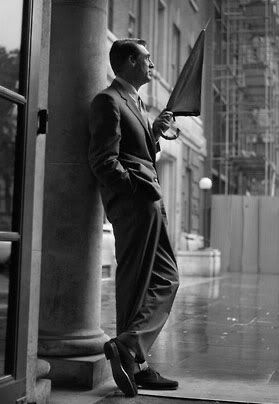
Cary Grant On Style


Cary Grant
Photo by Harry Benson
1957


Cary Grant On Style
Gentlemen's Quarterly, Winter 1967/68
[Reprinted in the April 2013 issue of GQ]
By Cary Grant

I'm often asked for advice or an opinion about clothes, and I always try to answer the best I can, but I'm not inclined to regard myself as an authority on the subject. Many times during my years in films, some well-meaning group has selected me as best-dressed man of the year, but I've never understood why. The odd distinction surprises me: first, because I don't consider myself especially well dressed, and, secondly, I've never, as far as I can compare the efforts of others with my own, gone to any special trouble to acquire clothes that could be regarded as noticeably fashionable or up-to-date.

Some of my suits are ten to twenty years old, many of them ready-made and reasonably priced. Those that were custom-tailored were made by many different tailors in many different cities: London, Hong Kong, New York and Los Angeles. I believe that American ready-made clothes are the best ready-made clothes in the world: that the well-dressed American man makes a better appearance than the well-dressed man of any other country.

No, it isn't only money that determines how well a man dresses—it's personal taste. Because of the demands of my work, I've purchased dozens of suits over the years and they all have one attribute in common: they are in the middle of fashion. By that I mean they're not self-consciously fashionable or far out, nor are they overly conservative or dated. In other words, the lapels are neither too wide nor too narrow, the trousers neither too tight nor too loose, the coats neither too short nor too long. I've worn clothes of extreme style, but only in order to dress appropriately for the type of character I played in particular films. Otherwise, simplicity, to me, has always been the essence of good taste.

I believe men's clothes—like women's—should attract attention to the best lines of a man's figure and distract from the worst. In all cases, the most reliable style is in the middle of the road—a thoughtful sensible position in any human behavior. Except perhaps on the freeway—but, even then, the middle lane, providing of course, it's on your side of the road, usually gets you where you're going more easily, comfortably, and less disturbingly. And so it should be with clothes. They should be undisturbing, easy and comfortable.

There are many established stores or haberdasheries in each city, and probably in your neighborhood. Look at the suits in the windows. See how they compare with those worn by men whose taste you respect and admire. Think about the practical, functional and long-wearing qualities as they apply to your particular job or social activities. It's better to consider carefully before buying than to regret your purchases for months afterwards. Study the cut, the price.

And here, by the way, is a tip. If the sleeves seem disproportionately wider than customary, it indicates a very deep armhole. Don't contemplate buying if you are of average or slim size—you'll get a well-fitting back but an extremely loose-fitting front and sleeves that tend to ride up if you lift your arms. A deep armhole is popular with many manufacturers because each coat fits a wider range of customers.

How much on should pay depends on how much one has to spend. I'm reminded of a piece of advice my father gave me regarding shoes: it has stood me in good stead whenever my own finances were low. He said it's better to buy one good pair of shoes than four cheap ones. One pair made of fine leather could outlast four inferior pairs, and, if well cared for, would continue to proclaim your good judgment and taste no matter how old they become. The same applies to suits, so permit me to suggest you buy the best you can afford even though it means buying less. Rather like the stock market: it is usually more sensible to buy just one share of blue chip than 150 shares of a one-dollar stock.

What should one buy? Well, if a man's budget restricts him to only one suit, then I would choose something unobtrusive. A dark blue, almost black, of lightweight cloth, serviceable for both day and evening wear. I suggest lightweight because nowadays most restaurants, offices, shops and theaters are well heated during fall and winter. I found that so even, surprisingly, in Moscow. With such modern indoor comfort, one need only be concerned with cold weather while out-of-doors.

Which brings us to overcoats. I've learned to wear overcoats that button up to the neck yet still appear neat when left open. It mystifies me that some men wear heavy single-breasted and even double-breasted, overcoats to protect themselves from cold, yet expose the most vulnerable part of their chests with V-neck openings. By wearing an overcoat that buttons to the neck, there is no need for a scarf.

The topcoat I use for traveling can be worn spring or fall. It's black and therefore not only less apt to show dirt and travel stains, but usable for both day and formal wear. It's made of a gabardine-type waterproof material, with slash side pockets that enable one to reach through easily for change, or to carry a book, or something similar, protected from the rain. There is also a detachable lining that buttons inside for very wintery days. An all-purpose coat.

What about a second suit? Well, I think a grey worsted or flannel would be most serviceable. Not too light in color, not too dark. And, this time, of medium weight but not more than what is known as ten-ounce cloth. It might be advantageous to purchase an extra pair of trousers for wearing separately with a sweater or a sport shirt. A grey flannel suit, with or without extra trousers, together with a sport coat could, at a pinch, be sufficient for a weekend in the country.

A sport coat ought to be easy-fitting, its pattern neither loud nor flashy. If you're unsure which plaid or check to choose, then one of those dark blue, single-breasted blazers that have been worn by all classes in England for years, and have since become popular here, is acceptable for most casual wear.

Except, of course, on very hot days. During summer I've taken to wearing light beige, washable poplin suits. They're inexpensive and, if kept crisp and clean, acceptable almost anywhere at any time, even in the evening. Also, the coat can be worn with grey flannels at the seashore or in the country, and the trousers used separately with a sport shirt and moccasins, or a pair of those heavy-soled white canvas shoes that are popular with young college men.

Poplin or seersucker suits are the mark of no special social class or income group, but are worn by all. And, providing he is well-mannered, a young man wearing such a suit can confidently approach the other fellow's girl, secure in knowing that his way of dress is no deterrent.

A cardigan coat sweater of lightweight wool and conservative color is a useful investment. It can be worn without a coat on many occasions, and has the advantage of being easily slipped on without those arm-raising contortions and the need to re-comb your hair.

How do I feel about ties? If I had only one to choose, then I think a black foulard, not too wide nor too narrow, is best, as it's acceptable with most clothes. An expensive tie is not a luxury—the wrinkles fall out quicker and the knot will hold better. Personally, I wear ties of small, conservative pattern and color.

Shoes? I've already mentioned that good shoes look better and last longer. If a man must limit himself to only one pair of shoes for city wear, then they should be black. If two, then a brown pair of darkest chocolate color are useful with almost all suits and, if he has no moccasins, even with grey flannels. The moccasin type of shoe is, to me, almost essential and especially convenient when traveling, since they can be easily slipped off in the airplane or car.

If your pocket handkerchief is monogrammed, don't wear it carefully folded to show the monogram peeking above your breast-pocket. That's somehow ostentatious.

Shirts should usually be white for the evening, but, in the city's grime, it's practical and permissible to wear a light blue or conservatively striped shirt during the day. The type of collar should suit the contours of the neck and face. As a younger man, I tried wearing a flared, too-high collar that, although modish amongst those I regarded as the sophisticates of that day, looked ridiculous on my 17 1/2- inch neck. Luckily, after the embarrassment of viewing myself from almost every angle on screen, that mistake was soon rectified. Button-cuffed shirts are simplest to manage, but if you wear cuff links, as I do, don't, I beg you, wear those huge examples of badly designed, cheap modern jewelry. They, too, are not only ostentatious, but heavy and a menace to the enamel on your car and your girl friend's eye.

Learn to dispense with accessories that don't perform a necessary function. I use belts, for example, only with blue jeans, which I wear when riding, and content myself with side loops, that can be tightened at the waistband, on business suits.

A tip about trousers. Trouser cuffs seem to me unnecessary, and are apt to catch lint and dust. However, whether you prefer cuffs or not, ask the tailor to sew a strip of cloth of the same material, or a tape of similar color, on the inside at the bottom of the trouser leg where it rubs the heel of the shoe. It will keep your trouser-bottoms from fraying.

Do I have any special do's and don't's about clothes? I can't think of and rules about clothes, since there really aren't any, but I suggest you buy trees to conform to the shape of your shoes, and keep your coats on curved hangers.

Take care of your clothes, keep them clean and in good repair. I suggest you avoid using heavily scented cologne or soaps. When I meet a man I like him to smell like a man, or not to smell at all; certainly he shouldn't smell like a woman. Do see that your socks stay up. Nothing can spoil an otherwise well-groomed effect like sagging socks. Don't stuff your pockets with heavy articles and bulging wallets filled with seldom-used cards. They ruin not only the neatness of your appearance but the actual tailoring of your suit.

Don't be a snob about the way you dress. Snobbery is only a point in time. Be tolerant and helpful to the other fellow—he is yourself yesterday.

Don't overbuy. When you contemplate an article, judge whether or not it harmonizes with items you already own. Again, avoid exaggeration of current fashions. It's best to be inconspicuous. But inconspicuous does not mean dull. Extreme dullness can be conspicuous in itself. Just do the best you can.

Come to think of it, who knows how anything becomes bad or good taste? Who decides a standard of esthetics? If it's the majority, then how is it the minority are the ones considered well dressed? Everything is only exactly what it is. If a man wears the kind of clothes that please him, then, providing they're clean and don't shock society, morals, and little children, what is the difference as long as that man is happy?

Any other thoughts on clothes?

Yes. Somewhere I read that Harvard's Professor Archibald MacLeish was asked by a student about to graduate into our highly competitive world what advice he could give him. Professor MacLeish's answer was, "Wear your Sunday suit every day." The inference, of course, being that the suit would give the young man such confidence in seeking positions that he would eventually own many Sunday suits, for any and all days.

Splendid advice even by itself, but it's probable that the professor meant not only his Sunday or best suit, but also his Sunday or best smile, disposition, and behavior—knowing that each begets the other. So wear, not only your clothes, but yourself, well, with confidence. Confidence, too, is in the middle of the road, being neither aggressiveness nor timidity. Pride of new knowledge—including knowledge of clothes—continually adds to self-confidence.

-------------------------------------------------------------------------------------------------------------------------------------------------------------
Posted By: Kidist P. Asrat
-------------------------------------------------------------------------------------------------------------------------------------------------------------

The Aggression Behind Scruffy Jeans

The article below is a compilation of several posts from Camera Lucida (see links below). It will probably go in the "Beauty in Masculinity" chapter of Reclaiming Beauty.

- The Sexy Escape
- The Barbarization of Contemporary Young, White Men
- The Curse of the Vera Wang Wedding Dress
- The Arrogant Aggression of Scruffy Jeans
- The Aggressive Sloth of Young, White Men
- Busy Chelsea, Married Lady
- More Thoughts on Chelsea's Wedding

------------------------------------------------------------------------------------------------------------------------------------------------------------


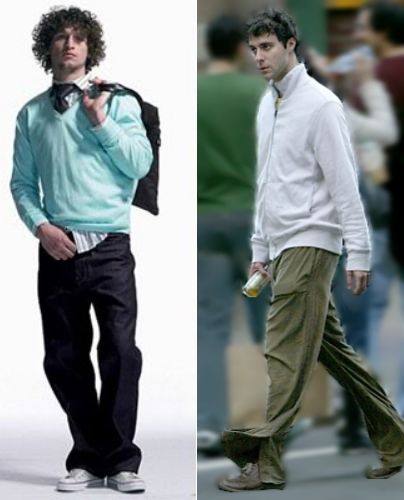
Fig. 1
Left: Model for a jeans ad
Right: Marc Mezvinsky


This must be the only civilization in the history of our planet where men define their masculinity by wearing scruffy clothes [Fig. 1]. It looks, at first, quick glance, as though men are abandoning style, but they're not.

There is a very particular look to the scruffy jeans ensemble: the un-tucked shirt; the "just so" length of the pants, which fold over sneakers and scrape the floor; those sneakers which are never dirty, but have a clean, almost brand new look; a clean sweater with the shirt hanging out from underneath; a loosely tied tie; a tote bag, or some "man" purse; some kind of twisted thread bracelet, or a copper or silver bangle, and a ring on one ear or some body piercing; disheveled, over-grown hair; and a day-old beard, although clean-shaven is also acceptable. The clothes look clean and washed, and if they have a few rips or tears, that is part of the style.

The slouch is the uniform posture from which these young men assess their surroundings, pretending to look nonthreatening, whereas they are observing closely to make the necessary moves to maintain their stakeout.

This look is not at all spontaneous and nonchalant. The men sporting this look, usually in their early to late twenties, appear to have spent some time putting it together, although with practice it probably doesn't take them too long.

I started observing their expressions and behaviors, and I began noticing a self-centered narcissism. For example, they are unlikely to cede the sidewalk to me, and expect me to walk a half a circle around them to avoid collision. Although these days, I just stop in my tracks and wait for them to make the adjustments. If they are with women, they walk very fast, oblivious to the extra fast pace the women have to maintain to keep up with them, although I think it's more that they're uncaring than not noticing.


Fig. 2
Buffalo Jeans Advertisement


Advertisements also expose the narcissism of these young men. In the jeans ad [Fig. 2], the young man looks arrogantly confident. His ensemble is baggy jeans and a long, disheveled shirt, un-tucked, and worn over some undershirt. He looks aggressive, and possessive. Who would want that kind of a guy around? But in this world of gender equality, there is still male swagger, and female demureness. In this "girl power" era of ours, young women actually seem to find this obnoxious-looking male attractive.


Fig. 3
Man in Bowler Hat


The man in the suit, bowler hat and cane [Fig. 3] is also aware of style and clothing. But he isn't using his style and his appearance as some kind of war against the world, but as a way to fit in the world, and to make it look civilized. At the same time, he is giving clear codes through this bold and well-defined attire that other men should aspire to a similar presence.

The twenty-first century young man, on the other hand, is as much concerned with aesthetics as he is with power and aggression.


Fig. 4
Marc Mezvinsky's expression vacillates between the insipid,
characterless look that is so common in young men these days,
but seems to change into the hard glint of a narcissist without warning.


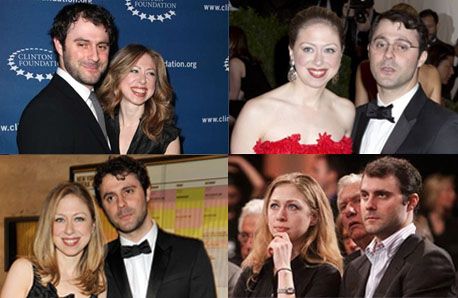
Chelsea Clinton's husband fits this appearance perfectly. Marc Mezvinsky at times looks like the insipid male that is so common these days, but then flashes without warning a hard glint of narcissistic aggression [Fig. 4]. Despite his scruffy look in Fig. 1, Mezvinsky's pants are clean and trendy cargo pants, and his sweat shirt is a spotless white. And no sneakers for him as he pushes his way forward with a growl.


Fig. 5
Chelsea and Mark: A Match Made in Hell?


Mezvinsky regularly pulls out his bow tie and white shirt in public appearances. Like all narcissists, he knows he has to win over his audience, and his wife, since extreme behavior will alienate them, and he cannot allow anything to jolt his prestigious and affluent lifestyle. He also manages to put on a subdued expression [Fig. 5]. Chelsea Clinton often has a bewildered, and intimidated look in her eyes, albeit with a glint of her own narcissistic ambitions (it has been reported that she is waiting to have her first child in order to pursue a "career"). It must be hard to keep up with her husband.

------------------------------------------------------------------------------------------------------------------------------------------------------------
Posted By: Kidist P. Asrat
------------------------------------------------------------------------------------------------------------------------------------------------------------

How to Acquire Style and Substance

This article is a re-write of Style and Substance in a Postmodern Age from Camera Lucida. It will probably go in the "Beauty and Masculinity" chapter.
-------------------------------------------------------------------------------------------------------------------------------------------------------------


Cary Grant
Photo by Harry Benson
1957


A young man recently wrote to me and asked:
Your posts are great and so pertinent to the madhouse we currently live in. I was wondering if you think the slovenly dress habits will be discarded within the next 10 years or so as people get fed up with the general ugliness. Or are they too far gone?

I generally gird myself mentally before I enter the public square these days. I expect to see slobs, hear rude language, be tailgated, walk away from cell phone conversations etc. I'm praying that network news goes the way of dvds.

And the way people let their kids scream and screech!

I think Lawrence Auster called it the age of the "totally liberated self".

Is this anti-culture too far gone? Should we traditionalists run for the hills and try to carve out a little patch of sanity?

George Orwell (a weird kind of socialist) wrote an essay called "Some thoughts on the common toad" and concluded it saying that in spite of the lies spewing out into the world Spring is Spring and they can't stop you enjoying it. A little comfort I guess.
I answered him with what I thought would be a practical guideline on how to maneuver the non-aesthetic mentality of our age:
I don’t know. Beauty, beautiful things, like a culture and a country, take years, centuries, generations to build and solidify. Ugliness and destruction occur in very little time. Even consider dressing: It is easier to slap on anything as opposed to wearing clothes that have an aesthetic sense.

I think our era hasn’t constructed, or built, its aesthetic sense. Other eras built theirs, out of what came from their past. Ours hasn’t bothered with that. I think it stopped soon after the late sixties and early seventies. I cannot think of a definitive eighties, nineties or “new millennium” style, but I can immediately recognize sixties, fifties, forties, thirties, twenties, styles, and further into the past.

I’m still trying to figure out why that is, but I think it happened when beauty was “downsized” as I call it, and when people thought it was too elitist. It probably has to do with equality, as I write here. But the problem with “equality” is that it courts the lowest denominator, so everyone becomes equally ugly.

But, the interesting thing about aesthetics is that it doesn’t require “equality” to function in any and all levels of life. The young shop girl can look beautiful (or at least aesthetically pleasing) and can borrow her ideas form the wealthy socialite to form her own pleasant look. Also, when beauty is around, even in limited quantities, everyone benefits. A beautiful statue in park is for everyone to appreciate. A beautiful lady glimpsed at in her car (in a store, a restaurant, etc.) makes people happy, including the lowly shop girl. Beauty does make the world a better place, I’m convinced.

Anyway, back to your question:

I think it is possible to discard slovenly dress habits, and even sooner than within the next 10 years.

1. You can start right away. For example:

A. Rather than wearing sneakers, always wear good shoes.

B. Dress well when going out, even to the corner store.

C. Of course, over-dressing to the corner store can look odd, so try to fit your dress to the occasion. There are great casual clothes around, and you don’t have to slip on a silly t-shirt or a worn out sweat shirt to go out and buy your milk.

D. Have a good hair cut, perhaps copying a style from another period, or using a men’s magazine for ideas (some have surprisingly well-groomed men models).

E. Try to get things to match, in style, color, design etc.

F. Find good accessories like ties, hats, belts, handkerchiefs, jackets. The whole look matters.

G. Avoid jeans at all costs. They look sloppy, and they are boring and unattractive.

H. And behave well, gentlemanly and chivalrously.

2. Avoid these items:

- Sweat shirts or t-shirts
- Sneakers
- Jeans
- Shorts
- Thematic prints like a shirt you bought at your last rock concert, or the tie with Disney motifs.
- Dramatic prints. Stripes and small circles or diamonds on shirts is as far as you should go.
- Baseball hats
- Odd jewelry, or pierced ear/nose
- Tattoos
- Hoodies

3. Try to find different styles for different occasion

A. Office wear

This is still generally more formal. Even if you work in a casual office environment, dress as if you might meet your next new boss, or your big client.

B. “Street” wear

Street wear is less formal. But you are out showing yourself to the whole world. Do you want to be seen in sloppy t-shirt and jeans, or look nice, presentable and attractive? You can add the thematic printed shirt here, perhaps a Hawaiian shirt for summer, and penny loafers are a good substitute for sneakers. As a hat, a panama hat might be a nice touch rather than that ubiquitous, ugly baseball cap.

C. Week-end and home wear

You’d be surprised at how people dress at home, when they think that “no one” is looking. Of course, their own families are looking, observing and often mimicking. If you have young children, they will be influenced at how you present yourself even at home. Get out of the pajamas and dressing gown mode, and actually wear some real clothes that are not for sleeping in. “Pajama mode” dressing includes baggy sweat shirts and sweat pants, and t-shirts, sloppy slippers/flip flops, etc. Leave the t-shirts and sweat shirts for the garden or yard work. You can be comfortable in a loose shirt and pants. Try a Hawaiian shirt, a short-sleeved golf shirt, sweaters, penny loafers, Dockers once in a while.

D. Visitors/Visiting wear

Dress up when visiting friends, and when friends come to visit. Don’t overdue it, of course, if the event is casual, but look good. Rather than a sweat shirt, put on a dress shirt, or a short-sleeved golf shirt. Try different, subdued colors for a change, like pastel lilac or light blue. Don’t pull out the Hawaii shirt for this one. No jeans, of course, and no sweat pants. But tan Dockers are a good, neutral choice. Penny loafers, and more formal shoes like Oxfords, can substitute for sneakers.

E. Visitors and week-end and home wear are somewhat similar

In a way, you should be ready for some event, even if at home. Some-one may decide to pop in for a visit. Mix your “visitors wear” with your casual home wear when you’re at home.

4. Look for good examples and guides

A. Magazines

Look up GQ magazine and other men’s magazines. Many have surprisingly good selections of men’s clothes. But pay more attention to the ads. The articles are often featuring the next “avant-gard” designer, whereas the ads are more conservative.

B. Tailors

Go to a tailor. Try to find a small, modest, old-fashioned one, who has had some formal or “old world” training. Such tailors are often a wealth of information. Ask for their advice. Have a suit custom made.

C. Formal Occasions

Look around during formal occasions. See what people are wearing for weddings, engagement parties, christenings, office formal parties, etc. Formal wear has been downgraded so much that wedding suits might actually fit your every-day life style.

D. Public Figures

Watch what public figures – news anchors, presidential candidates, Donald Trump, etc. - are wearing. Study how they accessorize with their ties, handkerchiefs, shoes, hats, and even their hair styles. We are still a some-what conservative culture when it comes to how our leaders are dressed.

E. Fashion History

Look up the history of fashion. How did people dress ten years ago, fifteen years ago? In the fifties, or forties? In the 19th century? During Medieval times? You’d be surprised to find that men took what they wore very seriously. A knight is identified partly by what he wears. So is a king. As is an early twentieth century gentleman.

F. Fashion Statements and Items

Find distinguishing items of different eras, periods and styles. It could be the walking stick/umbrella of the English Gentleman. Or the colors of a sixteenth century costume which you can incorporate into the colors of your tie and lapel handkerchief. Or the hats worn in the 1950s.

G. Different Cultures

Look at different cultures around the world and study how they differentiate between formal wear and casual wear (e.g is “casual wear” universal?). Did they have specific, attractive wear for men? Were men and women equally well-dressed?

H. Different Classes

How do the rich and the poor dress? You might think that only the wealthy are concerned with looking good. But, all walks of people dress cleanly, respectably, and with some flair. Poor people in Africa, for example, the poorest of the poor in the world, managed to develop a bright and cheerful style, with imaginative tie-dye, block print and batik fabrics, which million-dollar designers copy as their latest runway creations. Even cheap Walmart clothes are often colorful and attractive.

I. T.V. Shows and Movies

If you watch T.V., try to find shows that can give you good style examples. Subscribe to a “Hollywood movies” channel and watch shows and movies from the forties and fifties. We can still relate to those styles, and in fact they’re making a come-back. Study the suit cuts, the colors men wore, the shoes and ties, the hair cuts. Find what you like, and what can fit into your lifestyle, and just copy it!

Cary Grant shows true style and substance with a simple, relaxed pose (see above image). No aggressive expression, no slovenly style. Here is male aesthetics at its best.

J. Vintage Styles

Look for vintage style magazines (including women’s magazines), style history books, etc., and read about the dress and style expectations of those eras. Go to antique and vintage clothing stores and search their racks. As the shop owners for information. Many of them have a fountain of knowledge about style and design.

5. Ignore those who call you "old fashioned"

The MTV DJs or the slovenly week-end sweat shirt wearers have become standard bearers of our contemporary style. They are NOT experts. If your children or younger acquaintances tease you about your style, ignore them, and continue with what you’re doing. They will come around if they see you’re serious. Young people are susceptible to beauty, both boys and girls. We just need to show and teach them. Adults who tease you with subtle jibes are not worth paying attention to, especially if they are the types that wear the droopy sweat shirts and old t-shirts. They might come around, but don’t be too concerned about that.

6. How to approach those annoying loud cell-phone monologues, and jeans hanging down to the knees

Find it in yourself to “confront” slobs, bad language, loud cell phone conversations disclosing intimate details, etc. Don't do this every day, though, and don't stress yourself out. But, try it once in a while to show such people that they’ve passed beyond norms of decorum. This might get risky since people can get really angry, but assess who you can do it to. People need to know that such behavior is unacceptable.

7. How to personally make a difference

I think revolutionary things start with leaders, or those who take a bold step ahead of others, and who are not afraid of confrontations and negativity. But, prepare yourself mentally, intellectually and personally before you embark on your “making a difference” mission. Here are some things you can start with:

A. Start a blog.

B. Write letters to the editor.

C. Find a magazine, a newsletter, a community paper etc. which will accept your articles.

D. Talk to family and friends about your observations, especially if it concerns them.

E. Make suggestions to your retail stores about clothing items to bring into the store.

F. Form a society like "The Society of Sartorially Conscious People," or "The Well Dressed Group" as you develop ideas and plans on how to make the differences you wish to see around you. Many changes in the past occurred because people formed groups of some kind for support and for strength. Fashion is no less serious, and requires as much energy as any other movement.

8. Change your manners and style to fit your message

A. Please, thank you and excuse me go a long way.

B. Decent and polite behavior attracts people to you and your style.

C. Don’t shirk from full-on arguments, and don’t get bullied by bullies. But choose your place and your manner carefully when interacting with such people. Often, abrasive behavior will only alienate you from others, and prevent you from making your influence. Everyone can a potentially be on your boat, but some more than others.

9. Running to the Hills

I haven’t thought about this. I think it is an option, or could be an option. But this place, this whole place and not some cave in the hills, is our world. I think we need to defend it where we are. We can metaphorically run to the hills by building our own community as I have described above. But that should (could?) be the start of us building our defensive/offensive strategies, when we can begin more concrete changes. I think some inevitable confrontation is looming in the future, so we better get ready now.

10. "Spring is Spring and they can't stop you enjoying it."

And yes, you are right (or George Orwell is right). There are still many beautiful things around us, natural, cultural, familial, and so on. Enjoy the lovely spring that is already here, and the warm summer months just ahead of us. Read good books, look at good art, take care of yourself physically and spiritually. Start a hobby such as photography, woodwork, marathon running, etc., to enjoy life and to keep you in good spirits. We are not here to destroy, but to create.
And be good to people, even the slothful ones.
-------------------------------------------------------------------------------------------------------------------------------------------------------------
Posted By: Kidist P. Asrat
-------------------------------------------------------------------------------------------------------------------------------------------------------------