Thursday, February 13, 2014

God's Garden


Plaque from the website Life With Tess
(The flower growing by the bark is a Star Jasmine, or a Confederate Jasmine)


The kiss of the sun for pardon,
The song of the birds for mirth,
One is nearer God's heart in a garden
Than anywhere else on earth.


-------------------------------------------------------------------------------------------------------------------------------------------------------------

God's Garden
By Dorothy Francis Gurney

The Lord God planted a garden
In the first white days of the world,
And He set there an angel warden
In a garment of light enfurled.

So near to the peace of Heaven,
That the hawk might nest with the wren,
For there in the cool of the even
God walked with the first of men.

And I dream that these garden-closes
With their shade and their sun-flecked sod
And their lilies and bowers of roses,
Were laid by the hand of God.

The kiss of the sun for pardon,
The song of the birds for mirth,
One is nearer God's heart in a garden
Than anywhere else on earth.

For He broke it for us in a garden
Under the olive-trees
Where the angel of strength was the warden
And the soul of the world found ease.

About Dorothy Francis Gurney:
Dorothy Frances Gurney (October 4, 1858 – June 15, 1932) was an English poet and hymn writer. Though both her father and husband were Anglican priests, Mrs. Gurney became a Roman Catholic (as did her husband) in 1919. The second to last verse of her best-known poem, "God's Garden" is seen everywhere on signs, plaques and other garden ornaments, but few people know its author.

“[God's Garden was] originally written in Lord Ronald Gower’s visitor’s book. It was inspired by his exquisite garden at Hammerfield Penshurst.”

From a copy handwritten in England on an envelope circa 1925, and found in a book on the Church of England’s Liberal Evangelicals in 2010. [Source: Wikiquote]
-------------------------------------------------------------------------------------------------------------------------------------------------------------
Posted By: Kidist P. Asrat

Wednesday, February 12, 2014

Man, Nature and God


Aksel Lund Svindal of Norway skis during the Alpine Men's Downhill.
He finished fourth


Many of the Winter Olympics' events are frighteningly dangerous. I recently watched a replay of a female skateboard competition, where the Czech Republic contestant fell in a dramatic way. She came back to show she was O.K., although her helmet was cracked!

I feel sorry for these contestants. I think they are being pushed to the extreme. But what else is there but for more - more speed, more height, more aerial acrobatics, more danger. Perhaps it is time to stop these Olympic events (and other championships too). But that will never happen.

It is sad that I have to feel sorry for athletes, whose role (if I can call it that) is to show me their strength, not for me (or spectators) to detect any weakness. The Olympics, and the inhuman standards that have been set, have made these athletes into vulnerable creatures, instead of confident and bold humans. The joy of watching sports is lost once we suspect that the athletes aren't up to the standards.

So, do we lower these standards that we have set? I think it is too late for that. Either we have to re-invent the Olympics' sports, or we have to watch each competition with the dangers (of death, even) that are imminent. If we chose the latter, than we have truly become barbarians, sending our men into the lion's den to be devoured for our enjoyment.

So all we can do is watch with bated breath at these incredible feats of these mere humans. We want them to be god-like. We want more of everything, for them to prove their mettle. After all, humans have always aspired to, and admired, physical strength. But I don't think we've ever gone this far, pitching one human being with nature, with the mountains.

And we watch in horror as nature takes one of them and plays with him as a puppy does with a ball.

But, there is an option: NOT to watch. That is the one I have chosen, which is the only one I have control over. And of course, that means not listening to the news for the next couple of weeks, and to click past all postings that fill every webpage. We have to be inhumanly absent from the world around us, for two weeks, at least.

Leni Riefenstahl, Hitler's filmographer, understood the god-like energy of man that can be displayed in the best of men. Her film Olympia, on the Berlin Summer Olympics accentuates the incredible feats of the athletes. She was a skier herself, and had already acted in several mountain films, and understood the majesty of nature, and the thrill of conquering it.

Her magnum opus is the film Triumph of the Will. It has been labeled as a "Nazi film" or a "propaganda film for Hitler," The initial shots of the film are of Hitler hovering above in an airplane, ready to land, god-like, on earth. But Triumph of the Will is bigger and more ambitious than a propaganda, or even a Nazi, film. Riefenstahl's artistic vision (and mission) was to show the glory of man, who can reach the skies. Yet she forgot, or ignored, Icarus, one mere man who tried to reach the heavens where only gods could reach.


Henri Matisse (French, 1869–1954)
Icarus, plate VIII from the illustrated book, "Jazz"
Date: 1947
Medium: Stencil
Dimensions: 16 1/2 x 10 1/4 in.
Metropolitan Museum of Art, New York


And the biggest irony of all, which she in her frenzied passion didn't see, was that Hitler is not even an Icarus, but a stringy, spindly, short, dark-haired man, who was ready to destroy the world for the Nordic Blonde Gods of Germany. His Icarus moment was short-lived, although devastating to Germany. His vision of heaven transformed quickly into a Götterdämmerung, leaving Europe shell-shocked for decades to come.

Here we are adulating athletes, and urging them to fly close to the sun. How close are we to Hitler's vision now?


An unidentified skier takes part in the first training session
of the Val Gardena Men’s World Cup Downhill on December 16, 2009

-------------------------------------------------------------------------------------------------------------------------------------------------------------
Posted By: Kidist P. Asrat
-------------------------------------------------------------------------------------------------------------------------------------------------------------
Objective
Modern man is a literary man, possibly more so than a visual one. Through the written word, with timely examples and with an exhorter’s clarity, I will be able to relay the urgency of the message of that beauty is disappearing.

The book Reclaiming Beauty aims to document the contribution that beauty has made toward our Western civilization, from the earliest records of God’s love of beauty, to a young child who sees beauty almost as soon as he is born. Our civilization thrived, prospered and matured because of beauty. Our great artists, architects, writers, philosophers and scientists have always referred to beauty with awe and wonder. It is in the modern era that beauty began to be undermined and eventually neglected by artists and other intellectual leaders.
Reclaiming Beauty will show that the abandonment of beauty leads to the death of culture, and eventually society. Modern man’s neglect of beauty has initiated the cult of ugliness, leaving us with bleakness and nihilism.

But, people want beauty. And they will surround themselves with some kind of aesthetic quality. Still, beauty is the business of the knowledgeable. The man on the street may be able to recognize beauty, but he would not be able to explain why it is beautiful. That is the task of the experts.

With Reclaiming Beauty, I aim to present my ideas, observations and analyses on beauty, and to provide a guide for recommendations on how to remove oneself from the nefarious influences of our beauty-rejecting world. This way, we can build a parallel world which will
eventually form a growing movement of beauty-reclaiming individuals, who can start to shape a world where beauty is not minimized and rejected.

Significance
Reclaiming Beauty will be the first book on beauty to make a comprehensive, historical, cultural and societal review of beauty. It will describe the moment (or moments) when beauty was not only undermined, but eventually abandoned, as a paradigm of civilized life. Rather than attributing beauty to a Godly goodness, philosophers, writers and artists began to view beauty as their enemy, and as their nemesis. They saw God as a judge who would not let them do as they wished. In order to pursue the image of beauty they desired, they began to look elsewhere. They began to abandon God, and by abandoning God, they began to change their world, filling it with horror and ugliness.

I maintain that this was not their objective, which was merely to look for a different perspective on aesthetics. This realization may have come too late, and too weakly, from the cultural leaders, but ordinary people, who are most affected by these changes in worldview, are already incurring changes. But they cannot make useful inferences, and hence necessary changes. They still need an elite to help them materialize their desires and observations.

A new elite that is pro-beauty needs to take the cultural reins, to guide and return our world back to its awe and wonder of beauty. To this end, Reclaiming Beauty will add an element which no other book on beauty has attempted: guidelines on how to renounce this world of anti-beauty, and how to progressively bring beauty back into our culture.

The book will be a manifesto for concrete references to these basic ideas. Along with the
book, a website will be developed that will be an interactive continuation of the book. On the website, members can post their original articles, shorter commentaries, articles and excerpts from other authors, and encourage feedback and comments from other members. At some point, this group can develop into a more formal society, which can meet in a physical locations a few times a year, building beauty societies, whose purpose would be to develop ideas and strategies for bringing beauty back into our culture

Part of the book will revised versions of what I've been developing over a number
of years in my blog posts at Camera Lucida, Reclaiming Beauty and Our Changing Landscape, and from my full-length articles from Kidist P. Asrat Articles.

All images that head the chapters will be from my own collection of photographs and designs. Some of these images can be found at Kidist P. Photographs and Well-Patterned. Others I will choose from my collection of photographs, mostly in negatives and prints. Others I will take as the project progresses.

The image on the book cover is a photograph I took of the the inner courtyard at the Cloisters Museum in New York. There is a section in the book dedicated to the Cloisters titled: The Sturdy Periwinkle: Linking the New World with the Old, which discusses the Western, European influences in North American culture. The chapter will be a revision of a post at the blog Reclaiming Beauty.

What I plan to accomplish at the New York Public Library
The library’s vast, world class research facilities will assist me in finding the scholarly, historic and artistic information necessary to substantiate the ideas in my book.

How I plan to use the NYPL’s Stephen A. Schwarzman Building
I will primarily be using the Arts and Architecture Collections. The material I am interested in is the Western collections (fine art, decorative arts, architecture and design history, as described in the website). Here are the specific ways I will peruse the library’s facilities:

- Catalogues Raisonnes
This will provide me with specific works of art by specific artists, whose played important if not seminal influence on Western art and culture
- Thirty Minute Consultations
Since my time is limited at the library, periodic, short consultations, especially at the beginning of my research schedule, will save me time and help me find relevant and pertinent information.
- Vertical Files
Although vertical files are no longer being catalogued, my research is also concerned with a historical perspective on art and culture, and the perception of beauty. The material that is catalogued between 1910-1950 will be useful to analyze how the detrimental effects of two world wars (1914-1945) affected the culture.
- Photographic Collection
Examining photographic records of recent history will provide me with a documentary of the society's aesthetics when image production started to be more democratic, and more available. Photographs don’t, and don’t need to, eulogize their subjects, as did painters.
- Print Collection
The collection which dates from the 15th century, and which encompasses almost five hundred years of image reproductions, will provide me with a historical survey of how beauty, and beautiful images, were viewed over these centuries.
- Spencer Collection
I will have access to the Spencer Collection through the Photograph and Print Collections, providing me with further material to enhance these two collections, including medieval and renaissance manuscripts.
- The Manuscript and Archives Division
This houses documents ranging from medieval and renaissance illuminated manuscripts, which is also connected to the various other prints divisions in the library, and will enhance my research.
- Map Division
Besides the practicality of maps. there is an aesthetics to maps as well. The Map Division will provide me with this aesthetic survey of maps over the centuries.


Saturday, February 8, 2014

The Nuts and Bolts of Beauty

Email and Photos from Dean Ericson:
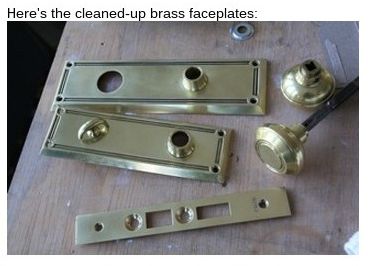
Let me show what I've done yesterday to reclaim some beauty. I'm renovating our 1924 apartment, as you may recall. In our front entry door is the original "lockset" -- the 1924 door lock and handle hardware. I've taken it out and prettied it up.

It works well now, oiled and adjusted, the action smooth and easy, and the soft luster of polished and waxed brass looks warm and lovely. Nobody will ever see it except my wife and a few friends (if I point it out to them), but it pleases us, and I like to think it pleases God.

Your work is just like my lock. (Only I hope more people see it!)


-------------------------------------------------------------------------------------------------------------------------------------------------------------

Dean's unique take on beauty, that the nuts and bolts can be beautiful, is one I hadn't thought of before. Of course, sometimes the end result of nuts and bolts is to create objects of beauty, but how about the nuts and bolts themselves? They can also be beautiful, albeit often hidden, and add to the overall dignity of beauty. Someone who considers the beauty of nuts and bolts is a true advocate of beauty.

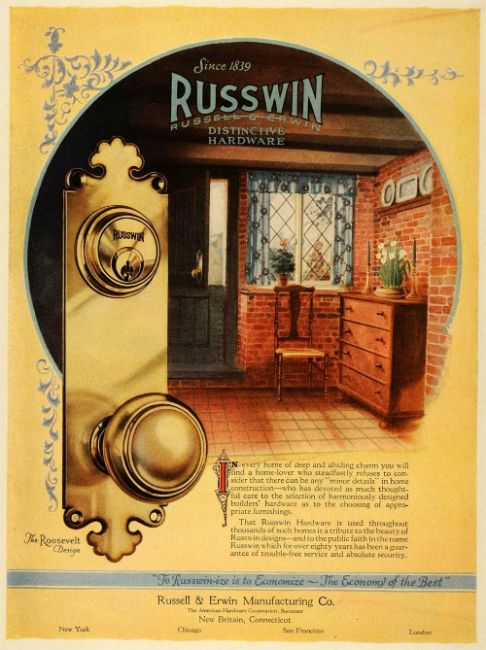
Below is a print of a 1924 Russell & Erwin home hardware advertizement. The script describes the homeowner who devotes attention to the details, and the beauty this "nuts and bolts" type of designer aspires to.

About the Russel & Erwin ad:
This is a rare stunning original 1924 color print ad for the Russell & Erwin Manufacturing Company of New Britain, Connecticut, as well as New York, Chicago, San Francisco, and London. This ad features their Russwin distinctive hardware for home improvement, including their doorknobs and locks.


And about Russel & Erwin:
Established in 1846, Russell & Erwin Manufacturing Company of New Britain, Connecticut, created some of the most innovative hardware designs of the Victorian era, including the highly collectible "Doggie Doorknob" and a sought-after line of door hardware ornamented with a geisha. [Source, including photos of hardware items]
Even the 1924 poster has elegance.

Below is a contemporary Home Depot poster. Although the soft-focus effect of the photography is pleasant, it doesn't reach the level of refined illustration of the 1924 ad. The dark handle has a simple and attractive design, but I would wager that it isn't inexpensive. I would rather have a Russel & Erwin style lock and handle in my home, and the cost probably won't be that much different.


-------------------------------------------------------------------------------------------------------------------------------------------------------------
Posted By: Kidist P. Asrat

Thursday, February 6, 2014

Baltimore Federal Era Furniture


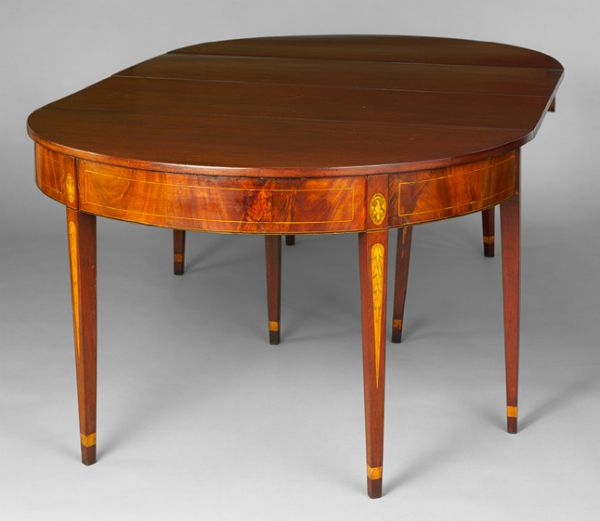
Drop-leaf dining tables, 1795 - 1810
Baltimore
Mahogany, holly with yellow poplar, white pine, sycamore;
28 3/4 x 47 7/8 x 78 1/2 in.
The Metropolitan Museum of Art


Drop-leaf dining table (from above)
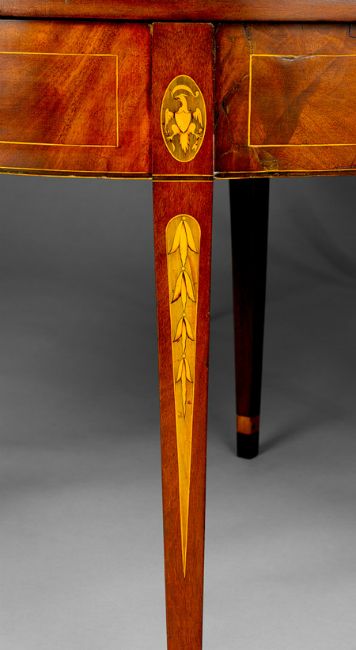
Detail of leg showing the graduated bell flowers
and the American Eagle


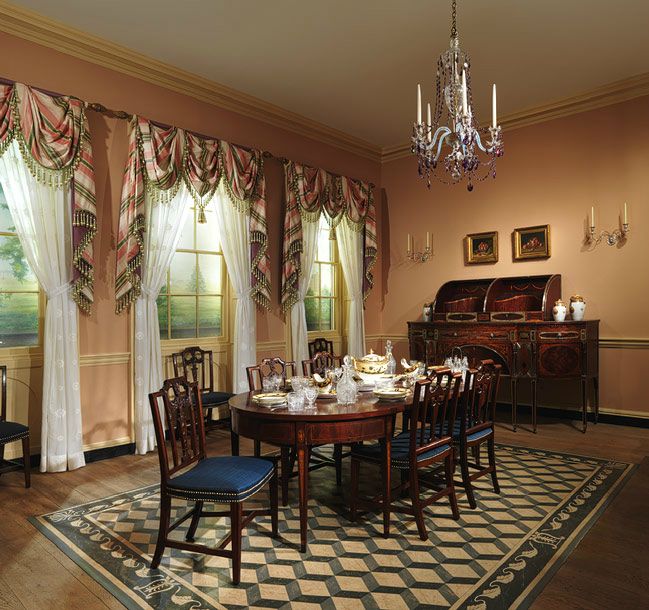
Drawing room of the Craig House, Baltimore, Maryland, ca. 1810
Metropolitan Museum of Art, New York City


Notes from the online exhibit:
The architectural elements of the Baltimore Room are from the parlor of a brick row house built for Henry Craig between 1810 and 1811. The parlor was the most important room in Henry Craig's dwelling devoted to entertaining guests. Accordingly, it contained the finest woodwork, which illustrates a delicacy and restraint typical of the Neoclassical style of the period.
-------------------------------------------------------------------------------------------------------------------------------------------------------------

I usually sit pen in hand while watching PBS' Antiques Roadshow. It is one of the few programs (or places) where old and hidden treasures get revealed.

This past week, the show was from Detroit. We forget that before Detroit deteriorated, it was a wealthy city.

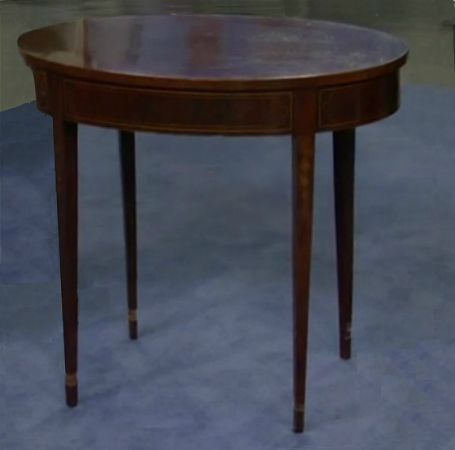
One lovely piece of furniture that showed up at the auction was a Baltimore Federal Era Center Table.


Baltimore Federal Era Center Table
Mahogany
ca. 1790
From the Antiques Road Show, Detroit
Which aired in February 3, 2014


Baltimore Federal Era Center Table
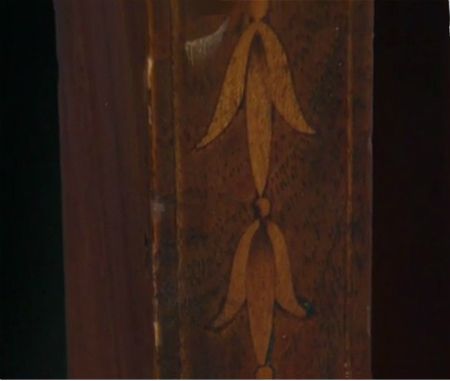
Detail of leg, showing graduated bell flowers


The appraiser says about the table:
They made these Baltimore style tables in the 1880s, 1890s, 1900, 1910. And so they were copies of the original tables.

...The good news is that you have a really fully inlaid table. A really high styled table...We're going to try and figure out now whether its First Period or Second Period...You have period table from 1785 to 1795, maybe 1800, so it's a real thing.

...The legs have graduated bell flowers, which are sand-burnt to make them three dimensional....
This is what I could find out about this style:
In the years immediately following the Revolution, Baltimore became an important port, and a school of cabinetmaking flourished there during the Federal period [1780-1820]. Elaborate pieces of painted furniture made the Baltimore pieces’ sophistication and grace hard to match. In addition to the painted furniture, Baltimore was known for its use of églomisé (glass panels with symbolic figures) and large ovals inlaid in mitered panels. Like Baltimore, Annapolis also became an important Maryland cabinetmaking center. The most prominent craftsman was John Shaw. A labeled mahogany bookcase-desk by John Shaw was made in 1797 and formerly stood in the Kennedy Green Room in the White House. It is now is shown in the Diplomatic Reception Room. The Maryland State House holds a desk for the President of the Senate made by John Shaw in the same year. [Source: Bartley Classic Reproductions]
And:
Baltimore furniture, decorated with paint or fancy wood inlays, and beautifully detalied Baltimore silver of this period [the Federal era] took their places in the forefront of American design. The merchants=craftsmen John and Hugh Finlay typified the trade; they advertized in 1803 that they had for sale but would "also make to any pattern all kinds of fancy and Japanned furniture." Their wares and shop skills ran to car, pier, tea, dressing, writing and shaving tables; stands for candles and washpans; bedsteads along with bed and window cornices; cane-seat, rush-seats and Windsor chairs; and fire and candle screens "with or without views adjacent to the city." In this flush time of European war and Baltimore profit, the wealthiest Baltimoreans could afford interiors, furnishings and finery that spoke clearly of personal and family taste. [Source: The Architecture of Baltimore: An Illustrated History. Mary Ellen Hayward and Frank R. Shivers, eds. John Hopkins University Press, 2004. P. 29. Full Text Online, here]
General information from Wikipedia:
Federal furniture refers to American furniture produced in the Federal Period, which lasted from approximately 1789 to 1823. Notable furniture makers who worked in the federal style included Duncan Phyfe and Charles-Honoré Lannuier. It was influenced by the Georgian and Adam styles, and was superseded by the American Empire style...

Pieces in this style are characterized by their sharply geometric forms, legs that are usually straight rather than curved, contrasting veneers, and geometric inlay patterns on otherwise flat surfaces. Pictorial motifs, when extant, usually reference the new federal government with symbols such as the eagle. [Source: Wikipedia]


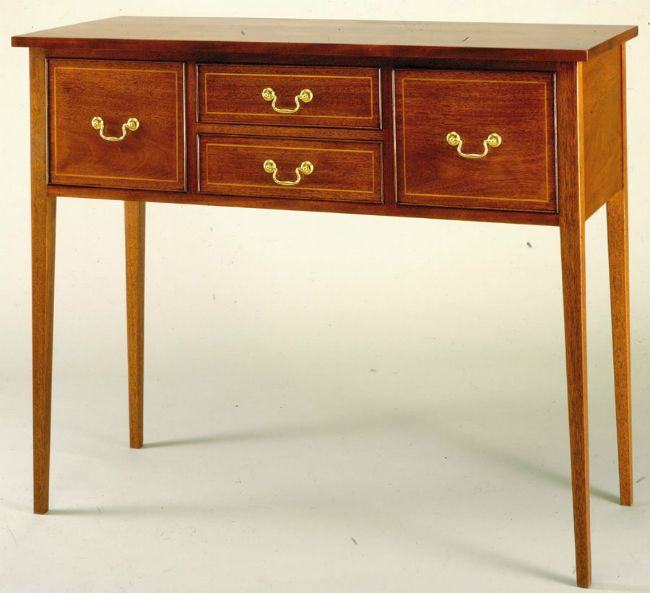
Contemporary version of a Federal Style side board
At Bartley Classic Reproduction


The full Antiques Roadshow video is here. The section on the center table appraisal starts around the 8 min. point.
-------------------------------------------------------------------------------------------------------------------------------------------------------------
Posted By: Kidist P. Asrat
-------------------------------------------------------------------------------------------------------------------------------------------------------------

Monday, February 3, 2014

First-time Publisher


Cover Design and Photo by Kidist Paulos Asrat

I sent the following email to a publisher, whose reputation I discerned from having published a recent book of someone I esteem.

I got back a positive reply.

If anyone has any publisher that would be interested in the kind of book I'm preparing (have been preparing), please let me know at: cameralucidas@yahoo.com.
To whom it may concern,

I am writing a book titled Reclaiming Beauty.

Its premise is that we have been given a world of beauty by God, who is the pre-eminent lover of beauty, and who has told us to make the world more beautiful.

My book explores beauty, historically, culturally, artistically, and through a religious (Christian) lens. My thesis is that we have veered far away from God's desires, especially in the 20th and now the 21st century.

But, I conclude that it is not too late. And that with faith, and our own creativity, we can revive and reclaim beauty.

One way I propose is to start a "beauty movement" which the book can be a reference to, and which can continue online at Reclaiming Beauty, and beyond in communities around the country.

Please let me know how, as a first time writer, I can have my book published.

Here are:
- My resume
- My website: Reclaiming Beauty
- The outline of my book's chapters
- My proposal for a beauty movement

Thank you,
Kidist Paulos Asrat
-------------------------------------------------------------------------------------------------------------------------------------------------------------
Posted By: Kidist P. Asrat

Sunday, February 2, 2014

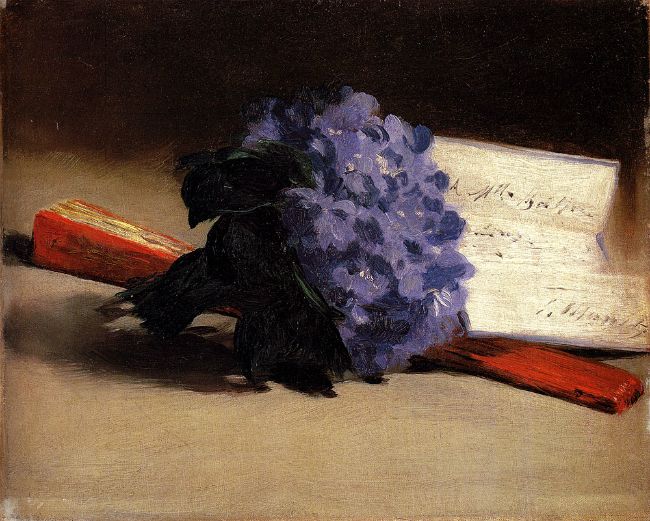
February Month Of The Violet


Eduard Manet (1832-1883)
Bouquet Of Violets
Oil on canvas
1872
8.66" x 10.63"
Private collection


Rather than find flowers and gems related to a horoscope sign, I thought it would be interesting to find them as they relate to a month.

February is the month for violets. According to Wikipedia, February's:
- Birth flower is the violet (Viola) and the common primrose (Primula vulgaris).
- Birthstone is the amethyst
- Symbols are piety, humility, spiritual wisdom, and sincerity.
- Zodiac signs are Aquarius (until February 18) and Pisces (February 19 onwards)
This month, which is in deep winter, already has four things that I like:
- The violet flower is part of a perfume that I find delicately pleasant: Elizabeth Taylor's Violet Eyes has the essence of the violet flower (below is my review I wrote in 2011)
- The deep purple amethyst is my second favorite stone
- I am Capricorn, but as I read Aquarius astrology notes signs, I find that I have a lot in common with that sign, including getting on well with the creative, imaginative and often visionary Aquarians. Perhaps it is to do with the moon, sun and planets?
- Humility, spiritual wisdom and sincerity? I think I do have a certain sincerity in what I do. That is probably why I decided to be a blogger.
- I did a post on Elizabeth Taylor only a month ago. It was mostly about her perfumes, where I wrote:
...[I]n Taylor's time, celebrities didn't run around in embarrassing outfits confessing all kinds of unmentionable things to callous magazine interviewers who have to take things (gossip and ugliness) up a notch in order to sell their stories. Despite their clearly difficult lives (Elizabeth Taylor was married eight times), there still was an aura of mystique and mystery around these celebrities. This provided them with the shelter to continue with their creative energies. And it gave Taylor room to create her perfumes.




She had been in the news mostly about her readmission into hospital because of her heart. Even for such a trip, she put on her best face and best clothes.
She still had energy to compose one final perfume, Violet Eyes, in 2010, perhaps her most personal...
Here is perfumer Carlos Benaim describing the perfume, and Elizabeth Taylor:
At first, you perceive the brightness of her gaze. Then she looks straight at you, and there you are, staring into the most famous eyes in the world. And they are indeed violet, absolutely unique and truly beautiful.

Both the bottle and the outer package were carefully designed to my specifications. The contrast of both shiny and matte surface and watercolour violets combine to make this an exquisite design.
And here are the notes for Violet Eyes:
Top: White Peach
Middle: Purple Rose, Jasmine
Base: Violet, Cedar Wood, Amber
I took the photograph below of a field of violets sometime in spring. I'm not sure what violets have to do with February, but I have noticed this small, unassuming flower, which gives a purple carpet on fields where it is allowed to grow.


Violet Garden (2011)
[Photo By: KPA]

-------------------------------------------------------------------------------------------------------------------------------------------------------------
Posted By: Kidist P. Asrat
-------------------------------------------------------------------------------------------------------------------------------------------------------------

It Is Up To Us To Reclaim Beauty


Commenter Jennifer K. writes regarding my post Fighting For My Coffee in Multi-Culti Canada:
I live in Milwaukee, Wisconsin, which is in the Midwestern region of the United States. Starbucks is the closest coffee place to me, but I always bypass it for our local, independent coffee shops. Not only do they offer a great cup of various types of coffees, they also offer a great selection of teas, fine pastries and delicious sandwiches, soups and salads.

As for the perfume, well, Kidist, if you want to know the notes of a perfume GOOGLE IT!!!! It's not that hard. Sure, I'd expect someone at a high end parfumerie to know about various notes, but at a standard mall shop? Well, no. Just like I don't expect a cashier at my grocery store to know everything about a bottle of wine I purchase. Sure, if I go to a high-end wine shop, I expect some knowledge. But my local Pick n' Save? Nope.
Here is my reply.

1. Re: Coffee shops

- I agree that there are many nice, cosy independent coffee shops. But, I think that Starbucks coffee is as good as (some, a few) and superior to many. Many of these coffee shops also have their "cultural" elements to wade through, e.g.: oddly dressed owners/receptionists/customers; music which is often not my taste; strange decorations, or "artwork" by patrons for sale or on some rotating exhibition; food and drinks that I'm not familiar with (e.g. funny flavored muffins); items that are too expensive; etc.

- These "cosy" coffee shops are often too cosy, with crammed seating too close to the patrons (and their conversations) around me.

- The spaces are also old, or not as modernized as Starbucks, and I often wonder about their hygiene.

- I don't usually drink tea. And when I do, I prefer to make my own, strong, brew at home.

- At Starbucks, I can buy my freshly ground coffee to take home and drink at my leisure. I doubt that many coffee shops can provide ground coffee for their customers.

2. Re: Perfume knowledge

- There is no excuse for "perfume" girls not to know the perfumes they're surrounded with all day. How many do they sell per day, let alone discuss with a customer?

- I'm not talking about Jennifer Lopez's latest, or the Body Shop's bubble bath. I'm talking about Chanel, Christian Dior, Nina Ricci, Armani (you get the drift?). A few perfume girls (I should call them women) at Sephora's are very good, and will tell me what the dry down is (what scent is left on your sweater or scarf at the end of the day). But, I usually have to deduce this from the perfume guide they have put up conveniently. And I always ask for a sample for that very reason: to see how the perfume interacts over the course of the day. How difficult is that for a shop girl to do? In fact, what fun! She can start the month at the beginning of the store, and work her way around.

3. Re: Wine and supermarkets

In Canada, we cannot buy wine in supermarkets (which is probably a good thing). At liquor stores, I can always find someone who tells me exactly what I need to know. I don't bother with those who are shelving, and I bother the least with the cashiers. I don't expect them to know much about wine, just as I don't expect help on wine selection from the cashier in the grocery store.

Conclusion

What is going on, as I keep writing at Reclaiming Beauty, is a gradual deterioration of our culture. I don't mean this in an elitist way at all. The shop girl's "nose" will be more refined the more she is expected to elevate her standards. And all this terrible stuff coming at us from alcohol drenched factories wouldn't exist because no-one would buy them. Then, those less expensive scents which have disappeared, can make a comeback (like Coty, Yardley, Max Factor and Revlon). Or women can buy one perfume a year, if only to replenish an existing bottle - how difficult is it to save $70? Or women can start making their own scents at home - what a concept!

Wines from California (and some regional Canadian wines) are great, and really inexpensive (you can always get the expensive ones if your wallet leans that way). The French have wine at dinner (I don't think it is, or has become, a myth), and their wineries produce wine for a pleasant home consumption. Like perfume, the more people demand, the more manufactures will deliver.

So, my final point is: it is up to us to elevate our standards; it is up to us to reclaim beauty.
------------------------------------------------------------------------------------------------------------------------------------------------------------
Posted By: Kidist P. Asrat
------------------------------------------------------------------------------------------------------------------------------------------------------------

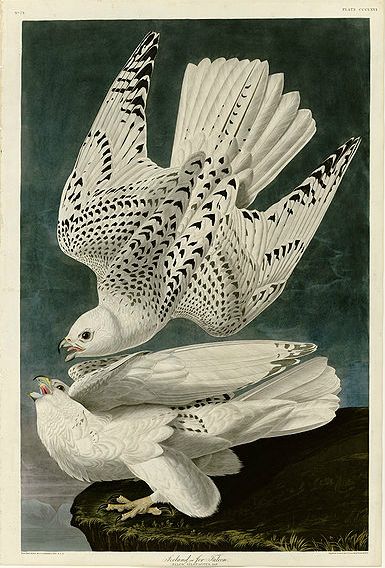
Birds of America


Iceland or Jer Falcon
By John James Audubon (1785-1851)
From: The Birds of America
Publication date 1827 - 1838
Falco Islandicus, Lath. Iceland or Jer Falcon - Gyr Falcon. Labrador Falcon.

Tooth-like process of the bill generally obsolete in old, festoon slight in young birds; tail from three to four inches longer than the wings. Adult white, with slate-grey sagittate spots above, the bill pale blue, the cere and feet yellow. Younger birds light grey, the feathers white on the edges; the bill and cere light blue, the feet greyish-blue. Young brownish-grey above, the feathers margined and spotted with reddish-white, the lower parts yellowish-white, longitudinally streaked with dusky.

Male, 221/2, 49. Female, 231/2, 511/4.

Breeds in the extreme north, and in Labrador. In winter, migrates southward as far as Maine.

[Text source: A Synopsis of the Birds of North America
By John James Audubon
Edinburgh: Adam And Charles Black;
London: Longman, Rees, Brown Green and Longman
1839]
I recently posted on bird illustrations by Charley Harper (1992-2007), where I said:
His whimsical world captures, despite his best intentions I'm sure, some of that movement (chaos, as he calls it) of life, and especially the life of birds.
John James Audubon is another American illustrator who drew a large number of birds. His world is less whimsical than Harper's, but no less bewitching. His gyrfalcons, with their dark, and perhaps cruel, eyes, still win us over with their thick, mottled, black and white feathers.

From the University of Pittsburgh:
The Donation of Audubon’s Birds of America

The daughters of William McCullough Darlington and Mary Carson Darlington, of Pittsburgh, Pennsylvania, donated their family library to the University of Pittsburgh in 1918 and 1925 as a memorial to their father. Birds of America was part of the collection that became the Darlington Memorial Library, established in the University’s Cathedral of Learning. According to one of Mr. Darlington's record books, he paid $400 to purchase the complete set in 1852.
------------------------------------------------------------------------------------------------------------------------------------------------------------
Posted By: Kidist P. Asrat
------------------------------------------------------------------------------------------------------------------------------------------------------------

Saturday, February 1, 2014

Computer Glitch


I am working on my image postings. It looks like I have reached my bandwidth limit for image posting. I have subscribed to another image posting site, and will update all those "empty" images as soon as I can.
-------------------------------------------------------------------------------------------------------------------------------------------------------------
Posted By: Kidist P. Asrat
-------------------------------------------------------------------------------------------------------------------------------------------------------------

#Biracial And PROUD


Michelle Malkin's Biracial Children

The useless Michelle Malkin is in an uproar because someone called her racist. Or rather, someone tweeted on MSNBC about a new Cheerios cereal ad which depicts a white mother and a black father, and a biracial young girl who I suppose is meant to be their offspring.

The tweet on MSNBC says (about the ad):
Maybe the rightwing will hate it, but everyone else will go awww: the adorable new #Cheerios ad w/ biracial family.
on.msnbc.com/1dpgQEU
Then there's a whole lot of twitching going on at Malkins #myrightwingbiracialfamily, which is at "Twitchy," a custom made twitter type of site made for Malkin. She has her latest hashtag as: #myrightwingbiracialfamily. It should be #biracial and PROUD.

There is nothing wrong with the instinctive (perhaps knee-jerk, and thoughtless) reaction of the MSNBC guy, who is only saying what he sees. True conservatives are ambivalent about inter-racial marriages, and will not put it in the focus of others' attention if there is one (in their own marriage, or a family member's marriage). They understand the difficulties of inter-racial marriages, and that such families' dynamics are distorted, often incurring split family loyalties.

Generally, if the offspring resemble the dominant culture (whites in America) these children often ambivalently follow and support that culture, but they are always on unstable ground, having to refer all their lives to the non-white member of their family. If the offspring don't resemble the dominant culture, then these children begin a long life of rejecting this dominant culture, some vociferously, others tamely. But still, rejecting it. In any case, nobody's life is easy with inter-racial marriage.

Malkin could have been humble about her family situation by saying that somehow she and Jesse Malkin made the leap to get married and raise a family, but that it was a difficult step, and is a difficult ordeal.

But perhaps it isn't so difficult for her. With her high-volume opinions, she must either intimidate or brain wash her friends, family and now political audience, into believing that her way is just fine, and that is what America is all about now.

But the fact that she's getting so worked up shows that it is still a big deal, and people (left, right, old and young) will notice such couples and families, and some might even comment on it. Theirs is not a racist reaction. It is a human reaction.

I've posted below the screenshots of Malkin's back-and-forth twitches because they are likely to be taken down by Twitchey et al. And here a the link to a site which has screen-shot the posts.


Malkin's Twitchy site even has a "biracial,"
"bi-gender" - is that the right term? - couple.
Such is the extent to which she will take her
conservatism to defend a legitimate point.


Jesse Malkin, from a 1991 photo.
He is Malkin's husband, and the father of her two children.
I don't see any resemblances between him and his children.
This is part of the tragedy of mixed race children.
They often look nothing like one of the parents, and often have a
slim resemblance to the other. They are true orphans.


How will Malkin's Philipino-looking children behave when they grow older? I would wager that they try to be as "Philipino" as they can, and given that they are thousands of miles away from the country, this will be quite a feat. So instead, they will stick to an amorphous "non-white" narrative, even as their own father is white, and elect people like Barack Obama, and all else that follows from there (and has followed)...

Malkin's amalgam of a family has long-range consequences, least of all changing the consvervatism (and liberalism) of America.
-------------------------------------------------------------------------------------------------------------------------------------------------------------
Posted By: Kidist P. Asrat
-------------------------------------------------------------------------------------------------------------------------------------------------------------

Wednesday, January 29, 2014

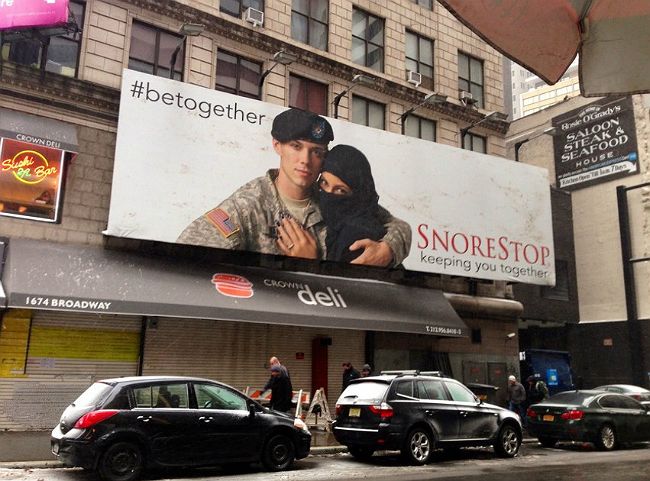
Broadway Burqa


Billboard at 52nd Street and Broadway in New York City

I usually like Megyn Kelly, who has a program called The Kelly File over at Fox News. I think she is very smart, and often amuses, and surprises, her hosts with her original twists on their commentaries.

In her show a couple of days ago, her lame duck panel all say that the billboard I've posted "doesn't offend" them. One tries to fine-tune it saying that he doesn't have a problem with an American soldier marrying a Muslim woman, but that this full-gear Islamic garb is what bothers him. I.e. the "moderate vs. extremist" debate which should have long been resolved by now.

Kelly tries to bring in the "radicalized," i.e. "extremist" argument in, but she doesn't go far enough. She could have interrupted one of the speakers to make her point, but she didn't, and I can only conclude that she mostly agrees with them.

Muslims themselves have told us in as many words that the Koran is what they follow. A "modern" Muslim woman, wearing the latest from Chanel, will at some point have to confront the Koran. And this usually happens with her children. Whether they grow up in Iran or Canada, these offspring at some point have to accept or reject (there is no middle ground) Islam, even as their mothers disguise their true feelings with Western fashion.

In my mall in Mississauga (Ontario), I see more and more young women, in their early twenties, walking around in groups wearing the head-covering (for now). They try to "modernize" it - accessorize would be a better word - with make up and tight jeans, but they are only one garment away from the full-body garb that Kelly's panel seems to abhor.

Of course, the panelists point is that they don't want to be "racist." But their "tolerance" is only inviting intolerance. Muslims have no choice but to be Muslims. Their Koran mandates it.

Some notes:
- The billboard was rejected initially by the advertising company.
- The couple on the billboard is a "real life" American soldier and his Muslim wife. The wife apparently wore the full Muslim clothing for the advertisement. But this proves my point that under every "modern, Western" Muslim woman is a Koran-following Muslim woman.

Below is the panel on the billboard, at The Kelly File:

-------------------------------------------------------------------------------------------------------------------------------------------------------------
Posted By: Kidist P. Asrat
-------------------------------------------------------------------------------------------------------------------------------------------------------------

Tuesday, January 28, 2014

Charley Harper's Menagerie

Western Tanager
Bright as a circus poster on a weatherbeaten barn, the Western Tanager looks like a highly embarrassed goldfinch. No tree-top Caruso, he sings for his own enjoyment, telling of far-flung solitudes and the carefree existence, while his wife does the chores. When he visits your fruit orchard, remember that he eats mostly insects, ornaments Christmas trees in July, commemorates in color the autumn leaf, and is what you can say something is not as yellow as.
[From Charley Harper Prints page: Captions and Puns]
Charley Harper, often dismissed as an "illustrator," is a proficient artist. Wikipedia describes his as an "American Modernist artist."

Harper refines this "modernist" label as "minimal realism" as:
When I look at a wildlife or nature subject, I don’t see the feathers in the wings, I just count the wings. I see exciting shapes, color combinations, patterns, textures, fascinating behavior and endless possibilities for making interesting pictures. I regard the picture as an ecosystem in which all the elements are interrelated, interdependent, perfectly balanced, without trimming or unutilized parts; and herein lies the lure of painting; in a world of chaos, the picture is one small rectangle in which the artist can create an ordered universe.
His "modernist" description is too vague, and what Harper was attempting was not "modernism" but a picture "without trimming or unutilized parts" where "the picture is one small rectangle in which the artist can create an ordered universe."

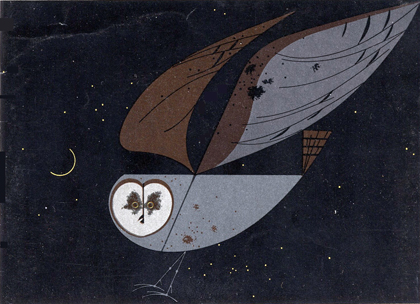
His whimsical world captures, despite his best intentions I'm sure, some of that movement (chaos, as he calls it) of life, and especially the life of birds. We can see, and feel, his barn owl in flight, startled by something (Harper?) and ready to pounce on the small animal (a barn mouse?) that would feed him and his family. Or the barn swallow, preening and mocking (the barn owl?) in its gloriously red plumage, ignoring the poor, industrious insect above it for a later rendezvous for a meal. Or a blue jay furiously bathing in a calm stream with unperturbed fish which are more cautious of bathing hawks or eagles than neurotic blue birds. Harper's pictures are delightfully detailed, despite their apparent simplicity. And he is as fascinated with the mundane robin as with the exotic anhinga.


The Western Tanager (Piranga ludoviciana) is:
...a medium-sized American songbird. Formerly placed in the tanager family (Thraupidae), it and other members of its genus are now classified in the cardinal family (Cardinalidae).[2] The species's plumage and vocalizations are similar to other members of the cardinal family.

Adults have pale stout pointed bills, yellow underparts and light wing bars. Adult males have a bright red face and a yellow nape, shoulder, and rump, with black upper back, wings, and tail; in non-breeding plumage the head has no more than a reddish cast and the body has an olive tinge. Females have a yellow head and are olive on the back, with dark wings and tail.

The song of disconnected short phrases suggests an American Robin's but is hoarser and rather monotonous. The call is described as "pit-er-ick". [Source: Wikipedia]


Video of song of the Western Tanager
-------------------------------------------------------------------------------------------------------------------------------------------------------------
Posted By: Kidist P. Asrat
-------------------------------------------------------------------------------------------------------------------------------------------------------------

Thursday, January 23, 2014

Well-Perfumed


Bon Chic Bottle. The Max Azria signiature logo is the two Bs in mirror image.
The bottle's lid is designed with the logo in mind, but looking like the open petals of a flower
.

Bon Chic Bon Genre, or BCBG (Bé Cé Bé Gé) is a French term for "preppy." But it doesn't have the sophomoric, college student, connotations behind its name. It really just means well styled, and well mannered.

The fashion designer Max Azria, of BCBG Max Azria, has been releasing a series of BCBG perfumes, created by perfumer Stephen Nilsen. The first of the BCBGs was called BCBG (initials only), and came in a pretty pink bottle with a rose-like lid. He then broke down the BCBG, and released a yellow-bottled Bon Chic in 2012, and a purple Bon Genre in 2013.

I've tried all three (through the generous "sample" bottles provided at Sephora), and I find Bon Chic the most successful (although all three are good).

Here are the notes for Bon Chic:
Top: Mango, Pear, Rasberry
Middle: Violet, Pink Peony, Orange Blossom
Base: Vanilla, Musk
A tiny Eau de Parfum bottle (0.25 fl. oz) is $20. The Sephora shop assistant told me that this was as long as quantities last. These small bottles were initially designed as promotional bottles at department stores during the holidays.

There is nothing overwhelming about this perfume. I think putting in the delicate raspberry scent, rather than the stronger strawberry, was a clever move by the designer to maintain the lightness of the scent.

I don't smell any strong "woodsy" scent either, although I think it is masked by the vanilla and the musk, which I think give a warm and unobtrusive dry down. The top "fruity" scents are take over by the floral middle notes. This gives the perfume an initial burst of cheery fruits, which then give way to the sweet and floral middle notes supported by the delicate base notes.

All the perfume sites I found gave copied and pasted versions of some original (and I'm not sure where its origins are). But here is one cheerful reviewer who writes:
This is feminine and summery -in a really good way! I was pleasantly surprised by the complex sweetness of this. My first thoughts on this were apple and mimosa with a touch of powder. Then there's a smokey quality to this perfume that balances the sweetness ( I'm not the best at detecting notes.. albeit this is my humble description :). It is sweet but not unsophisticated.

The dry down is very pleasant, soft, and sensual. Unfortunately, it doesn't stick around for a very long time :(. Maybe several hours, which isn't terrible, but at the end of the day it's barely there. But, all in all I was very pleased with this scent and I think it's the best of the BCBG Fragrances. Would repurchase!
I don't agree with her about the short scent span of the perfume.I sprayed mine on a scarf to test its longevity, and I still detect a light, sweet, floral scent even after about a week.
-------------------------------------------------------------------------------------------------------------------------------------------------------------
Posted By: Kidist P. Asrat
-------------------------------------------------------------------------------------------------------------------------------------------------------------

Fighting for My Perfume and Coffee in Multi-Culti Canada


Indian wedding in Toronto

I went to the Max Azria store in the mall here in Mississauga, and found a bottle of Bon Chic. I asked the shop assistant what were its notes. This Indian shop assistant clearly didn't know, but stalled for time waiting for another assistant to finish with a customer. While waiting, I asked her about the bottle sizes, since there was a tiny one in a gift package. Again, she didn't know.

So I just took matters in my own hands, and took out the small bottle to see the contents underneath. No information there. So I turned the box upside down, and found what I needed. The bottle was the same size as the bottle on sale at Sephora.

I put the small bottle on the stand, not bothering to replace it in the box, and left the store.

The Mississauga Mall, that is being renovated with a plethora of high-end stores, is filled with such Indian and Chinese shop assistants, who have very little idea about the fashion, perfume and style the stores are selling. I think they are hired to "represent" the large influx of Chinese and Indians in the city, in the past couple of decades. Now, rather than being "new" immigrants, they are merely immigrants. They have infiltrated many institutions in the city, including important, governmental ones, and these leaders have much say about how their "people" are represented in the city.

I do see a large number of Indians and Chinese walking the mall's hallways. But, I don't think they are the real shoppers. From the various news and magazine articles I could find on the mall, many of the patrons are from nearby towns, of mostly wealthy white residents. The mall was refurbished and renovated to attract such high-end clientele.

The only reason I talked to this BCBG representative was because she was standing so close to the merchandise, I thought she might have found a way to give me the information I wanted. Usually, I bypass these multi-culti attendants, or I look for a white attendant. If the white attendant doesn't have all the information, she usually has something useful to say.

Non-whites in Canada are changing the culture if only by not preserving it (destroying it and replacing it with their own cultures is a well-documented phenomenon).

A non-white shop assistant who has no clue about BCBG, and doesn't understand the volume measurements of a perfume bottle, and cannot tell the difference between Eau de Parfum and Eau de Toilette, simply has a slot that has opened up for her, and her group, to press in further and replace our culture with her own culture and cultural items.

This new wave of immigrants looks like it's well-integrated, without any accent, and with all the superficial adaptations, but the serious things like their ancestral culture are never forgotten. Chinese look like they've adapted well, with the women easily marrying white men. But, the home life of these white-men-marrying Chinese women will always be infused with their cultural background.

And now coffee.

I like Starbucks coffee, and will find it where ever I am, rather than buy something else. Right beside the bus depot (which takes me periodically to Toronto) is a small Starbucks. I went early one morning and asked for Pike. The coffee machines (both!) were empty, and I said I would wait (two seconds, as the sales girl told me). I waited for abut five minutes, which was fine. When the coffee was ready, it was so weak, I would have been better off going to some fast-food chain to get a cup. The "coffee maker" was an Indian women with a strong accent. She couldn't even make a Starbucks coffee (measure the water? what a concept!). I was going to get the manager to deal with this, but I had no time. I took a mental note of the woman, to report her later on.

These non-white immigrants, (first, second and even third, so clearly all generations of these immigrants) have come to an established, cultivated, civilized place, with an enviable culture. A good cup of coffee is easy to find, and beautiful perfumes are being continuously created. They showed up to take advantage of all this, but at the same time instilling their past (and abandoned) culture into the mix. Theirs is winning. And we are suffering because of that. How long before they destroy everything and we are left with replicas of the places they left behind?

It may be too late, but I will fight for my perfumes and my coffee.
------------------------------------------------------------------------------------------------------------------------------------------------------------
Posted By: Kidist P. Asrat
------------------------------------------------------------------------------------------------------------------------------------------------------------