Wednesday, February 20, 2013

Sarcophagi in the Cloisters

From Lawrence Auster's View From the Right: "What happens to us after we die?"
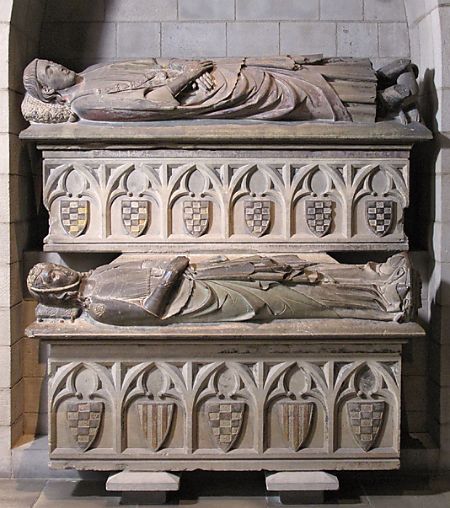
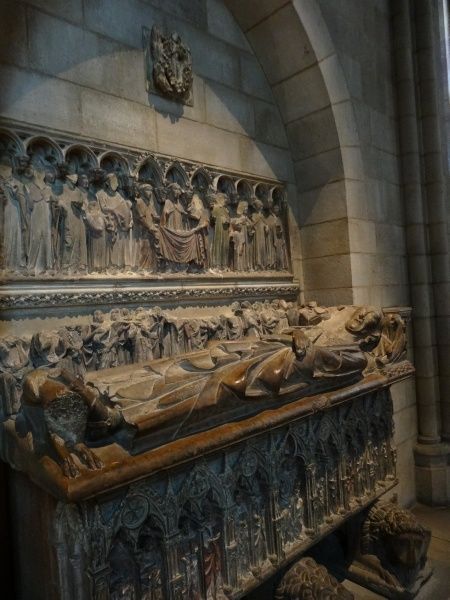
The truest Christian picture of the afterlife that I have seen are the sleeping statues of the dead on the sarcophagi from twelfth century France in the crypt in the Cloisters in New York City. These men and women are depicted not as dead, but as asleep, with an expression of joyous anticipation on their faces as they await their resurrection. They were devout followers of Christ in life, and they are sure of their reward. Are these statues literally true? No. But they are an expression of the truth, a truth we cannot know directly.
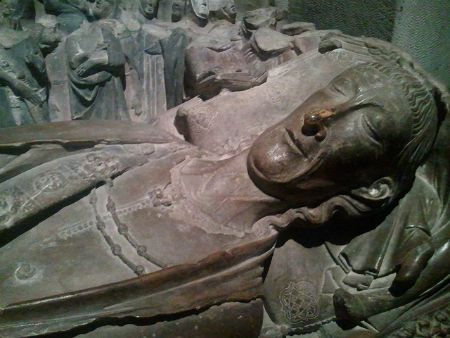
I have seen those sleeping statues at the Cloisters. One thing that struck me about the faces depicted on some of them was their youthfulness (combined with the peaceful and joyous expressions), despite the older age of the deceased. Perhaps we do go into the afterlife as youthful, joyous and peaceful.


Sarcophagus of Armengol VII, Count of Urgell (d. 1038)


Close-up of Sarcophagus of Armengol VII, Count of Urgell


Double Tomb of Alvaro I, Count of Urgell (d. 1038)
and His Wife Cecilia of Foix

Here's what Metropolitan Museum of Art says about Alvaro I:
Documentary evidence suggests that this tomb ensemble was made for Àlvar Rodrigo de Cabrera and his wife, Cecília of Foix, the parents of Ermengol X. The monastery of Bellpuig de les Avellanes was abandoned and badly damaged during the Wars of Succession that began around 1700. When the monastery was reinhabited in the 18th century, the church with its burial chapel was reconstructed. The sarcophagi with the arms of the counts of Urgell and Foix were probably made at that time to fit the original effigies.

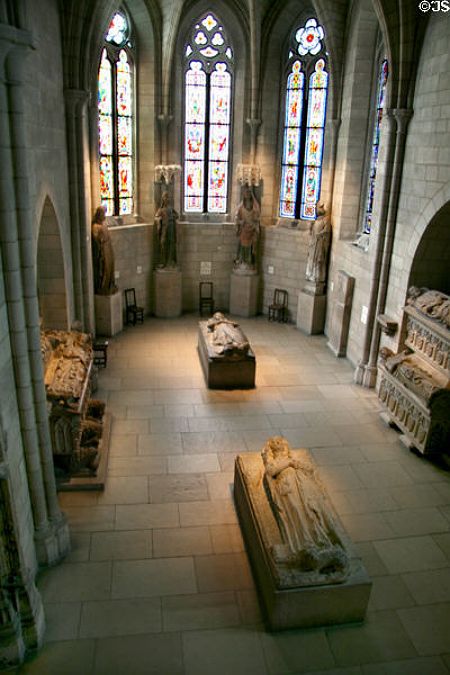
Sacrophagi Exhibition Hall

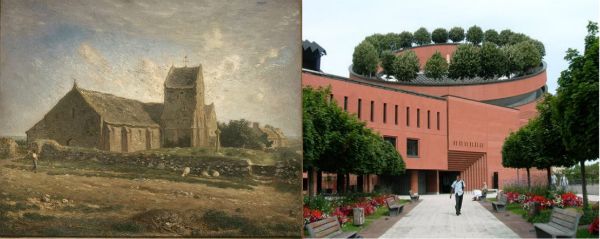
Learning to distinguish the good from the mediocre


Left:
The Church at Greville
Jean-François Millet
Between 1871 et 1874
Oil on Canvas
28.7 x 23.6 inches
Musee d'Orsay, Paris, France

Right: Évry Cathedral
[more views of the building at linked site]

-----------------------------------------------------------------------------------------------------------------------------------------------------

The Evry Cathedrale was begun in 1992 and completed in 1995. It was controversial from the start because government funds were used to partially finance the project. The same controversy goes on today over mosques.

It is difficult to know how to have good taste, but some are born with it while others learn by doing, by trial and error and by comparing two things, say two rooms, one mediocre and one with successful decor. I think showing comparisons is very important. Compare Rita Hayworth and Jennifer Lopez, for example. The fabulous Rita, a great dancer, who held her own with Fred Astaire. And the teen-idol Jennifer, whom I would never recognize in the street, because there is so little that is noteworthy. I know we are hard on the young girls today, but unfortunately, they deserve it.

And look at the new Catholic churches built in France - they look more like Soviet prisons, compared to a charming old church somewhere in the countryside.
-----------------------------------------------------------------------------------------------------------------------------------------------------
By: Judith Hakimian

Tuesday, February 19, 2013

Mozart Piano Sonata in A Major, K331. Andante Grazioso


Pianist: Jeno Jando
-----------------------------------------------------------------------------------------------------------------------------------------------------
Posted By: Kidist P. Asrat

The Tyranny of Artistic Modernism


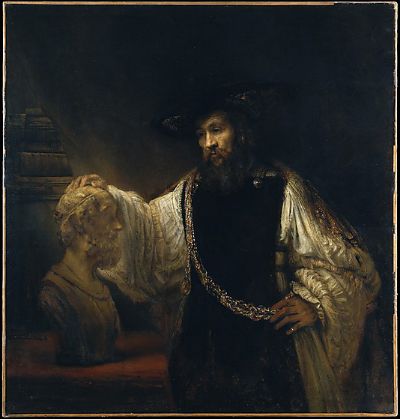
Aristotle with a Bust of Homer
Rembrandt van Rijn, Dutch, 1606–1669
1653
Oil on canvas
56 1/2 x 53 3/4 in

Metropolitan Museum of Art

-----------------------------------------------------------------------------------------------------------------------------------------------------

The Tyranny of Artistic Modernism
Mark Anthony Signorelli and Nikos A. Salingaros
New English Review, August 2012

[Note: I went to Mark Anthony Signorelli's website and found this as his main page. This is the same image I used at a post on aesthetics. I've re-posted the image above].

We who live in the Western world at the present time continue to suffer under the reign of a great tyranny — the tyranny of artistic modernism. The modernist aesthetic, which dominates our age, takes a variety of forms in the respective arts — in architecture, a lack of scale and ornamentation combined with the overwhelming deployment of materials like glass, steel, and brutalist concrete; in the plastic arts, a rejection of natural forms mixed with an unmistakable tendency towards the repulsive or meretricious; in literature, non-linear narrative, esoteric imagery, and an almost perfect lack of poetic form and diction. Yet common now to the practice of all these arts are certain primal impulses which may be said to form the core of the modernist aesthetic — a hostility and defiance towards all traditional standards of excellence, discovered over millennia of craftsmanship and reflection; a notion of the artist’s freedom as absolute, and entirely divorced from the ends of his art; and, as Roger Scruton has so clearly demonstrated, a refusal to apply the category of beauty to either the creation or the estimation of artwork. Standing behind this aesthetic is an ideology supported by nearly the entire institutional structure of the Western world — the universities, the publishing houses, the galleries, the journals, the prize committees, the zoning boards. Books that evince a fidelity to modernist principles are the ones that get published. Buildings that conform to the brutal codes of modernism and its derivatives are the ones that get built. Whatever creative efforts spring from other sources of inspiration other than modernist aggression are invariably ignored and dismissed as something antiquated or reactionary. This is the great totalitarian system of our times — the dictatorship of modernism.

Of course, the reign of modernism has been with us for over a century, and its domination has developed over a long period of time. At this point, it has been around long enough to propagate its own rules and standards as it institutionalized its strategy for survival and dominance. It has been around long enough to establish its own canon of “classics.” In short, it has by now developed into its own distinct tradition. Because contemporary artistic production — whether in the field of literature, architecture, music, or the plastic arts — is so obviously inferior to what has been produced before, proponents of modernism generally aver that modernism per se belongs to the early part of the twentieth century, that the creative world has since moved beyond modernism into a “post-modernist” phase, then beyond even that, and thus any criticism of contemporary art is irrelevant to the period of “high modernism.” But this clever strategy pretends to miss the fact that the vast majority of developments since modernism retain its essential negation of complex order. Any evolution of types and forms that has occurred since the period of “high modernism” have applied merely on a superficial level, but the essential ideological core of artistic practice remains the same. The modernists’ tradition of negation still rules over us.

In one respect, this seems like a remarkable development, since arguably the dominant impetus behind the advent of modernism was the rejection of tradition. Whether heard in Ezra Pound’s admonition to “make it new,” or the credo of the Bauhaus to “start from zero,” the desire to break free from what the modernists regarded as the confining strictures of the West’s artistic legacy was obviously an overriding goal and motive of the movement. In a manner too obviously analogous to the totalitarian political regimes of the twentieth century, the modernists endeavored to create an art that would be entirely free of any indebtedness to the past, best captured in the noxious appeal of Alfred Jarry to “destroy the ruins.” That such a virulently “anti-traditional” movement has coagulated into its own tradition must appear paradoxical.

In fact, though, the transformation of modernism into its own discrete tradition can hardly be surprising to anyone who has reflected upon the nature of artistic production. Practical rationality dictates that all artistic creation is law-like, entailing as it does the selection of certain means to achieve certain ends. Artistic traditions emerge over time when any number of artists, under common influences, employ generally similar means to achieve generally shared ends, and thus, consciously or unconsciously, create their artifacts according to the same laws. It is thus impossible for the work of any like-minded artists, working in sympathy with one another, not to develop into a tradition, marked by allegiance to its own laws. If the rules inherent in one tradition are abandoned or proscribed, another set of rules will replace it. Thus we find that the modernists, in breaking all the rules of harmonious composition, in turn generated a set of rigid rules that are simply the opposite of the rules they replaced, rules that guarantee that complex coherence is permanently denied. They began as wild revolutionists, and have ended in our own time as the most stolid conventionalists, and only someone entirely ignorant of art and human nature would have guessed things would turn out any differently.

We see, for example, that contemporary prize-winning architects slavishly copy the same industrial aesthetic originally approved by the Bauhaus, whose members were working for the German industry to sell the industrial products of that time: steel, plate glass, and concrete. Those buildings perform terribly in all climates and are dysfunctional for most human activities inside and in their immediate external vicinity, yet so-called “starchitects” continue to emulate the rules embodied in those failed examples. Alleged artists like Damien Hirst and Cindy Sherman still recycle basically the same pranks first played on the public by Marcel Duchamp and the Dadaists almost a century ago. Poets like Geoffrey Hill and John Ashberry continue to cultivate the same arcane diction, comprised of disjointed syntax and esoteric reference, which was employed by purported “high modernists” like Pound and Wallace Stevens. In every case, whether they acknowledge it or not — whether they realize it or not — the most notable creators in our times repeatedly display their fidelity to the rules imposed by modernist ideology.

As soon as we inquire into the nature of these rules, we discover that they are opposed in almost every way to the principles of artistic creation prevailing in the world prior to the end of the nineteenth century. Of course, no one would suggest that prior to the era of modernism, artists all adhered to one monolithic tradition, or that there are not important and irreconcilable differences between, say, the tradition of Gothic cathedral architecture and the tradition of Islamic sacred architecture, or between the neo-classicism of a Pope and the Romanticism of a Wordsworth. Nonetheless, one can identify certain very deep underlying similarities among these traditions, which are not common to modernism — which in fact are antithetical to modernism — and thus we may correctly distinguish between pre-modern traditions and the modernist tradition. Whereas earlier traditions of artistic creation embraced symmetry within complexity, modernism has embraced extreme simplicity, dislocation, and imbalance. Whereas earlier traditions sought to bring pleasure to an audience — “to teach and delight,” as Horace’s famous dictum would have it — modern art attempts to “nauseate” or “brutalize” an audience (the terms are from Jacques Barzun’s The Use and Abuse of Art). Whereas pre-modern architecture employed scale and ornament, modern architecture aggressively promotes gigantisms and barrenness. Whereas classical literature was grounded in regular grammar and public imagery, modern literature routinely resorts to distortions of syntax and esotericism.

The tradition of modernism is thus at enmity with the classical and vernacular traditions of art-making at the most fundamental level. And those evolved from the human effort to grasp and engage with the natural environment. Any artist who believes his work can display loyalty to both traditions is fooling himself. Any playwright who believes he can write on the principles implicit in the work of both Sophocles and Beckett, any architect convinced he can design according to the principles underlying the work of both Palladio and Le Corbusier, is in the grips of a delusion, because the work of the latter artists came into the world to be a rejection and negation of the work of the former. An artist must settle a thousand stylistic questions in the course of his labor, but to any artist working in our times, the first and most pregnant question which must be answered before a line can be written or a stone can be laid is this: will I respect and celebrate the life-affirming aspects of human nature (as traditional artists do), or will I reject and condemn human nature, and celebrate its most destructive traits (as modernists and their derivatives do)?

How an artist chooses to answer this question will depend crucially on what sort of conception he entertains of how human beings are connected to life and the cosmos. Artistic styles, and the traditions which perpetuate them, do not emerge from an abyss, but rather grow out of the deep philosophical convictions of their practitioners. There is such a thing as consistency between one’s beliefs and one’s artistic techniques. The artist in our time will therefore need to ask himself what understanding of humankind manifests itself in the parallel strands of classical and vernacular traditions, versus what understanding of humankind manifests itself in the modernist tradition, and which of these understandings best matches his own. He will discover that the prevalence of complex forms among pre-modern artworks bespeaks a conception of liberty bound to a conception of essence — a deep, even unconscious, belief that the limits and strictures of artistic form do not constitute a deprivation of the artist’s freedom, but rather the preconditions for any creative activity at all. Traditional societies produced artifacts and shaped their environment in a way to give maximal sensory and emotional pleasure within the constraints of materials and utility. This action was therapeutic, a means of emotional nourishment akin to and just as necessary as physical nourishment. The order and proportion inhering in these forms demonstrates their creators’ conviction that their work was to be presented to rational creatures, to creatures capable of recognizing order, and moreover, irresistibly attracted to order, according to the ineffable but universal phenomenon of beauty. The constant pursuit of beauty in classical art evinces the similarly profound conviction that the human soul is a thing capable of edification, of being drawn more constantly and more thoroughly towards harmony, and that the making of art is unrivaled in its capacity to further such edification.

To the contrary, modern art betrays a pursuit not of harmony, but of domination — domination of nature, of language, of one’s fellow man. The level of stylistic violence implicit in modernist architecture is extraordinary: overhangs without obvious supports, leaning buildings, extremely sharp edges sticking out to threaten us, glass floors over heights leading to vertigo, tilted interior walls also leading to vertigo and nausea. Look at the horizontal windows of modernist buildings that violate the vertical axis defined by gravity, or the “brutalist” exposed concrete in dangerously rough surfaces — a violence against the tactile environment, often falsely excused as being “honest” rather than a sadistic architectural expression. The “milder” forms of this violence are represented in minimalist environments devoid of all signs of life: totally blank walls, windowless façades, curtain glass walls, buildings as cubes of glass, buildings as cubes of smooth concrete, etc. Indeed, the subtlety that earlier attempted to camouflage this intrinsic violence has finally been abandoned, and buildings are now built as if blown apart, dismembered, and their forms melted. Consider also the jarring disjunctions of meaning and sense in modernist poetic lines like Hart Crane’s “Again the traffic lights that skim thy swift / Unfractioned idiom, immaculate sigh of stars, / Beading thy path--condense eternity” or Geoffrey Hill’s “Vehemencies minus the ripe arraignment / Clapper this art taken to heart the fiction / What are those harsh cryings astrew the marshes / Weep not to hear them.” Such passages constitute an assault on the normal conventions of linguistic usage and discursive thought, which is why Jacques Maritain claimed that the poetry of his age “endeavors to get free from the intelligible or logical sense itself,” that it represented “a process of liberation from conceptual, logical, discursive reason.” Or consider the deformations of the human form in painters from Picasso onwards, or worse, the displays of body parts with or without fresh blood, excrement, anything that is disgusting and revolting to our physiological systems, all of which, as Ortega y Gasset claimed, “betray a real loathing of living forms or forms of living beings.” Through this stylistic violence, modernism pursues not an edification of man’s rational nature, but rather an exaltation of his unqualified will. And behind it all is nothing but despair, betrayed by the total absence of beauty, which signifies these artists’ complete inability to imagine any reality transcending the calamitous ugliness of the modern world.

We can see then that modern art embodies and manifests all the worst features of modern thought — the despair, the irrationality, the hostility to tradition, the confusion of scientia with techne, or wisdom with power, the misunderstanding of freedom as liberation from essence rather than perfection of essence. In short, artistic modernism is the nihilism of our epoch made incarnate. The modern world did give us a vastly improved understanding of our environment coupled with enormous power over it. We became drunk with that power and abused it abominably, yet modern science increasingly reveals the superiority of evolved solutions for furthering human civilization in a healthy and sustainable manner, compared to arbitrary artistic whims. We have equated this power with the modernist agenda, and, terrified of losing our dominance over nature, continue to subjugate creative endeavor to ideology.

Because the practices of modern art emerge from this false conception of human nature, its productions are typically repellent to human nature. The ordinary response to modern art is not attraction, but nausea or revulsion. This is why the vast institutional structure supporting modernism is necessary, to forcefully maintain the perpetuation of forms of art which, if left to the tastes of people in general, would die off in a day. Only the absolute dominance of the institutions could ever convince the population that a lopsided building or paint splattered across a canvas should qualify as a masterpiece. The public is normally revolted by such artistic violence, which is why its propagandists call out constantly and hysterically for more “education,” by which they mean brainwashing, intended to bully ordinary people into accepting these perversions. Indeed, the modernists’ almost complete take-over of the schools has been the single most important factor in the triumph of their style; witness the architecture schools, where only a handful of programs in the entire world dare to teach design on traditional principles. Modernism’s project of domination, control, and destruction has naturally attracted persons who crave power, and who master all the techniques for achieving power and dominance over others. It should be no wonder, therefore, that a dominant elite producing and promoting an art of hatred controls the market today. A “new normal” has been imposed, according to which the most unnatural — or rather, anti-natural — of styles has been exalted. What is worse, the classical styles have been represented as aberrant; the pursuit of beauty or harmony has become the gravest crime an artist could commit. Poets who attempt to write in structured form are attacked as “fascists.” Architects who employ the design vocabulary of pre-modern traditions are dismissed as “reactionaries.” The propaganda machine of modernism has been so successful that we now witness the complete inversion of artistic standards.

And what now drives the construction of such anti-art and anti-architecture more than anything else is simply the lust for financial gain. Success in the corporate commercial sector has come to depend upon the ability to find ever more shocking expressions. Contemporary art is no longer about art, and has not been for decades. Instead, we have a vast corporate media machine that produces “objects,” often repulsive ones, as play-pieces in a financial game of manipulative speculation. The commercial value of these objects is artificially inflated via cycles of promotion and sales, and then the end-owner enjoys a tax write off by donating the object to a museum. The paid mercenaries who play this sordid game are then pushed upon the public as great figures, worthy of our admiration and emulation. This is how the farce of modernism ends, with the anti-bourgeois rebel revealed to be a money-grubbing little fraud. As with all unscrupulous money-making schemes, the people who engage profitably from selling such art and design to the public are habitual practitioners of deception: the global advertising industry is a vast and willing participant in this game. And throughout the corporate and academic structures supporting this system, otherwise decent people lead a life of continual lying, in order to achieve a level of economic comfort. Conservatives who continue to lament the decline of our cultural standards in one breath while expressing unqualified loyalty to the “free-market” in the next ought to give serious consideration to how much of the decadent cultural detritus surrounding us has been ushered into the world out of the profit-motive.

When the authentic nature of artistic modernism is thus laid bare, we have no doubt that young artists of good intentions will readily reject it in favor of the natural and timeless traditions of artistic creation. Not that we ought to return to the past, but to use the accumulated wisdom of discovered knowledge to finally move forward. The stakes could not be higher. This is not about aesthetics but civilization itself. We are watching the increasingly rapid dissolution of civil society on all sides of us — the failure of our schools, a breakdown of the family, the degradation of language, the abandonment of polite manners, the rape of the environment, and the replacement of a stable economy with a torrent of dangerous speculation. We do not give sufficient consideration to how far the depravity of contemporary art may be implicated in this catastrophic decline. Nothing is so important to the spiritual and mental flourishing of a people as its art. The stories they tell, the buildings they inhabit, the public spaces in which they gather, the songs they sing, the fashioned images they gaze upon — these things shape their souls more permanently and effectively than anything else. We live in a time when the art all around us accustoms men to, and insinuates into their souls, the most erroneous and degrading ideas imaginable about themselves and their world. A humane society can hardly be expected to grow out of such an adverse cultural environment.

The prerequisite, then, for restoring sanity to our civilization is an unqualified rejection of artistic modernism. Consequently, the first duty for every true artist at this moment of history is an act of spiritual fidelity to the timeless traditions of art-making, and an uncompromising, unmitigated hatred towards the dictatorship of modernism. Every true artist should come to his work now with something of the spirit of a liberator fighting an entrenched tyranny. Just as important for the long term is that people now intimidated by the regime’s hegemony do their part through passive resistance, a Gandhian refusal to participate in and be manipulated by the corrupt system, and a willingness to mistrust “experts” who have for years promoted creations that disdain life and human sensibilities. Every true artist will have engraved in his heart and mind the powerful words of Schiller, “But how is the artist to protect himself against the corruption of the age that besets him on all sides? By disdaining its opinion.” Buoyed by this disdain for the professors and the critics, the “starchitects” and the laureates, who have done so much to wreck the various arts which they pretend to practice and promote, the true artist will turn his gaze away from the disastrous wasteland those individuals have wrought, and return again to the permanent sources of all genuine inspiration — the beauty pulsating throughout the natural world, the capacity for excellence inhering in the human soul, the faint and sporadic glimpses we have of a purposefulness behind the observable chaos of life. From such springs the great traditions of artistic creation were once nourished; from such springs alone will a renovated culture emerge once more in our times.

-----------------------------------------------------------------------------------------------------------------------------------------------------
Posted By: Kidist P. Asrat
Beauty Will Save the World


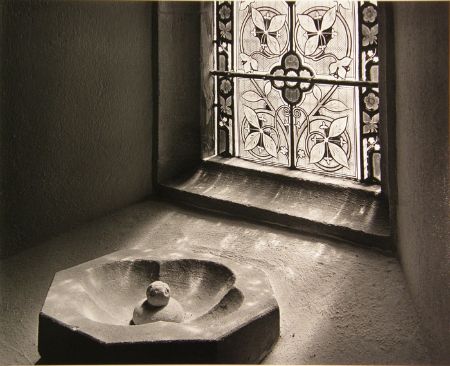
Howard Bond (b. 1931)
Window, Pylle, England, 1982
Black and white photograph (gelatin silver)
Brauer Museum of Art


I was just reading Solzhenitsyn, from a little volume of collected essays Larry [Auster] had given me, and in his address to the Nobel Committee on receiving their prize he said this about beauty:
Dostoevsky once let drop an enigmatic remark: ‘Beauty will save the world.’ What is this? For a long time it seemed to me simply a phrase. How could this be possible? When in the bloodthirsty process of history did beauty ever save anyone, and from what? Granted, it ennobled, it elevated—but whom did it ever save?

There is, however, a particular feature in the very essence of beauty—a characteristic trait of art itself: the persuasiveness of a true work of art is completely irrefutable; it prevails even over a resisting heart*. A political speech, an aggressive piece of journalism, a program for the organization of society, a philosophical system, can all be constructed—with apparent smoothness and harmony—on an error or a lie […] But a true work of art carries its verification within itself […] works which have drawn on the truth and which have presented it to us in concentrated and vibrant form seize us, attract us to themselves powerfully, and no one ever—even centuries later—will step forth to deny them.
So perhaps the old trinity of Truth, Goodness, and Beauty is not simply the decorous and antiquated formula it seemed to us at the time of our self-confident materialistic youth. It the tops of these three trees do converge, as thinkers used to claim, and if the all too obvious and the overly straight sprouts of truth and goodness have been crushed, cut down, or not permitted to grow, then perhaps the whimsical, unpredictable, and ever surprising shoots of Beauty will force their way through and soar up to that very spot, thereby fulfilling the task of all three.
(*Larry marked this passage in the book)

In searching the web for Solzhenitsyn's quote (so I didn't have to type it from my paperback) I found it, and some additional commentary on the topic that you may find of interest:

- Christien Chany. Beauty and Truth, The Cresset: A Review of Literature, the Arts and Public Affairs. Easter 2009 (Vol LXXIII, No. 4 pp 16 - 20)
- Margaret Perry. Can Beauty Save the World?, Ten Thousand Places January 24, 2008
- Santiago Ramos. Why Kim Jong-Il Should Fear Antonín Dvořák December 27, 2007

-----------------------------------------------------------------------------------------------------------------------------------------------------
By: Dean Ericson

Monday, February 18, 2013

The President and The First Lady as Epicureans


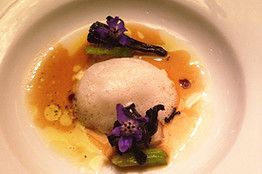
Smoked oyster in a glass dome
filled with apple wood smoke
From Chef Jose Andres' Washington D.C.
Restaurant Minibar


There a post at Diana West's site, where she reproduced a full article from Barron's Penta Daily, which describes the restaurant where the Obamas dined for Valentine's Day.

She prefaces it with an image of a "dragon's breath" and writes:
Minibar's "dragon's breath" course is a curried popcon ball dunked in liquid nitrogen.

Did the president eat it in one bite, as staff suggests, so vapor would stream from his nose?
What does this have to do with reclaiming beauty?

Well, it goes with the theme of reclaiming beauty. I will post this under the topic "Gastronomy." Food can be an art. Chef's are culled from prestigious restaurants to create meals that are visually and aesthetically superior for those who can afford it who hopefully are also those who can appreciate them.

I cannot imagine Michelle Obama as an epicurean. What would she do with "a smoked oyster...in a glass dome filled with apple wood smoke?" Obama, perhaps, would be more appreciative. But his leftist, black "inner voice" would prevent him from taking it all in neutrally, and it would probably be grading, comparing, and finally rejecting this as "one of those white people things" even as he eats it. He would be destroying even as he, in elitist fashion, understands its superior culinary qualities.

And of course, Michelle will give him the much required backing - for the destruction part, and by bringing him "back to black reality."


Below is the article from West's site:
In case anyone is wondering what the Obamas' Valentine's Day dinner out at Minibar was like, here is a recent Barron's review of dinner for two, which came to $958.

From Barron's Penta Daily: Insights and advice for families with assets of $5 million or more [no wonder I never read it before]:
"A Bargain Dinner at $500 a Head"

At 6 p.m. on a rainy night this week, my guest and I sat down at the counter of Washington D.C.’s Minibar. Only six privileged guests at a time dine here on a 26-course meal handcrafted by Chef Jose Andres and his young staff.

One of the most acclaimed restaurants in the country, there is no shingle announcing Minibar on the corner of E and 9th streets, just an anonymous frosted-glass door of the type I’ve previously seen at private banks on the Bahnhofstrasse in Zurich. But behind the door stands a hostess with iPad. She took us from the white foyer to an adjacent waiting room, where more smart-looking staff brought us a cocktail, hot towel, and a wooden box filled with seaweed-dusted rice crackers.

We privileged six were ushered behind a diaphanous curtain, to the island counter where two dozen staff members stood waiting to serve us. The minimalist white-walls and chairs, coupled with banks of steel cooking ranges, created an aesthetic I would describe as 1960s Courreges-meets-Japanese-sushi-bar.

I was, quite frankly, unprepared for what followed. A dozen talented chefs ranging in age from 21 to 34, performed for us a culinary ballet, starting with a frozen cocktail made with St. Germain, a liqueur of distilled Alpine elderflower, and served in the form of a snowball. A wine-red pillow the size of a postage stamp was decorated with a dainty white flower; it was filled with peanut butter and jelly.

A pink piggy made of meringue tasted of apple until you bit into the center “sorbet” made of bacon. My favorite of these amusing dishes looked like a macaroon, but exploded bomb-like with buttery goose liver. The chef showed us how a metal ring reaching 248 degrees Fahrenheit created a thin sugar-shell holding together the light and airy foie-gras mousse.

Minibar’s “baby carrots with coconut” is built on a technique famously invented by Chef Ferran Adria of Spain’s now-closed elBulli. Deconstructed carrots are rebuilt so an invisible outer skin, shaped as a carrot, encases an intense liquid essence of the vegetable. Minibar surrounds its “carrots” with dribbles of olive oil, exotic spices, and coconut flakes, creating a rolling wave of salty, soothing, sweet and piquant flavors in the mouth. A chef told us the dish took them 2.5 years to perfect.

While diners can order an expensive bottle of wine to go with their meal, I highly recommend sticking to the beverage packages designed to accompany the weird dishes. My buddy had the $75 “Experience,” twelve glasses that started with an amontillado sherry. I had the $200 “Jose,” which began with a Krug Grande Cuvee Brut Champagne and included, with some big names, a stunning Movia Sauvignon Blanc Primorje from Slovenia.

A smoked oyster arrived in a glass dome filled with apple wood smoke, and sat in an escabeche-style sauce of roast chicken stock and sherry vinegar. Their delicate white beans-and-clams dish from Asturias was tarted-up with slivers of pickled garlic, and was an homage, the lead chef told us, “to our boss.” Meanwhile, the simple “eggs and toast” was made sublime by an “egg white” actually made of Parmesan cheese.

Not every dish was a home run. In one, a morsel of lobster was ringed by yogurt, walling in a pool of chicken wing-and-lobster stock. The sauce didn’t fuse the competing yogurt-and-sea flavors for me. The chef said they had gone through 100 permutations and were still working on the dish.

For sheer fun, nothing beat the “dragon’s breath,” a cube of curried popcorn dipped in liquid nitrogen at the table. A furious stream of smoke roared out of my nostrils, like a dragon, when I bit into it. “Pine snow with honey” was an elegant dish of decorative pine branch and pine nuts, sprinkled with what looked exactly like icy snow, but was in fact a specially treated cheesy-yogurt, dribbled with honey. Two hours later, in yet another bar-type room, we had coffee, cognac, and a host of unique petits fours.

The waitress brought an egg to our table, smashed it with her fist, revealing our bill. The dinner cost $958 for two.

It’s a bargain. There is no way, even at those prices, that Chef Andres is making money on Minibar, considering the labor needed to create and “perform” each dish; only 24 guests, eating in staggered shifts, are picked each night from the 100 to 300 reservation requests that are emailed a month in advance. Minibar is really a “laboratory of ideas,” the creative lifeblood of Jose Andres’ successful group of restaurants and the ideal training ground for young chefs learning their boss’ style and ethos. This is not comfort food, but it is great theater, an evening filled with artistry of the highest order.
-----------------------------------------------------------------------------------------------------------------------------------------------------
By: Kidist P. Asrat
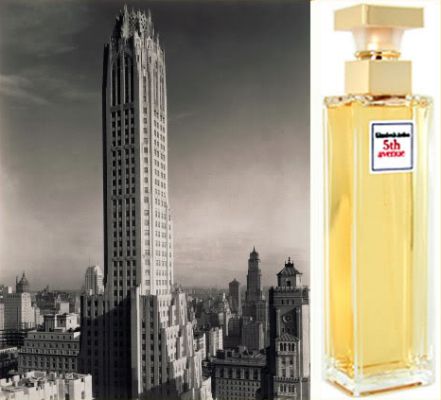
The Structure of a Perfume: 5th Avenue by Elizabeth Arden


5th Avenue's bottle delicately conjures the sleek, elongated structures of New York City's sky scrapers. I tried to find a building that might fit its structure, and while looking at turn-of-the-century photographs of New York by Alfred Stieglitz, I came up with the RCA tower posted above.

Its scent is a whirlwind of florals; eleven according to the perfume website Fragrantica, which are interspersed in all three of its notes. The perfume, like the sky scraper, is an ambitious creation.

5th Avenue is clearly a reference to Chanel No. 5. The symmetrical, unadorned, modernist bottle from Chanel No. 5 has been elongated into the 5th Avenue flask. The bottle stoppers are also very similar. Chanel named her perfume after the laboratory vial labeled No. 5, which contained the scent that she chose for her perfume.


The five in 5th Avenue is also a systematic way of labeling, this time the long streets in New York City. 5th Avenue is where Arden opened her first store. It is also the center of fashion in the fashion center, New York City. It is thus an apt name for a perfume that references a famous fashion predecessor.

Yet despite the restraint in the bottles' adornments, and even names, the scents of both Chanel No. 5 and 5th Avenue are complex and unrestrained. 5th Avenue, on a conservative count, has eleven ingredients. The original No. 5 had 31 .
-----------------------------------------------------------------------------------------------------------------------------------------------------
By: Kidist P. Asrat

Sunday, February 17, 2013

New York City Fire Escapes

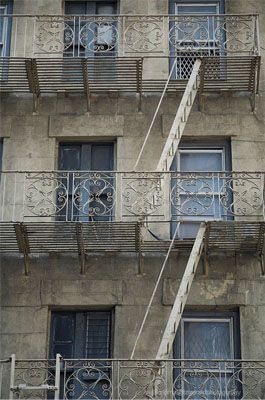
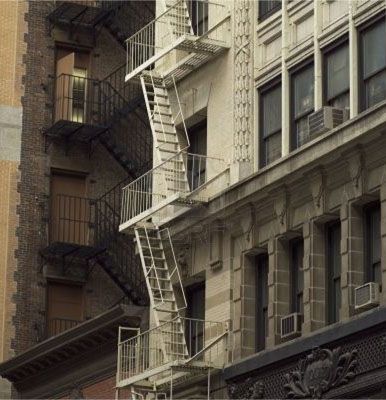
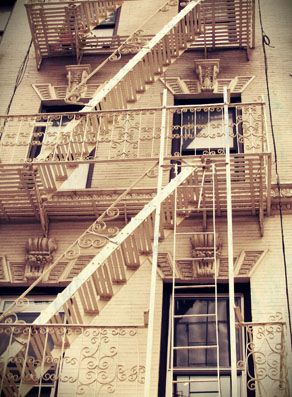
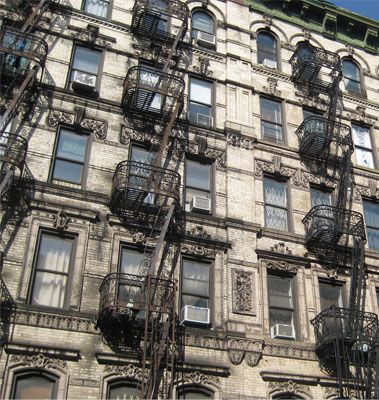
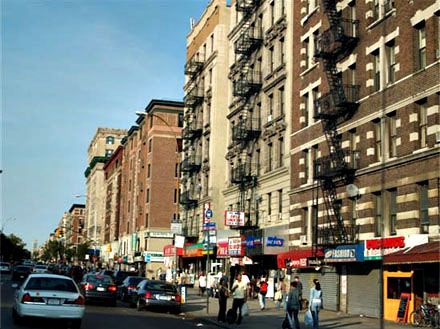
Below, I've collected several examples of fire escapes in upper Manhattan from various sources on the web.


I went to the Cloisters a second time with a friend. It is not enough to go once, and even twice doesn't cut it. The ride up to the Cloisters is an experience in itself. The best way to get there is on the M4 bus, which might crawl along its route, but this gives one ample time to observe the scenery. Several tourist buses were on this route, most likely for a steep price. The M4, for a mere $2.25, goes all the way up Broadway right up to the Cloisters. The most interesting part of the ride up is probably between 155th Street up to around 193rd Street.


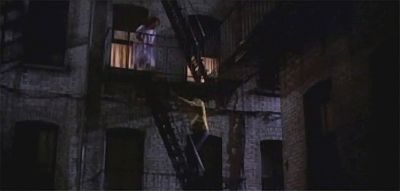
The outdoor fire escape stairs fascinated me. They briefly reminded me of the fire escapes in West Side Story. They are intricate, beautiful wrought iron works, which are works of art.


I have never noticed them, or bothered to look at them, during my previous trips to New York. But, that is the nature of New York. Despite the imposing presence of the skyscrapers, the city's building facades are subtle, and can easily be ignored. "Subtle isn't what one associates with New York," said my New Yorker friend.

I have posted above photos I have culled from around the web buildings with these wrought iron fire escapes. I will write a post on the history of these structures soon.


I don't like to end on a negative note, but the above image shows buildings whose ground level messy bodegas and stores still do not spoil the beautiful architecture and stairways above.
-----------------------------------------------------------------------------------------------------------------------------------------------------
By: Kidist P. Asrat

Cloisters: With Larger Photos


I've re-posted my article on the Cloisters with larger photos.
-----------------------------------------------------------------------------------------------------------------------------------------------------
By: Kidist P. Asrat
The Cloisters, New York


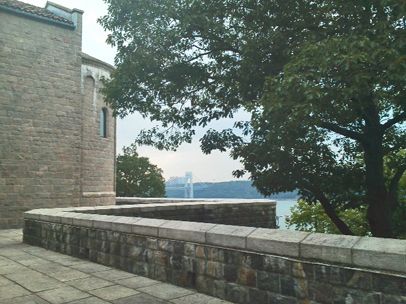
Cloisters Terrace With a View of the George Washington Bridge
[Photo by KPA, August 2012]

Above is a photo I took from Cloisters' terrace with a view of the George Washington Bridge and the Hudson River (it is the background image on my tablet). Across the river is New Jersey, and the undeveloped stretch of land is the New Jersey Palisades. John D. Rockefeller had the Cloisters built especially to house his medieval collection. He also bought several acres of the Palisade hills across the river in order to have the best view possible from the Cloisters.

Below is a Wikipedia image of the Palisades with the Hudson River and the George Washington Bridge (more on the Palisades at the link provided):


Below are photos I took of the cloisters.


Garden in the Cloisters
Discussed in: Garden Guide: New York City pp. 33-37
Cloisters Flowers
[Photo by KPA, August 2012]

According the the Garden Guide: New York City, the Cloister Gardens are divided into three sections:
- The Cuxa Cloister Garth Garden, which
was assembled from the remnants of a Romanesque (eleventh century) Benedictine monastery, Saint-Michel-de-Cuxa, located in the French Pyrenees...

This space demonstrated key elements of the medieval garden: it is enclosed, rigorously symmetrical, and organized around a central feature, here a handsome fountain.

- The Bonnefont Cloister Herb Garden
On the lower level of the museum is the Bonnefont Cloister, a tidy working herb garden that, except for the stunning views of the George Washington Bridge in the distance, looks like a page from a medieval script.

- The Trie Cloister Garden,
...named for the Carmelite convent in Trie-en-Bigorre in south-western France, the original site for much of the stonework.

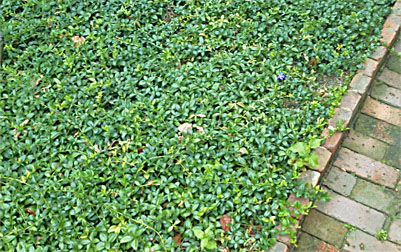
Periwinkles in the Cloisters
Discussed in
Garden Guide: New York City pp. 33-37
Periwinkle Label:
Common Periwinkle, Myrtle
Vinca minor
[Photo by KPA, August 2012]

The information plaque by the periwinkle bed describes the flower as a medieval cancer treatment.
Annual periwinkles have been used for centuries for folk medicine, especially for treating diabetes, and are the source of several cancer drugs.
And from this site, on the meaning of the flower's name:
The Latin name of periwinkle's genus, Vinca, is derived from a word meaning "to overcome."
Such a small flower, with such a sturdy name!

Below is a single flower, standing its ground. Although the flower bed nearby is full of periwinkles, this one flower stood out amidst a hostile leaves.


Sturdy Periwkinle in the Cloisters Garden
Discussed in: Garden Guide: New York City pp. 33-37
Periwinkle Label:
"Common Periwinkle, Myrtle
Vinca minor
[Photo by KPA, August 2012]


[Photo by KPA, August 2012]


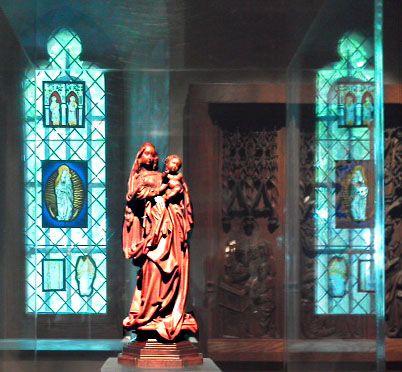
Standing Virgin and Child
Attributed to Nikolaus Gerhaert van Leiden
(North Netherlandish, active in Strasbourg, 1460–1473)
Date: ca. 1470
Medium: Boxwood, tinted lips and eyes
Dimensions: 13 1/4 x 5 1/8 x 3 9/16 in.
[Photo by KPA, August 2012]

Above is a photo I took of The Standing Virgin at the Cloisters Medieval Gallery in New York. She is enclosed in glass. I wasn't aware that I couldn't use my flash. The museum staff were quick to point that out to me, upon seeing the sudden flash of light. I apologized - I really don't want to participate in the destruction of these beautiful pieces. The damage was done, but I got the lovely photo above, with the light glowing on the faces of Mary and Jesus, and on the folds of Mary's robe. The stained glass window on the left, part of the collection in the Treasury, is reflected in the glass on the right.


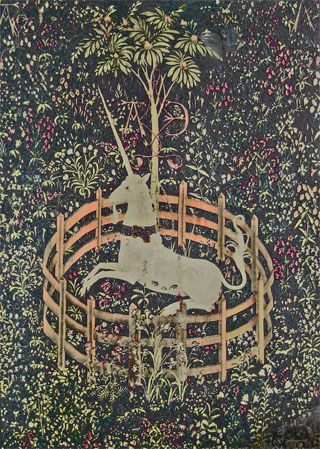
The Unicorn in Captivity
South Netherlandish, 1495-1505
Wool warp with wool, silk, sliver, and gilt wefts
12ft. 7/18 in. x 8 ft. 3 in.
The Cloisters, Metropolitan Museum of Art
Gift of John D. Rockefeller Jr., 1937

Here's what I wrote about the Unicorn Tapestry in 2008:


Here is a link to the Met, which has details of the flowers on the tapestry:
The Unicorn Tapestries: Flowers, Plants and Trees

I had been wanting to see the Unicorn Tapestries at the Cloisters for many years. I have blogged about them here, and even written about their floral designs in this article (posted on my blog) on plants in the decorative arts (the original pdf article is on pp 3-4 of the Summer 2007 issue of the Botanical Artists of Canada Newsletter). As I wrote in my blog post in 2010 (when I first wanted to see them):
I have never been to The Cloisters, but have always known that they house the beautiful tapestries The Hunt of the Unicorn. But, I was lucky to see another set of unicorn tapestries, The Lady and the Unicorn (La Dame à la Licorne), housed in the Musée de Cluny, in Paris.
And from my article:
One of the most enchanting mergers of scientific observation and religious symbolism are the tapestries of the Hunt of the Unicorn. These tapestries are covered with the late Medieval tradition of fields of millefleurs. When analyzed carefully, many of these flowers are clearly identifiable, in their correct environment. The Madonna Lily, depicted in The Unicorn in Captivity tapestry, is both a religious symbol of the purity of Mary and also a medicinal plant that treated burns, ulcers and ear infections, amongst other things.
Finally, I got to see them during my trip in New York this past August. I tried to take photos (without my flash, as instructed by the guards), but couldn't come up with any decent images, so I had to make do with a postcard of The Unicorn in Captivity from the gift shop.

-----------------------------------------------------------------------------------------------------------------------------------------------------
By: Kidist P. Asrat

Saturday, February 16, 2013

Multiculturalism and the War Against Western Culture

Video From Lawyrence Auster's 1992 Speech
"Multiculturalism and the War Against White America"


Here is the part dealing with the arts in America in the written form of the speech:
Cultural institutions in cities with large third-world populations are rapidly abandoning the Western high culture tradition in favor of third-world folk cultures. According to music critic Edward Rothstein writing in the New Republic, the new immigrants simply aren’t interested in Western music:
“[S]trikingly in a city like New York, [classical music culture] is largely a racially stratified culture as well: there are almost no black or immigrant faces (aside from Asians) to be seen in concert halls...My neighborhood arts organization, like many others around the country, has been unsuccessful in marketing Western art music to the new racial and international communities in the area. So instead they’ve begun presenting the folk musics of immigrant and black cultures.”
The same applies to the theater. “The reason that Broadway appeals less to New Yorkers these days,” writes theater critic Thomas Disch, “isn’t just that Broadway has changed: so have New Yorkers… [A] glance around the lobby at any Broadway show reveals who isn’t there: any of the city’s readily identifiable minorities — blacks, Hispanics, Asians …”
[Source: "Multiculturalism Discriminates Against Whites" in Discrimination Frontmatter. p.200 - pdf form]
Auster makes this further observation in the written form of the speech:
While the “delegitimizing” impact of unassimilable immigrants can be seen in many areas of American life, such as education, criminal law, and national identity, in no other field is the problem of unassimilability more obvious than in the arts.
[Source: "Multiculturalism Discriminates Against Whites" in Discrimination Frontmatter. p.200 - pdf form]
If we cannot agree on the "common culture" that Auster talks about in the video excerpt, then we cannot form a cohesive movement to save this culture.
-----------------------------------------------------------------------------------------------------------------------------------------------------
Post By: Kidist P. Asrat

Friday, February 15, 2013

The Holy as Transparent


I got the idea for the Holy as Transparent from a weekly television show which features various Rabbis reading and analyzing the Old Testament. I can no longer find the source of this discussion, but here is what I wrote:
The Holy is transparent, whereas the unholy is opaque.

And that which is in the middle, which can go either way, is neutral.

I think the idea of gemstones (or stones in general) wonderfully explains this concept.

A beautifully cut gem, like a diamond or an aquamarine, gives so much pleasure to our eyes because it is so transparent. The more transparent, the more expensive. What gives it this transparency is the work that went into making it so faceted. Holiness requires work to achieve its perfect transparency.

Those uncut gemstones, which have the potential to be worked on to be transparent (cabochons for the precious stones, and others like turquoise or lapis lazuli) are less attractive to us because of their middle-ground. But, we still desire them because we see the potential in them.

Yet, sometimes what looks like a potential turquoise can end up looking like an opaque pebble. We are least attracted to this pebble, and most likely to discard it at some point.

And that is exactly what the judicious Rabbis say. The opaque requires no judgment. They call it evil at one point, but prefer in the end to describe it as something which wouldn't bring us closer to God, and therefore something to be discarded.

On a more practical level, evil (the opaque) always leaves us questioning and probing (why, how what, etc...) whereas we marvel at the clarity of Holiness.

But, rather than judge it with our limited capacity, it is better to leave the opaque aside, and concentrate instead on the Holiness that is in front of us.
-----------------------------------------------------------------------------------------------------------------------------------------------------
Post By: Kidist P. Asrat
Mozart's Birthday


27 January 1756

I can never have enough praise for Mozart. You could say that I am a Mozartphile. I am forever surprised, astounded, delighted and intrigued by his music. Recently, I have been listening to Dvorak and Sibelius, and they surprise and astound, but they never really delight like Mozart.

The incredible thing about Mozart is how accessible he is, without losing any of his musical complexity. I think he does this by keeping his essential melody (often enchantingly beautiful) always within the listener's reach.

He bends and rotates the melody, without ever putting the fear into the listener that the melody would get lost in a myriad of incomprehensible notes. Each note, however distant and distinct from the original, makes perfect sense, and is as natural a progression as the air we breathe.

In other composers, I sometimes wonder why they went in the direction they went, or at some point, I get a little bored or distracted with their melodious experiments. But never with Mozart.

In fact, I get irritated when other (worldly) things distract me from Mozart's intricate meanders. But, he never leads us far from the origin, and never teases us too much, although he loves to tease. His music may have some jest and playfulness in it, but it is, down to the simple piano sonatas, very serious. Each note was chosen with a certain aim, and is as precious as the next.
-----------------------------------------------------------------------------------------------------------------------------------------------------
Post By: Kidist P. Asrat
Beauty in the Alleyways


Sunday Morning
Albert Franck

(1899 – 1973)

Here is a lovely Albert Franck scene of the back alleys of Toronto. Although this one was painted in 1965, I see exactly the same scene in today's Toronto.

For a northern city, which is associated with drab weather and even drabber colors, these town houses and alleyways exemplify the colorful and haphazard Toronto that is really underneath it all.

Talking of snow, almost all of Franck's paintings are done in the nostalgic light and colors of deep winter.

And, yes, we do miss it when it isn't there!
-----------------------------------------------------------------------------------------------------------------------------------------------------
Post By: Kidist P. Asrat

Aesthetics


Aristotle with a Bust of Homer
Rembrandt van Rijn, Dutch, 1606–1669
1653
Oil on canvas
56 1/2 x 53 3/4 in
Metropolitan Museum of Art


I have added Aesthetics to the list of topics. The philosophy of beauty is an important, and complex, topic, that I hope we will uncover in our quest to reclaim beauty.
-----------------------------------------------------------------------------------------------------------------------------------------------------
Post By: Kidist P. Asrat