A Response to Mark Signorelli
By James Kalb
Solidarity Hall
March 20, 2013
Responding to Mark Signorelli’s review of Beauty Will Save the World, I agree with Mark and author Greg Wolfe that life requires beauty, culture comes before politics, and the imagination plays a central role in social health.
If conservatism lacks those things, it becomes a matter of team spirit and arbitrary rules and assertions. Team spirit and arbitrariness have their uses, but they’re not something anyone would want to live by. For something more adequate we need the transcendent, which means we need imagination and cultural tradition to make it present to us, and beauty to make it attractive and worthy of love.
I line up with Signorelli on the need for traditionally-minded people to find cultural styles and forms that suit their understanding of what life and the world are about. The view that we need to adopt current styles and forms, because they are current, comes too close to the view that the actuality of the present moment is what there is, so if you don’t like it you don’t like reality. That view expresses the modern rejection of imagination, cultural tradition, and the transcendent. It’s what we need to get rid of, so why buy into it?
If an artist can use current stylistic elements for his own purposes in an effective way, or if he can bring out aspects of today’s life and culture that point to better things, that’s all to the good. The need though is for engagement with the good, beautiful and true, rather than with dominant cultural and stylistic tendencies that reflect a turn away from those things. Presenting something better and more hopeful is also engagement with culture. Wherever that can be found is where we should go.
Since we’re talking about basics, I’d like to add that more than beauty is needed to save the world. Beauty, imagination, and cultural tradition are wonderful and necessary, but they don’t hang in the air. They require an understanding of the world that supports and orients them. In the end, it’s what’s most real that matters to us, so they have to be understood as ways of knowing reality.
That requires an understanding of the world that’s essentially religious. A crisis of imagination and culture that goes deep enough to discredit beauty is fundamentally a religious crisis. It means that our relationship with realities that are basic to human life but can’t be observed, measured, and pinned down has been shattered. At bottom, it’s the restoration of that relationship that’s needed to save the world. That restoration will require beauty, along with goodness and truth, but most of all it will require what is holy.
-------------------------------------------------------------------------------------------------------------------------------------------------------------
Posted By: Kidist P. Asrat

Friday, March 22, 2013
Mark Signorelli: Modern Art and Ancient Beliefs
Modern Art and Ancient Beliefs
By Mark Signorelli
Solidarity Hall
March 19, 2013
I do not remember when a book has ever aroused in me the sort of pronounced ambivalence I felt in the course of reading Gregory Wolfe’s Beauty Will Save The World. For there are really two theses at the heart of Wolfe’s book. The first of these stems from the author’s dismay at the wholesale abandonment of the arts by Christians and conservatives alike, and the trivial politicization of right-wing thought that has been proceeding relentlessly for several decades now. Throughout his book, Wolfe argues repeatedly for the precedence of culture over politics, and the important role which the imagination must play in restoring our society to health, declaring, on the opening page, “I am now convinced that authentic renewal can only emerge out of the imaginative visions of the artist and the mystic.”
Simply put, this is the insight which people of a traditional bent of mind must digest, and it is their failure to digest it as of yet which has led directly to the marginalization of their views in contemporary society. Policy battles and elections will never suffice to mold minds and hearts in a fundamental way, and when the cultural forms which do display that power – film and literature and music foremost among them – all embody ways of thinking about the world which are entirely alien, and even hostile, to traditional patterns of thought, it is ridiculous to suppose that any political victories on the part of traditionalists will prove more than pyrrhic in the end. Wolfe’s emphasis on this point could not be more timely, or more clearly stated.
Beside this thesis, however, Wolfe asserts a second one which concerns the way Christians and conservatives should resume the cultural and artistic labor which they have neglected for so long. According to Wolfe, traditionalists have consistently erred in rejecting the prevailing cultural forms of our times, including the various styles of modernism and post-modernism (and they really are one thing, post-modernism being nothing more than a late and necessary development of modernism) to be found in the respective arts. He laments, for instance, that “conservatives frequently mock abstract art, experimental fiction, the theater of the absurd, and functionalist architecture.” Instead, Wolfe thinks, conservatives should embrace these styles, should “contribute to the renewal of culture by participating in the life of art in our time,” precisely because it is the art of our times. It is this position of Wolfe’s, reiterated forcefully at numerous points in his book, that I found myself objecting to most strongly while I read. I think Wolfe is wrong about this, and moreover, I think this second thesis is incompatible with his first thesis. I am convinced that so long as persons of traditional belief confine themselves to the dominant cultural forms of our age, they will continue to find all of their efforts to create artwork adequate to their beliefs futile and self-defeating.
To begin with, Wolfe’s account of the relationship between conservatives and contemporary art strikes me as wildly inaccurate. Far from being generally hostile to modern styles of art, conservatives now promote the production of these styles as routinely as any other segment of the public. Influential conservative thinkers like Roger Scruton and Roger Kimball have argued strenuously for the merits of modernist art, and for the congruity of its forms with their conservative beliefs. Conservative publications like The New Criterion and the Claremont Review of Books have celebrated avant-garde authors ranging from August Strindberg to David Foster Wallace. Other conservative publications regularly publish reviews of various pop cultural phenomena, thus signaling their esteem for these branches of contemporary artistic production. The brutal steel and concrete boxes of modern architecture are erected with as much frequency in conservative bastions like Nashville or Birmingham as in the unabashedly liberal strongholds of New York or San Francisco. I could go on, but I think the point is obvious by now. The fact is there are absolutely no prominent vehicles of artistic production or opinion making remaining in the Western world, on the left or on the right, which have not been thoroughly shaped by the stylistic cataclysms occurring at the turn of the twentieth century. There are no thriving centers of artistic production which have avoided the imprint of the modernist revolution, or which have successfully preserved pre-modern traditions of making. Conservatives and Christians are as deeply implicated in this mess as anybody else. Their failures in the cultural sphere cannot then be attributed to some obstinate resistance to prevailing trends in the arts. To the contrary, it seems very clear to me that the failures of traditional minded artists throughout our age have resulted from their passive, at times pusillanimous, acquiescence to those prevailing trends. They have failed because they have never created rival cultural forms which might serve modern traditionalists as alternatives to the degraded forms produced by the broader culture.
But if Wolfe’s assessment of the present scene remains unconvincing, it is his consistent misreadings of history which, in the end, really vitiate his argument. Consider his interpretation of Christian Humanism, found in Chapter Four. His point in this section is that devout Christians of the Renaissance like Thomas More and Erasmus managed to reconcile their faith with the humanistic culture of the period, and the forms of classical antiquity upon which that culture was based. He offers their careers as models to modern Christians: “Because Christian humanists believe that whatever is good, true, and beautiful is part of God’s design, they have the confidence that their faith can assimilate the works of culture. Assimilation, rather than rejection or accommodation, constitutes the heart of the Christian humanist’s vision.” Of course, as an argument in favor of modern art forms, this statement simply invites the question of whether those forms can fairly be called good, true, or beautiful; in the case of Abstract Expressionism or Black Mountain Poetry or rap music, it is not obvious that the answer is yes.
The deeper problem for Wolfe, though, is his assumption that any meaningful analogy can be drawn between the “secular” culture of antiquity and the “secular” culture of our times. For one, the artwork of the pagans wasn’t secular, not in the sense we attribute to that term, as denoting a sphere of meaning thickly separated from the theological. The works of Sophocles or Praxiteles are not secular in that way at all. Its not even clear that the idea of the “secular” – a realm of civic life totally detached from religion – dates back any further than the Enlightenment, or that a deep divorce between the impulses of worship and artistic creativity occurred prior to that time.
More to the point, the forms of classical antiquity embodied a dignified, and even exalted view, of human nature which proved to be remarkably consistent with much (though not all) Christian belief. If Christians assimilated these forms to their religion, it was because there was something assimilable about them. On the other hand, many of the forms of modern art embody a distorted or degraded view of human nature. The Spanish philosopher Jose Ortega y Gasset, for instance, notes in his essay The De-humanization of Art that most paintings of the early modernist period “betray a real loathing of living forms or forms of living beings.” Can such vandalism of the human form be reconciled with a faith teaching the innate dignity of the human person? Can a “theater of the absurd,” built on a suspicion of the meaningless of all narrative, become a sufficient vehicle for expressing belief in a religion teaching the eternal significance of both one particular narrative, and our own individual narratives?
Quite frankly, it appears to me rather perverse to ignore the monumental differences between the forms of classical art on the one hand and modern art on the other, between say, the Parthenon and the Bilbao Guggenheim, or between the tragic theater and a poetry slam, or between the Laocoon and the installments at the Moma. There is just no way a Christian artist’s acceptance of the former models can demonstrate his need to accept the latter. And after all, Wolfe fails to mention that a ruling impetus of the Renaissance humanists was a thoroughgoing detestation for the “gothic” culture of their times (represented best perhaps by Petrarch’s complaint about being born to a barbarous people, in a barbarous age), and that their general goal was to return to the models of a previous and, to their minds, more glorious era. Such motives run directly contrary to Wolfe’s admonitions to present-day Christians to appreciate and work within the cultural forms of their own age. So it is not even clear that a real appeal to the example of the Renaissance humanists would not lead to conclusions for modern Christians diametrically opposed to the ones he espouses in his book.
I have dwelt at length on Wolfe’s interpretation of the Renaissance because it demonstrates the thinness of his historical awareness, and this thinness, I take it, is the source of his misguided confidence in the appropriateness of modernist forms for contemporary traditionalists. The only way to really understand the significance of those forms, and their real incompatibility with traditional belief, is by grasping their historical development. This is the argument at the heart of a book published recently, Gabriel Josipovici’s Whatever Happened to Modernism? Josipovici is no foe to modernism; he is himself an experimental novelist, and laments the failure of contemporary novelists to learn the appropriate lessons from the modernist “masters.” Yet in narrating the genesis of modernist styles, Josipovici emphasizes their origins in the accumulating spiritual crises of the modern era: “In our modern age, an age without access to the transcendental and therefore an age without any sure guide, an age of geniuses but no apostles, only those who do not understand what has happened will imagine that they can give their lives (and their works) a shape and therefore a meaning, the shape and meaning conferred by an ending.”
The only honest artist, in our day and age, is the one who embraces this absurdity, who, like Duchamp, “draws the inescapable conclusion: since all art is choice and all choice is in the end arbitrary, a mere throw of the dice, why not face up to this fact, make one big choice right at the start and leave it at that.” The modern artist realizes “what is at issue is reality itself, what it is and how an art which of necessity renounces all claim to contact with the transcendent can relate to it, and if it cannot, what possible reason it can have for existing.” In the end, such an artist must acknowledge, in theory and in practice, that “certain ways of writing, painting, or composing ‘are not possible any more’ because they are worn out, thin, lacking in interest, as well as because there are certain things we are not capable of doing any more.”
No one can deny the power of Josipovici’s case, or fail to recognize the spiritual lineaments of our era in his description. But look closer at the assumptions hidden behind his words. The modern era has not simply been cut off from all transcendent sources; it has been cut off for all time from those sources. This is not a contingency of one particular era, but an irreversible dynamic of historical development. There was a necessity at work in the formation of modernity, which rendered it disenchanted at first and will continue to keep it so forever. No possible change in our ways of living could lift this cloud of despair from us (Josipovici writes of Eliot’s Waste Land, “in Eliot the disjunction goes deeper because there is no sense that a change in the attitudes of society would set things right…”). Art, from hereon after, must bow before this iron imperative, and artists must simply reconcile themselves to the severely constricted possibilities of their art. Behind all of Josipovici’s pronouncements lurks a faith in a massive historical determinism, and it is unquestionably from this same faith that the forms of modernism sprung.
Well, what if one doesn’t believe such things? What if one does not subscribe to stories of historical determinism, and suspects that they are really obscurantist fables, contrived by Western peoples in order to avert their eyes from their own grotesque spiritual malfeasance? What if, for instance, one has read any number of authors, such as Alasdair MacIntyre, or Jacques Barzun, or Edward Feser, who have argued persuasively (I would even say, conclusively) that far from unwinding in any necessary fashion, the confusion and disillusionment of our era have resulted largely from a host of willful and repeated philosophical errors? What if one believes it is impossible for us to be eternally cut off from the transcendent, and that anyone who really understood what is meant by “the transcendent” would know this? What if one believes that no historical contingency could ever reduce art to mere choice, or choice to arbitrariness, and that those who believe otherwise are treading along the boundaries of insanity? What if, that is to say, one rejected the entire world view of Josipovici and all who think like him (probably the far greater portion of the western public)?
I take it that all traditional minded persons, conservatives and Christians included, do reject that world view; I simply take such a rejection to be implicit in a traditional perspective. I have no wish to speak for Christians, but I am quite certain that their doctrines absolutely prohibit them from regarding human life as a story lacking in shape or meaning, or from feeling compelled to renounce the transcendent for all time. So what should such people make of modernist forms, forms which came into the world to be the embodiment of a perspective they do not share, a perspective they find plagued with error from beginning to end? It seems quite clear to me that they should do whatever artists have done historically when they find their era burdened with dead forms instantiating alien patterns of thought: they should turn away from those forms entirely and turn their attention to creating new ones.
Wolfe never entertains such a course as a real possibility for traditionalist artists because, unlike Josipovici, he never fully owns up to the historical origins of modernism. The closest he comes to acknowledging an inherent incompatibility between the forms of modernism and the beliefs of a traditionalist are when he advocates his aforementioned notion of “assimilation,” the idea that artists of traditional belief can “adapt and transform” the seemingly hostile forms of modern culture. But a sensible Christian or conservative artist will ask why he must be saddled with a burden no other artist in history has been forced to endure, by working in forms utterly foreign to his vision of the world. He will ask why he may not have the same privilege enjoyed by every other artist, of selecting the forms most appropriate to his understanding of reality. Yet even to address these questions is to assume that there is something in modernist forms capable of being “redeemed,” or turned to the intentions of the traditionalist artist. It is to assume that there is nothing essentially incompatible between such forms and such intentions. And that assumption, as I have argued, can only spring from a real failure to come to terms with what modernism is fundamentally about.
For Wolfe, a thoroughgoing rejection of contemporary art and culture amounts to one thing and one thing only: despair. As he writes, “There is a large body of believers who have essentially given up on contemporary culture…One might almost say that these individuals have given in to despair about our time,” or later, “the stark truth is that despair haunts many on the Right.” The truth, however, is that by insisting on the necessity of working within the impoverished forms our culture offers to us, it is Wolfe’s views which condemn us to despair, for he is demanding restriction to habits of artistic creation which came into the modern world to be the explicit manifestation of its despair. What he cannot see is that so long as he encourages aspiring artists to confine themselves to the forms of modernism, he is implicitly telling them that the grand artistic achievements of past eras are simply “not possible any more.” And what admonition could sound so desperate to a developing poet or composer as that!
It is on this point – a psychological rather than a historical one – that I part ways most dramatically from Wolfe. For he believes that acknowledging the extreme decadence of contemporary culture is a demoralizing act. I strongly disagree. Facing reality candidly is never an act of despair, and it is the plain truth that our contemporary culture is more worthless than anything seen in the western world since the invasion of the Huns. Saying so is not demoralizing. It is bracing and galvanizing; it arouses us from our complacency, it focuses our energies on the monumental task at hand, and it inspires us with all the fervor of a righteous cause.
Most importantly, it provides us with clarity about how to move forward, a clarity we will never achieve so long as we toy with paradoxes about making the ugly beautiful, or the chaotic orderly. Every historical movement which has left any mark in the world, whether in the spheres of religion, politics, or the arts, has begun by drawing a line in the sand, and brazenly declaring, “these are the errors which have misled us into our moribund condition, and therefore these are the errors with which we will no longer have anything to do.” It is an unfortunate fact that Christians and conservatives in the modern era have been notably unwilling to draw any such lines, that they have bent repeatedly to every new puff of the progressive breezes, until the Church has morphed into one more branch of our therapeutic culture, and the right-wing has twisted into another branch (a very vociferous though deluded branch) of liberalism. But as far as the arts go, traditionalists have exceeded even their normal levels of spinelessness, not only acquiescing to the cultural deterioration of our age, but cheering and abetting it with all the gusto of their contemporaries. I am sorry to say that Wolfe’s book looks like just another act of concession in this long surrender.
The imagination does hold the power to restore our society to sanity; Wolfe is gloriously right about this. But the special virtue of the imagination is to discover possibilities for human life concealed by the immediacy of present circumstances. Throughout the modernist era, the imagination has been shackled in that immediacy, compelled to speak of nothing but the anarchy of the times, and forbidden to perform those liberating duties it alone can perform. It has been denied all converse with the transcendent, its favorite object and best source of nourishment, told instead that it must be content to “renounce the transcendent” forever. Most crucially, the imagination has been starved of beauty, according to the pernicious bias that whatever is beautiful is inherently untruthful. This is the deadly yet inescapable contradiction at the heart of Wolfe’s book; he implores us to find hope for our times in beauty, while offering us nothing but artistic forms which have been marked from the beginning by an extraordinary degree of hopelessness and brutality. It just won’t work. Beauty will indeed save the world, but beauty will never be attained by imitating the artistic visions of those who regarded the world as beyond salvation.
-------------------------------------------------------------------------------------------------------------------------------------------------------------
Posted By: Kidist P. Asrat
By Mark Signorelli
Solidarity Hall
March 19, 2013
I do not remember when a book has ever aroused in me the sort of pronounced ambivalence I felt in the course of reading Gregory Wolfe’s Beauty Will Save The World. For there are really two theses at the heart of Wolfe’s book. The first of these stems from the author’s dismay at the wholesale abandonment of the arts by Christians and conservatives alike, and the trivial politicization of right-wing thought that has been proceeding relentlessly for several decades now. Throughout his book, Wolfe argues repeatedly for the precedence of culture over politics, and the important role which the imagination must play in restoring our society to health, declaring, on the opening page, “I am now convinced that authentic renewal can only emerge out of the imaginative visions of the artist and the mystic.”
Simply put, this is the insight which people of a traditional bent of mind must digest, and it is their failure to digest it as of yet which has led directly to the marginalization of their views in contemporary society. Policy battles and elections will never suffice to mold minds and hearts in a fundamental way, and when the cultural forms which do display that power – film and literature and music foremost among them – all embody ways of thinking about the world which are entirely alien, and even hostile, to traditional patterns of thought, it is ridiculous to suppose that any political victories on the part of traditionalists will prove more than pyrrhic in the end. Wolfe’s emphasis on this point could not be more timely, or more clearly stated.
Beside this thesis, however, Wolfe asserts a second one which concerns the way Christians and conservatives should resume the cultural and artistic labor which they have neglected for so long. According to Wolfe, traditionalists have consistently erred in rejecting the prevailing cultural forms of our times, including the various styles of modernism and post-modernism (and they really are one thing, post-modernism being nothing more than a late and necessary development of modernism) to be found in the respective arts. He laments, for instance, that “conservatives frequently mock abstract art, experimental fiction, the theater of the absurd, and functionalist architecture.” Instead, Wolfe thinks, conservatives should embrace these styles, should “contribute to the renewal of culture by participating in the life of art in our time,” precisely because it is the art of our times. It is this position of Wolfe’s, reiterated forcefully at numerous points in his book, that I found myself objecting to most strongly while I read. I think Wolfe is wrong about this, and moreover, I think this second thesis is incompatible with his first thesis. I am convinced that so long as persons of traditional belief confine themselves to the dominant cultural forms of our age, they will continue to find all of their efforts to create artwork adequate to their beliefs futile and self-defeating.
To begin with, Wolfe’s account of the relationship between conservatives and contemporary art strikes me as wildly inaccurate. Far from being generally hostile to modern styles of art, conservatives now promote the production of these styles as routinely as any other segment of the public. Influential conservative thinkers like Roger Scruton and Roger Kimball have argued strenuously for the merits of modernist art, and for the congruity of its forms with their conservative beliefs. Conservative publications like The New Criterion and the Claremont Review of Books have celebrated avant-garde authors ranging from August Strindberg to David Foster Wallace. Other conservative publications regularly publish reviews of various pop cultural phenomena, thus signaling their esteem for these branches of contemporary artistic production. The brutal steel and concrete boxes of modern architecture are erected with as much frequency in conservative bastions like Nashville or Birmingham as in the unabashedly liberal strongholds of New York or San Francisco. I could go on, but I think the point is obvious by now. The fact is there are absolutely no prominent vehicles of artistic production or opinion making remaining in the Western world, on the left or on the right, which have not been thoroughly shaped by the stylistic cataclysms occurring at the turn of the twentieth century. There are no thriving centers of artistic production which have avoided the imprint of the modernist revolution, or which have successfully preserved pre-modern traditions of making. Conservatives and Christians are as deeply implicated in this mess as anybody else. Their failures in the cultural sphere cannot then be attributed to some obstinate resistance to prevailing trends in the arts. To the contrary, it seems very clear to me that the failures of traditional minded artists throughout our age have resulted from their passive, at times pusillanimous, acquiescence to those prevailing trends. They have failed because they have never created rival cultural forms which might serve modern traditionalists as alternatives to the degraded forms produced by the broader culture.
But if Wolfe’s assessment of the present scene remains unconvincing, it is his consistent misreadings of history which, in the end, really vitiate his argument. Consider his interpretation of Christian Humanism, found in Chapter Four. His point in this section is that devout Christians of the Renaissance like Thomas More and Erasmus managed to reconcile their faith with the humanistic culture of the period, and the forms of classical antiquity upon which that culture was based. He offers their careers as models to modern Christians: “Because Christian humanists believe that whatever is good, true, and beautiful is part of God’s design, they have the confidence that their faith can assimilate the works of culture. Assimilation, rather than rejection or accommodation, constitutes the heart of the Christian humanist’s vision.” Of course, as an argument in favor of modern art forms, this statement simply invites the question of whether those forms can fairly be called good, true, or beautiful; in the case of Abstract Expressionism or Black Mountain Poetry or rap music, it is not obvious that the answer is yes.
The deeper problem for Wolfe, though, is his assumption that any meaningful analogy can be drawn between the “secular” culture of antiquity and the “secular” culture of our times. For one, the artwork of the pagans wasn’t secular, not in the sense we attribute to that term, as denoting a sphere of meaning thickly separated from the theological. The works of Sophocles or Praxiteles are not secular in that way at all. Its not even clear that the idea of the “secular” – a realm of civic life totally detached from religion – dates back any further than the Enlightenment, or that a deep divorce between the impulses of worship and artistic creativity occurred prior to that time.
More to the point, the forms of classical antiquity embodied a dignified, and even exalted view, of human nature which proved to be remarkably consistent with much (though not all) Christian belief. If Christians assimilated these forms to their religion, it was because there was something assimilable about them. On the other hand, many of the forms of modern art embody a distorted or degraded view of human nature. The Spanish philosopher Jose Ortega y Gasset, for instance, notes in his essay The De-humanization of Art that most paintings of the early modernist period “betray a real loathing of living forms or forms of living beings.” Can such vandalism of the human form be reconciled with a faith teaching the innate dignity of the human person? Can a “theater of the absurd,” built on a suspicion of the meaningless of all narrative, become a sufficient vehicle for expressing belief in a religion teaching the eternal significance of both one particular narrative, and our own individual narratives?
Quite frankly, it appears to me rather perverse to ignore the monumental differences between the forms of classical art on the one hand and modern art on the other, between say, the Parthenon and the Bilbao Guggenheim, or between the tragic theater and a poetry slam, or between the Laocoon and the installments at the Moma. There is just no way a Christian artist’s acceptance of the former models can demonstrate his need to accept the latter. And after all, Wolfe fails to mention that a ruling impetus of the Renaissance humanists was a thoroughgoing detestation for the “gothic” culture of their times (represented best perhaps by Petrarch’s complaint about being born to a barbarous people, in a barbarous age), and that their general goal was to return to the models of a previous and, to their minds, more glorious era. Such motives run directly contrary to Wolfe’s admonitions to present-day Christians to appreciate and work within the cultural forms of their own age. So it is not even clear that a real appeal to the example of the Renaissance humanists would not lead to conclusions for modern Christians diametrically opposed to the ones he espouses in his book.
I have dwelt at length on Wolfe’s interpretation of the Renaissance because it demonstrates the thinness of his historical awareness, and this thinness, I take it, is the source of his misguided confidence in the appropriateness of modernist forms for contemporary traditionalists. The only way to really understand the significance of those forms, and their real incompatibility with traditional belief, is by grasping their historical development. This is the argument at the heart of a book published recently, Gabriel Josipovici’s Whatever Happened to Modernism? Josipovici is no foe to modernism; he is himself an experimental novelist, and laments the failure of contemporary novelists to learn the appropriate lessons from the modernist “masters.” Yet in narrating the genesis of modernist styles, Josipovici emphasizes their origins in the accumulating spiritual crises of the modern era: “In our modern age, an age without access to the transcendental and therefore an age without any sure guide, an age of geniuses but no apostles, only those who do not understand what has happened will imagine that they can give their lives (and their works) a shape and therefore a meaning, the shape and meaning conferred by an ending.”
The only honest artist, in our day and age, is the one who embraces this absurdity, who, like Duchamp, “draws the inescapable conclusion: since all art is choice and all choice is in the end arbitrary, a mere throw of the dice, why not face up to this fact, make one big choice right at the start and leave it at that.” The modern artist realizes “what is at issue is reality itself, what it is and how an art which of necessity renounces all claim to contact with the transcendent can relate to it, and if it cannot, what possible reason it can have for existing.” In the end, such an artist must acknowledge, in theory and in practice, that “certain ways of writing, painting, or composing ‘are not possible any more’ because they are worn out, thin, lacking in interest, as well as because there are certain things we are not capable of doing any more.”
No one can deny the power of Josipovici’s case, or fail to recognize the spiritual lineaments of our era in his description. But look closer at the assumptions hidden behind his words. The modern era has not simply been cut off from all transcendent sources; it has been cut off for all time from those sources. This is not a contingency of one particular era, but an irreversible dynamic of historical development. There was a necessity at work in the formation of modernity, which rendered it disenchanted at first and will continue to keep it so forever. No possible change in our ways of living could lift this cloud of despair from us (Josipovici writes of Eliot’s Waste Land, “in Eliot the disjunction goes deeper because there is no sense that a change in the attitudes of society would set things right…”). Art, from hereon after, must bow before this iron imperative, and artists must simply reconcile themselves to the severely constricted possibilities of their art. Behind all of Josipovici’s pronouncements lurks a faith in a massive historical determinism, and it is unquestionably from this same faith that the forms of modernism sprung.
Well, what if one doesn’t believe such things? What if one does not subscribe to stories of historical determinism, and suspects that they are really obscurantist fables, contrived by Western peoples in order to avert their eyes from their own grotesque spiritual malfeasance? What if, for instance, one has read any number of authors, such as Alasdair MacIntyre, or Jacques Barzun, or Edward Feser, who have argued persuasively (I would even say, conclusively) that far from unwinding in any necessary fashion, the confusion and disillusionment of our era have resulted largely from a host of willful and repeated philosophical errors? What if one believes it is impossible for us to be eternally cut off from the transcendent, and that anyone who really understood what is meant by “the transcendent” would know this? What if one believes that no historical contingency could ever reduce art to mere choice, or choice to arbitrariness, and that those who believe otherwise are treading along the boundaries of insanity? What if, that is to say, one rejected the entire world view of Josipovici and all who think like him (probably the far greater portion of the western public)?
I take it that all traditional minded persons, conservatives and Christians included, do reject that world view; I simply take such a rejection to be implicit in a traditional perspective. I have no wish to speak for Christians, but I am quite certain that their doctrines absolutely prohibit them from regarding human life as a story lacking in shape or meaning, or from feeling compelled to renounce the transcendent for all time. So what should such people make of modernist forms, forms which came into the world to be the embodiment of a perspective they do not share, a perspective they find plagued with error from beginning to end? It seems quite clear to me that they should do whatever artists have done historically when they find their era burdened with dead forms instantiating alien patterns of thought: they should turn away from those forms entirely and turn their attention to creating new ones.
Wolfe never entertains such a course as a real possibility for traditionalist artists because, unlike Josipovici, he never fully owns up to the historical origins of modernism. The closest he comes to acknowledging an inherent incompatibility between the forms of modernism and the beliefs of a traditionalist are when he advocates his aforementioned notion of “assimilation,” the idea that artists of traditional belief can “adapt and transform” the seemingly hostile forms of modern culture. But a sensible Christian or conservative artist will ask why he must be saddled with a burden no other artist in history has been forced to endure, by working in forms utterly foreign to his vision of the world. He will ask why he may not have the same privilege enjoyed by every other artist, of selecting the forms most appropriate to his understanding of reality. Yet even to address these questions is to assume that there is something in modernist forms capable of being “redeemed,” or turned to the intentions of the traditionalist artist. It is to assume that there is nothing essentially incompatible between such forms and such intentions. And that assumption, as I have argued, can only spring from a real failure to come to terms with what modernism is fundamentally about.
For Wolfe, a thoroughgoing rejection of contemporary art and culture amounts to one thing and one thing only: despair. As he writes, “There is a large body of believers who have essentially given up on contemporary culture…One might almost say that these individuals have given in to despair about our time,” or later, “the stark truth is that despair haunts many on the Right.” The truth, however, is that by insisting on the necessity of working within the impoverished forms our culture offers to us, it is Wolfe’s views which condemn us to despair, for he is demanding restriction to habits of artistic creation which came into the modern world to be the explicit manifestation of its despair. What he cannot see is that so long as he encourages aspiring artists to confine themselves to the forms of modernism, he is implicitly telling them that the grand artistic achievements of past eras are simply “not possible any more.” And what admonition could sound so desperate to a developing poet or composer as that!
It is on this point – a psychological rather than a historical one – that I part ways most dramatically from Wolfe. For he believes that acknowledging the extreme decadence of contemporary culture is a demoralizing act. I strongly disagree. Facing reality candidly is never an act of despair, and it is the plain truth that our contemporary culture is more worthless than anything seen in the western world since the invasion of the Huns. Saying so is not demoralizing. It is bracing and galvanizing; it arouses us from our complacency, it focuses our energies on the monumental task at hand, and it inspires us with all the fervor of a righteous cause.
Most importantly, it provides us with clarity about how to move forward, a clarity we will never achieve so long as we toy with paradoxes about making the ugly beautiful, or the chaotic orderly. Every historical movement which has left any mark in the world, whether in the spheres of religion, politics, or the arts, has begun by drawing a line in the sand, and brazenly declaring, “these are the errors which have misled us into our moribund condition, and therefore these are the errors with which we will no longer have anything to do.” It is an unfortunate fact that Christians and conservatives in the modern era have been notably unwilling to draw any such lines, that they have bent repeatedly to every new puff of the progressive breezes, until the Church has morphed into one more branch of our therapeutic culture, and the right-wing has twisted into another branch (a very vociferous though deluded branch) of liberalism. But as far as the arts go, traditionalists have exceeded even their normal levels of spinelessness, not only acquiescing to the cultural deterioration of our age, but cheering and abetting it with all the gusto of their contemporaries. I am sorry to say that Wolfe’s book looks like just another act of concession in this long surrender.
The imagination does hold the power to restore our society to sanity; Wolfe is gloriously right about this. But the special virtue of the imagination is to discover possibilities for human life concealed by the immediacy of present circumstances. Throughout the modernist era, the imagination has been shackled in that immediacy, compelled to speak of nothing but the anarchy of the times, and forbidden to perform those liberating duties it alone can perform. It has been denied all converse with the transcendent, its favorite object and best source of nourishment, told instead that it must be content to “renounce the transcendent” forever. Most crucially, the imagination has been starved of beauty, according to the pernicious bias that whatever is beautiful is inherently untruthful. This is the deadly yet inescapable contradiction at the heart of Wolfe’s book; he implores us to find hope for our times in beauty, while offering us nothing but artistic forms which have been marked from the beginning by an extraordinary degree of hopelessness and brutality. It just won’t work. Beauty will indeed save the world, but beauty will never be attained by imitating the artistic visions of those who regarded the world as beyond salvation.
-------------------------------------------------------------------------------------------------------------------------------------------------------------
Posted By: Kidist P. Asrat
Thursday, March 21, 2013
VW Factory - Germany
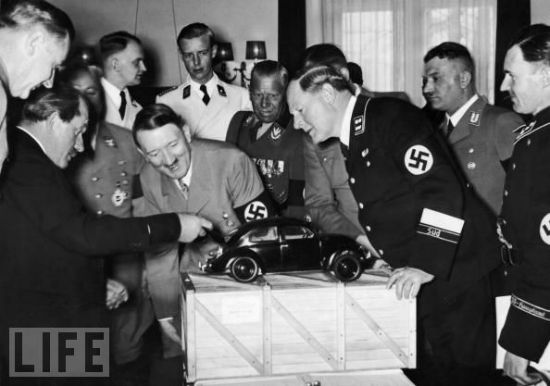
Demonstration of the first model of the "People's Car" (German: Volkswagen) to Adolf Hitler.
The vehicle, the first of the "beetle" models, was presented to Hitler on April 20, 1938
[Photo source]
Kristor Lawson, who writes at the Orthosphere, sent me the video below which, in six short minutes, shows us the process of buyers entering the factory and exiting with their choice Volkswagen. The site deserves a better name than a factory: it is a modern museum of technology, where performance, production and exhibition merge.
The Volkswagen factory in southern Germany, in Dresden, is a formidable place. It is like a small town of mechanical parts, ejecting a perfect car every few seconds. As the narrator describes the place: "Paul and Briggitte...have come to the most innovative factories in the world...The only factory in the world where you can peer through glass walls and see cars being made right befor of your eyes."
The video ends at the Brandenburg Gate, with an original WW2 Beetle
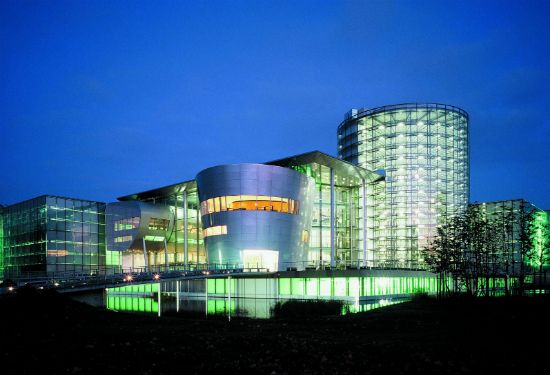
Volkswagen Factory in Dresden
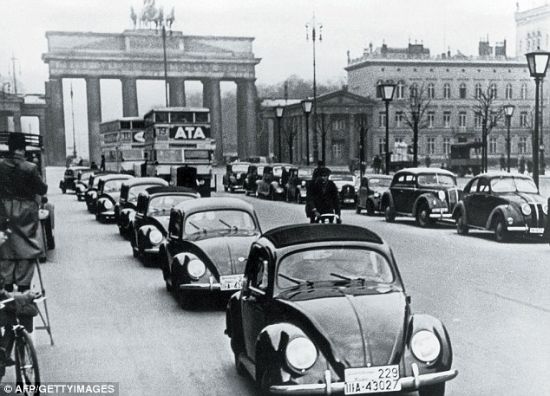
Picture taken in 1938 shows the first Beetles of the pre-production
series VW 38 in front of Berlin's Brandenburg Gate. [Photo source: HO/AFP]
This is the same Gate dedicated to Christian Ludwig, for whom Bach wrote the Bradenburg Concertos. Hitler runs amidst great company.
Christian Ludwig (14 March 1677 – 3 September 1734) was a Margrave [military commander] of Brandenburg and a military officer of Brandenburg-Prussia's Hohenzollern dynasty. The title "Margrave of Brandenburg" was given to princes of the Prussian Royal House and did not express a territorial or allodial status. He is best known as the recipient of Johann Sebastian Bach's Brandenburg concertos. [Source]
Bradenburg Concerto No. 3 - Allegro moderato
Volkswagen was just that, before it became a quasi-luxury car in this century - a people's car. And only twenty years ago, the beetle was a cute car that filled many a street throughout the world.
But it has a macabre history. Hitler commissioned it as his volks car, for the ordinary German:
The Volkswagen was a centerpiece of Nazism’s claims to benefit ordinary Germans. Hitler proposed to build a cheap car that almost anyone could afford. He gave it the name “KdF Wagen,” which we know as the Volkswagen. KdF was the abbreviation for “Kraft durch Freude" (Strength through Joy), a subsidiary of the Deutsche Arbeitsfront (German Labor Front), headed by Robert Ley. This chapter on the beginnings of the Volkswagen is taken from a book celebrating the achievements of “Kraft durch Freude.” As it turned out, not many people got their cars until after the war. As the chapter notes, the first deliveries were planned for early 1940, at which point the factory had been turned over to war production.The car was also formed in the shape of a helmet.
Still, no Hitler can dampen the German mind, and this little car is now fast becoming a technological masterpiece. It may even provide an avant-garde to battle off cheap (cheaper) Japanese cars, who have been very clever so far at using German and American technology to produce cars that they sell right back to the Germans and Americans.

2013 Volkswagen Beetle TDI Diesel [Review here]
Wednesday, March 20, 2013
English Folk Songs in America
Buck Creek Girls
By Appalachian folk singer Hobart Smith
(Below is more information on Hobart Smith)
Here is a track listing of the album where Buck Creek Girls appears.
-------------------------------------------------------------------------------------------------------------------------------------------------------------
A reader posted this comment on Vaughn Williams and Holst's English Folk Songs.
Complementing RVW's [Ralph Vaughn Williams] and Holst's harvest of English folk song in the period were songcatchers, like Cecil Sharp, founder of the English Folksong society and instigator of the Morris Dance revival, who spent a couple of summers during World War I tramping Appalachia in search of pristine specimens of ancient English and Scottish folk song. Sharp was to collecting and preserving the northern British tradition as RVW and Holst were to the southern. You're right--the charm of folk song derives from its link to the landscape. American traditional and mountain music expresses the same appreciation and longing for the land--and, as it turns out, since those tunes find their roots in the old world, it's the same landscape, made even dearer by the singer's distance from it.Here is more information on the "songcatchers" Cecil Sharp, and how he built a repertoire of English folk songs in America:
Hobart Smith (May 10, 1897—January 11, 1965) was an American old-time musician. He was most notable for his appearance with his sister, Texas Gladden, on a series of Library of Congress recordings in the 1940s and his later appearances at various festivals during the folk music revival of the 1960s. Smith is often remembered for his virtuosic performances on the banjo, and had also mastered various other instruments, including the fiddle, guitar, piano, harmonica, accordion, and organ...The excerpt below is Hobart's account of his musical beginning. It appears to come from this source: Smith Hobart: "I grew up into it" DB no. 22 (1 sept, 1973), 18-22, Short autobiography, originally accompanying Folk-Legacy Records FSA-17. The link provides the rest of the narrative:
During the years of the First World War, Sharp found it difficult to support himself through his customary efforts at lecturing and writing, and decided to make an extended visit to the United States. The visit, made with his collaborator Maud Karpeles during the years 1916–1918, was a great success. Large audiences came to hear Sharp lecture about folk music, and Sharp also took the opportunity to do field work on English folk songs that had survived in the more remote regions of southern Appalachia, pursuing a line of research pioneered by Olive Dame Campbell. Travelling through the mountains of Virginia, North Carolina, Kentucky, and Tennessee, Sharp and Karpeles recorded a treasure trove of folk songs, many using the pentatonic scale and many in versions quite different from those Sharp had collected in rural England. Generally, Sharp recorded the tunes, while Karpeles was responsible for the words.
Sharp was greatly struck by the dignity, courtesy, and natural grace of the people who welcomed him and Karpeles in the Appalachians, and he defended their values and their way of life in print.
Sharp's work in promoting English folk song dance traditions in the US is carried on by the Country Dance and Song Society
I Grew Up Into ItDespite the sad themes of many songs, the melodies appear less plaintive, and more confident, than the Irish melodies I wrote about here.
As Told By Hobart Smith:
I started playing the banjo when I was seven years old. When I was three, I commenced playin' on an old fire shovel. I was raised in an old log house that had a fireplace and my mother had a bar that went across the fireplace with hooks that came down to cook her stuff in the pots and then she had a big oven and lid and she'd bake her bread and pull out those coals with that shovel — cover it up with red-hot coals, you know — and bake her bread thataway. We didn't have any cook-stove at that time. They said I was just three years old, I'd get that fire shovel and just pick on it; and they asked me what I was pickin' and I just said "Sour Colics!"[Read the rest of the narrative here].
Next stop, Wales, then Scotland!
-------------------------------------------------------------------------------------------------------------------------------------------------------------
Posted By: Kidist P. Asrat
Snow Drop: First Day of Spring

Photograph by: Dan Kitwood, Getty Images
-------------------------------------------------------------------------------------------------------------------------------------------------------------
Posted By: Kidist P. Asrat
-------------------------------------------------------------------------------------------------------------------------------------------------------------
The Germans: 2013 Audi A1 Quattro
The video shows it all. But for the technically minded, here's the Audi A1 Quattro:
Audi creates limited edition, 252-hp A1 Quattro
Autoblog: Auto News
By Damon Lavrinc
December 20th 2011
[T]he A1 Quattro comes equipped with the automaker's legendary all-wheel-drive system, with power provided by the same 2.0-liter turbocharged and direct-injected four-cylinder used in the S3. The reworked mill puts out 252 horsepower at 6,000 rpm and 258 pound-feet of torque from 2,500 to 4,500 rpm – a boost of more than 70 hp and 74 lb-ft over the standard 1.4-liter A1.
A six-speed manual shuttles that power to a Haldex AWD setup and on to center-locking 17-inch wheels that ape the original 80s-era Quattro's style. There's no word on weight, but Audi claims the hi-po A1 will match the S3's 0-60 mph time of 5.7 seconds and top out at 152 mph.
In addition to grippy 225/35 R18 rubber, the wheel wells are filled with a modified MacPherson strut suspension in front and a multi-link setup out back, while the braking hardware has been upgraded with larger discs at all four corners with black painted calipers. The electromechanical steering has also been tweaked to provide a 14.8:1 ratio, the ESP has been modified for high-performance duty and a new electronically controlled differential lock will keep wheelspin at bay. Although Audi decided to keep the rear seats in place, the AWD components have reduced trunk space to 7.4 cubic feet – or 2.1 cubes less than the standard model. Not that you care.
The exterior speaks for itself, drawing cues from past Audi concepts and a few bits from the S and RS lines, while the interior receives a new instrument panel, aluminum pedals, seriously bolstered buckets and black leather with red contrast stitching.

-------------------------------------------------------------------------------------------------------------------------------------------------------------
Posted By: Kidist P. Asrat
Tuesday, March 19, 2013
In The Fen Country
Vaughn Williams
In The Fen Country
Bournemouth Symphony Orchestra
Conducted by Paul Daniel
---------------------------------------------------------------------------------------------------------------------------------------------------------
In the Fen Country:
Landscape and Music in the Work of Gustav Holst and Ralph Vaughan Williams
By: Thomas F. Bertonneau
Sensitivity to the landscape has always been associated with religious sensibility. In the decorative murals with which the wealthy classes of Rome during the Imperial centuries adorned their domestic lives, the idyllic scene, with its groves and grazing sheep, invariably contains a rustic temple. In Hellenistic poetry, too, the writer – it might be Theocritus or at a later date Ovid – in describing the sylvan setting of Sicily or Arcadia emphasizes the presence everywhere of the nature-spirits. Ovid’s Metamorphoses seem in part to be an explanation of why everywhere in the ancient world one encountered innumerable altars and shrines. To the pagan mentality, everything, every tree and stream and mountain, was sacred, a home to spirits and demigods. So too in romantic painting and verse, the artist’s response to the natural scene is essentially religious and pantheistic. Thus in William Wordsworth’s famous sonnet “The world is too much with us” (1802), the calamity of the emergent industrial and commercial order manifests itself most poignantly in the terrible loneliness of being cut off from participation in the sacredness of the elements –
The world is too much with us; late and soon,
Getting and spending, we lay waste our powers;
Little we see in Nature that is ours;
We have given our hearts away, a sordid boon!
The lyric subject of the poem, concluding that the modern dispensation has left men “for everything… out of tune,” wishes that he were (although he is not) “a Pagan suckled in a creed outworn,” that is, someone who might “have glimpses that would make me less forlorn” of “Proteus rising from the sea.” That men should have become acutely aware of nature in the early nineteenth century is hardly surprising. The social and economic developments of the period, the hypertrophy of cities and the dissolution of ancient arrangements in the countryside, wrought changes in the very appearance of the rural landscape. A generation later than Wordsworth, in the “Wessex” stories and novels of Thomas Hardy, the situation has grown even more acute. In the short story “The Fiddler of the Reels,” the great fact of existence is the Crystal Palace, in the year of whose construction much of the action takes place. The countryside is emptying into the great cities; railroads have appeared in the provinces, and the landscape itself is being altered by the expansion of a new order.
Art is frequently a response to loss and the resultant absence, as generically in lyric poetry. The elegiac impulse finds one of its most profound expressions in the response to landscape – often to vanishing landscape – in the work of what is sometimes called the English Pastoral School of musical composition, the heyday of which was the early twentieth century. The two instigators of English musical idyllicism, Ralph Vaughan Williams (1872 – 1958) and Gustav Holst (1874 – 1934), had been fellow students at the Royal College of Music, London, in the 1890s, where both studied composition with Charles Villiers Stanford. Both men experienced the powerful intuition that Stanford, notwithstanding his technical mastery, spoke in a musical language insufficiently native, and, in a paradoxical way, insufficiently au courant. Stanford took his models in mid-nineteenth century German music – in Mendelssohn, Schumann, and Brahms – and except for an occasional Irish inflection, his music sounded a good deal like theirs. But what musical language would be au courant? Holst, who came from a long line of church organists and musicians, suggested to Vaughan Williams that they investigate the music of the rural parishes and from that milieu their curiosity took them quite naturally into folksong. As did Bela Bartók in Hungary and Romania around the same time, Vaughan Williams and Holst began to tramp the countryside in Somerset, Hampshire, Essex, East Anglia, and Norfolk, notebooks at ready, to collect and annotate the archaic song-tradition that they well knew was on the verge of extinction. These were the years from 1902 to 1905. In addition to their project of preserving the treasury of the traditional ballads, love songs, and lullabies, both men had the notion that English folksong could become the basis of a novel and truly English concert music. That music would be new because its basis would be more ancient than that of the Germanic conservatory-vocabulary employed by Stanford and his peers.
There was one additional consideration – or rather a conclusion that both Vaughan Williams and Holst drew independently and that struck them as exploitable. The modes and melodic outlines of English folksong reflected the regional landscape; the tunes especially grew from the topography. As in Wordsworth’s lyrical ballad “The Solitary Reaper,” where the singing field-girl’s half-heard song seems to the reporter to express the “natural sorrow, loss, or pain,” that belongs to traditional life, in contact with the earth and season and sky: so too for the fellow folksong collectors, the tunes that they took down from those who sang them seemed saturated with an ethos – a character of place that imprinted itself on its denizens and that they bespoke in song. As Vaughan Williams wrote many years later in his study of National Music (1934), folksong is the expression of “the absolutely unsophisticated though naturally musical man… one who is untraveled and therefore self-dependent for his inspiration [and] whose artistic utterance will be entirely spontaneous and unself-conscious.” Or as Hubert Foss writes of Vaughan Williams himself in his study of the composer, he “grows from the earth”; according to Foss, Vaughan Williams “likes that which grows naturally” and “his roots are in the past.” Of Holst, Wilfrid Mellers writes in Romanticism and the Twentieth Century (1962), that folksong studies taught him how to compose “in lines that are vocally modal [and] free in rhythm,” so that even his purely instrumental inspirations resemble “folk-song or plainsong” in their melodic outlines.
Folksong early began to inform and vitalize Vaughan Williams’ music, which it does already in the “symphonic impression,” so described, for orchestra entitled In the Fen Country, composed in 1904 and given its first performance under Thomas Beecham in 1907. In the Fen Country, in many ways RVW’s first characteristic work, purports to represent its composer’s complex aesthetic, emotional, and spiritual response to the extensive southeastern marshlands of England – that half-aqueous world, with its dykes and canals, and its university and cathedral towns of Cambridge and Ely. As Foss puts it in his study, in the Fen Country “gives… a picture of the countryside where Vaughan Williams found folk-song,” adding that, “those frigid, frosty mornings that make the journey from Cambridge to Ely so soul-searching a trek are portrayed here.” Yet In the Fen Country quotes no folk melody. Rather, Vaughan Williams lets the pattern of folk melody animate his rhythmically free, generally slow, and modally minor instrumental lines. The work, lasting around a quarter of an hour in performance, opens with a long improvisatory sounding solo on the cor anglais, joined gradually in a freely evolving polyphony by other solo instruments. Although the motifs are songlike, the effect on the listener is rather of something non-human – “the place in itself,” perhaps. After a number of episodes, some quite portentous and brassy, In the Fen Country ends on a drawn-out viola solo that fades into silence.
Holst composed his Somerset Rhapsody, Op. 21, in 1906. Unlike Vaughan Williams’ In the Fen Country, Holst’s Somerset Rhapsody incorporates actual folksongs, including a traditional sheep shearing song, whose real topic despite its title is the custom of countryside courtship, and a march, “High Germany.” The sheep shearing song keeps in the minor-key and suggests the melancholy of the lovelorn; the march is in the major-key, outgoing, rhythmically incisive, and bold. Holst exploits the contrast and drives the work to its big moment with a brassy treatment of the march, in augmentation. A Somerset Rhapsody conjures a more human atmosphere than does In the Fen Country although in its quieter concluding passages after the climax on “High Germany,” Holst’s score strongly resembles Vaughan Williams’ score. Vaughan Williams composed his own version of the sheep shearing song, for female voices and chamber-orchestral accompaniment, assigning it to his suite Folksongs of the Four Seasons (1950). The tune “High Germany” makes an appearance in Vaughan Williams’ English Folk Song Suite, for wind band (1923).
Concerning landscape – and its aesthetic and metaphysical meanings – the philosopher Roger Scruton has written in his study of Beauty (2009) that, “Landscapes… are very far from works of art – they owe their appeal not to symmetry, unity and form, but to an openness, grandeur and world-like expansiveness, in which it is we and not they that are contained.” In confronting the landscape then the percipient subject experiences something like a cosmic moment, understanding his own mortal limitations against the enduring earthly and vegetative environment that afford him a home and yet, being non-sentient, remains alien or at least indifferent to him. Yet vegetative though it might be, the landscape can stand as metaphor for something else sublime and, with respect to man, entirely prior and creative – namely the divine. In this respect it is interest to reflect that neither Vaughan Williams nor Holst was conventionally religious. Vaughan Williams professed agnosticism but also took religious experience seriously; Holst inclined to thoroughgoing ecumenicism, showing an interest in mystic Christianity, Hinduism, and the whole range of esoteric traditions.
In the years 1906 – 07, Vaughan Williams composed his Three Norfolk Rhapsodies, fragments of a projected but unachieved “Norfolk Symphony.” The Third Rhapsody is lost; the Second was never played in its composer’s lifetime, while the First established itself among RVW’s early work. In these works, following Holst’s manner in A Somerset Rhapsody, Vaughan Williams used actual folk melodies. In the Norfolk Rhapsody No. 1, for example, we hear “The Captain's Apprentice,” “A Bold Young Sailor Courted Me,” and “On Board a 98.” In the Norfolk Rhapsody No. 2, we hear, among others, the hymn-like “King’s Lynn,” sometimes sung as a chapel song. As was the case with In the Fen Country, the two Norfolk Rhapsodies, in exploiting the modally flavored folksongs, require a largely minor-key harmonics, saturating the musical structure in a mood of nostalgia. Knowing that John Constable (1776 – 1837) and Albert Goodwin (1845 – 1932) painted the regions from which RVW collected his tunes adds to the listener’s appreciation of the spirit that the composer evokes through his purely musical structures. Foss describes the First Rhapsody, the only one known when he wrote his study, as “a deeply considered work… a moving piece of music that never rises above piano, and closes in the sea of mist of [its] beginning.”
Vaughan Williams wrote his best-known score, A Lark Ascending, in 1914, when he scored it for violin and piano; later in 1920 he arranged the piano part for small ensemble, giving the score its familiar form, as a “Romance for Violin and Orchestra.” Taking its inspiration from a poem of the same name by George Meredith (1828 – 1909), A Lark Ascending has acquired something like iconic status in English music, as the prime representative piece of the national-pastoral school, such that many people who know little else from that repertory know this gentle composition. Foss remarks that the two main melodies of the score “are coloured by English folk-song.” The solo violin part is nearly pictorial in its depiction of the avian ascent, its long cadenza-like passages being interrupted by episodes in dance rhythm. If the rustic piping heard halfway through the score were close in its archaism to Pre-Raphaelite preciosity, this would perhaps be the result of the listener having heard the work too often. The “sheer beauty” of A Lark, to borrow a phrase from Foss, should be reserved for special occasions. Overplaying the composition threatens to deaden us to its delicate gestures and ecstatic sweetness.
Holst’s Egdon Heath and Vaughan Williams’ Flos Campi date from the mid-1920s. Holst’s inspiration came from a Hardy novel, The Return of the Native (1878), one of the author’s “Wessex Tales,” in which the eponymous geographical tract rises to the level of a character in the drama. Hardy describes Egdon Heath in something like antediluvian terms, as swarthy, forbidding, and almost actively inimical to the human beings who must cross it going from one habitable place to another. In Holst’s tone-poem (1927), one of his masterpieces, the composer eschews any quotation of traditional melody and confines himself to pure tone-painting, evoking in sound the emotions that Hardy’s verbal description produces in its reader. This means that in mood Egdon Heath stands light-years distant from A Somerset Rhapsody. A slow, stalking figure in the double basses establishes the atmosphere; a quiet horn call, as from far away, and spare counterpoint in the flutes and oboes, followed by a fugitive rustling in the violins and violas, make for an impression of ghostly, nocturnal activity. Halfway through the score, there is something like a funeral cortege, colored by the trombones and tuba in their lowest registers. That these sounds tell of a tragic vision, the score’s association with Hardy’s grim narrative guarantees even though listeners can assign no specific concepts to the various stark motifs.
Flos Campi – Suite for Viola, Chorus, and Orchestra (1925), which like Egdon Heath quotes no actual folk songs, is not topically connected with the English countryside although its Latin title means “Flower of the Field.” The suite’s ostensible subject, the Biblical Song of Songs, celebrates that psychological point where erotic passion for the beloved passes over into mystic contemplation of absolute beauty. Nevertheless, Flos Campi will strike the reader as the consummation of that trend in RVW’s creativity, which begins with In the Fen Country; the music seems to spring from the identical, and quite English, landscape, the Biblical allusion notwithstanding. Professor Mellers in his book on RVW The Vision of Albion (1989) places Flos Campi in company with a group of large-scale choral and vocal works that its author composed around the same time – including his setting of The Magnificat (1932). Mellers identifies the solo viola with “the voice of Pan, or Nature, or of human lover and beloved, or he might be… all of these simultaneously.” Mellers also identifies the oboe, almost as important as the viola in its part, as specifically in context “a pastoral instrument.” In the last of the work’s six movements, according to Mellers, “Man and Nature… attain at-one-ment,” if only temporarily. Foss too lavishes praise on Flos Campi, calling it “one of [RVW’s] most original, and most important, expressions,” and praising its “lone philosophic attitude of thought.” The device of a wordless chorus has rarely been employed so convincingly, not even by Maurice Ravel in his Daphnis and Chloe ballet.
Vaughan Williams wrote Five Variants in Dives and Lazarus for string orchestra and harp in 1939, to be played at the World Fair in New York City. In this score the composer once again draws on an actual folk tune, “Dives and Lazarus.” As in the case of Flos Campi, although RVW does not proffer the score as a musical landscape that is nevertheless its feeling.
In the last year of his life Holst produced a small but potent work that belongs to the “landscape” genre – his Lyric Movement for Viola and Chamber Orchestra (1934), a work smaller in scale yet close in mood and intention to Flos Campi. To his soloist, Holst gives the same type of improvisatory and continuously developing line as RVW his in Flos Campi, and the same yearning for fusion with the object of contemplation flavors both scores. Mellers in Romanticism and the Twentieth Century writes of its “tenderness in the sonorous spacing of the harmony.” One might justly attribute to the Lyric Movement what Mellers attributes to Egdon Heath – that in it the personality of the composer is “purged away in the bare organum-like harmony and transparent scoring.” Was this brief sketch supposed to be the slow middle movement of a three-part concerted work? Nevertheless, it achieves stand-alone perfection. Holst died before his sixtieth birthday. In listening to the Lyric Movement, one can only regret that a composer capable of such concentrated expression did not live to explore the remarkable new avenues of musical exploration that he was, in that moment, opening up.
---------------------------------------------------------------------------------------------------------------------------------------------------------
Posted By: Kidist P. Asrat
Monday, March 18, 2013
A Walk in the Sun
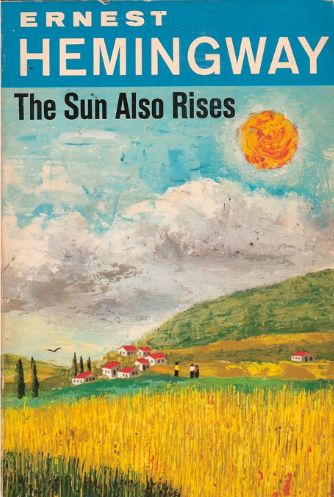
Cover Painting By James and Ruth McCrea
Hemingway was a favourite of mine, back when I used to carry books with me wherever I went. I don't do that as much now, but I do keep up with my fiction reading. I’m often re-reading older classics. Current fiction writers leave me unsatisfied. I can see their talent (of the talented ones, that is), but their stories are imbued with their personalities, as though they cannot shake off their egos as they write. Also, their stories have macabre, strange, or nihilistic endings, and I come away bewildered or depressed.
I've read four of Hemingway’s books: The Sun Also Rises, A Farewell to Arms, For Whom the Bell Tolls and The Old Man and the Sea, and many of his short stories. I'm not a literary critic, so I don't really know how to start analyzing Hemingway's writing - it's already been done ad infinitum anyway by experts and laymen alike. The first three are told in first person, and are accounts of unrequited love in many ways. The protagonists are too sophisticated and polished to pass off as Hemingway, but who knows, they could be his alter-ego. He brings them to life so clearly. They enter into all kinds of debacles, yet they come out surprisingly pure and unblemished despite their weaknesses and failures. Even The Old Man and the Sea reads like an autobiographical story of Hemingway himself - he wrote it twenty-five years afterThe Sun Also Rises, and was fifty-two years old, an age when the end of life gets closer.
I'm re-reading The Sun Also Rises. What surprises me this time around are the long, unending sentences that Hemingway uses at times, producing almost a trance-like meditative quality. This goes against the hard simplicity of his prose that many analysts have described. His description of places, whether it is a café in Paris, or the Spanish (and Italian) countryside, resonates in my mind – always has – and is an urge to visit these vivid locales.
Here is a quote from The Sun Also Rises, describing a walk in the beautiful northern Spanish countryside:
We packed the lunch and two bottles of wine in the rucksack, and Bill put it on. I carried the rod-case and the landing-nets slung over my back. We started up the road and then went across a meadow and found a path that crossed the fields and went toward the woods on the slope of the first hill. We walked across the fields on the sandy path. The fields were rolling and grassy and the grass was short from the sheep grazing. The cattle were up in the hills. We heard their bells in the woods.
The path crossed a stream on a foot-log. The log was surfaced off, and there was a sapling bent across for a rail. In the flat pool beside the stream tadpoles spotted the sand. We went up a steep bank and across the rolling fields. Looking back we saw Burguete, white houses and red roofs, and the white road with a truck going along it and the dust rising.
Beyond the fields we crossed another faster-flowing stream. A sandy road led down to the ford and beyond into the woods. The path crossed the stream on another foot-log below the ford, and joined the road, and we went into the woods.
It was a beech wood and the trees were very old. Their roots bulked above the ground and the branches were twisted. We walked on the road between the thick trunks of the old beeches and the sunlight came through the leaves in light patches on the grass. The trees were big, and the foliage was thick but it was not gloomy. There was no undergrowth, only the smooth grass, very green and fresh, and the big gray trees well spaced as though it were a park.
"This is country," Bill said.
The road went up a hill and we got into thick woods, and the road kept on climbing. Sometimes it dipped down but rose again steeply. All the time we heard the cattle in the woods. Finally, the road came out on the top of the hills. We were on the top of the height of land that was the highest part of the range of wooded hills we had seen from Burguete. There were wild strawberries growing on the sunny side of the ridge in a little clearing in the trees.
Ahead the road came out of the forest and went along the shoulder of the ridge of hills. The hills ahead were not wooded, and there were great fields of yellow gorse. Way off we saw the steep bluffs, dark with trees and jutting with gray stone, that marked the course of the Irati River.
"We have to follow this road along the ridge, cross these hills, go through the woods on the far hills, and come down to the Irati valley," I pointed out to Bill.
The Ancients and Their Chiding Message
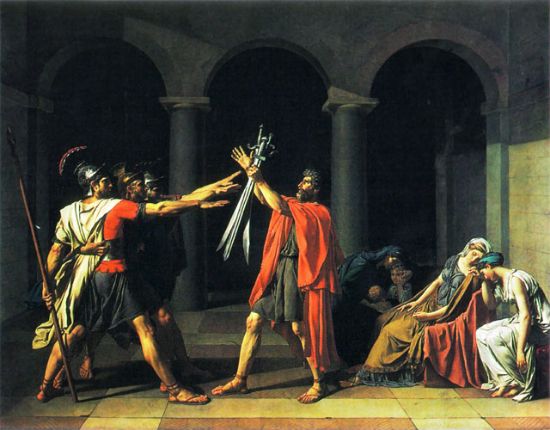
Jacques-Louis David (1748 – 1825)
Oath Of The Horatii
Oil on Canvas, 10' 10" x 13' 11""
1784
Musée du Louvre at Paris
I watched two films yesterday.
One was Spartacus, by Stanley Kubrick, a fictional recounting of the supposed slave rebellion in Rome. I don't know much about the historical accuracy of the film, but this historian says:
Perhaps the most surprising thing is that the Kubrick film isn't complete fiction, but offers some historical truth. The truth is that Spartacus really was a slave and a gladiator in Capua, Italy, and he really did lead a revolt. As the movie shows, it started in the kitchen of the gladiatorial barracks with the men using basic kitchen utensils to fight the guards and break out. And it's even true that Spartacus had a ladylove as he did in the movie. But there are some real differences as well. The movie Spartacus was born a slave and was the son and grandson of slaves, but the real Spartacus was born free. He came from Thrace, roughly equivalent with today's Bulgaria. And far from being a lifelong opponent of Rome, he started out as an allied soldier in the Roman army. He fought for Rome. His fate, ending up as a slave and gladiator, was quite unexpected and quite unjust. The Romans themselves admitted that Spartacus was forced to become a gladiator even though he was innocent. (The historian is Barry Strauss, and here is his link at Cornell University)The other was My Life in Ruins, a silly film with Nia Vardalos (who was in the mildly funny and somewhat successful film My Big Fat Greek Wedding). My Life in Ruins is about a Greek-American academic (Vardalos - highly unlikely as an NYU professor) who goes to Greece as a tour guide (much more likely) to share her erudition with annoying tourists.
Spartacus is by far the superior film. It takes us back to a formal, civilized Rome. The Romans' strategic and methodical fighting plans are deeply contrasted with the thousands of men that Spartacus has amassed, who swarm across the plains towards the Romans during an epic (in the film at least) battle. The Romans, in their beautiful crimson capes, riding their multicolored horses (white for the leaders), with the footmen carrying steely shields, shine against the slaves in their tattered rags of grays and browns. Even in war (especially in war?), the Romans took care with their appearances. Red for blood, red for war, and the crimson red for beauty.
But My Life in Ruins, despite its silliness and its clever title, takes us to ancient Greece. It is hard to imagine that the pretty Greek villages that the tour bus drives by are on the same land as the civilization which built the Parthenon almost 3,000 years ago.
One of the most memorable scenes in the film was when the tour guide takes her motley crew to a ruins site. We see one pillar standing. It is part of the Temple of Zeus at Olympus. As the camera pulls out, we see the rest of the ruins, with scrambling tourists stepping all over the sacred stones.
The effect of the lone pillar, filmed separately from the human rabble, was strong. It was as though these ancient peoples had left behind a god buried deep in the pillar, who was watching over them (their remnants) as well as gently warning these swarming modern humans who they are.
Later on, the tour guide takes her group to the Acropolis at night. Approaching it, we realize why. It is lit up, on the low hill. A regal, gentle presence. I don't think this lighting is out of place. The Greeks would have found a way to light their beautiful monument, with candles and torches, so that it glows for miles around, to admire and to be in awe of.
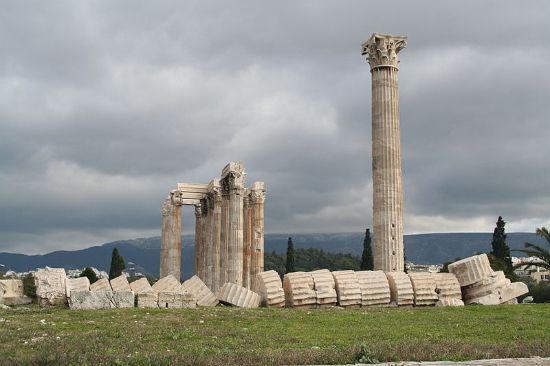
The Temple of Zeus After Restoration Works
The Temple of Zeus was burnt by order of [the Byzantine Emperor] Theodosius II in AD 426. Badly damaged by the fire, it was finally thrown down by the earthquakes of AD 551 and 552. Excavations at the temple began by the French in 1829, and were completed by the German School. Parts of the sculptural decoration have been restored and are now on display in the Olympia Archaeological Museum, while the metopes removed by the French expedition of 1829 are in the Louvre. Conservation and cleaning of the monument are currently in progress. [Source]And more information below:
Since the 1870s, the excavation and preservation of Ancient Olympia has been the responsibility of the German Archaeological Institute at Athens. The first major excavation of Olympia began in 1875, funded by the German government. [Archaeologists] excavated the central part of the sanctuary including the Temple of Zeus, Temple of Hera, Metroon, Bouleuterion, Philipeion, Echo Stoa, Treasuries and Palaestra. Important finds included sculptures from the Temple of Zeus, the Nike of Paeonius, the Hermes of Praxiteles and many bronzes. In total 14,000 objects were recorded. The finds were displayed in a museum on the site.
Excavation was continued in a more limited way...between 1908 and 1929 but a new systematic excavation was begun in 1936 on the occasion of the 1936 Summer Olympics in Berlin under... [The] excavation focus was on the area to the south of the stadium, the South stoa, bath complex and gymnasion.
Between 1952 and 1966, [archaeologists] excavated Pheidias' workshop, the Leonidaion and the north wall of the stadium. They also excavated the southeast section of the sanctuary and out of approximately 140 debris pits found many bronze and ceramic objects along with terracotta roof tiles.
[E]xcavations between 1972 and 1984 reveal[ed] important dating evidence for the stadium, graves, and the location of the Prytaneion. From 1984 to 1996...the focus shifted to the earlier history of the sanctuary with excavation of the Prytaneion and Pelopion.[Source: 1000 years of the Olympic Games: Treasures of Ancient Greece - pdf file]
Sunday, March 17, 2013
Understated Art Deco in New York City

The muted Art Deco of the the Louis J. Lefkowitz Building, which houses offices of
the Manhattan District Attorney and various court offices
There is always something surprising about New York architeture. We have become so used to a crass, loud, garish New York from all those movies and television shows (mostly post-50s) that permeate our chanels, that it is a surprise to discover what a grand project its builders (structurally and culturally) had in mind.
I've been to New York about three times in the the past two years. Each time, I find a gem, big or small, to discover.
Well, my favorite show on TV (yes, I do watch!) is the family-centered cop show Blue Bloods, which became somewhat of a renaissance for the rugged Tom Selleck. He is charming in the show, and often not as accomplished and actor as Lee Strasberg would have wanted him to be, but he makes up for that through his genuineness and a certain gravitas he now carries in his older age. His mustache is still there, too.
He plays the New York Police Commissioner for the show, tracking down criminals (often murderers) with his motley crew of a team, which includes his busy-body assistant (a male) and his three children: Danny, Erin and Jamie, all of whom have entered law enforcement as officers or lawyers. I actually like the rough and street-wise Danny best, although Erin comes off as strong but sweet (as her real self - Bridget Moynahan - she has a commercial for face cream). Danny's partner Jackie has been cut from the show. Jennifer Esposito, who plays Jackie, apparently has celiac disease. She really was a good partner, with her own cynical observation skills matching Danny's hot-headed, but often correct, ones. Still, it is hard to believe she stays calm and collected during the gory scenes, which Danny whizzes through without a flicker of fear. Danny now has a Hispanic partner (Esposito - who played Jackie - is apparently "Italian American"). This is another politically correct casting by the directors. His new partner isn't only female, she is also ethnic.
We get to see a lot of New York's court houses and police precincts. I have written about the New York Court House and the gilded interior of the City Hall here, which we briefly (3-5 minutes) visit each week.
Manhattan District Attorney's building is one that figures every week in the show. From the small TV screen, it doesn't look that impressive: just a tall, granite building. Closer look shows understated dignity, with many interesting details.
At the top, I have posted the building.
Below are details from the building:



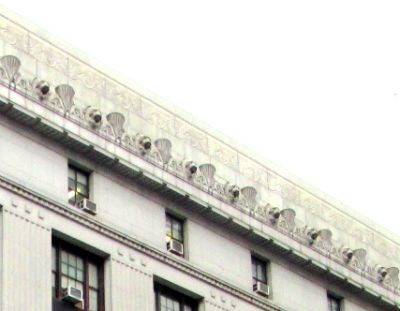
Here is information on the building:
The Lefkowitz Building is adjacent to Foley Square and is bounded by Worth, Centre, Leonard and Baxter Streets. It houses offices of the Manhattan District Attorney and various court offices.
The block-long building has nearly 700,000 square feet of office space in its nine stories, plus penthouse and basement levels. It is constructed of Maine Coast granite. The Centre Street lobby is decorated in an elaborate Art Deco Egyptian design.
The building opened in 1930 as a central home for state government offices in Lower Manhattan. In 1984, it was renamed to honor Louis J. Lefkowitz, New York State’s longest-serving Attorney General. The building was transferred to City management in 2002.
The Office of the City Clerk and its Manhattan Marriage Bureau moved to the building in 2009 from the Manhattan Municipal Building. The Clerk’s Office is reached through a separate entrance at 141 Worth Street.
William Haugaard, state architect, designed 80 Centre Street under a height restriction so that it would not overshadow the nearby courthouses and symmetry of Foley Square. It was constructed by Cauldwell Vingate Company at a cost of $6 million.
The new building was greeted with great fanfare at a groundbreaking ceremony on December 17, 1928. The band played “Sidewalks of New York” as Governor Alfred E. Smith laid the cornerstone containing a time capsule with records, newspapers and photographs of that day.
Saturday, March 16, 2013
Irish Charms

Lake Isle of Innisfree
[Photo by: Pictures of Ireland]
Lake Isle of InnisfreeAs always, with all things beautiful, there is a string of associations.
by William Butler Yeats
I will arise and go now, and go to Innisfree,
And a small cabin build there, of clay and wattles made:
Nine bean-rows will I have there, a hive for the honey-bee,
And live alone in the bee-loud glade.
And I shall have some peace there, for peace comes dropping slow,
Dropping from the veils of the mourning to where the cricket sings;
There midnight's all a glimmer, and noon a purple glow,
And evening full of the linnet's wings.
I will arise and go now, for always night and day
I hear lake water lapping with low sounds by the shore;
While I stand on the roadway, or on the pavements grey,
I hear it in the deep heart's core.
This perfume company has created a scent which it calls Innisfree, after Yeats' poem:
The scent has been developed by us in collaboration with one of the world's leading perfume 'noses' and includes, at its core, lavender oil distilled by us from our field of lavender in County Wicklow - 'the Garden of Ireland'. It is a magical fruit and floral fragrance; the top notes are an accord of Lily of the Valley and fruit notes of Peach, Blackcurrant, and Apricot, in conjunction with Lemon, Bergamot and Lavender. The middle notes are an accord of Jasmine, Rose and Iris constructed on a smooth foundation of the base notes of Sandalwood, Cedarwood and Musk. The overall effect of the fragrance is lightness, freshness and youthful zest which develops into a classically elegant and very rich woody floral perfume of great depth and transparency. There can be no better evocation of all the softness, greenness and richness which compose Ireland. It is a celebration of femininity, nature and Ireland.
We feel that Ireland's beauty, nature and spirit have much to offer the world. Essentially, it is a place of inner peace, which is why so many people travel to experience it. We have tried to capture this in our perfume.

"I hear it in the deep heart's core"
----------------------------------------------------------------------------------------------------------------------------------------------------------
My friendly Irish Pub, Failte, is celebrating St. Patrick's Day all week-end long. I went there yesterday afternoon with my various computer gadgets and a book, and thought it would be a peaceful afternoon of a 1/2 pint of Harp. Instead, I was welcomed with a burst of Irish music.
I asked the Portuguese waiter (Failte's general manager is Portuguese. I had asked him a few weeks ago if I could take photos of the interior, and he gave me his card. "Your name looks Portuguese" I said, which he confirmed) if I could sit in the back, away from the conundrum. But, the music traveled in joyful waves across the various divisions of the pub to where I was sitting. I stopped what I was doing to listen. Irish music is like nothing else. The songs don't sound like English folk songs, or French, or Scottish, which all have some similarity. I'm not sure what it is. I'll have to study it. It seems like a combination of the plaintive and the joyful, a meshing of sadness and happiness.
Below is an online source I found by googling 'analyzing Irish Music.' I don't think it is particularly difficult to understand.
According to Breandan Breathnach in his "Folk Music & Dances of Ireland" there are only two major scales relevant to Irish folk music: the Dmajor scale and the Gmajor scale. Both of these scales fit naturally on the whistle/flute/pipes in D. [Note: Most Irish musicians who play an instrument in a different key than D still tend to think about it (and talk about it) as if it were in D. But the accompanists will have to transpose in such a case. Guitar/bouzouki players will usually resort to using a capo.]I don't want to bore the readers, but musicians (amateur guitar players, or symphonic orchestra players) might be interested to read more here.
By repeatedly applying a process that Breathnach calls "inversion", which simply means detaching the first note from the scale, and appending it (actually, it's octave higher equivalent) to the end of the scale, 7 alternate scales can be derived from this major scale: the "modal" or church music scales. Of these "modal" scales (again according to Breathnach) only 3 are relevant for Irish folk music: the ones based on the 2nd, 5th and 6th note of the major (or Ionian, as it is called in church music) scale, resulting respectively in Dorian, Mixolydian and Aeolian scales.
Scales based on Dmajor:
D major/D Ionian: D E F# G A B C# d
E Dorian: E F# G A B C# d e
A Mixolydian: A B C# d e f# g a
B Natural minor/Aeolian: B C# d e f# g a b
G major/G Ionian: G A B C D E F# g
A Dorian: A B C D E F# g a
D Mixolydian: D E F# g a b c d
E Natural minor/Aeolian: E F# g a b c d e
These 8 scales are the basis for Irish folk/dance music, and will lead us to deriving the appropriate chords for providing backup for this type of music. [Note: occasionally you will come across a tune in Amajor, a key which is not listed here. I've heard a theory (I think it was Arty McGlynn who told me this) that these tunes are not originally Irish, but imported from Scotland. The ideas presented here do not apply to such tunes - these can be dealt with using ordinary "Western art music" chord theory.]
I googled again (please excuse the lack of sophistication) 'Irish music sad and joyful' and I found a musician (I'd never heard about) say this about Irish music:
While in general you are dealing with something sad, sadness occurs but at the same time there’s a kind of equilibrium that comes back in some kind of joy, and in this particular piece, I think I tried to express the idea that life, no matter how brief, is nevertheless majestic.Michael Culhane is talking about his daughter's twins, one who died before birth, while the other was born healthy. So there was loss and sadness, birth and a joy, at this event, which Culhane transposed into his music. This mixture of emotions is of course not solely an Irish trait, but perhaps Irish music captures it best.
Last year, I accidentally walked into a St. Patrick's Day Parade, which I wrote about at Camera Lucida. I compared the modest parade to the aggressive, loud and large Gay Pride parade, and the equally noisy Caribbean Carnival, both of which get government funding to hold their events. The Irish get nothing. Multiculturalism is for select cultures.
Toronto hosts the largest "gay pride" parade in North America, where half naked men and women prance around the streets, rerouting traffic and unsuspecting pedestrians away from the main streets. And the Caribbean Carnival, where there is at least one gun shot, if not murder, every year, brings in thousands of tourists from the Caribbean. The city foots a portion of the bills for both these events. These parades take over the several blocks of streets, and fill the television and newspaper news for days.I also wrote about some brief interactions I had with reveling, polite, Irish-Canadians:
The official St. Patrick's Day parade was last Sunday, and was hardly noticeable. There were no dramatic stories other than a few green-haired jumping leprechauns. It is organized by the The St. Patrick's Parade Society of Toronto, and if you look at their sponsors, not one is a government agency.
Here in Toronto, there was emerald green everywhere today, although the official parade took place last Sunday. It was a rather cloudy day, so the green could be seen from a distance, peppering the streets. What a refreshing gathering of people, who are having a good time, and remembering a good thing. Let's not forget that this is all for St. Patrick, as one girl reminded me when I wished her group "Happy Irish..." "St. Patrick's Day!" we both finished at the same time.The Irish Embassy is actually a pub in downtown Toronto. I pass by it regularly on Yonge Street. I realized this after I walked away from the group and the parade. I've taken photos of the stately building, as well as the pleasant interior. In my long database (some unclassified) of photos, I cannot find what I took. I'll make a quick trip back one day.
I overheard some guy say that the Irish Embassy will be pretty busy tonight.
In the meantime, here is the interior, with portraits of various famous Irish, including the poet Yeats, from the Irish Embassy website.
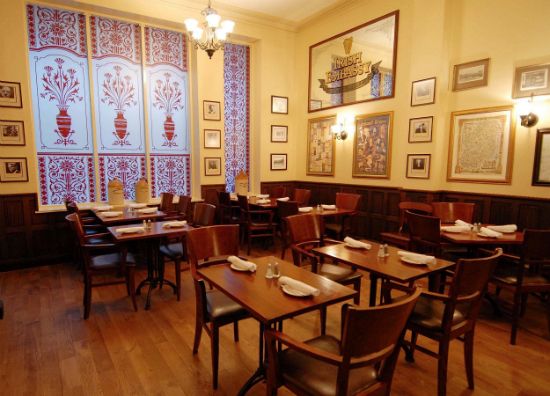
Yeats' portrait is at the bottom left hand corner:

While in the pub, I checked on the stencils in the back. They're not etched or painted on the glass, but are plastic stick-ons. A little disappointing. But it looks pretty. I wonder if they are copies of an original. The building itself is a renovated landmark:
The first branch of The Bank of North America in Toronto was built in 1845 at the northeast corner of Yonge Street and Wellington. It was designed by architect John Howard.

The redesigned building (it looks like a total demolition, and restructuring) was built in 1875 by Hugh Langley.
This blogger says about the reconstruction:
The structure that replaced the 1845 bank building opened in 1875. The “Royal Arms” from above the doorway of the previous building were relocated to the new structure. However, they have since been removed, likely due to the danger of them falling to the street below. I have been unable to determine their present location. Designed by Henry Langley, the building was described as a structure that reflected the opulence and resources that were appropriate for a successful bank. Others felt that the bank brought to Toronto a sophistication that was reminiscent of those structures found on a Parisian boulevard. Interestingly, it was Henry Langley who popularized in Toronto the Second Empire style with its Mansard roofs. The new bank building was constructed of Ohio sandstone and richly decorated with classical designs. Even today, its Mansard roof appears impressive. Originally, the main entrance to the building was on Wellington Street, but as Yonge Street emerged as the city’s main thoroughfare, the doorway was relocated without any loss of splendour.This seems to be the history of Toronto: restructuring its identity to bring it a sophistication that [is now] reminiscent of those structures found on a [New York Avenue].
I cannot find any information on why the original building from 1845 was replaced in 1875. This was long before the Yonge Street Fire of 1904, which destroyed many heritage buildings along the street. It could be that Torontonians wanted something they perceived as grand, but not ostentatious, which is what the second building looks like.
The current Irish Embassy Pub took over part of the building, and opened on St. Patrick's Day in 2000.
The Irish Charms of a Leprechaun on Yonge Street (Toronto, St. Patrick's Day 2012)
----------------------------------------------------------------------------------------------------------------------------------------------------------
Posted By: Kidist P. Asrat
Friday, March 15, 2013
Daffodils!

Photo by Kidist P. Asrat
The Allan Gardens, in downtown Toronto, has a beautiful Victorian conservatory. Right in front of the conservatory, the diligent garden staff plants seasonal plants. Needless to say it is pretty bare during the winter.
Then there is an explosion of Spring, around mid-March.
Here are the daffodils!
Daffodils
By William Wordsworth
I wandered lonely as a cloud
That floats on high o'er vales and hills,
When all at once I saw a crowd,
A host, of golden daffodils;
Beside the lake, beneath the trees,
Fluttering and dancing in the breeze.
Continuous as the stars that shine
And twinkle on the milky way,
They stretched in never-ending line
Along the margin of a bay:
Ten thousand saw I at a glance,
Tossing their heads in sprightly dance.
The waves beside them danced; but they
Out-did the sparkling waves in glee:
A poet could not but be gay,
In such a jocund company:
I gazed--and gazed--but little thought
What wealth the show to me had brought:
For oft, when on my couch I lie
In vacant or in pensive mood,
They flash upon that inward eye
Which is the bliss of solitude;
And then my heart with pleasure fills,
And dances with the daffodils.
Daffodils at the Allan Gardens
Photo by Kidist P. Asrat
Shifting Towards Oblivion: No Place to Stand, No Place to Grow*

A Canadian Dhimmi and his Canadian Contribution
(By the way, the "T" of "Shift" is deliberately designed to bleed off the book cover.
This is a cleaver way of "shifting" the text, and its meaning along. Out of the picture?)
* The second part of this post's title comes from Ontario's national anthem:
Give us a place to stand-------------------------------------------------------------------------------------------------------------------------------------------------------------
And a place to grow
And call this land Ontario.
A place to live
For you and me
With hopes as high
As the tallest tree.
Give us a land of lakes
and a land of snow
And we will build Ontario
A place to stand, a place to grow
Ontario!
From western hills,
To northern shores.
To Niagara Falls,
Where the waters roar.
Give us a land of peace,
Where the free winds blow.
And we will build Ontario
A place to stand, a place to grow
Ontario!

John Ibbitson at the 4.58 point of the interview on Television Ontario
"I'm an optimist"
John Ibbitson, of the New Canadian Conservative (my label), is being interviewed by the astute and intelligent Steve Paiken of Television Ontario (TVO) - video of the full interview here). He has just written a book called The Big Shift: The Seismic Change In Canadian Politics, Business, And Culture And What It Means For Our (Darrett Bicker and John Ibbitson, 2013).
The cover of the book is worth noting. It has the Canadian flag, but instead of the red and white, it is blue and white. I cannot find any explanation for this, other than Ibbitson's underhanded way of saying that Canada is turning away from Liberal Red to Tory Blue.
This Toronto Star writer concurs:
Anyone who has been paying attention to the so-called “visuals” of governance from Ottawa these past few years cannot help but notice the efforts to change the colour of Canada from Liberal red to Tory blue.Here is the definition of the Blue Tories:
Blue Tories, also known as small 'c' conservatives, are, in Canadian politics, members of the former federal Progressive Conservative Party of Canada, current Conservative Party of Canada and provincial Progressive Conservative parties who are more economically right wing. Prior to the 1960s, these Conservatives were most identified with the Montreal and Toronto commercial elite who took positions of influence within the Progressive Conservative Party. Since the mid-1970s, they have been heavily influenced by the neo-liberal movement. Blue Tories tend to favour neo-liberal policies such as devolution of federal power to the provincial governments, a reduced role for government in the economy, reduction of taxation and similar mainstream neoconservative ideals. The term Blue Tory does not refer to social conservatism.[Source: Wikipedia]And of the Red Tories:
A Red Tory is an adherent of a particular political philosophy, tradition, and disposition in Canada somewhat similar to the High Tory tradition in the United Kingdom.[Source: Wikipedia]And
High Toryism is a term used in Britain, Canada, Australia and elsewhere to refer to a traditionalist conservatism which is in line with the Toryism originating in the 17th century. High Tories and their worldview are sometimes at odds with the more liberal and cosmopolitan elements of the Conservative Party in these countries at present.[Source: Wikipedia]This Globe and Mail journalist, who has lived his whole career moving further away from his people and his country, is revealed conclusively to be a willing apologist for the formidable non-white population that is now ready to take over and replace him and his country. He's doing so without a fight and not even a whimper, but with a dhimmitized acquiescence. He is willing and ready to shift.
And the new, replacement population is formidable. It wants nothing less than replacement of whites by non-whites from China, India, the Middle East, Africa and Latin America. The most vocal, prominent and so-far successful groups are those from China (and their offspring) and India (and their offspring).
Still, Ibbitson is a sorry example for whites. His unkempt hair, his lop-sided tie, his haggard features, and above all, his soft but panicked eyes show us that he is petrified of what will happen. But his multicultural ideology, his belief in "equality," and his probable gastronomical indulgence in ethnic foods which these immigrants bring right to his doorway, doesn't let him realize the utter danger he is in. He ends up writing a book which he titles The Big Shift which exposes every corner of his mushy brain for the fallacies it holds.
Below are excerpts from the TVO interview which pertain to immigrants, immigration and multiculturalism.
Ibbitson says:
The Lauratian elites [those governing elites in Toronto, Ottawa, Montreal and other cities along the St. Lawrence River or its watershed] doesn't [sic] realize that Canada no longer belongs to them. A country that was once part of the Atlantic world is becoming part of the Pacific world. The provinces that mattered most don't matter as much any more. The country's center has shifted west, and the power has shifted with it. In fact, power is now shared by two groups: Westerners, and Ontario's suburban middle class, especially the immigrant suburban middle class. In terms of power and priorities, nothing else and no-one else is as important.The astute interviewer of The Agenda, Steve Paiken, who hosts the show, asks Ibbitson:
Do you feel bad about that?Ibbitson replies:
No. It's not that I don't like the Canada that the Laurentian elites created. In fact I love the Canada that the Laurentian elites created.And here's the zinger:
I love especially the multiculturalism that they created. The fact that we did open our doors, as no other country on earth has opened its doors, to so many people, from so many places. But they're [current immigrants] not the people who came here, for example, after the Second World War. They're not the people like my ancestors who came here after the First World War. They have different priorities, different interests. Some of them are different from mine. What I love is the fact that they are seizing the country. And they are seizing the agenda. And they are driving us forward. And I do believe it is forward. I love the idea that the west is no longer a region; it is the new center. I love the idea that Canada is becoming a Pacific nation rather than an Atlantic nation. There are things that I regret. But I'm essentially an optimist. I'm an optimist especially about the fact that new immigrant Canadians are embracing the country and driving a kind of nationalism, a patriotism even, that our generation was embarrassed ever to embrace. So on the whole I think it is a good thing.And later:
One of the things the Laurentian elites always believed was that Canada was fragile. It could break up at any moment. Ungovernable. It was like a humming bird. Theoretically it can't fly and yet it does. So, yes, there is a shift in power. Yes, one region that used to be peripheral is becoming central. But that doesn't make the country any less governable. It's going to make changes, absolutely. One of the things we talk about in the book is the "Ottawa River Curtain" where everything east of the Ottawa River - Quebec and Atlantic Canada - they're not bringing in immigrants. They're not even trying very hard, frankly, to bring in immigrants. Their population in consequence are aging and declining. Their economies are aging and declining. And the assumption that the Laurentianites have maintained, which is that there would be inter-regional transfers of wealth from the richer parts of the country to the poorer parts of the country, I don't think that these immigrant Canadians themselves embrace. They want to know why. Why is money going to these people? Why is seasonal industry considered so important? Why must the equalization program be what it is? So there are going to be challenges, there are going to be tensions, there are going to be stresses. But we've never been farther away on a Quebec referendum on separation than we are right now, even with a PQ government in Quebec. And I think it cannot weaken the country to have the west now not only in, but running the place. A region that was considered itself to be on the periphery at one time.Paiken asks:
I want to ask about that coalition. How do South Asian immigrants living in Toronto's suburbs have anything in common with white rural voters, or westerners? Because that's the coalition I gather, right?Ibbitson:
I guess the alternative coalition is what you want to oppose as an opposite...Those suburban immigrant voters in the (905) [telephone area code] are from China, are from India are from Philippines, are from Pacific nations. They are themselves here, succeeding, and wanting to succeed more. Those values are far more in alignment with the values in Calgary, and even Vancouver, and even Winnipeg...than they are with the notions of redistribution of incomes, protection of declining and diminishing populations and economies in the west. I don't see how you get (905) immigrant voters to make common cause with Quebec and Atlantic voters. I see every reason why they would make common cause with western voters. In fact, I see every reason why Ontario, because of immigration, is becoming what we call a Pacific and not Atlantic province.Further on:
The demographic fundamentals favor the conservatives. And the issues favor the conservatives. Actually not the issues, there's just one, there's the economy. And because of the recession, and because immigrant Canadians are rightly, focused on improving the quality of their own lives, improving their incomes, improving the chances for their own children, the economy is the one that trumps all the other issues.Ibbitson finally talks about the "deep patriotism" these "new immigrants" have for Canada. Of course they will defend all the gains that they enjoy: good schools, jobs, clean air, safe highways, friendly Ibbitson-types, groceries and stores full of (good) goods, and T.V. with 100+ stations. What's not to love? If these are gone, then their whole enterprise has failed.
But, there is also another "patriotism" that comes from these immigrants, and it is based on anti-Americanism. The hostility towards America that many Canadians have is doubly manifested in these immigrants. They come hating America, and have found the ideal location, a country almost like America, where they can grow their clinging roots, and realize their mostly materialistic opportunities.
So, I expect anti-Americanism, and its corollary, anti-Westernism, which also includes anti-Canadianism, which ultimately means anti-whitism, to grow even more with the coming generations as these new immigrants multiply into several generations.
And at some point, both immigrants and whites are going to realize that there are other identifiable issues like culture, language, religion that will start to take-over materialistic ones. I agree that immigrants come here to "make a better life." Ibbitson's ancestors also came over after WWI probably for the same reason. But they came to live within the constraints of the new country they arrived in. They didn't plan to, or want to, change it. And they in fact improved it.
Now immigrants, while with one hand reaping the wealth of the country, are giving it nothing back either economically or culturally. It is a fallacy that these current immigrants are making Canada wealthier, and it is a fallacy that their cultures are improving what we have. In fact there is a net loss on all counts.
So, ultimately, current immigrants are like parasites, Taking away, feeding off the blood, but giving nothing substantial back. But their agenda is bigger. It is a re-establishment of those cultures they left behind on the ready-made, wealthy and abundant Canadian soil. But in doing so, they are also destroying those very Canadian qualities that urged them to pack their bags and fly (no-one takes ships anymore) over.
Poor Ibbitson. Poor Canada. Oh Chanada!
------------------------------------------------------------------------------------------------------------------------------------------------------------
Posted By: Kidist P. Asrat
------------------------------------------------------------------------------------------------------------------------------------------------------------
Subscribe to:
Posts (Atom)