Monday, April 22, 2013

Book Project: The Truth That Follows George Washington


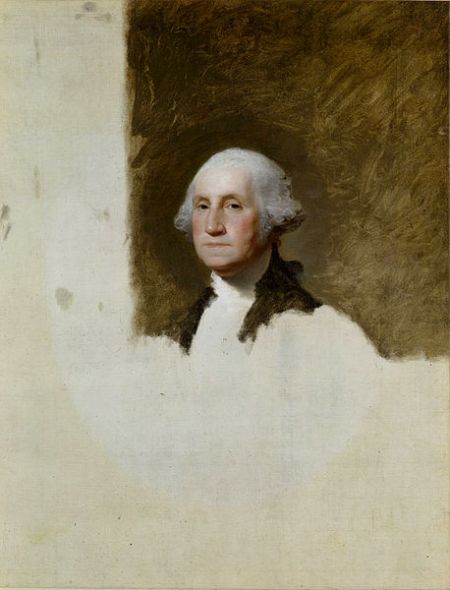
Gilbert Stuart (1755–1828)
George Washington: The Athenaeum Portrait
1796
Oil on canvas
48 x 37 in
Jointly owned by the National
Portrait Gallery, Smithsonian
Institution, Washington
and the Museum of Fine Arts, Boston


-------------------------------------------------------------------------------------------------------------------------------------------------------------

The article below is a compilation of several posts from my blogs Camera Lucida and Our Changing Landscape:
- Forces of Nature
- Washington: The Legend
- The State of Affairs of Our Modern world.

I will put it in one of the following Reclaiming Beauty chapters: Beauty Truth and Goodness, Beauty in Art, or Beauty in Culture and Society under Myths and Legends, with the same title: The Truth That Follows George Washington.

-------------------------------------------------------------------------------------------------------------------------------------------------------------

George Washington's prolific portraitist, Gilbert Stuart, painted approximately seventy-five portraits of the President, but used three portraits as references for all the rest (1). The Athenaeum Portrait is Stuart's most reproduced portrait, and is so called after the Boston Athenaeum which originally bought it. Stuart never finished this portrait. It was Washington's second sitting with Stuart, and perhaps Stuart didn't yet know how to appease the irritable Washington, who might have thought portrait painting a frivolous affair, and didn't like the long sittings. By the time Stuart painted his third portrait, he know that he could appease the accomplished equestrian through discussions about horses. The other two portraits are the Vaughan Portrait, where Washington is facing to his left, and the Landsdowne Portrait of Washington in full-length. The portraits are named after the owners. In the Athenaeum, Washington is facing to his right.

The Athenaeum Portrait provides an extraordinary vision of the President. Despite its unfinished state, Stuart manages to convey a strong vision of Washington emerging as though from some primordial matter, like a force entering our world. It was as though Washington were completely formed, somewhere behind the canvass, and Stuart was simply pulling him out with his brush and paint tools.

The French sculptor Rodin said that he could see the forms within the stones he chose for his sculptures, and all he he did was to entice them out of their hiding. He also left unfinished works, perhaps finding these forces to strong, and too alive, to contend with (2).
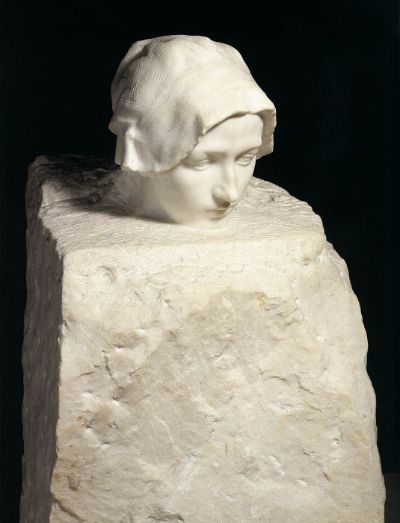

Auguste Rodin (1840-1917)
Thought
1886-89
Marble
Height 74 cm
Musée d'Orsay, Paris

In 1886 Rodin began modeling a portrait of Camille Claudel in traditional costume. When his assistant Victor Peter, executing the work in marble, reached the collar, Rodin made him stop: the head emerging from the block offered the contrast, as in Michelangelo, of a finished section imprisoned in the rough-hewn stone. This triumph of sculpture was exhibited as it was at the Salon in 1895, entitled Head. Only later did it receive its Symbolist title of Thought Emerging from Matter, then simply Thought (3).
Perhaps Stuart, like Rodin, was aiming for something bigger than he could handle. But, it is a calm Washington that emerges in the Athenaeum Portrait, exuding a steady temperament and ready to enter our world and to put it right. It is the unfinished nature of the painting which conveys this, and Stuart may be a greater artist than I give him credit for. This portrait is probably as much about Stuart's perseverance and patience as it is about Washington's character.

The Smithsonian's National Portrait Gallery in Washington D.C. explains Stuart's technique for the Athenaeum Portrait (4):
The strikingly fresh aspect of this life portrait of Washington comes from Stuart's application of subtly varied skin tones in separate, unblended touches of the brush. His technique is visible even in the shaded areas under the chin, where Stuart alternated darker and lighter flesh tones to indicate shadow and reflected light. The president's white-powdered hair and blue eyes stand out in contrast.
And the biographical notes on Stuart at the National Gallery of Art biography say this (5):
[Stuart] used it [the Athenaeum Portrait] throughout his career to make approximately seventy-five replicas, and the image - carefully built up with contrasting flesh tones - is one of Stuart’s most accomplished portraits.
Stuart spent time on Washington's face, once again supporting my idea that the process exhausted his artistic energy. He used this completed (or detailed) visage as his reference for his many other completed paintings of Washington, since perhaps using a painting reproduction was an easier reference than Washington himself.

Pictures don't lie, at least I don't think they do. And they often succinctly tell us truths which can easily be camouflaged by clever words or clever techniques. Despite Stuart's difficulties, he gave us one of the best portraits of Washington, depicting both his strength and his wisdom.

Another artist, the French sculptor Jean-Antoine Houdon, produced a life-like bust of Washington, which is now at the Morgan Library in New York (6). Houdon made a cast of Washington's face, and returned to France to complete his work. Washington had to remain behind the drying mask with his eyes closed, and Houdon had to use his creative powers to bring to bring life back into Washington's eyes. Like his countryman Rodin, he let the sculpture breath its own life in to the bust, and like Stuart, he gave Washington the calm, confident strength. As described in Ron Chernow's Washington: A Life (7):
The conscientious Houdon...asked if he could shadow Washington on his daily rounds and study his face and movements in social interactions. During the next two weeks he even attended a funeral with Washington and took part in the wedding of George Augustine Washington and Fanny Bassett. It reveals a good deal about Houdon’s genius that the most expressive moment for him came when Washington flared up indignantly as he haggled over a pair of horses; always a tough bargainer, Washington thought the other trader was asking too much. During this sudden flash of anger, Houdon thought he spied the inner steel in Washington’s nature.
Chernow continues with Houdin's paring down the bust to "essential truths about Washington":
Methodical in his own habits, Washington was naturally fascinated by the systematic effort that Houdon poured into each step of the artistic process. On October 6 the Frenchman began working on a terra-cotta bust that was likely a preliminary step in creating the full-length sculpture.

...To the extent possible, Houdon dispensed with artistic conventions and pared down the bust to essential truths about Washington, making him life-size and lifelike. The sculpted face is strong and commanding, and the skin smooth, without the crags time later carved into the cheeks. As Washington turns his head, his shrewdly appraising eyes seem to scan the far horizon. Washington’s expression is forceful, his determination evident in his narrow gaze, matched by the muscular strength of his shoulders. Because his hair isn’t fluffed out at the sides, the bust accentuates the hard, lean strength of his face. Houdon captured both the aggressive and the cautious sides of Washington, held in perfect equipoise.
Lawrence Auster wrote about Washington in a similar fashion (8):
We are so accustomed to the Gilbert Stuart portraits, painted in Washington’s sixties when he was already showing premature signs of age (though his firmness of character was not diminished), that it can be a shock to see a more vital Washington. Here is a marvelously life-like image of the then 53-year-old Washington rarely seen by Americans, one of the heads sculpted by Jean Antoine Houdon from the life mask he cast when he visited Mount Vernon in 1785, now at the Museum of the Louvre in Paris. Houdon told a friend he was in awe of "the majesty and grandeur of Washington’s form and features." One has the same awe at Houdon’s genius; it is to be doubted that any photograph could make us feel that we are as close to the living man as he really was.
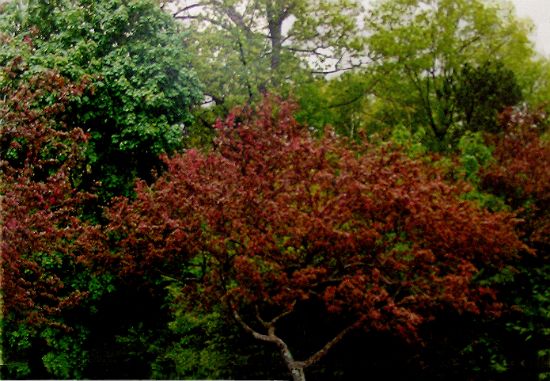
High Park Cherry Tree
Photograph by: Kidist P. Asrat
ca. 1997


And Truth was never far behind Washington. A famous legend which followed him throughout his life recounts his awakening to truth when confronted by his father (9):
Never did the wise Ulysses take more pains with his beloved Telemachus, than did Mr. Washington with George, to inspire him with an early love of truth. "Truth, George"' (said he) "is the loveliest quality of youth. I would ride fifty miles, my son, to see the little boy whose heart is so honest, and his lips so pure, that we may depend on every word he says. O how lovely does such a child appear in the eyes of every body! His parents doat on him; his relations glory in him; they are constantly praising him to their children, whom they beg to imitate him. They are often sending for him, to visit them; and receive him, when he comes, with as much joy as if he were a little angel, come to set pretty examples to their children."
But George Washington had told a lie, when he was six years old (10):
When George," said [an excellent lady], "was about six years old, he was made the wealthy master of a hatchet! of which, like most little boys, he was immoderately fond, and was constantly going about chopping every thing that came in his way. One day, in the garden, where he often amused himself hacking his mother's pea-sticks, he unluckily tried the edge of his hatchet on the body of a beautiful young English cherry-tree, which he barked so terribly, that I don't believe the tree ever got the better of it. The next morning the old gentleman [Washington's father] finding out what had befallen his tree, which, by the by, was a great favourite, came into the house, and with much warmth asked for the mischievous author, declaring at the same time, that he would not have taken five guineas for his tree. Nobody could tell him any thing about it. Presently George and his hatchet made their appearance. George, said his father, do you know who killed that beautiful little cherry-tree yonder in the garden? This was a tough question; and George staggered under it for a moment; but quickly recovered himself: and looking at his father, with the sweet face of youth brightened with the inexpressible charm of all-conquering truth, he bravely cried out, "I can't tell a lie, Pa; you know I can't tell a lie. I did cut it with my hatchet."--Run to my arms, you dearest boy, cried his father in transports, run to my arms; glad am I, George, that you killed my tree; for you have paid me for it a thousand fold. Such an act of heroism in my son, is more worth than a thousand trees, though blossomed with silver, and their fruits of purest gold.
The story is of course not only of telling the truth, but of telling the truth after one had told a lie. To recant, to accept one's guilt, and to rectify the error is what George Washington did, and why his father so whole-heartedly forgave him. And why we still hold this legend dear, which gives us the essential truth about George Washington.

It is a great legend to have for a nation's founding leader.

-------------------------------------------------------------------------------------------------------------------------------------------------------------

References:
1. Gilbert Stuart: Philadelphia (1794-1803). Notes on the National Gallery Art Exhibition, March 27-July 31, 2005.
http://www.nga.gov/exhibitions/2005/stuart/philadelphia.shtm

2. Thought (Portrait of Camille Claudel). Web Gallery of Art
http://www.wga.hu/html_m/r/rodin/3busts/claudel.html

3. Ibid

4. Gilbert Stuart. George Washington: The Athenaeum portrait. The Smithsonian National Portrait Gallery, Washington D.C.
http://www.npg.si.edu/cexh/stuart/athen1.htm

5. Gilbert Stuart: Philadelphia (1794-1803). Notes on the National Gallery Art Exhibition, March 27-July 31, 2005.
http://www.nga.gov/exhibitions/2005/stuart/philadelphia.shtm

6. Gilbert Stuart George Washington Life Mask: Morgan Library, New York.
http://www.themorgan.org/exhibitions/gwlifemask.asp

7. Chernow, Ron (2010). Washington: A Life. p. 511. Penguin USA.

8. Auster, Lawrence. (February 20, 2004). Washington's Birthday. View From the Right.
http://www.amnation.com/vfr/archives/002212.html

9. Mason Locke Weems (1809). The Fable of George Washington and the Cherry Tree
In: The Life of Washington. M.E. Sharpe. 1996 Armonk NY

10. Ibid

-------------------------------------------------------------------------------------------------------------------------------------------------------------
Posted By: Kidist P. Asrat
Friday, April 19, 2013

"Is Christianity Hard or Easy?"


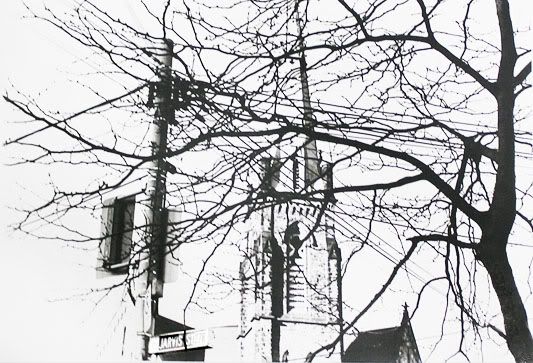
Jarvis Street Baptist Church, Toronto
Photograph By: Kidist P. Asrat
2001
From Winter's Patterns (Camera Lucida)

Below is Chapter 30 from C. S. Lewis' Mere Christinity: Is Christianity Hard or Easy?

-------------------------------------------------------------------------------------------------------------------------------------------------------------

Mere Christianity
C. S. Lewis

Chapter 30
Is Christianity Hard or Easy?

In the previous chapter we were considering the Christian idea of 'putting on Christ,' or first 'dressing up' as a son of God in order that you may finally become a real son. What I want to make clear is that this is not one among many jobs a Christian has to do; and it is not a sort of special exercise for the top class. It is the whole of Christianity. Christianity offers nothing else at all. And I should like to point out how it differs from ordinary ideas of 'morality' and 'being good'.

The ordinary idea which we all have before we become Christians is this. We take as starting point our ordinary self with its various desires and interests. We then admit that something else - call it `morality' or 'decent behaviour,' or 'the good of society'- has claims on this self: claims which interfere with its own desires. What we mean by 'being good' is giving in to those claims. Some of the things the ordinary self wanted to do turn out to be what we call 'wrong': well, we must give them up. Other things, which the self did not want to do, turn out to be what we call 'right': well, we shall have to do them. But we are hoping all the time that when all the demands have been met, the poor natural self will still have some chance, and some time, to get on with its own desires. What we mean by `being good' is giving in to those claims. Some of the things the ordinary self wanted to do turn out to be what we call `wrong'; well, we must give them up. Other things, which the self did not want to do, turn out to be what we call 'right': well, we shall have to do them. But we are hoping all the time that when all the demands have been met, the poor natural self will still have some chance, and some time, to get on with its own life and do what it likes. In fact, we are very like an honest man paying his taxes. He pays them all right, but he does hope that there will be enough left over for him to live on. Because we arc still taking our natural self as the starting point.

As long as we are thinking that way, one or other of two results is likely to follow. Either we give up trying to be good, or else we become very unhappy indeed. For, make no mistake: if you are really going to try to meet all the demands made on the natural self, it will not have enough left over to live on. The more you obey your conscience, the more your conscience will demand of you. And your natural self, which is thus being starved and hampered and worried at every turn, will get angrier and angrier. In the end, you will either give up trying to be good, or else become one of those people who, as they say, 'live for others' but always in a discontented, grumbling way - always wondering why the others do not notice it more and always making a martyr of yourself. And once you have become that you will be a far greater pest to anyone who has to live with you than you would have been if you had remained frankly selfish.

The Christian way is different: harder, and easier. Christ says `Give me All. I don't want so much of your time and so much of your money and so much of your work: I want You. I have not come to torment your natural self, but to kill it. No half-measures are any good. I don't want to cut off a branch here and a branch there, I want to have the whole tree down. I don't want to drill the tooth, or crown it, or stop it, but to have it out. Hand over the whole natural self, all the desires which you think innocent as well as the ones you think wicked - the whole outfit. I will give you a new self instead. In fact, I will give you Myself: my own will shall become yours.'

Both harder and easier than what we are all trying to do. You have noticed, I expect, that Christ Himself sometimes describes the Christian way as very hard, sometimes as very easy. He says, 'Take up your Cross'- in other words, it is like going to be beaten to death in a concentration camp. Next minute he says, 'My yoke is easy and my burden light.' He means both. And one can just see why both are true.

Teachers will tell you that the laziest boy in the class is the one who works hardest in the end. They mean this. If you give two boys, say, a proposition in geometry to do, the one who is prepared to take trouble will try to understand it. The lazy boy will try to learn it by heart because, for the moment, that needs less effort. But six months later, when they are preparing for an exam, that lazy boy is doing hours and hours of miserable drudgery over things the other boy understands, and positively enjoys, in a few minutes. Laziness means more work in the long run. Or look at it this way. In a battle, or in mountain climbing, there is often one thing which it takes a lot of pluck to do; but it is also, in the long run, the safest things to do. If you funk it, you will find yourself, hours later, in far worse danger. The cowardly thing is also the most dangerous thing.

It is like that here. The terrible thing, the almost impossible thing, is to hand over your whole self - all your wishes and precautions - to Christ. But it is far easier than what we are all trying to do instead. For what we are trying to do is to remain what we call 'ourselves,' to keep personal happiness as our great aim in life, and yet at the same time be 'good'. We are all trying to let our mind and heart go their own way-centred on money or pleasure or ambition-and hoping, in spite of this, to behave honestly and chastely and humbly. And that is exactly what Christ warned us you could not do. As He said, a thistle cannot produce figs. If I am a field that contains nothing but grass-seed, I cannot produce wheat. Cutting the grass may keep it short: but I shall still produce grass and no wheat. If I want to produce wheat, the change must go deeper than the surface. I must be ploughed up and re-sown.

That is why the real problem of the Christian life comes where people do not usually look for it. It comes the very moment you wake up each morning. All your wishes and hopes for the day rush at you like wild animals. And the first job each morning consists simply in shoving them all back; in listening to that other voice, taking that other point of view, letting that other larger, stronger, quieter life come flowing in. And so on, all day. Standing back from all your natural fussings and frettings; coming in out of the wind.

We can only do it for moments at first. But from those moments the new sort of life will be spreading through our system: because now we are letting Him work at the right part of us. It is the difference between paint, which is merely laid on the surface, and a dye or stain which soaks right through. He never talked vague, idealistic gas. When he said, `Be perfect,' He meant it. He meant that we must go in for the full treatment. It is hard; but the sort of compromise we are all hankering after is harder - in fact, it is impossible. It may be hard for an egg to turn into a bird : it would be a jolly sight harder for it to learn to fly while remaining an egg. We are like eggs at present. And you cannot go on indefinitely being just an ordinary, decent egg. We must be hatched or go bad.

May I come back to what I said before? This is the whole of Christianity. There is nothing else. It is so easy to get muddled about that. It is easy to think that the Church has a lot of different objects education, building, missions, holding services. Just as it is easy to think the State has a lot of different objects - military, political, economic, and what not. But in a way things are much simpler than that. The State exists simply to promote and to protect the ordinary happiness of human beings in this life. A husband and wife chatting over a fire, a couple of friends having a game of darts in a pub, a man reading a book in his own room or digging in his own garden - that is what the State is there for. And unless they are helping to increase and prolong and protect such moments, all the laws, parliaments, armies, courts, police, economics, etc., are simply a waste of time. In the same way the Church exists for nothing else but to draw men into Christ, to make them little Christs. If they are not doing that, all the cathedrals, clergy, missions, sermons, even the Bible itself, are simply a waste of time. God became Man for no other purpose. It is even doubtful, you know, whether the whole universe was created for any other purpose. It says in the Bible that the whole universe was made for Christ and that everything is to be gathered together in Him. I do not suppose any of us can understand how this will happen as regards the whole universe. We do not know what (if anything) lives in the parts of it that are millions of miles away from this Earth. Even on this Earth we do not know how it applies to things other than men. After all, that is what you would expect. We have been shown the plan only in so far as it concerns ourselves.

I sometimes like to imagine that I can just see how it might apply to other things. I think I can see how the higher animals are in a sense drawn into Man when he loves them and makes them (as he does) much more nearly human than they would otherwise be. I can even see a sense in which the dead things and plants are drawn into Man as he studies them and uses and appreciates them. And if there were intelligent creatures in other worlds they might do the same with their worlds. It might be that when intelligent creatures entered into Christ they would, in that way, bring all the other things in along with them. But I do not know: it is only a guess.

What we have been told is how we men can be drawn into Christ - can become part of that wonderful present which the young Prince of the universe wants to offer to His Father - that present which is Himself and therefore us in Him. It is the only thing we were made for. And there are strange, exciting hints in the Bible that when we I are drawn in, a great many other things in Nature will begun to come right. The bad dream will be over: it will be morning.
-------------------------------------------------------------------------------------------------------------------------------------------------------------
Posted By: Kidist P. Asrat
Wednesday, April 17, 2013

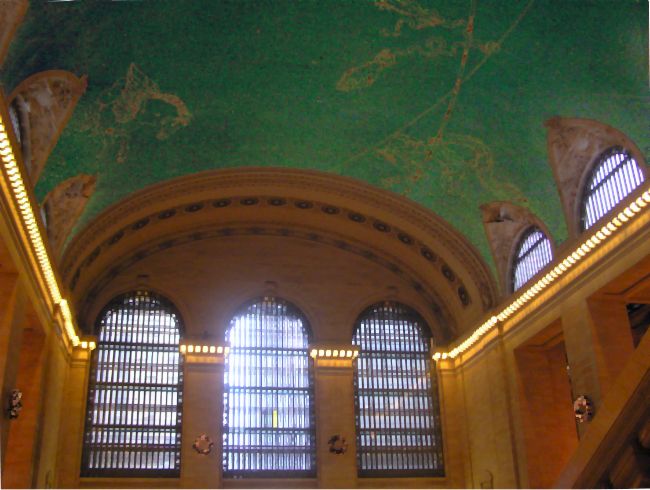
Ceiling Mural in "A Most Ancient Galaxy"


Grand Central Terminal Zodiac Ceiling
Photo By: Kidist P. Asrat
December, 2012


I posted this image under my post Most Ancient Galaxy, where I discuss the lack of awe that modern scientists have for the grandness of our universe.

The Grand Central mural dates back to 1912, and was designed by architect Whitney Warren and artist Paul César Helleu [1]. After a restoration in the 1930s because of falling plaster, the mural began to disappear under a film of tar and nicotine from tobacco smoke. Finally, it was restored in 2010 after a twelve-year restoration project.

The sky is reversed in this mural, and the stars are displaced. One explanation is that the design, which is based on a medieval manuscript, would be the vision of God viewing the constellation from outside the celestial sphere. And the stars may have shifted because of the procession of the equinoxes. According to this 1913 New York Times article [2]:
Aquarius, the Water Carrier, should have been allotted the spot on the ceiling occupied by Pegasus; and Cancer, the Crab, is where Orion, the Hunter, ought to be.
-------------------------------------------------------------------------------------------------------------------------------------------------------------

Reference:
2. A Constellation Reversed: Grand Central Ceiling Has the Ceiling Turned About.
New York Times, March 23, 1913, p.10
http://query.nytimes.com/mem/archive-free/pdf?res=9505EFD8133BE633A25750C2A9659C946296D6CF

2. The New York Preservation Project: Grand Central Terminal. 2010
http://www.nypap.org/content/grand-central-terminal

-------------------------------------------------------------------------------------------------------------------------------------------------------------
Posted By: Kidist P. Asrat
Monday, April 15, 2013

The Desecration of Rembrandt's Gentle Men

The article below, The Desecration of Rembrandt's Gentle Men, is a re-write of two blog posts from Camera Lucida: Rembrandt's Gentle Men: Beauty and Humanity, and Zadie Smith's "On Beauty": Lack of Beauty. It will probably go in Chapter Seven's Desecration of Beauty.


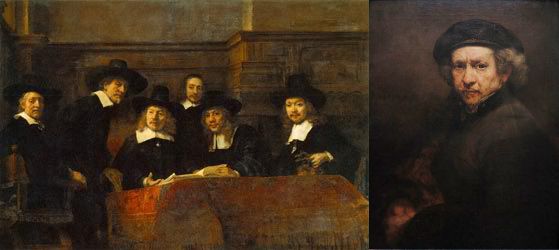
Left: Rembrandt van Rijn (1606-1669)
Syndics of the Draper's Guild
1661
75.4 in x 109.8 in
Oil on canvas
Rijksmuseum, Amsterdam

Right: Self-portrait
1659
Oil on canvas
33.3 in x 26 in
National Gallery of Art, Washington DC


-------------------------------------------------------------------------------------------------------------------------------------------------------------

The Desecration of Rembrandt's Gentle Men
By: Kidist P. Asrat

Rembrandt was commissioned to paint many group portraits of relatively wealthy and influential members of society from the guilds, town councils and other civic institutions of 17th century Holland. His group portrait of the De Staalmeesters, known as Syndics of the Draper's Guild in English, portrays a group of tradesmen reviewing the quality of cloth samples. He shows us more than just a guild meeting.

He has submerged the protagonists with a gentle light and avoids stark contrasts and sharp demarcations, which were common in his earlier paintings. This blending of contrasts makes the men to appear more gentle – they are not tormented by dilemmas of Biblical proportions. They are but wealthy citizens trying to bring about civility and order through their dutiful influence. At the same time, these are men who make difficult and sometimes harsh decisions, and the caution and wisdom in their faces recognizes that they need to always be alert to their surroundings.

Technically, Rembrandt achieves this mixture of gentleness and caution with the natural chiaroscuro provided by the dark clothes and the contrasting white collars. The men's illumined (enlightened, intelligent) faces are lit up by the light reflected off their white collars. The costumes, as well as describing rank and status, become natural props aiding Rembrandt's technique of playing with light and dark contrasts, light and dark moods, light and dark personalities, and other psychological polarities.

Rembrandt is the master of painting technique, above all using light. He has placed muted gold everywhere, from the cloth on the table to the paneling in the back wall. The effect is a glow from undecipherable sources, portraying a subdued presence of wealth, since despite their austere clothing, and probably equally restrained passions, these are men have financial and social security.

Rembrandt's art is also full of movement. The rhythm of the white collars in Syndics of the Draper's Guildtake takes us from one side of the group to the other in gentle curves. Rembrandt wants us to see the men one after the other with this slow sweep of motion, where each man is distinct and individual.

The men appear surprised by an unexpected visitor. They are looking up, or around, at the visitor, and one guild member is standing up to acknowledge (confront?) the visitor. This puts a spontaneous tone to the painting, which a formal sitting couldn't.

Since we cannot see this 'unexpected guest', then could it be us, the viewers? In such a manner, Rembrandt includes us into his painting, and joins us, even several hundred years later, with his gentle men.

This invitation is for all, including postmodern writer Zadie Smith. But Smith is unable to accept this invitation with dignity and humility. Instead, she reciprocates by writing her inaccurate and mean-spirited book against Rembrandt which she titles On Beauty. Her protagonists and mouthpiece, art history professor Howard Belsey, is writing (or unable to finish writing) a book on Rembrandt titled Against Rembrandt. What struck me most about the book was its inaccuracies, starting with the title. The whole book is a treatise against beauty; a book 'on beauty' whose main character hates Rembrandt.

Ultimately, I realized that Zadie Smith is unable to discuss beauty. Along with a lack of real knowledge on the subject, and on Rembrandt, she has no sensitivity toward beauty. In fact, overall, she is anti-beauty. Just like the anti-Rembrandt Howard.

I think this is the danger of this post-modern world, this multicultural world from which Smith hails, as evidenced in her second novel White Teeth. She personifies the contemporary writer or artist who doesn't want to spend the time doing the serious work, but would rather use an idea, a rebellious treatise against beauty, for example, or the chaotic world of multicultural London in White Teeth, to write rambling, imprecise and incomplete books. But her critics are equally lazy, or they've thrown out whatever standards they have to participate in the anti-beauty and anti-civilization treatises that "artists" and "writers" like Smith are advocating.

But the problem is more serious than a second-rate writer spilling out some angst. It is the sign of our times that people who profess to work against beauty are hailed as our cultural icons. With a careless sweep of the pen (or brush), they discredit centuries of learning and tradition. It takes little energy to destroy, but much energy to build. With one swoop of an explosive, a whole skyscraper can be brought to rubble. But to build that edifice takes years if not decades.

Beauty's progress has not been decades, but several millennia. Its slow evolution, building on the best of its past, has brought us wonders on earth. Within the last one hundred years, this process has had a potent grenade thrown at it, and we are beginning to see the desolate replacements, with the ruins not far behind them.

Smith's new book, NW, as in: "Northwest London, a council-flat heavy area in which Caribbean immigrants have gradually displaced the shanty Irish" is described as:
...a novel that feels unfinished and brandishes its uncertainties. In the essay "That Crafty Feeling," Smith compares the process of tricking herself into writing a novel to erecting scaffolding to construct a building. In NW, it's hard to tell where the scaffolding ends and the finished work begins: Perhaps that is the point (1).
No, there is no "perhaps." That is the point.

Smith could have redeemed herself by constructing a precise and artistic Rembrandt-like oeuvre. Instead, what we get from her is a lazy mesh of scrawls, hardly even a sketch. What would Rembrandt, strict and observant, think of the desecration of his paintings by second-rate writer Zadie Smith?

-------------------------------------------------------------

1. Cooke, Rachel. 2012, August 26. NW by Zadie Smith – review. The Guardian. http://www.guardian.co.uk/books/2012/aug/26/nw-zadie-smith-review

Working Titles for Reclaiming Beauty


Working titles for Reclaiming Beauty:

Chapter One
An Introduction to Beauty
- Synthesis of Beauty
- Beauty in the Worship of God
- Beauty and the Transcendent
- Beauty and Humanity
- Beauty, Truth and Goodness
- How to be a Beautiful Movie Star
- Beauty and Femininity
- Beauty and Masculininty
- Beauty: I will be your mirror
- Rejecting Beauty
- Elimination of Beauty

Chapter Two
Beauty in Art
- Architecture
- Painting
- Drawing and Illustrations
- Film
- Photography
- Dance
- Design and Fashion
- Art Criticism

Chapter Three
Beauty in Language
- Literature
- Poetry
- Writing
- Books
- Blogging
- Humor

Chapter Four
Beauty in Culture and Society
- Religion
- Christianity
- Islam
- Immigration
- Multiculturalism
- Politics
- Conservatism
- History
- Traditions

Chapter Five
Beauty in Nature

Chapter Six
Beauty in Science

Chapter Seven
Desecration of Beauty

Chapter Eight
Reclaiming Beauty

Friday, April 12, 2013

Book Project: Reclaiming Beauty

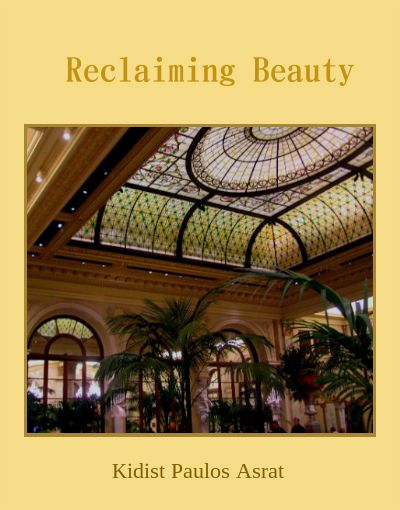
[Book design and cover photograph by Kidist P. Asrat
Dimenstions: 8in x 10in
]


I decided to call my book Reclaiming Beauty, after this blog where I've had a flurry of postings since I started it in February. These blog postings helped me fine-tune my ideas, and helped me to focus specifically on beauty.

I had originally thought to call the book Camera Lucida, but I think that is too obscure a term (it is actually a photography term, depicting the out-door photographic device which soon got replaced by our current "black box" camera).

Then, following C. S. Lewis' Mere Christianity, I thought to call it Mere Culture, a standard of plain, central culture, to paraphrase Lewis. But a standard of plain, central culture is hard to find these days in our era of multiculturalism, and my task is to find that central culture. But "mere" might be misunderstood to mean "just" or "simply" thus diminishing its importance. Below are brief explanation of Lewis' use of the word:
Sometime in 1943, Lewis began making the words "Mere Christianity" his own. That was in his Introduction to St. Athanasius, On the Incarnation, translated from the Greek by his friend Sister Penelope Lawson, CSMV. "The only safety [against the theological errors in recently published books]," wrote Lewis, "is to have a standard of plain, central Christianity (‘mere Christianity’ as Baxter called it) which puts the controversies of the moment in their proper perspective."
Here is another discussion of the term:
As editors of a journal of "Mere Christianity," we are often asked what we mean by “mere Christianity.” We got this phrase, of course, from C. S. Lewis, who picked it up from the Anglican divine Richard Baxter (d. 1691). Another way of saying “mere Christianity” is “what has been believed everywhere, always, and by all,” to use the words of St. Vincent of Lerins (d. 445).
Reclaiming Beauty describes the type of activity I'm advocating: to reclaim the beauty that our era is vehemently destroying. I have been advocating this for the many years I've blogged at Camera Lucida and at Our Changing Landscape. In Reclaiming Beauty, I am saying that rather than just an intellectual process, I envision reclaiming beauty to be also an active process, where each reclaimer of beauty participates in bringing back beauty into our world.

The book will be a type of manifesto for concrete references to these basic ideas. The website will be a living manifestation and continuation of the book, with like-minded people participating in the movement for reclaiming beauty.

The book chapters will somewhat follow the guidelines I set for Camera Lucida, with a section on defining beauty, and sections on the various cultural, societal and historical aspects of beauty. There will be a section on "Desecration of Beauty" where I will outline more specifically the factors that are destroying beauty, and our culture. The final chapter will be a guideline for how we can reclaim beauty, and give it back its due importance in our culture.

Some of the chapters are written, and I have copious notes and references that outline my basic ideas. Most of the writings are (and will be) improved and completed versions of my blog posts from Camera Lucida, Our Changing Landscape, and my full-length published and unpublished articles from Kidist P. Asrat Articles. Topics and ideas from this blog Reclaiming Beauty will also be incorporated. This will help me show book editors and publishers that my idea is sound, which I've been developing over a number of years.

Most of the images that head the chapters will be from my collection of photographs and designs. Some of these images can be found at Kidist P. Photographs and Well-Patterned. Others I will choose from my vast collection photographs mostly in negatives and prints. I will select other images from collections of paintings and drawings of the well-known artists whose works I discuss.

The image on the book cover is a photograph I took of the stained glass ceiling in New York's Plaza Hotel.


-----------------------------------------------------------------------------------------------------------------------------------

Here are the working titles:

Chapter One
An Introduction to Beauty
- Seek and Ye Shall Find
- Beauty, Truth and Goodness
- Synthesis of Beauty
- Beauty in the Worship of God
- Beauty and the Transcendent
- Beauty and Humanity
- Beauty and Femininity
- Beauty and Masculinity
- How to be a Beautiful Movie Star
- Beauty: I will be your mirror
- Rejecting Beauty
- Elimination of Beauty

Chapter Two
Beauty in Art
- Architecture
- Painting
- Drawing and Illustrations
- Film
- Photography
- Dance
- Design and Fashion
- Art Criticism

Chapter Three
Beauty in Language
- Literature
- Poetry
- Writing
- Books
- Blogging
- Humor

Chapter Four
Beauty in Culture and Society
- Religion
- Christianity
- Islam
- Myths and Legends
- History
- Traditions
- Conservatism
- Politics
- Immigration
- Multiculturalism

Chapter Five
Beauty in Nature

Chapter Six
Beauty in Science

Chapter Seven
Desecration of Beauty

Chapter Eight
Reclaiming Beauty

-------------------------------------------------------------------------------------------------------------------------------------------------------------

The article below, The Desecration of Rembrandt's Gentle Men, is a re-write of two blog posts from Camera Lucida: Rembrandt's Gentle Men: Beauty and Humanity, and Zadie Smith's "On Beauty": Lack of Beauty. It will probably go in Chapter Seven's Desecration of Beauty.


Left: Rembrandt van Rijn (1606-1669)
Syndics of the Draper's Guild
1661
75.4 in x 109.8 in
Oil on canvas
Rijksmuseum, Amsterdam

Right: Self-portrait
1659
Oil on canvas
33.3 in x 26 in
National Gallery of Art, Washington DC


-------------------------------------------------------------------------------------------------------------------------------------------------------------

The Desecration of Rembrandt's Gentle Men
By: Kidist P. Asrat

Rembrandt was commissioned to paint many group portraits of relatively wealthy and influential members of society from the guilds, town councils and other civic institutions of 17th century Holland. His group portrait of the De Staalmeesters, known as Syndics of the Draper's Guild in English, portrays a group of tradesmen reviewing the quality of cloth samples. He shows us more than just a guild meeting.

He has submerged the protagonists with a gentle light and avoids stark contrasts and sharp demarcations, which were common in his earlier paintings. This blending of contrasts makes the men to appear more gentle – they are not tormented by dilemmas of Biblical proportions. They are but wealthy citizens trying to bring about civility and order through their dutiful influence. At the same time, these are men who make difficult and sometimes harsh decisions, and the caution and wisdom in their faces recognizes that they need to always be alert to their surroundings.

Technically, Rembrandt achieves this mixture of gentleness and caution with the natural chiaroscuro provided by the dark clothes and the contrasting white collars. The men's illumined (enlightened, intelligent) faces are lit up by the light reflected off their white collars. The costumes, as well as describing rank and status, become natural props aiding Rembrandt's technique of playing with light and dark contrasts, light and dark moods, light and dark personalities, and other psychological polarities.

Rembrandt is the master of painting technique, above all using light. He has placed muted gold everywhere, from the cloth on the table to the paneling in the back wall. The effect is a glow from undecipherable sources, portraying a subdued presence of wealth, since despite their austere clothing, and probably equally restrained passions, these are men have financial and social security.

Rembrandt's art is also full of movement. The rhythm of the white collars in Syndics of the Draper's Guildtake takes us from one side of the group to the other in gentle curves. Rembrandt wants us to see the men one after the other with this slow sweep of motion, where each man is distinct and individual.

The men appear surprised by an unexpected visitor. They are looking up, or around, at the visitor, and one guild member is standing up to acknowledge (confront?) the visitor. This puts a spontaneous tone to the painting, which a formal sitting couldn't.

Since we cannot see this 'unexpected guest', then could it be us, the viewers? In such a manner, Rembrandt includes us into his painting, and joins us, even several hundred years later, with his gentle men.

Postmodern writer Zadie Smith got accolades of praise after her first book On Beauty hit the shelves in 2005. What struck me most about the book was its inaccuracies, starting with the title. This is evident from the main protagonist, art history professor Howard Belsey, who is writing (or unable to finish writing) a book on Rembrandt called “Against Rembrandt”. A book 'on beauty' whose main protagonist (and mouthpiece) hates Rembrandt!

Ultimately, I realized that Zadie Smith is unable to discuss beauty. Along with a lack of real knowledge on the subject, and on Rembrandt, she has no sensitivity toward beauty. In fact, overall, she is anti-beauty. Just like the anti-Rembrandt Howard.

I think this is the danger of this post-modern world, this multicultural world from which Smith hails, as evidenced in her second novel White Teeth. She personifies the contemporary writer or artist who doesn't want to spend the time doing the serious work, but would rather use an idea, a rebellious treatise against beauty, for example, or the chaotic world of multicultural London in White Teeth, to write rambling, imprecise and incomplete books. But her critics are equally lazy, or they've thrown out whatever standards they have to participate in the anti-beauty and anti-civilization treatises that "artists" and "writers" like Smith are advocating.

But the problem is more serious than a second-rate writer spilling out some angst. It is the sign of our times that people who profess to work against beauty are hailed as our cultural icons. With a careless sweep of the pen (or brush), they discredit centuries of learning and tradition. It takes little energy to destroy, but much energy to build. With one swoop of an explosive, a whole skyscraper can be brought to rubble. But to build that edifice takes years if not decades.

Beauty's progress has not been decades, but several millennia. Its slow evolution, building on the best of its past, has brought us wonders on earth. Within the last one hundred years, this process has had a potent grenade thrown at it, and we are beginning to see the desolate replacements, with the ruins not far behind them.

Smith's new book, NW, as in: "Northwest London, a council-flat heavy area in which Caribbean immigrants have gradually displaced the shanty Irish" is described as:
...a novel that feels unfinished and brandishes its uncertainties. In the essay "That Crafty Feeling," Smith compares the process of tricking herself into writing a novel to erecting scaffolding to construct a building. In NW, it's hard to tell where the scaffolding ends and the finished work begins: Perhaps that is the point (1).
No, there is no "perhaps." That is the point.

Smith could have redeemed herself by constructing a precise and artistic Rembrandt-like oeuvre. Instead, what we get from her is a lazy mesh of scrawls, hardly even a sketch. What would Rembrandt, strict and observant, think of the desecration of his paintings by second-rate writer Zadie Smith?

-------------------------------------------------------------

1. Cooke, Rachel. 2012, August 26. NW by Zadie Smith – review. The Guardian. http://www.guardian.co.uk/books/2012/aug/26/nw-zadie-smith-review

-------------------------------------------------------------------------------------------------------------------------------------------------------------
Posted By: Kidist P. Asrat

Thursday, April 11, 2013

They Sure Have Come a Long Way


I suppose for the next few days (weeks maybe) we will from all those confused feminists who did not, and cannot, understand her Margaret Thatcher.

Here is one particularly devious woman, blonde and Scandinavian, who proves the point that women should not hold serious positions.

Her "gimmick" is to make heads of state "jump" on her show.

Thatcher, indignant, replies: "No, no, no, to coin a phrase."

I wonder, despite her laughter, if this interviewer knew where this phrase came from?
[I]n 1990, [Margaret Thatcher] was deemed by colleagues to have gone too far when she told the House of Commons: "The president of the Commission, Monsieur Delors, said at a press conference the other day that he wanted the European Parliament to be the democratic body of the community, he wanted the Commission to be the executive and he wanted the council of ministers to be the Senate. No. No. No."
The interviewer covers her tracks by saying that she "just won a bet" that Thatcher wouldn't jump. But she made this bet not because the "request" was idiotic, but because Thatcher would be too stiff and conservative to "show another side" of herself.

Such is "the politics of a free society, if that's what they ask you to do," as Thatcher replies to this "journalist."

Women sure have come a long way, when dignified and feminine behavior is scorned, and "showing one's true self" (such as jumping off a cliff?) is is a prerequisite to "belonging."
-------------------------------------------------------------------------------------------------------------------------------------------------------------
Posted By: Kidist P. Asrat

Tuesday, April 9, 2013

Meryl Streep Praises her Subject


I wrote recently about Meryl Streep's portrayal of Margaret Thatcher in the movie Iron Lady.

Today, Streep has issued a long statement on Thatcher, once the subject of one of her films.

The full text is available here and which I've copied below.

Streep talks in typical liberal ambiguity. On the one hand, she admires Thatcher as a "feminist pioneer" who broke "through the ranks of the British political system" to become Prime Minister.

On the other hand, Streep cannot reconcile the more conservative views of Thatcher with her own left-liberal ones. She says, with carefully worded phrases:
[For Thatcher] to have managed to keep her convictions attached to fervent ideals and ideas – wrongheaded or misguided as we might see them now – without corruption – I see that as evidence of some kind of greatness...
I ask Streep: Where are the "...women and girls around the world...[who] supplant[ed] fantasies of being princesses with a different dream: the real-life option of leading their nation"?

Where is the proliferation of women-leaders that Streep is talking about, twenty years after Thachter resigned from politics? There is the Australian Prime Minister, Julia Gillard, and Germany's Chancellor Angela Merkel. The smattering of Third World and Scandinavian female leaders have no strong and dominant position in world politics, and do not count. Hillary Clinton, for whatever reason, couldn't pull through as the first female President of the United States, and Ségolène Royal of France lost to Nicolas Sarkozy in 2007.

Two female world leaders.

Meryl Streep's full text is below.
Margaret Thatcher was a pioneer, willingly or unwillingly, for the role of women in politics.

It is hard to imagine a part of our current history that has not been affected by measures she put forward in the UK at the end of the 20th century. Her hard-nosed fiscal measures took a toll on the poor, and her hands-off approach to financial regulation led to great wealth for others.

There is an argument that her steadfast, almost emotional loyalty to the pound sterling has helped the UK weather the storms of European monetary uncertainty.

But to me she was a figure of awe for her personal strength and grit. To have come up, legitimately, through the ranks of the British political system, class-bound and gender-phobic as it was, in the time that she did and the way that she did, was a formidable achievement. To have won it, not because she inherited position as the daughter of a great man, or the widow of an important man, but by dint of her own striving. To have withstood the special hatred and ridicule, unprecedented in my opinion, levelled in our time at a public figure who was not a mass murderer; and to have managed to keep her convictions attached to fervent ideals and ideas – wrongheaded or misguided as we might see them now – without corruption – I see that as evidence of some kind of greatness, worthy for the argument of history to settle. To have given women and girls around the world reason to supplant fantasies of being princesses with a different dream: the real-life option of leading their nation; this was groundbreaking and admirable.

I was honoured to try to imagine her late life journey, after power; but I have only a glancing understanding of what her many struggles were, and how she managed to sail through to the other side. I wish to convey my respectful condolences to her family and many friends.
-------------------------------------------------------------------------------------------------------------------------------------
Posted By: Kidist P. Asrat

Jacques Brel - Madeleine


Madeleine
Jacques Brel

Ce soir j'attends Madeleine
J'ai apporté du lilas
J'en apporte toutes les semaines
Madeleine elle aime bien ça
Ce soir j'attends Madeleine
On prendra le tram trente-trois
Pour manger des frites chez Eugène
Madeleine elle aime tant ça
Madeleine c'est mon Noël
C'est mon Amérique à moi
Même qu'elle est trop bien pour moi
Comme dit son cousin Joël
Mais ce soir j'attends Madeleine
On ira au cinéma
Je lui dirai des "je t'aime"
Madeleine elle aime tant ça

Elle est tellement jolie
Elle est tellement tout ça
Elle est toute ma vie
Madeleine que j'attends là là

Ce soir j'attends Madeleine
Mais il pleut sur mes lilas
Il pleut comme toutes les semaines
Et Madeleine n'arrive pas
Ce soir j'attends Madeleine
C'est trop tard pour le tram trente-trois
Trop tard pour les frites d'Eugène
Madeleine n'arrive pas
Madeleine c'est mon horizon
C'est mon Amérique à moi
Même qu'elle est trop bien pour moi
Comme dit son cousin Gaston
Mais ce soir j'attends Madeleine
Il me reste le cinéma
Je pourrai lui dire des "je t'aime"
Madeleine elle aime tant ça

Elle est tellement jolie
Elle est tellement tout ça
Elle est toute ma vie
Madeleine qui n'arrive pas

Ce soir j'attendais Madeleine
Mais j'ai jeté mes lilas
Je les ai jetés comme toutes les semaines
Madeleine ne viendra pas
Ce soir j'attendais Madeleine
C'est fichu pour le cinéma
Je reste avec mes "je t'aime"
Madeleine ne viendra pas
Madeleine c'est mon espoir
C'est mon Amérique à moi
Mais sûr qu'elle est trop bien pour moi
Comme dit son cousin Gaspard
Ce soir j'attendais Madeleine
Tiens le dernier tram s'en va
On doit fermer chez Eugène
Madeleine ne viendra pas

Elle est elle est pourtant tellement jolie
Elle est pourtant tellement tout ça
Elle est pourtant toute ma vie
Madeleine qui ne viendra pas

Mais demain j'attendrai Madeleine
Je rapporterai du lilas
J'en rapporterai toute la semaine
Madeleine elle aimera ça
Demain j'attendrai Madeleine
On prendra le tram trente-trois
Pour manger des frites chez Eugène
Madeleine elle aimera ça
Madeleine c'est mon espoir
C'est mon Amérique à moi
Tant pis si elle est trop bien pour moi
Comme dit son cousin Gaspard
Demain j'attendrai Madeleine
On ira au cinéma
Je lui dirai des "je t'aime"
Et Madeleine elle aimera ça.
------------------------------------------------------------------------------------------------------------------------------------------------------------
Posted By: Kidist P. Asrat

Le Plat Pays Qui Est Le Mien


Le Plat Pays
Jacques Brel

Although I have put up an English translation, the beautiful poetry, which includes the sounds as well as the meaning(s) of the words, is best experienced in French.

Le Plat Pays
Avec la mer du Nord pour dernier terrain vague
Et les vagues de dunes pour arrêter les vagues
Et de vagues rochers que les marées dépassent
Et qui ont à jamais le cœur à marée basse
Avec infiniment de brumes à venir
Avec le vent de l'ouest écoutez le tenir
Le plat pays qui est le mien

Avec des cathédrales pour uniques montagnes
Et de noirs clochers comme mâts de cocagne
Où des diables en pierre décrochent les nuages
Avec le fil des jours pour unique voyage
Et des chemins de pluie pour unique bonsoir
Avec le vent d'est écoutez le vouloir
Le plat pays qui est le mien

Avec un ciel si bas qu'un canal s'est perdu
Avec un ciel si bas qu'il fait l'humilité
Avec un ciel si gris qu'un canal s'est pendu
Avec un ciel si gris qu'il faut lui pardonner
Avec le vent du nord qui vient s'écarteler
Avec le vent du nord écoutez le craquer
Le plat pays qui est le mien

Avec de l'Italie qui descendrait l'Escaut
Avec Frida la blonde quand elle devient Margot
Quand les fils de Novembre nous reviennent en Mai
Quand la plaine est fumante et tremble sous Juillet
Quand le vent est au rire, quand le vent est au blé
Quand le vent est au sud, écoutez le chanter
Le plat pays qui est le mien

The Flat Country
With the North Sea for the last bit of waste land
And the waves of dunes to stop the waves
And the shapeless rocks that the tides pass over
And who forever have their heart at low tide
With an infinity of mists still to come
With the wind from the west listen to it hold
The flat country that is mine

With cathedrals for its only mountains
And black church towers for greasy poles
Where devils in stone unhook the clouds
With the passing of the days for the only journey
And roads of rain for the only good evening
With the wind from the east listen to it want
The flat country that is mine

With a sky so low that a canal lost itself
With a sky so low that it acts humiliated
With a sky so gray that a canal hung itself
With a sky so gray that you just have to forgive it
With the wind from the north that comes tearing itself through
With the wind from the north listen to it break
The flat country that is mine

With a little of Italy which will climb down the Escaut
With Frida the blond when she becomes Margot
When the sons of November return to us in May
When the plain is steaming and trembles under July
When the wind is for laughter, when the wind is for the wheat
When the wind is from the south, listen to it sing
The flat country that is mine
-------------------------------------------------------------------------------------------------------------------------
Posted By: Kidist P. Asrat
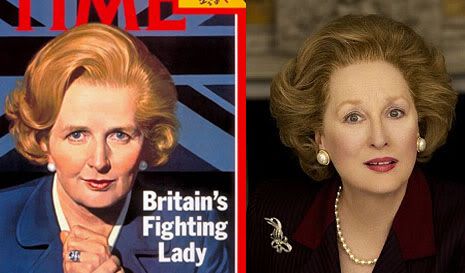
Iron Lady Lite


Left: May 14, 1979 Time magazine cover of Margaret Thatcher
Right: Meryl Streep as Thatcher in the 2011 movie The Iron Lady


I don't mean to say that the Iron Lady was a lightweight. I mean that Meryl Streep, who impersonated Thatcher in the 2011 film The Iron Lady, was giving us an Iron Lady Lite.

I wrote in Camera Lucida when the film came out in 2011:
Meryl Streep will be channeling Margaret Thatcher for her next movie The Iron Lady. I've written about Streep's never-ending creative (almost musical) ability for mimicking accents. But, from the above photo, I doubt Streep will go any further than caricature, like her depiction of Julia Child in Julie & Julia. Streep doesn't even follow Thatcher's political philosophy. In fact, she may be against it. I think this will add to her turning Thatcher more into a cartoon rather than an all-rounded figure.

Streep's expression in the photo above, which appears to be the early promotional photo for the film, says it all. She has a deer blinded by headlights look, which I'm sure Thatcher never had even in her most difficult days. In fact, the film is about one of Thatcher's most challenging moments, when she protected the Falkland Islands from Argentinian aggression.

Here is a synopsis of The Iron Lady:
The film is reportedly set in 1982, chronicling 17 days of Thatcher's life leading up to the Falklands War and how she dealt with the events.
Larry Auster had a somewhat similar take:
While I am a big fan of Meryl Streep’s, I refuse to see her movie about Mrs. Thatcher. The reason is that I consider it totally unacceptable that the movie uses the pathetic debility of Thatcher’s old age against her. We all grow old if we don’t die young. It is monstrous and cruel to exploit the senility of a historical figure as a framing device for a movie about that person, as though the person’s senility—occurring, in this case, twenty years after the person left the public stage—showed the true meaning of her life and achievements. This is even more the case when the person is still alive and suffering.
Margaret Thatcher had been ill for many years with dementia.
------------------------------------------------------------------------------------------------------------------------------------------------------------
Posted By: Kidist P. Asrat
Monday, April 8, 2013

Beauty Cannot Redeem Horror


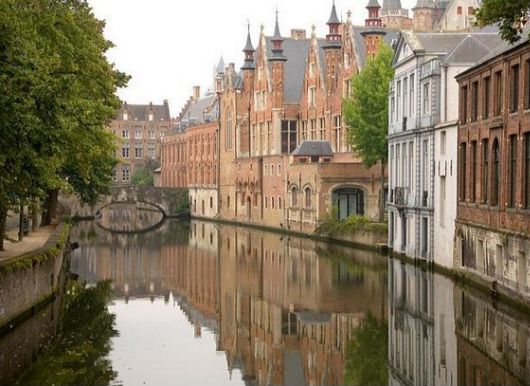
Bridge on a canal in Bruges

In Bruges, a horrible, nihilistic movie, was on T.V. the other night. I watched it solely because of the title. Belgium, and the Flemish region which contains Bruges, is often neglected and ignored (the Dutch get more attention than the Belgians). But it has beautiful Flemish art, the lovely Flemish lace, and extraordinary, lace-like architecture as seen here in Burg Square.

The film is about hit-men killing innocent by-standers (a child in a church!), who continue with their hit-jobs. One of them summons up some guilt for having shot an innocent child, and his expiation is to shoot and kill those he thinks have killed innocent children.

Yes, convoluted, but it all really was a permit for gun shots, blood spurting out of bodies, and creepy atmosphere (a dwarf who keeps re-appearing).

I watched it twice.

The first time, I missed the beautiful shots of Bruges because of the disgusting violence. I stopped watching about two-thirds of the way.

The second time, I wanted to see if the beautiful Bruges architecture in any way redeemed the film, which the clever and devious director and cinematographer as a backdrop for the film.

It doesn't. It desecrates the city.

We cannot reclaim beauty by putting it along-side horror, expecting it to be the winner. We cannot redeem horror by placing beauty along-side it.

We have to remove ourselves completely from the horror, the ugliness and the desecration, and let it devour itself, because otherwise, it will devour beauty along with itself.

We have reached a vicious (and new) impasse. Horror and ugliness are winning, unless we arm ourselves against their its assaults. We have to fight to the core to reclaim beauty. It is no longer enough to separate ourselves from horror, since it has also reached our own door-steps.

Bruges is an exceptionally beautiful, northern European city. It is in the northern part of Belgium where Dutch (or Flemish ) is spoken. Some call it the Venice of the North, because of the intricate canals and bridges, and the lovely architecture which surround these canals.

Can Bruges be re-captured and reclaimed?


Belgian Lace from Bruges

-------------------------------------------------------------------------------------------------------------------------------------------------------------
Posted By: Kidist P. Asrat

A Rosebush


Abraham Darby Rosebush

Debra Chamberlin sent the following article after reading my post The Lilac Rose:

Growing David Austin’s ‘Abraham Darby’ Rose
From: Hedgerow Roses
JUNE 11, 2011

I have a superstar in my garden, and his name is ‘Abraham Darby’. Last summer this rose was only in it’s first season in our garden and I was amazed at how quickly it shot up while having more roses than I knew what to do with, all the way up until fall.

Named for Abraham Darby I, a man who played an important role in the Industrial Revolution, Austin introduced this rose in 1985 as a cross between the modern roses ‘Aloha’ and ‘Yellow Cushion’.

'Abraham Darby' is described as a "well-formed shrub" reaching height/width of 5 feet with good disease resistance and repeat bloom. The blossoms are large, (approximately 5″ across), and are full, double, cupped, and have a strong fruity-sweet scent. I’ve seen Abraham Darby being listed as hardy to zones 5-10 and 4-8. Our garden is safely in zone 6.

In our garden, ‘Abraham Darby’ lives up to expectations by truly being incredibly vigorous. While I’ve heard reports that this is a rose that succumbs to rust, I have not seen that, nor have I seen problems with black spot which typically runs rampant around here. EDIT: 5/12 Holy cats! A.D. got a serious case of B.S. this spring and was almost completely defoliated. It’s recovering nicely, though, with lots of new growth and buds. Something to keep in mind, though, that this rose is not completely resistant. Additionally, I’ve found that it does not care for extreme hot, humid temperatures. (Who does?) We had a streak of days recently where temps climbed into the mid 90′s with high humidity and my blooms balled up and needed to be removed.

‘Abraham Darby’ has very dense, thick growth. I sometimes have to get in there and prune away some of the canes in the center of the plant to give it more air circulation. The leaves are bright green and glossy; even when not in bloom, this is an attractive plant. It recovers quickly from pruning and with dead-heading will continue to bloom all season.

My only complaint about ‘Abraham Darby’ was actually rectified this spring when I did some rearranging in our garden. You see, the roses are so large and heavy that they droop on the plant, and with the addition of it’s also somewhat arching canes, it’s former placement in the garden at ground level meant that the roses couldn’t be fully enjoyed. I transplanted our ‘Abraham Darby’ into a very large pot (15+ gallons) in early spring so now the roses are at eye-level, and the canes can flow for a pleasing, billowing appearance. If you choose to grow this rose yourself, I highly recommend training it to a pillar or placing it in a container as I did. You will get much more enjoyment out of it!

‘Abraham Darby’ blooms on new wood, so pruning early will encourage new growth and lots of flowering. Roses are heavy feeders, so I give ours plenty of organic material to grow in and feed them regularly during the growing season. I’ve found that with our Austin roses, pruning back after the initial first flowering will encourage repeat bloom all the way up until autumn. I leave the last of the autumn blooms on the plants, though, so our roses can safely go into dormancy for winter.

As our new garden takes shape, I find that I am increasing individual varieties of roses, but not multiple quantities of each, as I have limited space and too many that I want to try growing. However, I am making an exception with ‘Abraham Darby’ and hope to be adding another next spring, simply because I love it so much. EDIT: I went a little overboard with new additions this spring, so we’re just going to stick with the one Darby. I can’t wait for it to bloom!
-------------------------------------------------------------------------------------------------------------------------------------------------------------
Posted By: Kidist P. Asrat
Some Comments and My Responses

Here are my responses to some dense comments (and commentators).

On Churchill introducing the term "Iron Curtain" to the world:
Anonymous: April 8
It's strange that you did not know that Churchill introduced the term 'iron curtain'. It's a very famous fact.
Kidist: April 8
Well yes. And I bet a lot of others did not know that Churchill introduced the term Iron Curtain. Now they know. Now we all know.

That is how knowledge is transferred, but the way. By not making assumptions.

I found it interesting that Churchill introduced it to an American audience, and not a British one.
On the bold Edwardian lady traveler:
Anonymous: April 7
Freya Madeline Stark travelled in the Edwardian era and later, not the Victorian. There is a lot of difference between the Victorian world and the Edwardian world, especially regarding women and attitudes towards their autonomy.
Kidist: April 8
You miss my point on the Edwardian lady travelers vs. the Victorian Lady traveler. I don't see that much difference between the two (see below).

You seem to think "autonomy" is the greatest thing that happened to women. As visceral male reaction shows us, women can get raped for this "autonomy."

Women knew this. They knew that men could protect them, but they could "rape" and destroy them too. Now we have lost that instinct.

But I don't think your point stands. Women doing anything adventurous on their own would have been frowned upon in both societies, and even physically stopped.

And Stark took all kinds of "feminine" precautions, such as getting male leaders on her side through monetary and humanitarian means (she nursed THEIR wounded men!).

Lara Logan would never do this. She strutted along using her sexuality. The result was she got raped.

I have changed the title to the post from Bold Victorian Lady Traveler to Bold Edwardian Lady Traveler.
On where have all the intelligent men gone?
Anonymous: April 8
I am gratified that you chose Gregory Peck and Peter Falk as examples of intelligent men. Did you know that Peck was a lifelong Democrat and very politically active in Democratic and humanitarian causes, not unlike George Clooney ad Brad Pitt? Did you know that he was vocal enough on behalf of those causes that he made Richard Nixon's enemies list? Falk supported Democratic candidates, including Bill Clinton, in elections and gave money to NOW. Peck married working women.

As to Ginger Rogers and being led by Fred Astaire, she used to say that what she did was harder than what he did ... she had to do it backwards, and in heels.
Kidist: April 8
What we have are idiot democrats (i.e. liberals) in our current era hardly compares with the traditional democrats. And yes, Richard Nixon, that paragon of honesty and excellence himself!
-------------------------------------------------------------------------------------------------------------------------------------------------------------
Posted By: Kidist P. Asrat
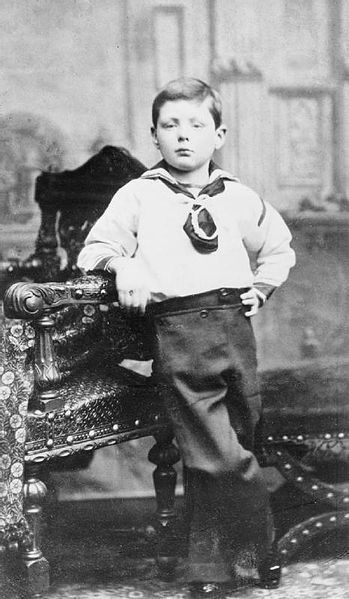
Churchill: Protecting England


Churchill, aged 7
In Dublin, Ireland
Ministry of Information
WWII Misc. Collection
Cat. No. ZZZ 7555D


On April 5th, PBS showed a documentary on Churchill titled "Great Romances of the 20th Century: Clementine & Winston Churchill." I cannot find any video (even promotional video) on it, but this is how the program describes the documentary:
The story of an enduring love match between two intelligent and forceful personalities. Clementine gave great strength to Britain's great war leader and helped him to weather the storms of his changeable political career.
There is a lot we already know about Churchill, including his persistence in fighting Hitler, which the documentary outlined. But I didn't know that he introduced the term "The Iron Curtain" to the world. He did so in a speech in 1946 at Westminster College, in Fulton, Missouri where he came to receive an honorary degree. Here is part of his speech:
From Stettin in the Baltic to Trieste in the Adriatic an iron curtain has descended across the Continent. Behind that line lie all the capitals of the ancient states of Central and Eastern Europe. Warsaw, Berlin, Prague, Vienna, Budapest, Belgrade, Bucharest and Sofia, all these famous cities and the populations around them lie in what I must call the Soviet sphere, and all are subject in one form or another, not only to Soviet influence but to a very high and, in some cases, increasing measure of control from Moscow. Athens alone -- Greece with its immortal glories -- is free to decide its future at an election under British, American and French observation. The Russian-dominated Polish Government has been encouraged to make enormous and wrongful inroads upon Germany, and mass expulsions of millions of Germans on a scale grievous and undreamed-of are now taking place. The Communist parties, which were very small in all these Eastern States of Europe, have been raised to pre-eminence and power far beyond their numbers and are seeking everywhere to obtain totalitarian control. Police governments are prevailing in nearly every case, and so far, except in Czechoslovakia, there is no true democracy.
A good part of the video showed Churchill's home, the beautiful Chartwell House. It was his paradisaical sanctuary, where he could work out his thoughts and ideas. "A day away from Chartwell is a day wasted," he said.


Winston Churchill
Arthur Pan (1894–1983)
Date Painted: 1943
Oil on canvas
40" x 50"


Chartwell grounds


A View of Chartwell
Winston Churchill
Date painted: c. 1938
Oil on canvas
23 3/4 x 36 in
Collection: National Trust


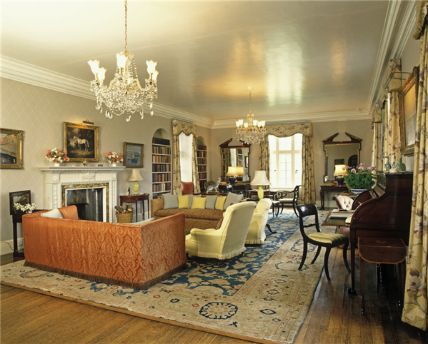
The Drawing room


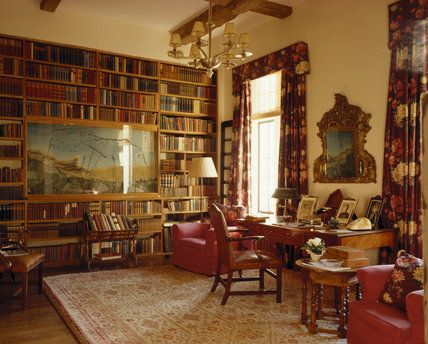
The Library


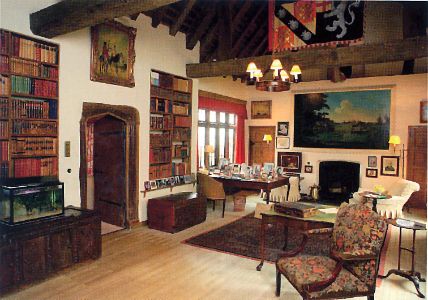
The Study


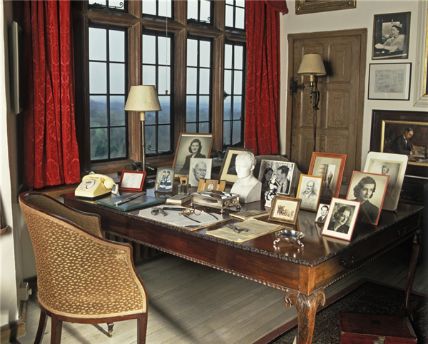
Churchill's desk in his study


Close-up of Churchill's desk in the study, with busts of Napoleon,
and family photographs


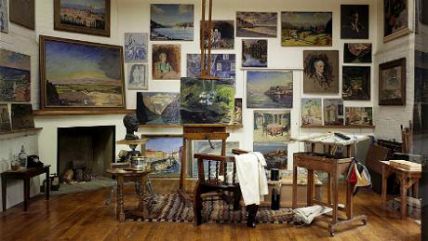
The Studio, with oil and watercolor paintings by Churchill


Churchill painting


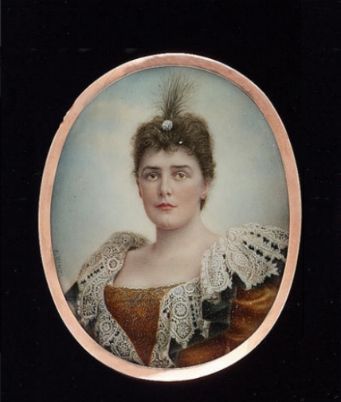
Lady Randolph Churchill (1854-1921)
(Churchill's mother)
Ernest Rinzi (British, 1836-1909)
Oval Miniature
81 in. high


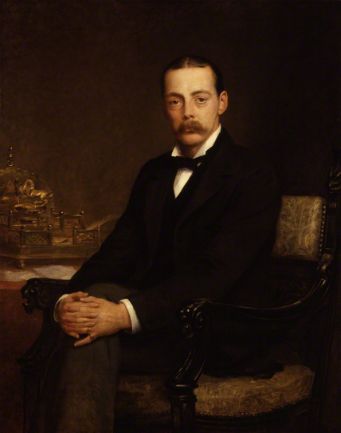
Lord Randolph Churchill (1849-1895)
(Churchill's father)
Edwin Longsden Long (1829-1891)
Oil on canvas
Exhibited 1888
50 1/8 in. x 40 in.


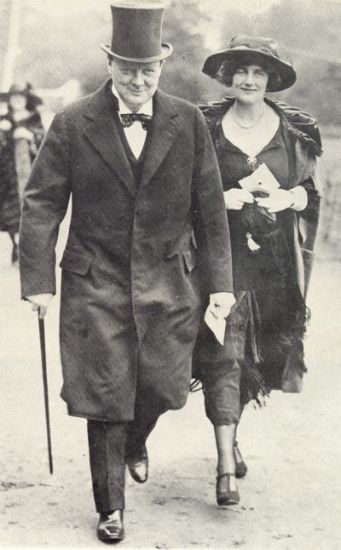
Winston Churchill and his wife Clementine (who resembles his mother)


The Beach at Walmer
Sir Winston Churchill (1874-1965)
Oil on canvas
25 x 30 in.
Date painted: c. 1938


-------------------------------------------------------------------------------------------------------------------------------------------------------------
Posted By: Kidist P. Asrat