Sunday, June 16, 2013

Sweet Scandinavian Girls Under the Influence

A Viking objects to Oz Conservative Mark Richardson's post on female conscription in Norway with:
We have lost brave women in combat in Afghanistan. And you ramble about the size of a girl's forearms?
And Mark responds with this post: A Viking objects.

In the post which the Viking disliked, Norway introduces conscription for women, Mark wrote:
...Norway has become the first European country to begin conscripting women into its army. The new policy was supported on both the left and the right.

The thinking behind the policy was put simply enough by one of the young women who is liable to be called up. Cana Elgvin said "I think it is natural that in an equal society girls and boys have the same duties."
Mark comments on this photo, which he has posted on his site, and continues:


Vivian Layno Jensen, Marie Mamen and Cana Elgvin
That attitude casually assumes that men and women are made the same way for the same purposes. I think Cana herself is living proof that this assumption is wrong. Cana is the 17-year-old Norwegian girl on the right of the photo below. Was she really made for aggressive physical combat? For the physical rigours of combat? Look at how slender her forearms are. Could she really lug around a heavy weapon with those arms? Is she equipped with hard chest muscle and muscular limbs? And does she look like she has the emotional hardness and the aggressiveness to stand up for herself in a bayonet fight? And should she, as a woman, be expected to be hard in this way? Would that be the highest realisation of her feminine being?
But then look at the girl on the left, who is identified as Vivian Layno Jensen in this Norwegian news site. Doesn't she look, despite her short height, that she could withstand the rigors of combat, with her stocky build, thick body, strong bones, and confident expression?

Layno Jensen may yet enter the army, but meanwhile, the two meek-looking Scandinavian girls, Marie Mamen and Cana Elgvin, are no match for her. Like with all things in current immigration, native populations of whites are readily succumbing to strong-willed, non-white members of Western society, who are taking aggressive initiatives that cause harm to the countries they live in. We know about the Muslim aggression, which is at least straightforward: to kill for Allah. But how can we discern the Vivians?

The two Scandinavian natives, Marie Mamen and Cana Elgvin, who are meekly following behind Vivian, would protest war because they think no-one should die at war, including Vivian. But, Vivian would most likely retort that whites are killing off non-whites, who have to protect themselves against the evil whites, and therefore are entitled to "fight" however they see fit, even by exploding bombs in buses and schools. How shocked Marie and Cana would be to realize their "close" friend Vivian probably thinks like this, and is not some radical Muslim immigrant living so far away in those closed-off ghettos in the outskirts of their cities.

Unlike Mark, I would have separated Vivian from the trio, and written:
Given the betrayal by non-white members of Western societies (look at what happened in England recently), can Australians really trust non-white young women (and men) to fight for Queen and Country (as Australia is still part of the British Commonwealth)?
Of course, Mark's point is that no woman should be conscripted into the army. Yet, what happens when one allows people, men or women, who have no cultural, ethnic, historical, or even a sliver of patriotic ties to a country into the army? How can we be sure that they will defend a country to their last breath? How can we trust the ultimate fate of a country (war is as far into an ultimatum as we can get) to people whose loyalty we can never be sure of?

Below I describe how Vivian Layno Jensen is proving my point.

I tried to find out more about Vivian Layno Jensen. Here is what looks like her twitter page, it is partly in English, partly in Norwegian, and some in a Philipino language. She peppers her comments with information about the Philippines such as:
Vivian Layno Jensen ‏@ViviJens 4 Aug
@chloeblatter which one? Filipino 60y bday?
And has E. Aldrin S. Angulo as her twitter "friend."
6:31 AM - 4 Aug 12
E. Aldrin S. Angulo ‏@AldrinAngulo 4 Aug
@ViviJens @chloeblatter lol mamma og pappa skal dit :P
Looking up E. Aldrin S. Angulo's profile here, he's most likely of Philipino background, with his Spanish names.

The image below shows the photo Layno Jensen posted on Instagram (her Instagram profile reads: Vivian Jensen WHATTUP! DREAMTEAM Twitter:vivijens Oslo, Norway), with the caption, "One heck of a family day" which looks like her sprawling, Asian, family:


And here is a photo from a collage at her twitter pictures page twicsy, who look like they could be her Asian parents or grandparents:


And from her twicsy page, with a blonde-haired, blue-eyed friend, who looks like a typical Norwegian:


And this looks like the blonde friend. (The twicsy video is really disturbing, with an animalistic sound emitting from this pretty blonde, as she flicks her long blonde hair around and writhes on her bed. This is what she has up for the world to see.)

And finally, I typed in the name layno name philippines in Google Search, and these are some of the links that came up:
- Belen Layno - Philippines | LinkedIn
- Amado Layno, MD Profile | The Filipino Doctor
- Danielle Layno Philippines flew to the United States and
took part in the 2012 Miss Universe pageant

And so on.

My assessment is that Vivian Layno Jensen is half-Philipino, half Norwegian, if not full Philipino.

Can Marie and Cana ever see Vivian for what she is? Vivian most likely has no illusions about them, and knows where she stands. Will these two sweet-looking girls ever learn to fight? But they're going to have to, and quickly.
-------------------------------------------------------------------------------------------------------------------------------------------------------------
Posted By: Kidist P. Asrat
-------------------------------------------------------------------------------------------------------------------------------------------------------------

Saturday, June 15, 2013

The Aesthetics of Foxhunting


John Ward Dunsmore (1856-1945)
The First Gentleman of Virginia: George Washington at the Hunt (c. 1777)
Frances Tavern Museum, New York City

Information on the painting is on page 20 of:
Images of America: Woodbrook Hunt Club
Joy Keniston-Longrie
Arcadia Publishing, 2009

-------------------------------------------------------------------------------------------------------------------------------------------------------------

Jessica Fletcher, the astute observer of human (and it seems, animal) behavior in Murder, She Wrote is on a Virginia estate solving the problem of the murdered estate owner Denton Langley in the episode It's a Dog's Life. The wealthy Langley leaves his estate to his dog Teddy, causing a lot of disappointment amongst his relatives, including the one who murdered him in the hopes of getting the spoils of his death. Teddy gets called a murderer (of his beloved master) by these greedy relatives, in order to disown him of the inheritance, and to claim it for themselves. It is up to Jessica to show that Teddy in as innocent as, well, a dog.

Here is the synopsis of the episode.

What was interesting was the foxhunt that took place during the program. Jessica usually carries out her special art of investigative activity in a charming Massachussets coastal town called Cabot's Cove. For this one, she travels to Virginia to visit a friend at Langley's estate. Foxhunting is apparently still practiced in the United States.

Jessica joins the crowd in her own charming version of a foxhunt attire:


Standard attire is:
[D]uring the formal hunt season (usually around late October to late March in the northern hemisphere)...hunt members [wear] 'colours'. This attire usually consists of the traditional red coats worn by huntsmen, masters, former masters, whippers-in (regardless of sex), other hunt staff members and male members who have been invited to wear colours as a mark of honour. Since the Hunting Act in England and Wales, only Masters and Hunt Servants tend to wear red coats or the hunt livery whilst out hunting. Gentleman subscribers tend to wear black coats, with or without hunt buttons. Ladies generally wear coloured collars on their black or navy coats. These help them stand out from the rest of the field.
Teddy, the dog is probably an American Foxhound, which was bred by George Washington, although he looks a little too small to be an American Foxhound (here are dimensions for the American Foxhound and here for the English Foxhound), since he was easily carried around by the various protagonists of the murderous show.


Teddy

Is this the face of a sleuth? Actually, it is the face of an intelligent and observant woman, with a sense of humor


Jessica Fletcher, who would rather be writing
her books than solving murders.

-------------------------------------------------------------------------------------------------------------------------------------------------------------
Posted By: Kidist P. Asrat
-------------------------------------------------------------------------------------------------------------------------------------------------------------

Thursday, June 13, 2013

McDonalds' Aesthetics


The Golden Arches of McDonalds
Rt.1, Saugus, Massachusetts USA
Photo taken on November 4, 2012


A reader at Laura Wood's site, under her posting Ugly Toronto where she quotes from my post "Stay Classy, Toronto" has this to say about McDonalds:
Jay from Goshen writes:
If a municipality wants to take the trouble, it can pass ordinances that even McDonald’s has to follow. That is why in some locales, McDonald’s restaurants look not only inconspicuous, but attractive. My family and I drove a long distance once in a very isolated part of the southwest. We finally found a McDonald’s. Normally I hate the place, but in that instance, it was comforting and reassuring. It was constructed of local materials and that normally garish golden arch was small, and attractive, under the circumstances.
There was a time in recent years when McDonalds was really an awful place, dirty and with dubious characters taking up the seats. Now they are gone, having been chased out, and the clientel is clean and proper. There is also a new and ambitious addition to the original McDonalds: the McCafé, which features good, strong coffee which is on a par with Starbucks. The
"é" at the end of cafe is not snobishness. It fits with McDonalds' new image of being cultured, and gets away from its grimy past.

McDonalds goes back to the America of the 1950s, with the hamburger joints, the car culture of teenagers, juke boxes, and waitresses on roller blades. There was an American architecture of burger buildings (there no longer is), and McDonalds was part of that. The burger, and the culture around it, is an American tradition.


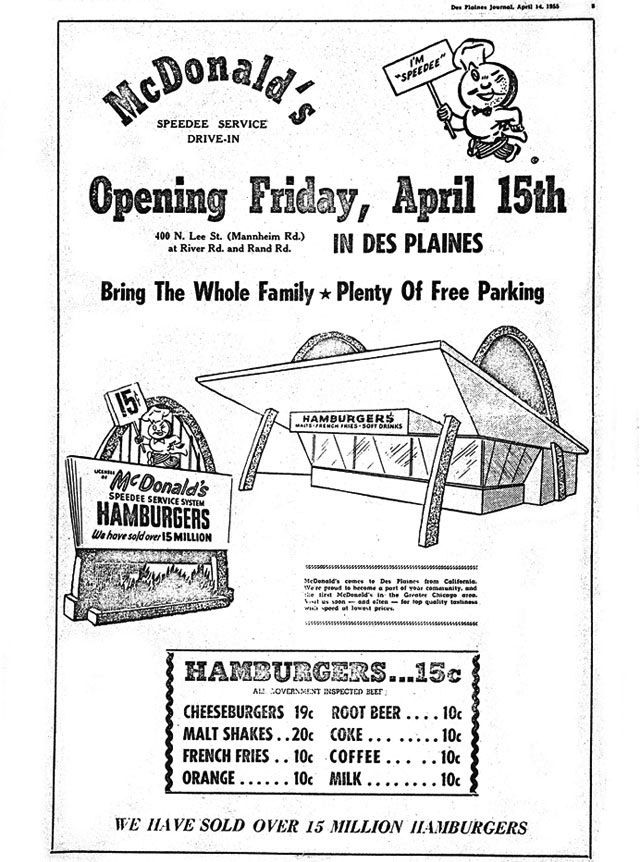
A 1950s McDonalds
Ray Kroc opened the first McDonald's franchise...on April 15, 1955, in Des Plaines, Illinois. Though it was the ninth McDonald's restaurant overall, it was Kroc's first franchise...The first day's sales were $366.12.

Just four years later, McDonald's notched its 100th restaurant with the opening of an outpost in Fond du Lac, Wisconsin [More inforamtion here].

A hamburger for 15c, made from "Government inspected meat"
[Larger menu version here]


A contemporary McCafé


Peppermint Mocha for $2.39, in Toronto


Apple Slices. They may not be fresh, but they follow
McDonads' new philosophy of eating healthy without sacrificing taste.


There would really not be a McDonalds without kids. What better way for a kid to have a snack than with sliced apples? It's not much, but this is the enlightened direction that successful institutions take.

Even McDonalds follows the concerns of its customers. But more than mere reaction to customers, the contemporary McDonalds is trying to make eating an aesthetic, pleasant, healthy and fulfilling experience.
-------------------------------------------------------------------------------------------------------------------------------------------------------------
Posted By: Kidist P. Asrat
-------------------------------------------------------------------------------------------------------------------------------------------------------------

The Degradation of Western Culture Due to Multiculturalism


Daniel S. writes at The Thinking Housewife, commenting on my post Ethnic Holes:
Ms. Asrat wrote:
Even those areas where reasonably well-to-do (these days they are “Asians” – i.e. Chinese, Koreans and Filipinos, and the South Asians – i.e. Indians and Pakistani) immigrants reside, we find generally inferior homes, with no landscaping or maintenance of the surroundings. Dull and lusterless places.
Not having been to Toronto I can speak to this particular situation, but thought I should mention that while maybe the Toronto-based Koreans have little interest in aesthetics, not so their ethnic brethren still in their native land. I am currently living in Seoul and must say that many neighborhoods here in the more affluent areas display quite pleasant architecture and landscaping. Furthermore, most of modern urbanity in the West is often ghastly or banal. I say this not to defend immigration, which I don’t, but it seems odd to single out Asians when one could produce numerous equally dull and inferior shop fronts run by Anglo-Americans.
Alex replies:
Daniel S. writes:
I am currently living in Seoul and must say that many neighborhoods here in the more affluent areas display quite pleasant architecture and landscaping.
People capable of creating affluent neighborhoods with pleasant architecture and landscaping for themselves in their own countries, stay in their own countries. They have no reason to emigrate. It’s people who are incapable of this that we get as immigrants.
Alex, in true "tourist" fashion talks about a select area, where he is privileged to stay. "Affluent region" says it all. I have also traveled to Korea, and stayed with an affluent Korean family for two weeks, the family of a Korean university friend. Through luck and circumstance, I have known elite segments of various other cultures. Staying with my friend, I was struck at the gaucheness of their elite lifestyle. One evening, the mother of the household planned an elaborate meal for us (visitors). The food was abundant, and took up a long stretch on a low table of rosewood. There were no "courses" and everything was on the table at once. We sat on the ground on cushions. We all had small bowls of rice and a pair of chopsticks. The method to the meal was to stretch to the various dishes along the table and scoop out a portion with the chopsticks, and transport it to our bowls. There was no re-shuffling of dishes, and I kept to my side. Others stretched out a little more.

The main attraction of the evening was the food. The table, although a lovely reddish color, was mostly hidden by all the dishes. The seating arrangements were invisible; we were sitting on cushions. I don't even remember what they looked like. There was no "center piece" or other decorative arrangements on the table. The bowls and dishes carrying the food were mostly undecorated. I think they were a shiny, lacquered black. A few may have had designs on them. Again, they did not stand out enough for me to remember that.

Here is a short piece of eating etiquette at a Korean meal:
There are rules which reflect the decorum of sharing communal side dishes; rules include not picking through the dishes for certain items while leaving others, and the spoon used should be clean, because usually diners put their spoons in the same serving bowl on the table.


A Korean meal: Low table and sitting on the floor,
and communal dishes for reaching out with chopsticks


Hanjeongsik, a formal traditional Korean table, similar to the one
I was invited to during my stay in Korea.
We all sat on cushions on the floor. This was a little difficult for me since I actually
wore a formal dress, with a narrow skirt. But I managed somehow.


Now, imagine a formal French table or a formal American one.


A formal American holiday dinner table


A formal (probably elite) French dinner table

Such societies have evolved superior forms of food culture. Food is not presented in one stretch of a meal, but in carefully structured segments, or courses. This way, each independent segment can be enjoyed without the palette being overwhelmed. And the aperetif opens up the appetite, while the digestif helps with the food's digestion, as do salad and fruit. The dessert clears the palette from other heavy tastes and spices of the previous courses. And coffee makes sense. After a heavy meal, it perks one up a little. So, besides the aesthetic and culinary aspects, these meals have also evolved health considerations.

Besides the food, the decor surrounding the meal is very important, from the chairs, the table cloth, the dinnerware design, and the floral and other decorative arrangements.

Formal French and American meals include the following:

The French meal:
L'AperetifL'Hors D’oeuvres
L'Entrée
Le Plat Principal
Le Salade
Le Fromage
Le Dessert
Le Cafe
Le Digestif
And a formal American meal divides its courses into:
An appetizer
Soup
Fish
Game
Salad
Dessert
Fruit and Cheese
Coffee

A Korean meal:

Spicy pickled garlic
Pickled oysters
Spicy pickled codfish gills
Burdock roots in red pepper sauce
Mung bean jelly with beef and vegetables
Shrimp with scallions
Wild sesame, rice, and root porridge
Water radish kimchi
Squid and fish pancakes
Sauteed mushrooms with carrots and squash
Spicy octopus and onions
Fish roe stew
Crepes with nine delicacies
Braised short ribs
Cold beef, Bamboo shoots, and vegetables in a persimmon dressing
Shrimp stew
Pickled cap mushrooms
Doenjang or soybean paste stewS
Shrimp and jellyfish salad in a mustard dressing
Sautéed fiddleheads
Bellflower roots, and crown daisies
Beef glazed with soy sauce
Pickled onions
Kimchi,
Pickled maesil plums
Clam-seaweed
And rice, of course. [Source]
So, this is the competition. If Asians can compete with this, and give us something superior, then I will reconsider my previous arguments.

I have not seen anything to change my mind.

As I wrote in my previous post, the contemporary immigrants who leave their countries are often of a mediocre type. Still, even the elite of Korea cannot compete with the elite of the West, so whichever "type" of Korean immigrant comes to the West, we will be dealing with an overall inferior culture.

---------------------------------------------------------------------------------------------------------------------------------------------------------
Posted By: Kidist P. Asrat
---------------------------------------------------------------------------------------------------------------------------------------------------------

Monday, June 10, 2013

Rina Shah: Part 1


Republican Strategist
Founding member of the Indian American Conservative Council


Bonnie Erbe, host of the PBS show To the Contrary had her usual panel of women discussing politics today. Here is the full video.

Below is her panel, with a short bio for each member.

To her right, Erbe has put:

1. Avis Jones-DeWeever


DeWeever starts her argument with:
Any time you find that in every city in this nation African Americans are much more likely than whites to live in areas where there are high concentrations of air toxins, I don't think there can be anything but [environmental racism].
And later on:
People who are more well-endowed economically are better able to lobby for themselves and for their neighborhoods to be able to say, "not in my backyard." But for people who are more economically vulnerable, who are disproportionately people of color, it's harder to have that same sort of political might to protect their neighborhoods in that way. And so as a result you end up with in situation where you do have high concentration of people of color who are economically vulnerable and environmentally vulnerable.
Erbe presses her with:
But is that more a matter of race or of class? Because there are surely plenty of poor white people living in those neigbhourhoods as well as we saw in that explosion with that plant in Texas, fertilizer plant. There were plenty of white people living right near that plant.
Weever:
That is true. But there's a lot of studies that suggest that even when you take out the economic factor and hold that constant, race still seems to be a driving force behind who tends to be more vulnerable in terms of being physically closer to different environmental hazards...
Writer. Speaker. Change Agent. Avis Jones-DeWeever Ph.D. is an authority on race, gender, the economy, and issues of privilege, power, and policy in the U.S. She is the author of numerous publications focused on policy issues of particular importance to women and the African American community. [Source: New Visions: New Voices]
Jones-DeWeever is introduced as Dr. Avis Jones-DeWeever on Erbe's show. As soon as I saw that, I wondered if this PhD (she is clearly no medical doctor) earned her title with a degree in sociology or education. Here is her doctoral qualification:
Dr. Jones-DeWeever received her Ph.D. in Government and Politics from the University of Maryland.
More information here:
Avis recently defended her dissertation which assessed three universities' post-affirmative action strategies. Guy's dissertation examined the influence of black state legislators on welfare reform implementation.
Yes, I was right. Education, or at least, the discrimination in education against blacks.

Here is some background on her dissertation thesis, and on her academic career:
[T]his dissertation assesses student opinion concerning the issue of affirmative action in higher education and examines the post-affirmative action realities experienced by three major institutions: the University of California at Berkeley, the University of Texas at Austin, and the University of Maryland, College Park. [Avis Jones-DeWeever's] research is funded by the Ford Foundation Dissertation Fellowship...In addition to her extensive research experience, Avis has also served as an Adjunct Professor at Bowie State University where she taught an upper-level undergraduate course in Urban Politics and Policy Analysis. Her current teaching and research interests include the following: The Politics of Education; American Welfare State; Urban Politics; Black Politics; Public Policy; Political Economy; Political Psychology; Critical Race Theory; Race, Class, and Gender Influences on Public Opinion and Political Behavior; and Survey Research Methods.
2. Amanda Terkel:


Terkel introduces her approach to the topic with:
Studies have shown that environmental policies affect people with economic, gender, racial disparities and more attention needs to be paid to that.
She seems as militant as DeWeever. Later on in the show she says:
Minority communities often tend to be more in poverty than white communities,and people who are poorer tend to have less of a voice, whether it is to lobby Washington or if there is a plant going up in their town nearby. Who's going to complain? Are they going to go Washington, lobby and complain? Are they going to be able to get in the media?...You're not going to hear from those people, and that's why a lot of times lets put something there because it's an open space, no-one there is going to complain...And a lot of these people are affected more too because they already do not have enough access to health care, for example. So these changes in the climate, these toxic plants that are going up will affect them more.
The perfect spokesman for Obama, and in a disjointed, garbled way where climate change gets lumped with toxic plants, the voiceless, and impoverished minority groups.

I noticed as she talked she kept referring to "these people." She means of course blacks. They are clearly not "her" people, and her lobby for them seems purely for a political agenda rather than to help blacks.

Another thought that has occurred to me is that Asians rarely identify with whites, other than for the women to marry white men, and these white men themselves have subtly abandoned their whiteness (or allied themselves with non-whites) by moving out of their racial community and marrying these non-white women. Terkel and her ilk consider themselves "minorities." Yet it is a distorted alliance. When cornered, they will admit to being more in alliance with non-whites than whites.

I tried to find out more abut Terkel. Her biography doesn't give out any information about her personal background. But Terkel is a Jewish name, and I will bet my bottom dollar that she is married to a white, liberal, Jew.

I wonder if DeWeever associates with Asians like Terkel? I doubt it. And how many blacks friends does Terkel have? None, I'll bet. So all this "speaking up" for "people with economic, gender, racial disparities" who "tend to have less of a voice" is likely a political, ant-white, agenda rather than a genuine desire to help those in real need.

Asians are becoming some of the most anti-white members of society. And I think it stems for their own inferiorities, complexes or otherwise.

To her left, Erbe has put women who have similar perspectives:

3. Jennifer Marshall


Here is information on Marchall:
Marshall collaborates with Heritage colleagues to explore how moral values and civil society relate to issues such as limited government, a strong national economy and foreign policy. One recent hallmark of her team’s efforts is “Indivisible,” a 2010 collection of essays in which prominent fiscal conservatives write on issues normally associated with social conservatives, and vice versa.

Marshall contributes a regular column on issues of faith and family to the McClatchy-Tribune news wire, placing her perspective in dozens of the nation’s best newspapers and affiliated websites. She has spoken at national and international forums, testified before Congress and appeared on numerous radio and television shows, among them C-SPAN’s premier talk show, “Washington Journal,” and PBS’ “To the Contrary.” [Source: The Heritage Foundation]
Marshall says:
Justice is about right relationships among people and the world around us, so yes, it includes proper stewardship of the environment. We need policy to put people first as the most precious and unique resource, and to inspire people to be good stewards of the environment.
4. Rina Shah


There's an interesting addition to the panel. An Indian woman is presented as: "Republican Strategist."

The fashion magazine Marie Claire has this about her:
Rina Shah, 28 Washington, D.C.
Occupation: President/founder of Rilax Strategies, Inc., a political consulting firm.
There is not much on her background, except that she grew up in West Virginia.

Here is something on her interests, which associates her with her Indian ethnic background:
Rina spent the past few years on Capitol Hill as a senior Congressional aide. A native of southern West Virginia, she has completed studies at West Virginia University and The George Washington University. Her background also includes work in TV news and as a freelance writer. She is a founding member of the Indian American Conservative Council, serves as a DC GOP Precinct Chairwoman, and is an alumna of Running Start's prestigious "Next Step" political professional development program. Rina is based in Washington, DC where she enjoys dance choreography and performance opportunities.
She is
...a founding member of the Indian American Conservative Council
And
...keeps her life-long love for dance alive via performing in a local East Indian fusion dance troupe.
Money for Lunch, a talk radio site, profiles her thus:
Rina Shah is a political strategist based in Washington, DC. She's a first-generation young Indian-American woman who was born & raised in West Virginia. Her background includes work in TV news and as freelance writer. After spending the past few years on Capitol Hill as a senior aide to two Members of Congress, she successfully launched a boutique consulting practice through which she advises on Republican congressional races across the United States. Rina delivers bi-weekly political commentary on various media outlets.
Her section (from 26:39-38:45) is worth listening to, only to see how "American" she is.

She was a
...top five finalist in the Ms. India D.C. Pageant in 2004
And she says about the pageant:
"The pageant was a truly unique experience for me. I was able to gain confidence and a renewed sense of pride in being a young Indian - American woman."
Yet she knows of this Indian identity only through her parents. Her father came to the US in 1973 to do his medical residency, and then opened his own private medical clinic in Beckley, West Virginia. She was born ten years after in 1983. It is not clear if parents were married in Indian, or if they met in the US. Her mother is listed as the secretary of Shah's medical clinic, as Hina Shah, with an Indian name. In any case, their daughter is American-born, yet like many second generation Indians of immigrant parents, her identity is tightly associated with this India that is kept alive quite probably in her home, growing up.

This is remarkably similar to another "Indian American" I wrote about here: The Daughter of Third World Immigrants, who's family background is also Indian, and who despite growing up in America, nonetheless couldn't identify with America.

This is the legacy of multicultural America, where communities are allowed, no, encouraged, to maintain their original cultural identities. Yet, the problem is bigger than cultural assimilation. What do these immigrants assimilate to? Where is the frame of reference for an Indians to live like Americans? Where are the gods, the dishes, the clothes, the music, that resemble what they consider their culture?

This is why multiculturalism is dangerous. It is subtly, imperceptibly, changing the American culture. People don't realize this since they have accepted the fundamental rightness of multiculturalism, and thus have put blinkers around their eyes hoping that things wont go too far (in usurping their culture). By the time the dust has settled, in a few short years, far shorter than anticipated, everything has changed.

I will write a more detailed post on Rina Shah, where I will include her apparently assimilated life, yet which is strongly linked to her Indian background.

-----------------------------------------------------------------------------------------------------------------------------------------------------------
Posted By: Kidist P. Asrat
-----------------------------------------------------------------------------------------------------------------------------------------------------------

Saturday, June 8, 2013

Ethnic Holes

In my previous post Classy Toronto, I wrote:
[Karen] Stintz (a Toronto politician) says: "But in terms of a city that works, as to a city that works, absolutely I think that we work."

This is not wishful thinking, or a myopic view of the situation. I think she really believes this. What could be better than to have a city full of vibrancy? Toronto, and its "white wine-sipping elites," and all those other whites, can only gain from a city full of "ethnics" with charming accents, exotic restaurants, colorful holidays, and wise and wonderful ways.

Yet, when we go to the areas most densely populated by these "ethnics" all we see are deteriorating restaurants and dull, colorless houses. So much for vibrancy. Even those areas where reasonably well-to-do (these days they are "Asians" - i.e. Chinese, Koreans and Filipinos, and the South Asians - i.e. Indians and Pakistani) immigrants reside, we find generally inferior homes, with no landscaping or maintenance of the surroundings. Dull and lusterless places.
I've posted some examples of "dull colorless houses" in Classy Toronto, and below are examples of the vibrant ethnic restaurants which Stintz eulogizes.

I'll bet a good dollar that she wouldn't go to any of these, and that her hangouts are the classy French and Italian restaurants on College or King streets.


And we get these strange combinations: Chinese halal


And "Indian Style Chinese Cuisine" from a group that calls itself Hakka


------------------------------------------------------------------------------------------------------------------------------------------------------------
Posted By: Kidist P. Asrat
-------------------------------------------------------------------------------------------------------------------------------------------------------------

Friday, June 7, 2013

"Stay Classy, Toronto"


"Stay Classy, Toronto"
Steve Paikin hosting the program The Agenda
Video can be viewed here


TVO's Steve Paikin has another one of his stellar programs. The June 7 program was on the urban/inner suburbs differences. The term inner suburbs is used for low-income neighborhoods within urban areas, which are usually located in the peripheries of the urban areas, and closer to urban areas than suburban ones. The urban and inner suburb areas rarely meet, mingle or use the same services. The inner suburbs are usually populated by government-dependent, poor, often unemployed or under-employed groups. The majority of the inner suburb population is of immigrant origin. Urban communities are wealthier than the inner urban groups. They are mostly white.

This new "class" division that is occurring in Toronto, and apparently in other Canadian cities from the information in the video above, has been acerbated by the high level of immigrants that Toronto has been accepting over the last thirty years. It is clearly a class issue, but it is primarily an immigration issue, which is turning into a racial issue.

The discussion below barely touches on immigration, and if the panelists do bring it up, it is a word buried amidst a forest of others, or it is alluded to. For example, the inner urban areas such as Scarborough and North York which have the highest population of poor, social assistance-dependent groups are the areas with dense immigrant groups, from Third World countries.

Paikin tries to bring this out in the open, and asks for solutions to the problem. But each time, the panelists blame the problem on evil politicians who don't dish out enough money to improve these conditions by providing the necessary social infrastructures, or social assistance funds.

In the end, all Paikin could do was to thank the panelists. I think his problem is that partly he is a nice guy, and partly he has to toe the line to keep his job at the leftist TVO. But, at least he brought the panel together, and gave us plenty of information to think about. I would think that he would be called a "white wine-sipping elite" by these two women, and by others. He lives a few blocks away from the TVO station, in an elite neighborhood called Forest Hill. How long before he takes insult?

This will be the phenomenon of the upcoming decades. People with values, abilities, religions and cultural and social structures very different from the original Canada (which is still being maintained by the "white wine-sipping elites" as they are now being disparagingly labeled) are populating the country. The net effect will be a society more inferior than the one that existed before they arrived (how can we expect more, since the societies they left were of inferior standards, which they will be replicating here thanks to the leniency of multiculturalism?). There will be other dangerous elements to contend with, one of which is the Muslim aggression which will precipitate Jihadist/terrorist behavior, and make the country less safe for all its inhabitants.

Below is a transcript of the video from between the 25 - 36 minutes point, where the immigration issue, in conjunction with poverty (clearly referring to the poor immigrants that are populating these inner subarbs) is subtly explored.
Karen Stintz
Chair, Toronto Transit Commission:

25:38 - 26:24
There's no question Toronto is growing and that's presenting challenges. But I think it's also important to recognize the reason we're growing and the rate that we are is because we are the largest city in Canada, because we have a diverse population, because Toronto is home to many people. And people who come to Toronto and chose it, I don;t think they're choosing North York, Scarborough or Etobicoke. They're choosing the city of Toronto. And when we think about the fastest growing city, I think about the fastest growing city I think we're now fourth in North America, we're hosting the Pan Am Games. We've got so many attributes that big cities can brag about, we've an arts community, the medical community, the universities that are now connected by mass transit. There's so many things we have going for us by virtue of the fact that we're such a big city, but we just have to consider ourselves that big city.

Steve Paikin
Host of The Agenda:

26:35 - 26:40
They used to call Toronto (thirty years ago] the city that works. And I don't hear people saying that as much anymore. Does the city still work given how big and clunky it is?

Stintz:
26:41 - 27:13
Yeah! Every day 1.7 million people use the TTC [Toronto Transit]. There's pressures on our system no question. But with the budget that we have, we provide a lot of services, from water to roads to sewers to snow clearing to snow plowing to leaf collection to parks and rec[reations], camps, the zoo. You know, there's the question that are we doing too much. I think that's a legitimate question. Are we doing the core things that we should be doing as well as we could be doing, I think those are legitimate question that the public has of us. But in terms of a city that works, as to a city that works, absolutely I think that we work.

Paikin:
28:10 - 28:30
But again I keep hearing this, that the values of the people who live in the Old City of Toronto the legacy city of Toronto, and the values of city of Toronto, Old Toronto, and the values of the people who live in the inner suburbs, Etobicoke, Scarborough, North York, East York, York, as they then were called, are different. And it's too hard to shoe-horn everybody into one shoe nowadays. That's what you hear.

Paikin:
30:40 - 30:45
The needs and desires of those living in Scarborough and Etobicoke are really different from those living downtown [Toronto]

Paikin:
31:30 - 31:46
What you would hear was...The people in the inner city, they get the subway because they are the white wine-sipping elites, and you folks living in Scarborough, you know, a street car is good enough for you. You're not entitled to a subway. I mean that kind of class warfare was played out on a daily basis when the city debated that, right?

Stintz:
32:50 - 33:00
There's lots of messages that resonate with people who again are not well-served by transit, who are feeling that they're paying more because they tend to be in the outer areas of the city because they're economically disadvantaged...

Paikin:
33:08 - 33:15
To the extent that those cleavages existed, do you think they are much worse now that Mayor Ford has been mayor for the last, almost, three years?

Stintz:
36:31 - 36:35
I don't think we're divided as the current administration would like us to believe.
Stintz says: "But in terms of a city that works, as to a city that works, absolutely I think that we work."

This is not wishful thinking, or a myopic view of the situation. I think she really believes this. What could be better than to have a city full of vibrancy? Toronto, and its "white wine-sipping elites," and all those other whites, can only gain from a city full of "ethnics" with charming accents, exotic restaurants, colorful holidays, and wise and wonderful ways.

Yet, when we go to the areas most densely populated by these "ethnics" all we see are deteriorating restaurants and dull, colorless houses. So much for vibrancy. Even those areas where reasonably well-to-do (these days they are "Asians" - i.e. Chinese, Koreans and Filipinos, and the South Asians - i.e. Indians and Pakistani) immigrants reside, we find generally inferior homes, with no landscaping or maintenance of the surroundings. Dull and lusterless places.

Stinz of course, being the "white wine sipping elite," lives in the affluent Forest Hill, where she has her ward, where she also resides. There are no photos of her home, but she has posted some scenery of beautiful houses surrounded by lush greenery.

Steve Paikin was kind and generous towards her. He should have simply demolished her illogical ramblings with devastating logic. He could have set a precedent for other journalists.


Left: A home in a woody cul-de-sac in Stinz's affluent Forest Hill ward
Middle: A housing complex in Scarborough's West Hill
Right: A detached pre-fabricated house with a bare lawn in West Hill Scarborough

-----------------------------------------------------------------------------------------------------------------------------------------------------
Posted By: Kidist P. Asrat
-----------------------------------------------------------------------------------------------------------------------------------------------------

Wednesday, June 5, 2013

Strands of Connection: Leading us to Abstraction

Strands of Connection
Unpublished article originally written in November 21, 2007
By: Kidist P. Asrat

Paul Strand’s basic idea never changed throughout his photographic career. Starting with his early, slightly out-of-focus 1916 prints to his much later views in Time in New England as well as his huge collection of portraits, his underlying theme has always been to connect.

Photography is a visual medium. But modern artists have a tradition of cross-referencing the sensations – known as synaesthesia. The most famous example of synaesthesia is Scriabin's Clavier a Lumières. Scriabin worked out a system of 'playing' colored lights with the keys of the piano where certain notes would cause certain colored lights to project, thus merging visual and aural experiences. Many other examples abound of artists describing colors that elicit tastes, and sounds that conjure up smells.

The sensation of touch is the least openly discussed of the modern artists' exploration of synaesthesia. Perhaps it is the most sublime or subconscious. And the most personal. It is easier to talk about more distant ideas like the color of sounds or the taste of shapes. To incorporate touch into one's art, both as a physical act and an emotional condition, suggests a vulnerability and a lack or human associations - the art becomes the contact. It no longer becomes an idea, but a necessity.

I believe this is where modern art makes one of its most hidden contributions. When perspective and depth, refined in the Renaissance painters, was slowly removed from the modern artist's technique, the canvass or the surface started to take on an important role. The surface, which started to take on a pronounced presence with the early modernists, continues to be so today.

Many modern artists talk about the material or the medium (the paint, the canvass, the paper) as having equal importance as the colors, forms, concepts and any other dimensions that help them create their art. Modern painters often evoke the surface of their canvass by adding layers of paint to distort the smoothness of the painting and to encourage us to touch these hanging pieces of sculptured paint. This exploration of the surface, both for the artist and the viewer, becomes part of the piece.

We see this reliance on surface in Strand's earliest photographs. His 1916 Chicken: Twin Lakes, Connecticut achieves this by the slightly out-of-focus, grainy quality of his print where the softened surface and tiny dots provides a textural as well as a visual effect. The photograph is also flattened, with no clear perspective, and the chicken dotted around as though patterns on a flat piece of cloth.


Chicken, Twin Lakes Connecticut 1916

His later abstracted - but still recognizable - works appear to lose this soft, dusty effect with their clean-cut and sharply focused prints. Yet, they too are very much concerned with the surface. Under the influence of the cubists, Strand would start to experiment with the geometric shapes that so befitted the angular buildings and streets of his New York series. As his 1915 Wall Street shows, he is using pure basic shapes of rectangles and straight lines (with his famous angled shots) to lead us into abstraction. His shadowy people act more as linear props than human characters. City Hall Park is still using formal structures with the curves and weaves of the linear footpath, and the more willowy human figures, to create recognizable forms. Eventually, he would produce his almost unrecognizable Chair Abstraction in 1916.


Left: Wall Street 1915
Right: City Hall Park 1915


Chair, Abstract 1916

But we shouldn't be deceived by these dehumanized figures and distorted daily objects. Although they do play a structural role in his photographs, the whole exercise is still about touch. The geometry and scattered patterns once again flatten the image, guiding us to explore the surface (and touch it if the museum wardens would let us), rather subsume us deeper into the picture.

All these ideas, I believe, lead to Strand's most beautiful work: "Time in New England". Its themes, the most important of which I think is connecting with America, can be glimpsed in this 1916 precursor "White Fence" shot in Port Kent, New York. Besides the iconic image of the idealized American fence, this is a photograph of pure geometrics. Rhythms and basic shapes (squares and rectangles) dominate to give us once again that disconcerting flatness where we expect conventional perspective. We are invited to connect with, touch, this image of an American landscape.


White Fence Port Kent 1916

Strand’s "Time in New England" was part of his life-long interest in taking pictures of specific locations. He was an avid traveler and took photographs in nearby Mexico and Quebec and as far afield as Morocco and Ghana. Yet "Time in New England" touches us the most. After all, it is his home. It is America. These were the years when he was concerned for his America out in the war fronts in Europe as by what was happening (in his views) internally. He had just completed "Native Land"; his patriotic documentary. “I wanted to look with vivid and intimate clarity into the past” says Strand in "Time in New England". All the more need to connect with those things that appeared to have been lost and bring them back to the surface, and to the present.

His most memorable photograph in this series is plainly titled “Church” which he took in Vermont in 1946. Once again, it appears to be a simplistic view of a quintessential American landscape – the plain New England wooden colonial Church. One can now call it iconic. It seems at though Strand were physically constructing this little church by placing the basic shapes – squares, triangles, the tiny circular window and even the swirls of clouds and scrawled of branches - directly onto the photographic paper. Perhaps it is something he wishes he could actually do, rather than click the aperture and make such a quick reproduction without contact with the parts.

We are also made to feel as though we could pick up these pieces of plank and build our own version, reuniting us with the pioneers who sawed and nailed the wood with their own bare hands. The rhythmic repetition of the horizontal planks provide a roughened texture to be stroked, much like a piece of fabric made out of coarse wool or flaxen. The distorted angle reminds us that we’re looking at a recreated structure, refusing us a suspension of disbelief that a perfected, right-angled building would induce. We are looking at, rather than into, this photograph. Finally, the croppings on the side and on top are an invitation for us to complete the picture, in our computer screens, in our own imagination or into our living rooms. Strand’s pictorial guides encourage us to be part of this picture, to touch it and connect with it, and to reach back into history and perhaps feel the energy and effort put by the plain folk who made this historic contribution. We have touched them, and Strand has touched us.


Church 1944

----------------------------------------------------------------------------------------------------------------------------------------------------

References:
Paul Strand. Time in New England: Photos.Text selected and edited by Nancy Newhall. New York: Aperture, 1980
Why people photograph: Selected essays and reviews. Robert Adams. New York: Aperture, 1994
----------------------------------------------------------------------------------------------------------------------------------------------------
Posted By: Kidist P. Asrat
----------------------------------------------------------------------------------------------------------------------------------------------------

Tuesday, June 4, 2013

I Get a Kick out of Fugue


Walt Disney's Fantasia, with
"Toccata and Fugue in D Minor, BWV 565"
By: Johann Sebastian Bach


I Get a Kick out of Fugue:
Mêlée and Free Play in the Most Abstract of Western Musical Forms

By: Thomas F. Bertonneau

The most famous fugue – we shall come to a definition of the term in good time – is Johann Sebastian Bach’s fugue from his Toccata and Fugue in D Minor, intended for the organ. Supposing Bach (1685 – 1750) to have written the score and not someone else, as a number of modern scholars have claimed, the Toccata and Fugue in D Minor dates probably from the last decade of the composer’s life, when his longstanding interest in fugal procedure intensified, yielding latterly the immense and daunting Art of the Fugue, its final quadruple fugue unfinished at the master’s death. Uniquely among the innumerable representatives of its genre, Bach’s “D Minor” succeeded in penetrating popular awareness. It did so in connection with the Walt Disney film Fantasia (1940), for the opening sequence of which the über-romantic conductor of the Philadelphia Orchestra, Leopold Stokowski, adapted his arrangement of Bach's organ-score for an immense modern symphonic ensemble. Stokowski’s version dates back to the late 1920s. He had been performing it in his concerts as a “curtain raiser,” which it undeniably is, for a decade when Disney lured him to the immortalizing Fantasia “gig.” The Toccata and Fugue in D Minor stands out in Fantasia, coming right at the beginning, for being the only sequence in the film whose visual accompaniment avoids the naively picturesque in favor of purely coloristic and geometrical effects. It is the only sequence that is not Kitsch. The “D Minor” turns up in another Disney film fifteen years later. Captain Nemo of the submarine Nautilus plays it for Professor Arronax in Twenty Thousand Leagues under the Sea (1954). In one of the 1950s Hammer Studios vampire ventures, Count Dracula lets on his affection for the same piece in an impromptu keyboard recital for his guests.

Very likely, the millions of people who have seen Fantasia, and who remember the music of the film’s opening sequence, will not recall the name of the composition; nor will the score’s generic affiliation (fugue) have meant anything to them particularly. Nevertheless, those people will have responded, with the help of Disney’s visual coaching, to the inevitable emotional trajectory of Bach’s complex counterpoint in Stokowski’s colorful orchestration. Musically and rhetorically, fugue exerts the effect of enthralling the listener to participate in the imaginative equivalent of flight, pursuit, and redemption – or flight, pursuit, and transfiguration. As always when in speaking of music, the exegete resorts to metaphor. Yet the very name fugue affirms the metaphoric image, for it means to fly or to flee, as from danger, to take on the role of refugee, and to brave hazards in order to reach asylum; the name fugue also refers to the situation that motivates flight – the mayhem of an emergent crisis, the breakdown of prohibitions, and the scramble for resources suddenly scarce. Again fugal procedure seems to reflect basic human nature. Human beings, wrote Aristotle, are the most imitative (mimetic) of all animals. In a crisis, people imitate one another – heading for the same narrow doorway or crowding the same sinking lifeboat.

The basic gesture of fugue is imitation: the “voices” (the term appears in quotation-marks because fugue, as it develops historically, is quintessentially an instrumental genre) mimic one another by appropriating the theme in such a way that it comes into counterpoint with itself. In the seventeenth century, before the term became more or less settled, compositions using fugal procedure often bore the name of caccia, Italian for “chase” or “hunt” – a word with close semantic relations to flight, fleeing, and taking refuge insofar as every quarry must have its hunter. Just as a steeple chase or horserace has its “final stretch” so too a fugue has its stretto, during which the action of the drama undergoes intensification through the thickening of the texture (the deliberate crowding of the voices) and the division (“dismemberment” would not be an inappropriate usage) of the theme before its final, reconciling unison-restatement, often as a chorale with the note-values augmented. The foregoing is the general outline, for example, of Bach’s “D-Minor.” One of the most marvelous explanations of what it means, in music, to fugue was undertaken on Canadian television fifty years ago by the redoubtable pianist-raconteur Glenn Gould – his own composition, for voices and string quartet, How to Write a Fugue. Listeners should remark the crucial element of conflict in the unfolding of the theme during its development. Gould’s approach is ironic and humorous, but the presentation is pedagogically efficient. The Swingle Singers execute a similarly ironic and humorous “take” on Bach’s G-Minor Fugue (BWV 578), an illuminating, jazzed-up companion-piece to Gould’s fugue.

Bach’s fugues and Gould’s faux Bach fugue represent respectively the acme of fugal composition in the mid-Eighteenth Century and the meritorious modern parody of the contrapuntal ethos. Early fugues were sometimes called by their composers, ricercari, from the Italian for “investigation” or “introspection.” The term fantasia was used interchangeably with ricercar. Such works, from the late-Sixteenth through the Seventeenth Centuries, tend to be less monumental and dramatic in their conception than the fugues proper of the High Baroque, especially those of Bach. They reveal, on the other hand, in their quiet way and as their nomenclature would suggest the meditative character of the contrapuntal art, its function as the expression in tone of pure imaginative genius at the highest levels of rigor and abstraction. Listeners will find a good example of this proto-genre in the Echo Fantasia in the Aeolian Mode by Jan Pieterszoon Sweelinck (1562 – 1621). They will find another in the Preludium und Fugue in A-Minor (BuxWV 153) by Dietrich Buxtehude (1627 – 1707). Buxtehude provides the connection between Sweelinck, one of the chief figures of the “Netherlands Polyphonists,” and Bach, who knew Sweelinck’s work well. Sweelinck in his Echo Fantasia develops his theme in a series of variation-episodes each of which exceeds its precursor in contrapuntal complexity. Buxtehude “warms up” with his Prelude, now so called, and follows up with his Fugue, in which the “subject” or theme remains identifiable throughout.

Paul Mark Walker in his Theories of Fugue from the Age of Josquin to the Age of Bach (2000) devotes a chapter to “German Theory during the Thirty years War.” Walker remarks the context in which musicology produced the earliest fully explicit scientific doctrine of fugue: “The Thirty years War (1618 – 1648) plunged Germany into one of the darkest periods in its history. Although most of the combatants were foreign, the fighting took place almost entirely on German soil, and its effects were felt in nearly every aspect of German life.” In a period when being hunted and harried by sectarian armies were common experiences, and when the symptoms of social breakdown in town and countryside were familiar to all, it is unsurprising that the convention (so to speak) of fugue should appear to its practitioners as increasingly serious and representative. Walker quotes the theorist Johannes Nucius: “A musical genius must be considered greatest of all if, in accordance with the fixed nature of the modes, he knows how to bring to light suitable fugues and to join them properly and in a coherent way.” In a time of social disorganization, fugue symbolizes the ideals of coherence and order.

Listeners will hear the musical equivalent of a search for order amidst disorder in the Toccata and Fugue in D-Major by Johann Jakob Froberger (1616 – 1667) and in the Präludium, Fugue, und Finale in G-Major by J. C. F. Fischer (1656 – 1746), a devotional enshrinement of order achieved. Fischer’s theme characteristically for the period resembles a chorale, which reminds us that fugue emerges with the great Protest in the German North. Johann Pachelbel (1653 – 1706), whose Canon in D-Major graces weddings ubiquitously, inhabits the same musical world as Froberger and Fischer, as his Fugue in D Major and his Fugues on the Magnificat Nos. 3, 5, 6, 8, and 9 testify. One could multiply the names of the German baroque composers almost indefinitely, extending also the numberless instances of late-Seventeenth and early-Eighteenth Century fugue; perhaps at no other time has abstract music of the highest order under the most stringent rules – and yet giving the impression of great freedom – been composed regularly and naturally by so many likeminded artists. The stately Prelude and Fugue in B-Flat Major by Johann Kuhnau (1660 – 1722), accompanied in the video-clip by a graphic realization of the score, will provide one further example.

There is no avoiding the fact, however, that of the names associated with fugue none looms higher into the musical stratosphere than that of Bach – the Bach, as musicologists designate him so as to distinguish him from his father and uncles, his brothers, his cousins, and his numerous children. The Bach family constituted, all by itself, a great guild of composer-musicians and music theorists. Johann Sebastian brought the fugal style to its astonishing consummation, not only in the many compositions from his hand that bear the title of fugue, but in almost everything that he composed. In a comparison of Bach and George Frederick Handel, the musicologist Wilfrid Mellers once summed up the difference this way (I paraphrase): Even when Handel fugues, he dances; and even when Bach dances, he fugues. Fugal thinking permeates Bach’s creativity and gives rise to the colossally abstract yet magnificently vital score that obsessed him in his final years – The Art of the Fugue. Those who experience an arousal of curiosity may listen to the entire Art (it runs in performance around seventy-five minutes) as arranged for organ and played by Helmut Walcha, as arranged for piano and played by Grigory Sokolov, as arranged for string quartet and played by the Quartetto Italiano, or as arranged by Jordi Savall for his baroque group Hesperion. But before The Art there came the series of organ works and the two volumes (1722, 1742) of The Well-Tempered Clavier, intended either for harpsichord or piano, complementary sets of twenty-four preludes and fugues in every possible key.

The fugal works of Bach illustrate the full gamut of species in the genre. The fugues “linked” two paragraphs back, written by the generation of composers who were elder contemporaries of Bach, are all “simple” fugues – they are composed, that is, on a single theme that comes into counterpoint only with itself and with a few passing accompaniments. But fuguing on single theme hardly exhausts the combinatory possibilities of the convention: A fugue might be constructed on two, three, or four themes, presented either simultaneously in the exposition or in successive expositions, and then combined in the development. Listeners will hear clearly the procedure of double fugue in Bach’s Prelude and Double Fugue in G-Sharp Minor (No. 18 from WTC II) and in Nos. 9 and 10 from Art of the Fugue, in an arrangement for string orchestra. Pianist Richard Grayson, in homage to Bach, has improvised a Double Fugue on the James Bond and Pink Panther Themes, in the same humorous vein as Glenn Gould’s How to Write a Fugue. Grayson’s improvisation, like Gould’s pastiche, is highly instructive. For a lesson in triple fugue, the listener could hardly do better than to turn to Bach’s “Saint Anne Fugue” in E-Flat Major, the second part of one of its composer’s many Prelude-and-Fugue scores; in this case, the three themes, because they are memorable by themselves and quite distinct from one another, enable the listener to “follow the argument” with admirable clarity. Fugue No. 8 from The Art of the Fugue is also a triple fugue.

Quadruple fugue being the greatest challenge its exemplars are fewer in number than in the cases of simple, double, or triple fugue. The logic of The Art of the Fugue strongly suggests that Bach intended the final “Contrapunctus” (No. 14) to be a quadruple fugue, but Bach died leaving the composition unfinished. The derelict state of the conception has tempted many a later composer to try his hand at “completing” it. Notable attempts have been made in recent years, as for example in the reconstruction by Zoltán Göncz for organ and the reconstruction by Vyacheslav Gryaznov for piano. That fugue is a colossally abstract enterprise cannot be gainsaid. At the same time, the abstraction of fugue can become a vehicle for intensely personal expression, which is the case in The Art. Bach has signified the spiritual-autobiographical character of the score by structuring one of its recurring themes on musical note-equivalences with the letters of his surname – the famous B.A.C.H. theme later appropriated commemoratively by other composers. (In Göncz’s reconstruction, we hear this theme at eight minutes into the clip.)

It belongs to the history of music after Bach’s death that his successors in the Austro-German tradition – particularly Franz Joseph Haydn (1732 – 1809), Wolfgang Mozart (1756 – 1791), and Ludwig van Beethoven (1770 – 1827) – came to important junctures in the maturation of their styles through their rediscovery of Bach and the fugal art. Haydn began composing at the moment when the taste of the traditional music-patrons, the nobility and aristocracy of Europe, turned away from the complexity and seriousness of the High Baroque towards a new “Gallant” style that avoided counterpoint for the homophonic procedures of sonata-structure. Haydn’s early work corresponds to the new simplicity, but by the point in his creativity marked by his middle symphonies, he had discovered that sonata-structure could be wedded with fugue to heighten the drama of tonality. A good example is the Finale of his Symphony No. 40 in F-Major (1763). Mozart’s encounter with Bach gave rise in 1782 to the twenty-eight-year-old composer’s set of six Preludes-and-Fugues for String Trio, of which the first and the second give the flavor. In the trios, the fugal practice is distinctly playful. In Mozart’s Adagio and Fugue in C-Minor (1788), we confront a noticeably more darkly colored essay on the convention, whose solemnity the minor key in the title already indicates.

The study of Bach deepened the seriousness of Beethoven’s already serious music and gave rise to fugal compositions that actually rival those of Bach in their audacity and genius. Beethoven’s overture, Consecration of the House (1822) has the form of a large-scale orchestral prelude and fugue; one can imagine it transcribed for organ, just many of Bach’s fugal scores for keyboard have been transcribed for orchestra. In three late works by Beethoven the fructifying influence of Bach makes itself especially strongly felt. These three are Missa Solemnis (completed 1823) the Ninth Symphony (1824); and the Great Fugue (Grosse Fuge), Op.133, originally the Finale of the String Quartet No. 13 (1825), later published separately. In Missa Solemnis, Beethoven has recourse to large-scale fugal procedure in the Credo and the Gloria, for which he took as his model the fugal movements in Bach’s Mass in B-Minor (1724). In Some Masterpieces of European Religious Music (2002), Wilfrid Mellers (whom I earlier paraphrased apropos Bach) writes of the Gloria that it can be analyzed as a four-part symphony with a fugal finale; Mellers describes the Gloria as “contrarious in rhythm,” “dislocated in tonality,” and “cataclysmic.” In another book, The Sonata Principle (1962), Mellers describes Beethoven’s instrumental fugues, including the Grosse Fuge, as “almost unplayable” because in each strives musically and metaphysically after “an experience that is unattainable.” Schiller’s An die Freude (originally, An die Freiheit), familiar from the vocal parts of the Ninth Symphony, is perhaps a verbal symbol of the same unreachable spiritual transfiguration. I link to a video-clip of the Great Fugue that animates the score and so helps the listener to
follow the argument.

The post-Beethovenian master of the fugue in the middle of the Nineteenth Century was Franz Liszt (1811 – 1886). In Revolution and Religion in the Music of Liszt (1987), Paul Merrick devotes a chapter to the meaning of fugue in Liszt’s work. According to Merrick (I paraphrase), fugue signified for Liszt the highest devotional exertion of the soul in musical praise of God. Fugues occur in Liszt’s two symphonies – the Faust Symphony (1857) and the Dante Symphony (1857) – and in several of his thirteen “Symphonic Poems.” The fugue in Prometheus (1850) is particularly noteworthy. Fugues also occur in Liszt’s masses and psalms, but the outstanding fugue in Liszt’s oeuvre is undoubtedly the one in his Präludium und Fuge über B.A.C.H. (1856; revised 1870, where the designation “Fantasy” replaces “Präludium”), originally for organ but transcribed also for piano. By employing the B.A.C.H. theme from The Art of the Fugue, Liszt declared his profound debt to the Leipzig Master. Liszt’s fugue is a highly chromatic fugue, which moves toward a kind of controlled atonality. Not for no reason has the Präludium-und-Fuge on B.A.C.H. been cited as an anticipation of Twentieth Century developments in music.

As I hope to write a follow-up to this essay exploring the destiny of fugue in the second half of the Nineteenth and again in the Twentieth Century, I will close by remarking the inclination of Twentieth Century composers to arrange Bach’s keyboard works, especially his organ fugues, for the modern symphony orchestra. We have already considered Stokowski’s famous arrangement of the Toccata and Fugue in D-Minor. There is also an arrangement of the “D-Minor” by Eugene Ormandy, Stokowski’s successor at the Philadelphia orchestra. Ormandy recorded transcriptions by other hands, such as Sir Edward Elgar’s arrangement of Bach’s Fantasy and Fugue in C-Minor. Bach’s Passacaglia and Fugue in C-Minor has attracted three arrangers – Stokowski, who recorded it many times, Ottorino Respighi (1879 – 1936), and René Leibowitz (1913 – 1972), whose version for two orchestras placed on either side of the stage really puts the contrapuntal marvel of the piece in full relief. Two revolutionary modernists, Arnold Schoenberg (2874 – 1951) and his pupil Anton Webern (1883 – 1945) made transcriptions of Bach’s fugal art. Schoenberg transcribed “St. Anne Fugue” in 1928; in Schoenberg’s version, the work seems completely modern, or rather it transcends any contingent place or time, speaking to us, as it were, from the Platonic Realm. Webern transcribed the concluding Ricercar a 6 from Bach’s Musical Offering (1747) in 1934 and 35, which likewise emphasizes the timelessness of the original. Gustav Holst (1874 – 1934), best known for his suite The Planets, crafted a wind-orchestra version of Bach’s sprightly Fugue à la Gigue in D-Minor.

Many arrangements exist of The Art of the Fugue. We have already linked to Savall’s, for a small orchestra of period instruments. An outstanding Art in orchestral garb comes from the hand of conductor Hermann Scherchen – heard in the second of his two transcriptions, this one for mixed small ensemble, from 1961 or 62. An English conductor, Neville Marriner, prepared a version of The Art in the 1970s for his Academy of St.-Martin-in-the Fields. The Art has been arranged for brass ensemble, for guitar duo, for saxophone quartet, and even for percussion ensemble. It seems appropriate to name the name of Ward Swingle (born 1927) once again: His “jazz-voice” transcriptions, mainly from The Well-Tempered Clavier, tell us that there was a high end to popular culture in the early 1960s. Readers who have come this far will be rewarded by Swingle’s arrangement of Bach’s Fugue in C-Major.
-----------------------------------------------------------------------------------------------------------------------------------------------------------
Posted By: Kidist P. Asrat
-----------------------------------------------------------------------------------------------------------------------------------------------------------

Monday, June 3, 2013

"Bill on Bill" Don Quixote Fighting Windmills


The text reads:
City in Bloom

The nonchalant look prevails at the Union Square Greenmmarket on Sundays. A bunch of poppies plopped in a bucket were not arranged by a designer, and yet they have an appeal that would attract an artist's eye. The same is true with the shoppers' attire. It's New York at its most relaxed style moment, excluding the kids who look like summer butterflies in their print dresses and shade hats. The new Andy Warhol statue, a few yards from his Factory, peers over the square from its column perched in a seating area north of the park. It wasn't long before Campbell's soup cans were decorating the pedestal, some holding flowers.
[Photo and text from On the Street, the New York Times Style Section, June 5, 2011]


Bill Cunningham closing in on a burgundy hat. His quest for beauty often brings him up close, usually to color. He probably also liked her yellow clutch. He uses whatever palette he's given, but I imagine he goes out of his way to avoid drab blacks and greys, unless he's infusing some sense of humor into this "colorlessness."


The famous Christian Louboutin red soles, and with leopard print and fur trims. Worth crouching down for. But then again, I would imagine Cunningham was looking for the contrast between the sneakers and the stylish ankle boots. He might even have a narrative: Well-heeled lady with scruffy boyfriend. That seems to be the trendy coupling of our era.


Louboutin originals run for about $1050, knock-offs for around $160. I doubt that the "street boots" on Cunningham's model are the real thing. This fits with Cunningham's "style in the street" vision. And I doubt that he cares too much whether they are real or not. Why not look good for a fraction the price? Equality in beauty. Still, he would know, and everyone else would know, that these are not really the real thing. To see that, one would need to go to the high class, high society functions. There is a hierarchy in beauty, after all.


Cunningham takes a photo of model and actress Carolyn Murphy, which is printed in the fashion magazine Harper's Bazaar. I don't know who she is, but it is typically likely that Cunningham does. His shot looks spontaneous enough that he wasn't part of a photo shoot, and just happened to see Murphy in the street. High fashion meets street sense, spontaneously.

I wonder why he's taking a shot of her head? It must be the pale pink handkerchief she's tied around her head - à la Jackie Onassis?


-------------------------------------------------------------------------------------------------------------------------------------------------------------

I recently did a review of the film Bill Cunningham New York, about the fashion photographer Bill Cunningham. He doesn't figure in Wikipedia's list of Fashion Photographers, and if any of them would know him, it would be through his tiny sections in the New York Times Styles section Sunday edition: "On the Street" and "Evening Hours."

He parallels his work of taking photographs in the streets (and the high society) of New York with Don Quixote fighting windmills.

I would say that is how the artist is these days. Bill is given a certain palette, often of unattractively dressed women who have been told by contemporary style experts that ugliness is the way to go. But he refuses to accept this, although he is somewhat immersed in that culture. His way out perhaps is to photograph all kinds of details to avoid the "whole ugly look." He often does find a pretty handbag, or a colorful shoe in that midst to offset the running style. He is a Don Quixote fighting the windmills.

Here is an article he wrote on his street fashion photography method.

Bill on Bill
By Bill Cunninghham
October 27, 2002

I started photographing people on the street during World War II. I used a little box Brownie. Nothing too expensive. The problem is I'm not a good photographer. To be perfectly honest, I'm too shy. Not aggressive enough. Well, I'm not aggressive at all. I just loved to see wonderfully dressed women, and I still do. That's all there is to it.

As a kid, I photographed people at ski resorts -- you know, when you got on the snow train and went up to New Hampshire. And I did parties. I worked as a stock boy at Bonwit Teller in Boston, where my family lived, and there was a very interesting woman, an executive, at Bonwit's. She was sensitive and aware, and she said, ''I see you outside at lunchtime watching people.'' And I said, ''Oh, yeah, that's my hobby.'' She said, ''If you think what they're wearing is wrong, why don't you redo them in your mind's eye.'' That was really the first professional direction I received.

I came to New York in 1948 at 19, after one term at Harvard. Well, Harvard wasn't for me at all. I lived first with my aunt and uncle. I was working at Bonwit's in the advertising department. Advertising was also my uncle's profession. That's why my family allowed me to come here and encouraged me to go into the business. I think they were worried I was becoming too interested in women's dresses. But it's been my hobby all my life. I could never concentrate on Sunday church services because I'd be concentrating on women's hats.

While working at Bonwit's, I met the women who ran Chez Ninon, the custom dress shop. Their names were Nona Parks and Sophie Shonnard. Alisa Mellon Bruce was the silent partner. Those two women didn't want me to get mixed up in fashion either. ''Oh, God, don't let him go near it.'' You have to understand how suspect fashion people were then.

But finally, when my family put a little pressure on me about my profession, I moved out of my uncle's apartment. This was probably in 1949.

I walked the streets in the East 50's, looking for empty windows. I couldn't afford an apartment. I saw a place on 52nd Street between Madison and Park. There was a young woman at the door, and I said: ''I see empty windows. Do you have a room to rent?'' She said, ''What for?'' And I said, ''Well, I'm going to make hats.'' She told me to tell the men who owned the house that I would clean for them in exchange for the room on the top floor.

So that's where I lived, and that's where my hat shop was. Elizabeth Shoumatoff, the artist who was painting President Franklin D. Roosevelt when he died, brought in Rebekah Harkness, Mrs. William Hale Harkness. She and the ladies from Chez Ninon sent clients over. They had to climb all those stairs, and the stairs were narrow. The place had been a speakeasy in the 1920's. There was a garden in the back with a lovely old Spanish fountain, all derelict. That's where I had my first fashion show. The only member of the press who came was Virginia Pope of The Times. I got to know her very well years later -- saw her almost every Friday for tea. But anyway, her rule was to go herself to see any new designer. So there was this lovely, gracious lady at my first show, and the next day in The Times there was a little paragraph: ''William J.''

See, I didn't use my last name. My family would have been too embarrassed. They were very shy people. This was maybe 1950.

To make money, I worked at a corner drugstore. At lunchtime, I'd stop making hats and run out and deliver lunches to people. At night, I worked as a counterman at Howard Johnson's. Both jobs provided my meals, and the dimes and nickels of my tips paid for millinery supplies.

Society women were coming to get hats. It was a good education, but I didn't know it. I didn't know who these people were. It didn't mean anything to me. And then, of course, you get to realize that everybody's the same.

I made hats until I went into the Army. I was drafted during the Korean War. When I came out in 1953, I was still looking for empty windows. I found one on West 54th.

John Fairchild had just come back from Paris to run Women's Wear Daily in New York, and he knew the ladies of Chez Ninon. John said to me, ''Why don't you come and write a column for us.'' Of course, the ladies at Chez Ninon were thrilled: ''Oh, good, get him away from fashion. Make him a writer.'' They didn't realize what John was really up to. He thought, Now, I've got the inside track on the clients at Chez Ninon, which was every Vanderbilt and Astor that there was. Plus Jackie Kennedy.

What John didn't realize was that the people at Chez Ninon never discussed the clients. Private was private.

I had never written anything, but John was like that. He wanted to turn everything upside down. He just said, ''Write whatever you see.'' He was open to all kinds of ideas -- until I wrote a column about Courrèges. When I saw his first show, I thought, Well, this is it.

But John killed my story. He said, ''No, no, Saint Laurent is the one.'' And that was it for me. When they wouldn't publish the Courrèges article the way I saw it, I left. They wanted all the attention on Saint Laurent, who made good clothes. But I thought the revolution was Courrèges. Of course, in the end, Saint Laurent was the longer running show. So Fairchild was right in that sense.

After that, I went to work for The Chicago Tribune, for Eleanor Nangle. She had been there since the 1920's. A wonderful woman. The best of the best. The Tribune had an office in New York, in the Times building. One night, in about 1966, the illustrator Antonio Lopez took me to dinner in London with a photographer named David Montgomery. I told him I wanted to take some pictures. When David came to New York a few months later, he brought a little camera, an Olympus Pen-D half-frame. It cost about $35. He said, ''Here, use it like a notebook.'' And that was the real beginning.

I HAD just the most marvelous time with that camera. Everybody I saw I was able to record, and that's what it's all about. I realized that you didn't know anything unless you photographed the shows and the street, to see how people interpreted what designers hoped they would buy. I realized that the street was the missing ingredient.

There's nothing new about this idea. People had been photographing the street since the camera was invented. At the turn of the 20th century, the horse races were the big thing. Lartigue was just a boy then. But the Seeberger brothers in France were taking pictures. They, and others, were commissioned by lace and fabric houses to go to the grand prix days at the Longchamp, Chantilly, Auteuil and Deauville racetracks and photograph fashionable women. The resulting albums were used as sample books by dressmakers.

Vogue and Harper's Bazaar were doing a similar thing, but they photographed only name people at society events. And Women's Wear has been photographing socialites and celebrities for years. But the difference for me is I don't see the people I photograph. All I see are clothes. I'm only interested in people who look good. I'm looking for the stunners.

I started taking pictures for The Times in the early 70's, though my first street fashion appeared in The Daily News. Bernadine Morris, whom I had known since the 50's, said to Abe Rosenthal: ''Take a look at his work. You have all these sections to fill.'' Then I got to know Arthur Gelb, and one day I told him about this woman I had been photographing on the street. She wore a nutria coat, and I thought: ''Look at the cut of that shoulder. It's so beautiful.'' And it was a plain coat, too. You'd look at it and think: ''Oh, are you crazy? It's nothing.''

Anyway, I was taking her picture, and I saw people turn around, looking at her. She crossed the street, and I thought, Is that? Sure enough, it was Greta Garbo. All I had noticed was the coat, and the shoulder.

Arthur was marvelous. I came in that morning in late December 1978, and no one was in the department except Mimi Sheraton, the restaurant critic. I showed her the Garbo picture. She stopped typing, got up, and away she went with the picture. Minutes later, the phone rang, and Mimi said: ''Come down here, Bill. Arthur's desk.''

Arthur looked at the picture and said, ''What else do you have like this?'' I had been hanging out at the corner of 57th and Fifth, and I said, ''A picture of Cornelius Vanderbilt Whitney, the king and queen of Spain, a Kennedy in a fox coat.''

I also had a picture of a woman who turned out to be Farrah Fawcett. I didn't know. See, I never go to the movies, and I don't own a television set.

Arthur said, ''Let's run these.'' The next day, Dec. 30, there was a half page of pictures in the Metropolitan Report.

I never bothered with celebrities unless they were wearing something interesting. That's why my files wouldn't be of value to anyone. I remember one April in Paris Ball when Joe DiMaggio came with Marilyn Monroe. But I was mesmerized by Mrs. T. Charlton Henry of Philadelphia. So chic. She'd take the train up in the morning to Penn Station and walk to Bergdorf, to be there when it opened. And when she came in, she'd say, ''Good morning, Miss Ida,'' ''Good morning, Miss Elizabeth.'' She knew everyone's name.

Back in the 60's, I remember that Eleanor Nangle and I were sitting at one of Oscar de la Renta's first shows in New York when she heard antiwar protesters down in the street. She said: ''Come on, Bill, we're leaving. The action isn't here.'' We got up and skipped out of the show. I knew from photographing people on the streets that the news was not in the showrooms. It was on the streets.

At The Times, when Charlotte Curtis was covering society, she called me one Easter Sunday and said, ''Bill, take your little camera and go quickly to Central Park, to the Sheep Meadow.'' That morning I had been on Fifth Avenue photographing the Easter parade. So I got on my bike and went up to the Sheep Meadow, and there before me were all the kids -- the flower children. All these kids dressed in everything from their mother's and grandmother's trunks, lying on the grass. It was unbelievable. It was all about the fashion revolution. And it was because Charlotte Curtis had called me on the phone.

MOST of my pictures are never published. I just document things I think are important. For instance, I've documented the gay pride parade from its first days. It was something we had never seen before. I documented every exhibition that Diana Vreeland did at the Met, but every picture is of her hand on something. I do everything, really, for myself.

I suppose, in a funny way, I'm a record keeper. More than a collector. I'm very aware of things not of value but of historical knowledge. I remember when Chez Ninon was closing in the mid-70's. I went in one day, and the files were outside in the trash. I said to the secretary, ''Well, I hope you gave all the letters from Jackie Kennedy and Mrs. Rose Kennedy to the Kennedy Library.'' And she said, ''No, they kept a few, but they felt that the rest were too personal, so they threw them out.'' I rescued everything I could and still have it.

I go to different places all the time. And I try to be as discreet as I can. My whole thing is to be invisible. You get more natural pictures that way, too. The only place where I really hung out was the old Le Cirque on 65th Street. My friend Suzette, who did the flowers there, has been with Sirio Maccioni since he got off the boat from Europe, when he was a captain at the old Colony restaurant. Everyone said Suzette tipped me off, but she couldn't have cared less about who was there.

Most people wouldn't believe that anyone would be so dumb to come every day and stand for two hours without knowing whether somebody was coming out. But I like the surprise of finding someone. Most photographers couldn't do what I do because of deadlines. You spend days, weeks, years waiting for what I call a stunner.

I think fashion is as vital and as interesting today as ever. I know what people with a more formal attitude mean when they say they're horrified by what they see on the street. But fashion is doing its job. It's mirroring exactly our times.

The main thing I love about street photography is that you find the answers you don't see at the fashion shows. You find information for readers so they can visualize themselves. This was something I realized early on: If you just cover the designers in the shows, that's only one facet. You also need the street and the evening hours. If you cover the three things, you have the full picture of what people are wearing.

I go out every day. When I get depressed at the office, I go out, and as soon as I'm on the street and see people, I feel better. But I never go out with a preconceived idea. I let the street speak to me.
-------------------------------------------------------------------------------------------------------------------------------------------------------------
Posted By: Kidist P. Asrat
-------------------------------------------------------------------------------------------------------------------------------------------------------------