Monday, April 21, 2014

Beauty Museum


Influenced by my excursion in New York last month, I started to think about a beauty museum, which exclusively looks at beauty in its many capacities. The book that I am working on could be a working plan for this museum/study center.

Simply calling it a "Beauty Museum" should attract a bigger crowd than the usual fine arts people. Beauty touches everyone, and with clever targeting, even the Walmart crowd might come for a visit.

In any case, this is the idea I am mulling around. My website Reclaiming Beauty can be a forum for further discussions.
-------------------------------------------------------------------------------------------------------------------------------------------------------------
Posted By: Kidist P. Asrat
-------------------------------------------------------------------------------------------------------------------------------------------------------------

Sunday, April 20, 2014

Light


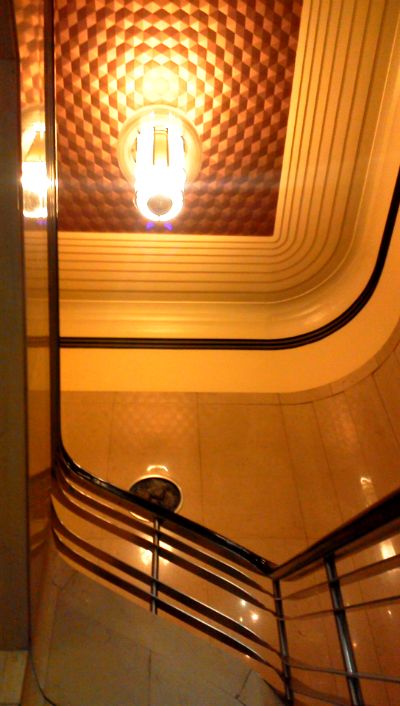
Light fixture on ceiling of the Design Exchange, Toronto
[Photo by KPA]


-------------------------------------------------------------------------------------------------------------------------------------------------------------
Posted By: Kidist P. Asrat
-------------------------------------------------------------------------------------------------------------------------------------------------------------
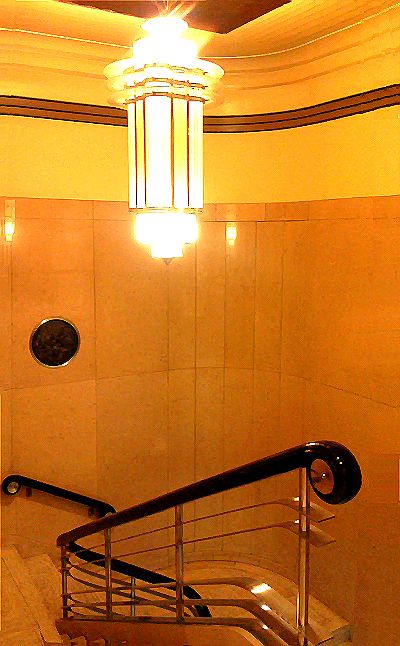
Image Posting


Saturday, April 19, 2014

Descent From the Cross


The Descent from the Cross, c. 1435
Rogier Van der Weyden (1399 or 1400 – 1464)
Oil on oak panel
86in x 103.5in

------------------------------------------------------------------------------------------------------------------------------------------------------------

Posted By: Kidist P. Asrat
-------------------------------------------------------------------------------------------------------------------------------------------------------------

Friday, April 18, 2014

This Good Friday


Andrea Mantegna, Calvary

The above image is posted at Laura Wood's The Thinking Housewife. Laura has posted paintings depicting Christ's ordeals through these holy days.

Also, on this Good Friday, Laura reminds us of the darkness of our times, by posting an article titled New York: City of Mohammed:
NEW YORK CITY becomes more and more congenial to Islam by the day. The Police Department recently announced that it will disband a surveillance unit that sent undercover detectives into Muslim neighborhoods for the purpose of identifying potential terrorists. The program, started in the wake of 9-11, was dropped in response to civil rights complaints, including civil rights complaints by Muslims.

And, Bill de Blasio continues to pledge to put Muslims holidays on the school calendar. According to one estimate, ten percent of New York public school students are Muslim
It is not enough to "observe" Good Friday this Easter, nor to optimistically wish each other Happy Easter on Sunday. Our calling now is bigger than words and songs. We have our enemies to ward off. We have to prepare for this.
-------------------------------------------------------------------------------------------------------------------------------------------------------------
Posted By: Kidist P. Asrat
-------------------------------------------------------------------------------------------------------------------------------------------------------------

Tuesday, April 15, 2014

Art Thieves

Image from Either/And Exhibition
Annie Macdonell
"The images in this series are scans of found 35mm slides. I came across a box of them next to the trash a few months ago. They were unlabeled, undated, and unsourced. I’ve put together a selection of 15, which now form a slideshow you can click through on your computer monitor. Maybe you will recognize some of the images. Others you may not recognize specifically, but you will certainly be familiar with their sources – art monographs, fashion magazines, notebooks and textbooks, technical manuals." [Annie MacDonell, Interview in Either/And] on her work Split Screen
[Note: Addendum below]

MacDonell was a former classmate of mine at Ryerson University, where she received a BA in photography. She went on to get a Master of Fine Arts in Lefresnoy, a university in France. Here is more on her statement of her work Split Screen in Either/And:
The slides were produced on a copy stand which, before the flatbed scanner, was the simplest means of reproducing images. Each one contains an interruption of the image by the spine of the book in which it originally appeared. The visibility of the spine is what attracts me to them. It marks only one of the many transformations these images have undergone since they were produced by the original photographer or artist. But in doing so, it places the histories and genealogies of these images in the foreground. The slides were shot for pedagogical purposes, to be projected large in front of a classroom and discussed as a group. Before that, they were published in books and magazines, to be purchased and leafed through by individuals. And before that they were, perhaps, images matted and framed behind glass on a wall. Now we may be browsing effortlessly through them, each on our slick backlit monitors. But the spine’s interruption of the image reminds us of where they came from in the first place, and how our ways of encountering them continue to shift along with the technology that delivers them to us.
That is a lot of words for simply showing pictures from magazines which spread across two pages (split by the spine of the book).

Such is the verbose nature of contemporary "artists" who have a lot to say about their vapid works.

MacDonell's Master of Fine Arts thesis was "about representation itself, which has always seemed to me a more interesting conversation," as she explains in the Either/And interview.

What this means is that MacDonell, for all her "artistic" vision, is not an artist. When tested, she's probably not very skilled at any of these artistic fields either: Film making (taking out the camera, shooting images, editing those images, producing a coherent whole), painting, drawing, or sculpture (she's big on "installations" which to her probably constitutes sculpture). All her works are borrowed, which I term as stolen, from various sources. And of course, not from real artists, which would have given her some exposure, and eventually something to emulate, but from the photographs and films she finds in people's garbage bins.

What a macabre and nihilistic way to represent the world! And it shows in her disjointed, cut ups, collages and installations.

Art for this conceited individual is about talking about art, rather than making art. And these "found objects" have been her means of "conversation" rather than creation.

Below is a photograph I took about two years ago which is around a similar theme of displaying cultural and sexual messages through contemporary cultural signs. The original post, with my commentary is in Camera Lucida under The Sexy Escape.

The Sexy Escape, 2010
Kidist P. Asrat

Here is how I see the superiority of my work:
a. My photograph shows:
- Context
- Humanity - how ordinary people look next to these iconic images
- Architecture - how images are placed in or on buildings
- Real life - the images show ordinary people juxtaposed with the images, mannequins and shop windows
- Poetry - I try to reference these views to come up with some kind of visual poetry

b. Macdonell's images show:
- Disjointed images, shapes and forms: Her cut-off hands of the mannequin, her burlesque dancer revolving in a few frames of a film, have no connection to the real world, and rotate within the image's confines
- Focused on phallic: Almost all her work, at some point, narrows in on the male or female sexual organs
- Cut off from real life: Even though she says she finds these "objects" in people's trash, she isolates them from the owners, and creates her own, insulated world out of them
- Morbid: Her objects form a collection of "found" items which have been thrown away, and which had no use for their owners. She doesn't salvage them and bring them back to their original use (building a new mannequin to of the hand, for example), or elevate them by creating something worthwhile, but uses them to further degrade them.
- Nihilistic: She says in an interview: "The work becomes about representation itself, which has always seemed to me a more interesting conversation [than talking about the work]." The objects, the images, the sculptures no longer count, which means what they represent does not matter either.

Macdonell, and the string of "artists" of her era, are clever wordmongers. They have not talent in art, but somehow decided that they wanted to work in art. This proved difficult, and their way out is to "have conversations about representation," as they spitefully malign art and creation.

Here are links to Macdonell's works and interviews:

- Cinema and Visual Pleasure at the 2006 Viennale

- Interview at the Mercer Union: Originality and the Avant Garde (on Art and Repetition)

- Grange Prize short-list

- Macdonell's website

Addendum:

Here are other strange, hard to locate, image reconstructions where MacDonell references Canadian photographer Roloff Beny:

The images are embedded in the 1967 collection of Roloff Beny's work: To Everything There is a Season: Roloff Beny in Canada, Essayd, Poems and Journals, Edited by Milton Wilson. It is not clear how much of the photographs are "collaged" additions to her work, if she retook photographs of the locations that Beny photogrpahed, or, what!

Here is one site which tells us this about the following photograph credited to MacDonell (and which doesn't appear on her website) The photo is for sale (!) for US$2,000:


This conceptual landscape by Annie MacDonell references the 1967 book, To Everything There is a Season, Roloff Beny in Canada. Beny, a world travelling artist/socialite obsessed with natural beauty sought to mythologize the Canadian landscape in a year that marked the country's centennial anniversary of confederation. MacDonell's interventions fracture and reconstruct Beny's mystical photographs, giving the soft, poetic imagery threatening edges that redress parallel social histories that existed (and still exist) in our society. Deceptively straightforward, these prints of reconfigured photographs layer our contemporary concerns on top of perspectives and sensibilities of past eras.

"Interventions?" "fracture and reconstruct?" "redress parallel social histories?" What does this all mean? No-one so far has given me a satisfactory explanation in my email queries.

And the tiny "53" (visible in the "original") at the bottom left hand I guess makes up for lack (absence) of information regarding this clearly appropriated work.
 
More to come.

-------------------------------------------------------------------------------------------------------------------------------------------------------------
Posted By: Kidist P. Asrat
-------------------------------------------------------------------------------------------------------------------------------------------------------------

Sunday, April 13, 2014

Easter and Passover


Moses and parting of the Red Sea, from Cecil B. Demille's The Ten Commandments

I wrote the article below in 2010, and it was published at Frontpage Magazine.

It is a critique of religion, contemporary American politics, multiculturalism, and Christianity. I am not a politician (nor a student of politics), but I'm surprised at how prescient some of my points were back then (this is four years before Obamacare becomes part of American health care)

----------------------------------------------------------------

Reclaiming Religion From the Left
Published in Frontpage Magazine
April 19, 2010


[Commentary on the 1956 Cecil B. DeMille's 1956 film The Ten Commandments should be screening this Easter on television, as it is an annual tradition. "Please check you local listings."]

Two television networks showcased Cecil B. DeMille’s epic 3 ½ hour The Ten Commandments this Easter: ABC and Canada’s CBC. The 1956 film had no need for our 21st century Computer Generated Imagery to convince us that the Red Sea was indeed parting, and that the “bush burned with fire, and the bush was not consumed” (Exodus 3:2). I wondered if the networks made this choice because there is really no superlative modern narrative of Christ’s crucifixion and resurrection? We have Mel Gibson’s The Passion of Christ, but its gore and blood is too hard to take at Easter. The Last Temptation of Christ by Martin Scorsese is too idiosyncratic, and would be something to watch and study at another time in the year. There are plenty of bland and insipid made-for-television versions of Christ’s story, many of which are programmed during Christmas, but for some reason they were not screened this Easter.

Perhaps these channels chose to commemorate Passover rather than Easter, which fell around similar dates this year. Or they’re simply following the ritual of politically correct inclusiveness. Even President Obama has made Passover Seder-at-the-White House a new tradition, hosting it for the second time as President. No other President before him has hosted the Seder at the White House. Obama’s Seder started on a whim, it seems. During his campaign trail, two young Jewish aides were celebrating their Seder in a basement of a Pittsburgh hotel, away from home and family, when Obama joined their festivities.

Obama’s interest in Jewish celebrations may indeed be a liberal’s outreach to cultural diversity – after all, the White House now hosts Ramadan dinners. But, it fits his narcissistic personality, conforming the Seder to any situation he may be experiencing at the time of the holiday. At the first, impromptu, Seder in Pennsylvania when his campaign was steeped in the Reverend Wright controversies and was “in the desert,” as another campaign aide put it, Obama proclaimed “Next year at the White House” as an addition to “Next Year in Jerusalem” commonly said at the end of the dinner. Perhaps, as suggests Judi Kantor from the New York Times, this year’s focus could have been one of the universalist themes that Obama is so fond of: to free Americans from the bondage of capitalist healthcare and to give them the abundance of Obamacare.

The Center for American Progress has another suggestion. In it’s article on Obama’s Seder celebration this year, CAP cleverly used the Bible’s New Revised Standard Version to quote from Exodus 22:21: “You shall not wrong or oppress a resident alien, for you were aliens in the land of Egypt.” Almost all the other versions use “stranger”, “foreigner” or “sojourner” in lieu of “resident alien,” clearly portraying a temporary dweller and not the long-term inhabitant that “resident alien” implies. The CAP’s advice to President Obama is that he treat Mexican illegal aliens with the same compassion they interpret from the NRS, and pass comprehensive immigration reform. But when we parse the words, it is clear that illegal aliens are not the “resident aliens” implied by CAP, but emboldened Mexicans, foreigners and strangers, who wish to take advantage of the lax rules and borders that makes it possible for them to enter and reside in the country with impunity.

One has to marvel at the President’s Seder chutzpah after his dismal treatment of Prime Minister Netanyahu during his recent visit to the United States. It is one thing to celebrate an ethnic festival, but another to respect the significance that the celebrants give their rituals. The Israelites that Obama commemorates in these Seders were freed from bondage in Egypt, and their descendants later received their Promised Land. Yet, Obama seems intent on removing this sacred land from the Jews, and forcing on them new enemies who are probably far more ruthless than the Egyptians.

Modern Christians are in as much danger as modern Jews. Our liberal neighbors, with their feel-good, made-up Christianity are destroying our religion and our communities. Liberal church leaders support issues ranging from comprehensive immigration reform to same sex marriage. Atheists, who have nonetheless constructed their own religion, now have their prophets. In the April 2010 publication of Vanity Fair, atheist Christopher Hitchens performs an iconoclastic dismantling of the Biblical Ten Commandments and then gives us his own petty ten. Like the Old Testament’s Jews, we have to trust that God will free us from our current tribulations.

In fact, End Time preachers use the exodus as an allegory for our liberation. Our ultimate release is entry into God’s heavenly land. But the Passover and Easter stories are also our personal stories. The journey from bondage to freedom reflects our own mundane ordeals. And we experience death and resurrection with each sin and atonement. Celebrating these holidays each year gives us the hope that we too will inherit our particular Israel.

The liberal, politically correct television stations were right after all. The story of Moses, recounting a people’s freedom from slavery, and culminating with the abiding Ten Commandments, was an apt choice for these holidays. Would that our leaders understand and practice its significance. Not just as at religious celebrations, but throughout the year.
-------------------------------------------------------------------------------------------------------------------------------------------------------------
Posted By: Kidist P. Asrat
-------------------------------------------------------------------------------------------------------------------------------------------------------------

Saturday, April 12, 2014

Poppy Blossom


Coach, which started out as a luggage store, is now selling perfume (and handbags, purses, wallets and other leather paraphernalia - minus shoes). So far, I think it's become quite successful. I bought several years ago the Coach signature scent, but I found it too sweet. I remember finding Coach Poppy Blossom, but for some reason, I remained unimpressed.

Recently, I went to my favorite perfume store Sephora (where they give samples of scents for the undecided, or the searching), and got a tiny flask (worth about ten sprays) to test. It usually takes several minutes for the scent to release its notes, and even longer for the middle and base notes to come out. Many current perfumes lose their scent within a few hours, but the good ones persist for days.

I asked a shop assistant (a man, unusual for stores these days) what he thought of the perfume. He started a conversation by saying that he recognized the New York Public Library's pin I was wearing on my coat lapel (a logo of the library's lion head). "I worked there for a while last year," he said. "Oh really, what section?" "In the Judaica section, in the Dorot." "Yes, I'm aware of it, but I haven't visited that section... Are you Israeli?"

I asked him his national origin because he had a peculiar name (to me), and a clear Israeli accent.

"No, I'm Moroccan. But I speak fluent Hebrew." he answered.

This didn't ring true (or honest). He did not have an Arab accent. I figured then that he must be one of the many ethnic Arabs who live (or lived) in Israel.

"Do you speak Arabic?" I asked him.

"Yes."

"Are you Muslim?" I finally asked.

"Yes."

Then I thanked him and left.

In any case, he had no idea about the perfume I was asking him, as is the case with most of the staff I ask for assistance at Sephora. What do these people have to do all day but stand around? A smart manager would have them go through all the perfumes, section by section, and study all the basic information about them. And the smart employees would go home online and read up more on the collections.

Which is what I did.

Poppy Blossom was disconnected from the Coach line for a while, but it is back as a limited edition in some of its stores, and Fragrantica and the Bay also carry the line. It is a modest $45 for 30ml.

I have to add, though, there is no poppy flower notes in the perfume, despite the name. It seems like a branding strategy, where the collection's bottles come with cloth poppy flowers for hair or dress decoration: Orange/red flower for the original Poppy Blossom), green for the Poppy Citrine Blossom, and violet/red for the Poppy Freesia Blossom.

The "Poppy" seems to be the name of the woman this perfume was designed for. But what kind of woman is called "Poppy?"

Here are the notes for the Poppy Blossom:
Top: Lychee, Strawberry, Orange, Freesia
Middle: Lily-of-the-valley, Rose, Tubrose, Gardenia, Jasmine
Base: Pralin, Vanilla, Musk, Woody notes

It has the lily-of-the-valley that I wrote about here.
The scent does last several days. Its final notes are a light combination of the floral and fruit, with the floral dominating slightly.

It is the perfect scent for late spring and summer.

Osmoz says this about the perfume:
Description: Poppy Blossom by Coach begins with fruity notes of mandarin, strawberry and lychee. The heart is a bunch of muguet, centifolia rose, tuberose, jasmine and gardenia. The warm and gourmand dry-down mixes praline, vanilla, blond woods and white musks.
At a glance: A playful and optimistic scent
History: After Poppy, and Poppy Flower, a citrusy and sparkling fragrance, Coach introduces Poppy Blossom, a more floral and fruity scent. According to the brand, the perfume combines the vivacious energy of Coach Poppy and the floral femininity of Poppy Flower. The fragrance embodies a whimsical, modern and sophisticated woman with an exhilarating personality.
Bottle: Poppy’s signature flacon is reinterpreted with a red poppy-like ribbon and a golden juice.
The era of the individual perfumer is over. Although Karyn Khoury is attributed as Poppy Blossom's creator, she worked with a large team of perfumers to make the scent. She says about the process:
...We spent many hours with Reed Krakoff (Coach’s executive creative director) and his team, listening to their vision of the brand and customer.

[...]

The result is a beautifully blended fragrance with great presence, signature and diffusion, which represents modern beauty, elegance and charm.
But, the "nose" of the original Poppy is Celine Barel, who has a modest collection of perfumes, including one nice one she designed for Jessica Simpson (modern pop star).

This original bottle has no corresponding flower, and is a darker bottle with a chocolate brown ribbon, perhaps referencing that "modern woman," with notes which include light and stronger elements, such as cucumber, gardenia, jasmine, and "decadent" marshmallow.

This site describes this dichotomy best with:
Poppy Blossom combines the vivacious energy of Poppy with the floral femininity of Poppy Flower. This luminous and warm fragrance is inspired by the modern beauty of the Poppy Woman.
But, as I said earlier, if left to its own qualities, Poppy Blossom is light, fresh, fruity and floral, and is perfect for spring and summer.
-------------------------------------------------------------------------------------------------------------------------------------------------------------
Posted By: Kidist P. Asrat
-------------------------------------------------------------------------------------------------------------------------------------------------------------

Wednesday, April 9, 2014

Dancing with the Stars

Maksim and Meryl, dancing the Foxtrot

Meryl Davis is the Olympian figure skater from the US,who came back from the 2014 Winter Olympics with two medals, one gold and one bronze.

Derek Hough, the star dancer and instructor of Dancing With the Stars, choreographed the Ice Dancing routine, for which she won gold with her partner Charlie White (who is also competing in Dancing with the Stars this year)

Meryl is partnered with Maksim Chmerkovskiy, the competing "star" instructor of Dancing with the Stars, for the 2014 season.

Below is the video for week two, with her and Maksim doing the Foxtrot:


In week three, there was a "switch-up" of partners, and Meryl danced with Maksim's brother Valentin.

Here is the video, with her and Val doing the Tango:


Meryl is the talent to watch. She's received some flack for competing in Dancing With the Stars with her dancing background, but dancers are quick to point out that figure skating might actually be a disadvantage, for the kinds of moves that make up that discipline.

Derek won an Emmy for Choreography at the 2013 awards. For this episode of Dancing with the Stars, he choreographed the Dancing With The Stars Macy's Stars Of Dance. Below is the video:


It is a dark and sombre piece. But what is to be expected of young artists today influenced by vampires and dark fairy tales?

Still, the weavings of Derek's choreography shows true talent. Perhaps, at some point, he will find a better subject then death and destruction (or nihilism). The glimmer of hope is the beautiful young woman in the dance, who might be the muse trying to get out of the horror story.

But, at some point, beauty will have to stand side-by-side with talent, as I hoped at this posting in 2011 on another television dance competition, So You Think You Can Dance. One step at a time.

Dancing With the Stars is also one such show, where amateurs train for weeks to perform like graceful dancers. Some even succeed. And they can all go home and spread the message of beauty.

The Coveted Mirror Ball
-------------------------------------------------------------------------------------------------------------------------------------------------------------
Posted By: Kidist P. Asrat
-------------------------------------------------------------------------------------------------------------------------------------------------------------

Saturday, April 5, 2014

Lily of the Valley

From: Faberge from the Matilda Geddings
Gray Foundation Collection
Metropolitan Museum of Art
New York
November 22, 2011–November 27, 2016
[Photo by KPA]

Lilies of the valley are late spring flowers, but they reminded me of snowdrops, which are one of the first flowers to come out in spring.

Here's a closer look at the design of the lily of the valley (from the Faberge exhibition):


Snowdrops are slightly larger, and their flowers are more open:


Snowdrops may indicate that spring (true spring, not the calendar spring) is around the corner, if it hasn't arrived yet, but the lily of the valley is a more poignantly beautiful flower.

According to Christian legend, it is:
...known as Our Lady's tears or Mary's tears from Christian legends that it sprang from the weeping of the Virgin Mary during the crucifixion of Jesus. Other etiologies its coming into being from Eve's tears after she was driven with Adam from the Garden of Eden or from the blood shed by Saint Leonard of Noblac during his battles with a dragon.

The name "lily of the valley" is used in some English translations of the Bible in Song of Songs 2:1, but the Hebrew phrase "shoshannat-ha-amaqim" in the original text (literally "lily of the valleys") doesn't refer to this plant. It's possible, though, that the biblical phrase may have had something to do with the origin or development of the modern plant-name.

It is a symbol of humility in religious painting. Lily of the valley is considered the sign of Christ's second coming. The power of men to envision a better world was also attributed to the lily of the valley. [Source: Wikipedia]
Here are some symbolic meanings of the lily of the valley:
-Return of happiness
- Purity of heart
- Sweetness
- Humility
- Happiness
- Love's good fortune
- It is also believed that this flower protects gardens from evil spirits. [Source]
These are the verses from Song of Solomon (2:1-17), which mention the lily of the valley:
I am the rose of Sharon, and the lily of the valleys.

As the lily among thorns, so is my love among the daughters.

As the apple tree among the trees of the wood, so is my beloved among the sons. I sat down under his shadow with great delight, and his fruit was sweet to my taste.

He brought me to the banqueting house, and his banner over me was love.

Stay me with flagons, comfort me with apples: for I am sick of love.

His left hand is under my head, and his right hand doth embrace me.

I charge you, O ye daughters of Jerusalem, by the roes, and by the hinds of the field, that ye stir not up, nor awake my love, till he please.

The voice of my beloved! behold, he cometh leaping upon the mountains, skipping upon the hills.

My beloved is like a roe or a young hart: behold, he standeth behind our wall, he looketh forth at the windows, shewing himself through the lattice.

My beloved spake, and said unto me, Rise up, my love, my fair one, and come away.

For, lo, the winter is past, the rain is over and gone;

The flowers appear on the earth; the time of the singing of birds is come, and the voice of the turtle is heard in our land;

The fig tree putteth forth her green figs, and the vines with the tender grape give a good smell. Arise, my love, my fair one, and come away.

O my dove, that art in the clefts of the rock, in the secret places of the stairs, let me see thy countenance, let me hear thy voice; for sweet is thy voice, and thy countenance is comely.

Take us the foxes, the little foxes, that spoil the vines: for our vines have tender grapes.

My beloved is mine, and I am his: he feedeth among the lilies.

Until the day break, and the shadows flee away, turn, my beloved, and be thou like a roe or a young hart upon the mountains of Bether.
-------------------------------------------------------------------------------------------------------------------------------------------------------------
Posted By: Kidist P. Asrat
-------------------------------------------------------------------------------------------------------------------------------------------------------------

Thursday, April 3, 2014

Spring Flowers (Bring April Showers)

Flower on the Atrium (across from the Coach Terminal)
Downtown Toronto
[Photo by: KPA]

It's not quite time for these flowers (they are from a Camera Lucida post from last May), and we're having a wet and cold March, and April started off the same. But, the showers should bring us flowers, soon.
-------------------------------------------------------------------------------------------------------------------------------------------------------------

Posted By: Kidist P. Asrat
-------------------------------------------------------------------------------------------------------------------------------------------------------------

Sunday, March 30, 2014

An American Foxhound in New York


A Winning Spirit


I saw a dog which looked to me like an American Foxhound near the Duane Reade on 106th and Broadway, when I was in New York last week. The second time I saw this happy and active dog, I asked the owner what kind of a dog he was. The young man told me that he didn't know, and that the dog was a "rescue dog" which he'd only had for a couple of months. The young man looked like he could do with a rescue more than the dog. As I was talking to his owner, the dog became friendly, but possessive, as though to ward me off his master. I took this as a greeting, and stroked him gently, while asking the man what he called the dog. "Grant," he said. "What a name you have," I told the dog, who by now looked like he just wanted to play.


"He looks like an American Foxhound," I said. "You should have him tested. George Washington's dog was an American Foxhound." I left Grant with his owner, still playful and rambunctious. I wonder where his owner got "Grant" from, the movie star (Cary), or from President Ulysses Grant? Either way, this Grant is a member of a prestigious group.


John Ward Dunsmore (1856-1945)
The First Gentleman of Virginia: George Washington at the Hunt (c. 1777)
Frances Tavern Museum, New York City

Information on the painting is on page 20 of:
Images of America: Woodbrook Hunt Club
Joy Keniston-Longrie
Arcadia Publishing, 2009


I've written about Jewel, an American Foxhound, who won several dog shows. And my post George Washington and his Dogs discusses how Washington bred the American Foxhound from English and French hounds, and the names he gave his large menagerie of hounds.
-------------------------------------------------------------------------------------------------------------------------------------------------------------

Posted By: Kidist P. Asrat
-------------------------------------------------------------------------------------------------------------------------------------------------------------

Notes on New York Trip

1. Met museum
a. Washington crossing the Delaware
b. Gilbert Stuart:
Two portraits
- Washington standing, young man - Full figure
- Washington head portrait, older statesman

2. Met Museum
Faberge:
- Just in time for Easter
http://cameraluc.blogspot.ca/2011/04/faberge-eggs-just-in-time-for-easter.html
- Faberge and Vereschchagin
http://cameraluc.blogspot.ca/2011/04/faberge-and-vereshchagin.html

3. Met Museum
Tiffany's stained glass

4. Cloisters
- Canterbury Cathedral Stained Glass
- St. Lawrence the Martyr- Stained Glass
- St. Lawrence attending to the poor - Relief
- Mary with Jesus: Boxwood Sculpture

5. New York:
106th Street Garden
Memory
Exedra

6. Philadelphia
Washington Square
http://en.wikipedia.org/wiki/Washington_Square_(Philadelphia)
a. Washington Statue
Based on Houdon's
Bust: http://en.wikipedia.org/wiki/Jean_Antoine_Houdon
Statue: http://en.wikipedia.org/wiki/George_Washington_(Houdon)
b. Eternal flame
c. Tomb of the unknown soldier
d. Quote by Washington

6. Dog "rescue"
At UWS, near Duane Reade
Named Grant (Ulysses or Cary?)
Looks like The American Foxhound
Washington's dog

7. See my posts on the winning dog show dog

8. Ruby Tuesday - see Wikipedia
- Restaurant by 42nd Street
- Song by Rolling Stones
- I sing the first stanza as I walk by either to walk to Port Authority or the NYPL
- Different cover versions
- About a free spirit

9. Purim
Taschen at the Plaza
- Purim just ended (March 15-March 16)
- My blog post
- PbS religion and ethics
- Many variations of Rembrandt paintings of Esther

10. First day of Spring
Thursday March 20th
When I traveled to Philadelphia

11. St. Peter and St. Paul's Cemetary
- It stopped raining
- The temperature was ok, but it seemed windy
- As I stood by Larry's grave, there was a gust of wind, which lasted perhaps a minute, or a minute and a half. It was not "ordinary."
It felt like a big hug

- I think each deceased person has his own way of communicating to the world below.
- Larry's fits his effusive, bigger-than-life, and generous character, holding nothing back

The last time I was there, it was a large burst of cicaaiadia (post here), which was extraordinary beause they are heard only a couple of times a year.

Cicaddia-- and Larry---- like a chorus...

Thursday was also the First Day of Spring.

The last time I was there, it was annuciation of Mary.

It must be lonely in heaven, lonely for those left behind. That is why we have all to do our best to meet up with those who left us behind....i.e., in heaven


Monday, March 24, 2014

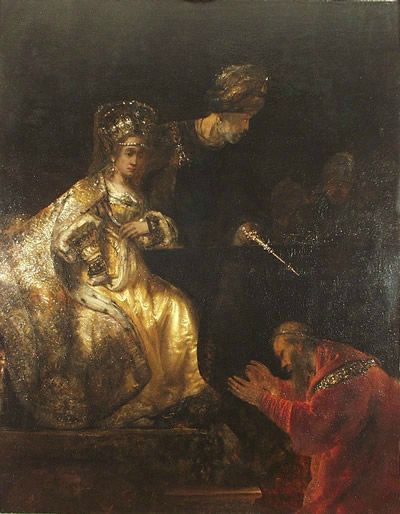
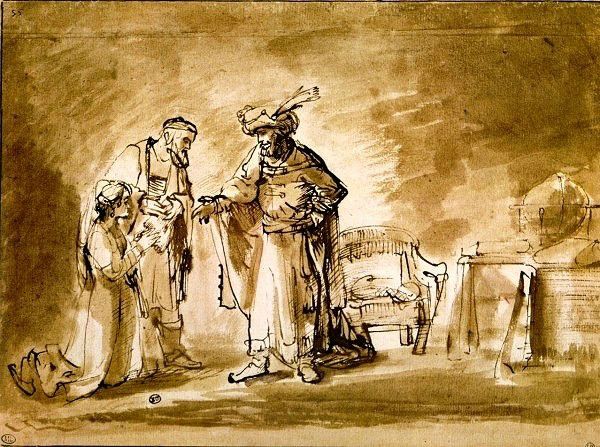
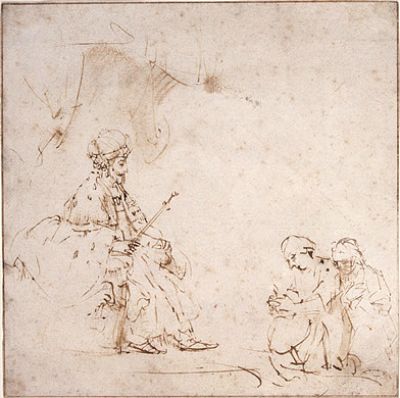
Rembrandt's Esther

The Jewish holiday of Purim ended last week. It commemorates:
...the deliverance of the Jewish people in the ancient Persian Empire where a plot had been formed to destroy them...

According to the Book of Esther, Haman, royal vizier to King Ahasuerus...planned to kill all the Jews in the empire, but his plans were foiled by Mordecai and his cousin and adopted daughter Esther who had risen to become Queen of Persia. The day of deliverance became a day of feasting and rejoicing [more here].
Rembrandt painted a series of paintings depicting Esther. Below are what I think it is a complete list:


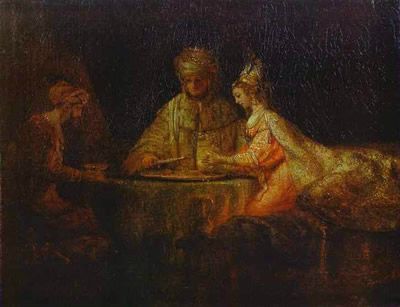
Haman and Ahasuerus at the banquet with Esther


Haman Prepares to Honour Mordecai


Haman Begging Esther for Mercy


Esther is Introduced to Ahasuerus


Esther before Ahasuerus


Esther with the Decree of Destruction


Esther Preparing to Intercede with Assuerus

More paintings of Esther by various artists can be found: here, here, here and here.

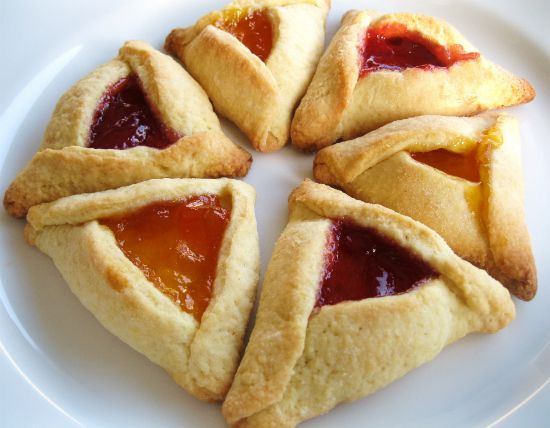
A special holiday cake called hamentashen is served for this holiday. I mention my first encounter with hamentashen in my post Kidist's Best of New York City (Best Hotel Bakery Item: The Hamentashen at the Plaza Hotel (apricot filling), which I discuss more here.


I'm not sure how the greeting goes, but I will just say: Happy Purim!
-------------------------------------------------------------------------------------------------------------------------------------------------------------
Posted By: Kidist P. Asrat
-------------------------------------------------------------------------------------------------------------------------------------------------------------

Saturday, March 15, 2014

Reclaiming Beauty Newsletter: New York in Spring

Below is the email newsletter I sent out for March 15, 2014. If you would like to be included in the list, please send me your email to cameralucidas@yahoo.com.

Kidist


March 15, 2014


Dear Friends of Western Civilization,

Thank you for those who made my upcoming trip to New York possible.

I will spend six days in New York City from March 17 - March 22. Actually, it will be four days, since on two of the days I will spend travelling from and to Toronto, a 12-hour trip by Greyhound. And before you feel sorry for me, it is a wonderful ride through western New York, parts of Pennsylvania, crossing New Jersey, before reaching Port Authority. The ride is mostly through rural and farm land, and we pass by some small towns. I blog about the route here at Camera Lucida in 2009. Here is post I did with photos I took of the mountain ranges I travel through. And here is a poston the Finger Lakes, with photos of Lake Cayuga. Customs at the American border is at Buffalo, and I am always surprised at the grand buildings in the center of the city.

In New York, I will join the roundtable group I mentioned in my last newsletter for dinner and discussion. I will spend most of my time at the New York Public Library to continue with my research for my book Reclaiming Beauty: Winning Back Our Civiliztion.

I am also going through various guides to find exhibitions that would be worth visiting (some might even be "essential viewing").

Two so far:
Radiant Light: Stained Glass from Canterbury Cathedral
At the Cloisters, Feb 25-May 18
The History of the Dressing Table
At the Metropolitan Museum of Art, through April 23

And Lincoln Center. When I was a student in New Jersey (in Rutgers) I used to make day trips to New York to listen to the free concerts. Actually, they were rehearsals open to the public. It was very intereting to see how the pieces were put together, and how the condictor went about doing so. Now, these rehearsals (called Open Rehearsals) cost $20, and the reviewer at the New York Philharmonic site agrees with me, saying:"An Open Rehearsal is a fascinating opportunity to watch the New York Philharmonic at work, and see how a piece of music is shaped and polished by the conductor and the musicians."

There's an Open Rehearsal on Thursday, March 20, at 9:45 am, at Avery Fisher Hall for:
- Ravel: Piano Concerto in G major
- Weill: Symphony No. 2
- Gershwin: Concerto in F

With Jeffrey Kahane conducting.

I had mentioned (in passing) on my blog that I had been through a long series of medical tests this past year. My latest doctor's visit (two days ago) showed that I have a clean bill of health. This is great news, and I believe that St. Michael, of St. Michael's Hospital, where I have been going through most of my tests, is watching over me.

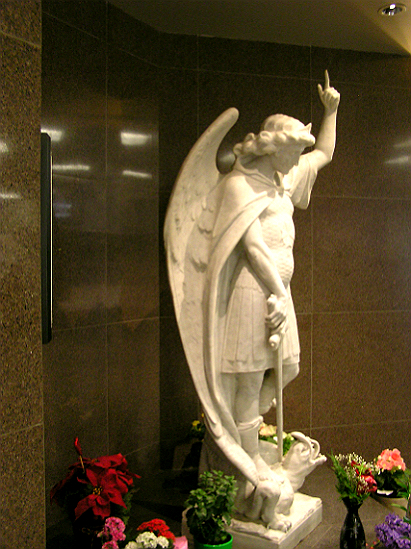
St. Michael Slaying Satan  St. Michael's Hospital, Toronto
[Photo by KPA]