I caught on back in 2008:
"Will anyone at Sotheby's stop and think?" Away from the Flock
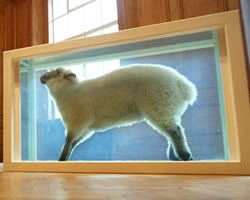
Formaldehyde soaked dead baby sheep
Courtesy HirstHirst is not a comedian as the article below tries to make light of his oeuvres. In fact he is dead serious. His "art" is the kind that has seeped into our culture aided and abetted by our own culture. There is a more nefarious and hidden aspect of his art. It is demonic. Its purpose is to replace God with Satanic forces; to complete the modernist trajectory of replacing Godly spiritualism with demonic spiritualism.
Here is Hirt's with his skull studded with diamonds:

Skull piece studded with diamonds titled:
For the Love of God Skull poster on the Rijks Museumn, Amsterdam,
Advertising Hirst's skull exhibition in 2007The article below makes fun of Hirst and his (temporary) loss of status and money. But Hirst is by no means trying to be funny. And he is by no means poor, nor has he lost any considerable following.
He still goes on.
--------------------------------------------------------------------------------------
 "Hirst reproduces himself like capital." / The Lowry
The Capsizing of Damien Hirst: Presenting the artist as shipwreck
By: Will Harrison
The Baffler.comHOW DID DAMIEN HIRST FIND HIMSELF in this predicament? Perhaps you’ve heard, from the New York Times or elsewhere, that Hirst has a big exhibition opening at the Pinault Collection in Venice next week—and the stakes are high. Once reportedly the richest artist in the world, Hirst’s market value and reputation have sunk, which makes it all the more appropriate that his new exhibition seems to involve the salvaging of a mythic, treasure-filled shipwreck. Can Hirst’s career—a scattered ruin of expensively produced artifacts—be dragged from the depths of the art market? As the Times almost gleefully suggests: his collectors need to know.
Yet details of the exhibition are few. Billed as “ten years in the making” and titled “Treasures from the Wreck of the Unbelievable,” the show has been highly if vaguely publicized. We only know that it marks the first time that a single artist has been displayed at both the Pinault Collection’s two locations—the Palazzo Grassi and the Punta della Dogana—and that it is Hirst’s first large-scale solo show since his terribly received “Two Weeks One Summer” at White Cube in London in 2012. Otherwise, not much has been forthcoming.
Still, we do know one thing about Hirst’s recent activity, even if it went curiously unmentioned in the Times. In late December, news leaked that the artist’s plans to build a 750-home eco-friendly village in seaside Ilfracombe had been scrapped. A spokesman eventually emerged to explain that Hirst and his team were unable to find a developer who could “deliver the housing in keeping with our vision.” With another group now in charge of the project once dubbed “Hirst-on-Sea,” the one-time enfant terrible found himself doing damage control, attempting to obscure what had really happened. In any case, the citizens of sleepy Ilfracombe have probably gotten more than enough of Hirst already: his sixty-five-foot sculpture Verity, which has stood watch above the village seafront since 2012, depicts an inexplicably robotic pregnant woman holding a spear aloft, her left side grotesquely flayed so that her fetus remains visible.
The impartial observer who might pass by this sculpture on the way to the office, or chance upon one of Hirst’s almost factory-produced works in a museum like the Tate Modern, probably couldn’t care less if he scores a comeback victory with his new “Wreck.” But for those of us with some modicum of interest, it is just as intriguing to consider how he got here, and why so many interested parties—the art media outlets, various gallerists, and especially his overcommitted collectors—feel such a desperate need to orchestrate his return.
Moral Hazard
Hirst is not famous for being an enigmatic talent. Certainly he is recognized for artworks that obsess over death, capital, and all things macabre, as well as his predilection for pickling sharks and other creatures in aqua-tinted formaldehyde, but he is best known for being brash, crass, and profitable. Although the general public had caught on to his insufferable personality by 2002, when he called 9/11 “kind of like an artwork in its own right,” the not-so-Young British Artist bestrode a tide of escalating asking prices through 2008, when he raised £111 million at a Sotheby’s auction without the help of a dealer or gallery. It was the same day Lehman Brothers collapsed.
Hirst’s valuation was not as solid as many believed; his stratospheric market position, in other words, foretold less about his future than did the Omens of Great Recession.
We now know that Hirst’s valuation was not as solid as many believed; his stratospheric market position, in other words, foretold less about his future than did the Omens of Great Recession. As it happens, the summer before his enormous pay day, Hirst had surreptitiously purchased his own sculpture—the ultra-famous, diamond-encrusted human skull known as For the Love of God—with the help of a consortium. It turned out that he’d failed to find a buyer for its £50 million list price. The move, later acknowledged as an attempt to preserve his market value and cover costs—and it worked for a time!—now seems emblematic of the financial hubris rampant in the late aughts. And, like the perpetrators of the financial crisis, Hirst’s consortium should have known better: For the Love of God, however famous, was a doomed instrument from the start, one Hirst curiously described in the language of finance. Explaining the work to the Tate’s video series in 2012, Hirst admitted that, in conceptualizing it, he began to wonder, “What is the maximum you can put against death?” Well? “Then, you know, diamonds came to my mind.” One should never attempt to leverage the abyss.
By 2009, with the global economy in full meltdown, Hirst’s annual auction sales had shrunk by 93 percent; since then, about a third of his works have failed to sell. In the wake of these financial stumbles, critics began to realize they could criticize Hirst with greater impunity. (In contrast, throughout his vertiginous ascent during the 1990s, Hirst’s detractors risked coming off as uptight Thatcherites in their attempts to question his corrosive cool.) Now, he was fair game; for example, his set of floating blue skulls, displayed at the Wallace Collection in 2009, was characterized as a “memento mori for a reputation.”
Mr. Gentrify
It hasn’t all been downhill. Like any too-big-to-fail entity, Hirst has a history of turning to real estate when he needs a shot of artificial market confidence. The most recent example—with the exception of the failed Ilfracombe project—came in October of 2015, when Hirst kicked off his comeback tour by opening the Newport Street Gallery. After purchasing a row of warehouses in dreary Vauxhall (long considered “London’s least fashionable arrondissement”), he got the architecture firm Caruso St. John to hollow the buildings out and slap white paint on the walls to the tune of £25 million, all of which he forked over himself. Outfitted with a predictably antiseptic interior, three tentacular stairwells, and six large galleries in which Hirst can display any of the 3,000 works in his personal “Murderme Collection,” the structure was apparently interesting enough to win last year’s Stirling Prize, awarded annually to the United Kingdom’s “best” new building.
Meanwhile, due in no small part to Hirst’s project, Vauxhall—home to a longstanding Portuguese community as well as a thriving gay scene—is now being primed as London’s next big thing, an alternative setting for the always mobile gallery scene. And while this development may come as a shock to neighborhood residents, it certainly doesn’t surprise anyone who has observed Damien Hirst’s career closely.
Gentrification, by all appearances, has always been Hirst’s favorite business, one that has been entangled with his artistic career from the start. Well before the skulls and sharks, Hirst’s first flirtation with fame came as the chief organizer for the much-lauded 1988 Freeze exhibition, in which he and several other peers—later dubbed the “Young British Artists”—displayed artwork in an abandoned Port Authority building in the South London Docklands.
In the wake of Freeze, art students like Hirst realized that self-curated shows in threadbare, impermanent spaces could attract attention and make money. One such exhibition, housed in an abandoned biscuit factory, featured Hirst’s A Thousand Years, a bisected vitrine in which flies hatched and then fed upon a rotting, bloodied cow’s head placed beneath a bug-zapper. In addition to being Hirst’s only work that summons anything close to terror (allegedly a primary theme of his oeuvre), it is an effortless emblem of his parasitic nature. Not only has Hirst persistently exploited his buyers, the free market, and the integrity of high art itself, he got his start by leeching upon the architectural carcasses of deindustrialization, contributing to the “regeneration” of areas that had just recently been left to rot. For example, in 1992, Canary Wharf, a subsection of London’s East End, contained seventy-one acres of derelict manufacturing buildings, and countless other light-industrial structures were languishing across the district. By 2002, with the help of Hirst & Co., the East End was home to over eighty art galleries.
To be sure, our valorization of artists as urban pioneers has always abetted the tide of gentrification, and the acceptance of this fact has (not unfairly) made many of us tire of the issue. With Hirst, though, we are granted a more encompassing means of viewing this progression, since it is his primary contribution to society. Hirst is no longer young and his art hardly shocks anymore, if it ever did, but the now decades-long reconstruction of a massive swath of London—often referred to as “art-washing”—can largely be attributed to his marketability (and market abilities).
Balloon Dogs and Doppelgängers
Newport Street has been framed as the artist’s experiment with “giving back”: admission is totally free. Yet it’s surely no coincidence that the project increases the value of Hirst’s own collection. Beyond that, too, Hirst might have been driven by a desire to compete with his estranged father figure, the advertiser and art-world archduke Charles Saatchi, who used his own personal gallery to promote and then profit from Hirst and the rest of the YBAs in the nineties. Finally, many critics are willing to imagine that the gallery’s launch has returned Hirst to his roots as a curator, hoping in vain for something as remarkable as Freeze. Quite clearly though, Newport Street Gallery is a primary act in Hirst’s redemption tour, an attempt to recover from the Sotheby’s debacle and his universally panned creative attempts since then.
After a perhaps intentionally dull opening exhibition at Newport Street in the fall of 2015—a retrospective of the abstract British painter John Hoyland (who once condemned the entire YBA cohort)—Hirst’s curatorial eye fixed upon a more kindred spirit: the one and only Jeff Koons. The exhibition, which opened in May of 2016, was called “Now,” a rather curious title for a retrospective of sorts that included a number of artworks from the 1970s and 80s. Like Hirst, Koons has made a career of generating art that interacts with, “comments on,” and occasionally embodies capitalist procedures. In particular, he has been able to convince collectors to provide the heaps of cash necessary for his colossal fabrication costs on projects like the now-ubiquitous Balloon Dog. Once the engineering was perfected, Balloon Dog, like the rest of Koons’s lacquered, impossibly kitschy “Celebration” series, could be reproduced by his team of approximately 128 assistants. More importantly, his initial investors could sell these facsimiles to other collectors before they were even completed.
Hirst once possessed a similar ingenuity, having wrung a not-quite-full career out of three ideas he had in his twenties. The taxidermied sharks certainly snatch the most attention thanks to their evocation of primal fears—though they induce a frisson of unease more than sublime horror—as well as for drawing a rather obvious parallel with capital itself: like a shark, our economy must move continuously or else expire. As if to illustrate this connection, Hirst’s original tiger shark, The Physical Impossibility of Death in the Mind of Someone Living, was obtained for $8 million by hedge fund manager Steven Cohen in 2004, one of the highest prices paid for a piece of contemporary art at the time. Hirst’s two other primary brands are much easier to replicate. Since 1986 he has produced, with a great deal of help from assistants, over a thousand “spot paintings,” in which colorful dots are strung in rows, executed with machine-like precision, or “by a person trying to paint like a machine,” as he has noted. Hirst’s “spin paintings,” generated by pouring paint on a circular canvas that has been affixed to a rotating potter’s wheel (like a larger version of the spin art offered at elementary school fairs), are even easier to duplicate.
Perhaps there was a time when intentionally blurring art with business seemed heady or original, but that age is certainly hard to imagine now. Hirst and Koons have benefited from a general emphasis on simplistic this-leads-to-that chronologies, garnering acclaim for merely repackaging the products of Warhol’s factory in shinier, costlier wrapping. It is this stubborn insistence on being current—of the “Now”—that reveals how unexpectedly out of date these artists have become. By embracing and incorporating pop culture tropes, advertising trends, and commodity culture at large, both Hirst and Koons effectively time-stamp their art, guaranteeing it the ephemerality of the latest toy craze rather than the longevity of truly great art. One suspects that amidst their empty posturing and flippant refusals to utter anything definitive during interviews (Hirst has said that he wants “the viewer to do a lot of work and feel uncomfortable”), they knew this would be the case. But they were determined to cash in while they could.
According to Guardian windbag Jonathan Jones, the shallow visions of both of these men form accurate reflections “of the kitsch hell capitalism has created.” But is it enough for art to simply hold a mirror up to the age from which it springs? In any case, Hirst and Koons appear more as symptoms of our time than actually being au courant, since both are indisputably past their critical apexes. It does seem ironic that in an era of endlessly proliferating images, two of our most profitable artists have made their fortunes by trotting out the same creations again and again: a full twenty-one years after The Physical Impossibility, Hirst was still plunging animals into formaldehyde.
But this is what buyers, and neoliberal economists for that matter, want: a time-tested moneymaker that can masquerade as something flashy and new. Often overlooked amidst the journos’ fetishization of Hirst’s wealth is that the general YBA style—sardonic, naughty, and “primitive,” yet always ready for a photo shoot—was born out of a monetary need more than from any creative vision. Hemorrhaging money during Britain’s recession of the early nineties, Charles Saatchi offloaded his blue-chip stable of artists and began buying the much cheaper work of Hirst & Co. in bulk. The YBAs reliably incited controversy and headlines almost as soon as Saatchi displayed them in his own gallery; by the time his collection was shown in the notorious Sensation exhibition at the Royal Academy in 1997, they were also paying major financial dividends.
Old Turks
Nostalgia is a peculiar and unbecoming costume for a brazen, lurid, and reflexively masculine artist to don. Hirst’s most recent show at Newport Street is yet another retrospective, this one devoted to his more easily forgotten YBA counterpart Gavin Turk. Turk’s corpus is notably self-referential and derivative, typified by a life-sized waxwork of himself dressed as Sid Vicious, locked in a pose that evokes Andy Warhol’s silkscreen of Elvis Presley. Like Hirst, Turk has attempted to conceal his get-rich ambitions with anarchic posturing, claiming that his primary objective is to create an artwork that ends art (an idea as old as Dada, appropriated and commodified nearly a century after the fact). But rather than killing anything off, Turk, along with Hirst, Koons, and contemporaries like Tracey Emin and Marc Quinn, make art that expressly encourages hyper-competitive art collecting, helping to foster an age where every oil tycoon and oligarch alike yearns to become the next Charles Saatchi.
More than contributing any lasting aesthetic or school of thought, Hirst and his peers are memorable for cynically glorifying the cannibalizing death march of late-late-capitalism.
Much more than contributing any lasting aesthetic or school of thought, Hirst and his peers are memorable for cynically glorifying the cannibalizing death march of late-late-capitalism. Unlike the Abstract Expressionists, or other avant-garde cohorts that at least went through a period of trying to transcend what makes an artwork a commodity, the Young British Artists presented a model where the art object immediately recognizes its status as product but ultimately amounts to little else. Though he rose to prominence during the “end of history” nineties, when a free-market Shangri-La was supposed to save us all, Hirst seems to have realized that we were actually operating a long-broken economic machine, kicking at the tires, hoping in vain that the engine would restart. The key was to get rich before the buyers noticed as well.
In the meantime, Hirst was willing to evoke the pessimism and violence of Margaret Thatcher’s England while also profiting from her reformation of the British economy, which made London an international finance hub once again. Last summer, Hirst circulated a series of images declaring support for the “Remain” campaign, a stance hard to interpret as motivated by anything other than a desire for market stability. While his persona has always drawn upon a certain laissez-faire shabbiness, whether through laddish drinking binges or the homegrown grunge of the Freeze show, Hirst’s business model has been to continually wring the status quo for all it’s worth.
So even though Hirst’s bad behavior and deployment of pop culture references have seemingly made “high art” more accessible to the masses—his 2012 Tate Modern retrospective was the museum’s second most visited exhibition ever—these proclivities also suggest a compulsion for expropriation. More often than we’d like to admit, art preys upon something in decline: stylistic antecedents, cultural trends, members of the populace. Hirst has plundered all three, but his exploitation of the final group—more specifically the working class—has predictably garnered the least attention. When he remarks, “I’m basically getting more yobbish,” and alludes to his rebellious childhood in Leeds, he is providing cheap thrills for rich gallerygoers keen on slumming it more than he is challenging the discriminations made by the art world.
Shipwreck with Spectator
Lost in the muddle of the Hirstean tabloid cycle is the simple fact that his recently aborted lark in Ilfracombe betrayed a similar disregard for the interests of the common people he so loves to aestheticize. Residents of the quiet seaside town seemed puzzled by the motivations behind the project and have been generally wary of Hirst’s fascination with their community, where he now owns a restaurant, a small gallery, and a country estate. Hirst’s village within a village would have increased Ilfracombe’s population by almost a third, a prospect that seemed to appeal exclusively to retailers and overeager politicians. “It’s the only topic of conversations ‘round here,” one woman remarked in the Daily Mail when the plans were first announced. Hirst’s own silence regarding the project’s failure, as well as the relative lack of media coverage, has surely been the subject of some barstool bantering.
But anyone outside of North Devon who heard the news had to wonder: where does he go from here? Newport Street provided a nice distraction, as well as a new part of town to fix up, but it is unclear if it has restored Hirst’s market value, and it certainly hasn’t solved his seeming inability to generate new work worthy of anyone’s attention.
Despite its secretive roll out, “Treasures from the Wreck of the Unbelievable” remains within Hirst’s usual comfort zone. As ever, opulence is predominant. “It was carrying a lot of treasures, sculptures, jewels and things like that, to create a palace,” Hirst vaguely remarked seven years ago. Catherine Mayer’s recent all-access profile of Hirst in the Financial Times seems to imply that his primary artistic achievement may be supplying the funds that helped a team of archaeologists haul actual artifacts from the ocean floor. Or perhaps he asked his herd of assistants to produce a few gold leaf encrusted facsimiles of ancient sculptures and then toss them overboard, only to drag them back up again once they had acquired a bit of decorative coral. Either way he will be getting all the credit.
Even if the show lands Hirst back inside the white-hot core of the art world, his new material, like the entire corpus that precedes it, will be no more than modern ruin sheathed in a glittering emptiness. On the other hand, Hirst may have finally achieved the sense of primal fear he always attributed to his own art, and this—perhaps more than what they stand to lose financially—is what mesmerizes his collectors, the gawking art media, and anyone else with skin in the game: Hirst’s career is a Gesamtkunstwerk, a total artwork that mirrors the maneuvers of capital with utmost precision, and if it runs aground, so too might the Sisyphean economic system with which it has merged. Shipwreck indeed.