Monday, April 13, 2020

Have a Sweet


Here is a post at the Ryerson Image Centre Facebook page. I recently sent a proposal to have my works exhibited at the RIC, and which I withdrew after I realized that: 1). They were going to stall, and eventually decline my proposal, and 2). Do I really want to be associated with such an organization anyway?

Here is my proposal, including images.

And, as usual, my instincts were prescient. Above is how the RIC sends out wishes for Easter on their Facebook page.

Have a Sweet, everyone!

Sunday, April 12, 2020

Palm Sunday


Title: Palmesel
Date: 15th century
Geography: Made in Franconia, Germany
Medium: Limewood with paint
Dimensions:O verall (w/ base): 61 1/2 x 23 3/4 x 54 1/2 in., 182lb.
Classification:Sculpture-Wood
Location: The Cloisters Collection, New York

[Photo By: KPA]

Letter to VDare


Detail of a 17th century painting of St. Mercurius,
from a church in Lalibela, northern Ethiopia,
now in the Addis Ababa National Museum


Below is a letter I wrote to VDare regarding a post by one of their authors, John Derbyshire, who wrote about WHO's COVID mastermind, Tedros Ghebreyesus, in his April 4 article: Globalization Meant Sinification—Until China Virus Intervened.

VDare is:
[A] non-profit journalistic enterprise, the main project of the VDARE Foundation. We publish data, analysis, and editorial commentary in a variety of formats. We inform the fight to keep America American.
---------------------------------------------------------------------------

Dear Mr. Fulford,

VDare recently published a post which discusses Tedros Ghebreyesus, the Director-General of the WHO, by John Derbyshire.

I understand the concerns that Mr. Derbyshire expresses, but I wish to correct him on one point (well another, too).

Firstly, Derbyshire makes reference to Ghebreyesus' background as Ethiopian, well, "Ethiop," to use his wording. More precisely, Ghebreyesus is Eritrean-born. His loyalties are for Eritrea. That is a fine line perhaps, like saying the Scottish and English are British, and both have their loyalties. But Ghebreyesus' loyalties to Eritrea go beyond ethnic association, and are also political.

As I write here:
He worked for the Ethiopian government during the Derg Marxist era of the 1908s in the Ministry of Health
And here:
His PhD dissertation was on malaria transmission in the Tigray region, a province in northern Ethiopia, which further distance him from the "Ethiopia" label, since the Tigray people have fiercely contested the historical leaders of Ethiopia, the Amhara, and often would not recognize the historical Ethiopia in defiance of the Amhara tradition and history as rulers of Ethiopia.
Most non-Amhara would wish to identify with the Amhara, as evidenced by their large numbers inter-marrying with the Amhara group, while openly associating with their various ethnic groups. I see this regularly within my own family circle (I am an Amhara).

And most Amhara will identify themselves as Ethiopians first.

The current politics in Ethiopia is a much larger and complex story. Yes, the Chinese have gained a foot-hold in Ethiopia for about a decade now, but the astute leader, Abiy Ahmed, a southern Muslim married to an Amhara woman, went to those who could help him in his time of "nation building" when America was too busy with wars in the Middle East, and unable (or unwilling?) to become the ally he needed.

Abiy, now, has enlarged his scope of allies, with Canada, Europe, and hopefully America, slowly replacing the Chinese and their many limitations. COVID-19 is now most likely the deal breaker.

Ghebreyesus' Chinese link in Ethiopia's politics may have been a reality at some point, but it is a weak one now.

The other point I would like to make is Derbyshire's condescending use of "Ethiop" to describe Ghebreyesus' (contested) origins.

Perhaps Derbyshire is using Shakespeare's "A rich jewel in an Ethiop's ear," although even Shakespeare got it wrong, since in his time (late 16th - early 17th century), those wearing such rich jewels, and often crosses, would be the lighter skinned Ethiopians, who consolidated themselves centuries earlier, through their various kings and emperors, as the Christian Amhara. They were leading that distant country then, as evidenced by paintings, mostly religious and Christian. Shakespeare perhaps associated this far off Christian civilization with the dark African (slaves?) whom he might have witnessed arriving within England's shores.

I have attached a detail of a 17th century painting of St. Mercurius, from a church in Lalibela, northern Ethiopia, now in the Addis Ababa National Museum, to give an idea of the Ethiopians prominent in that century.

Note, though, that Ghebreyesus has the Orthodox Christian background of his native Eritrea, which is of course the traditional religion of Ethiopia, which the Amhara developed and intertwined intricately with their culture, society, language, and their leadership (as kings, emperors and governors).

His first name Tedros comes from the Greek Theodore, later Christianized, with St. Theodore as an important namesake. It is also the name of two Ethiopian Emperors named Twedoros, one of the 15th century and another the 19th century. Perhaps Ghebreyesus intentionally changed his name's spelling from the traditional Twedoros (and which is phonetically more correct) to Tedros in order to weaken this association.

Ghebreyesus means servant of Jesus, with Ghebre being a common prefix for other "servants," such as Ghebremariam, Gherbreselassie (servant of the Trinity), etc. But Ghebreyesus' years as a Marxist would have annihilated his Christian spiritual references.

Ghebreyesus, through his WHO post (as Director-General), surely has close links with Canada's Chief Public Health Officer, the Hong Kong born, British educated Theresa Tam, who is the mastermind behind the COVID-Lockdown here in Canada. I have written on her and her links with the WHO. My article is published on the website of the Council of European Canadians.

Sincerely,

Kidist Paulos Asrat
Reclaiming Beauty

Faberge Eggs: Just in Time for Easter

This is a post from my Camera Lucida blog (2005-2013) posted on April 12, 2011.

-------------------------------------------------------------------------------------


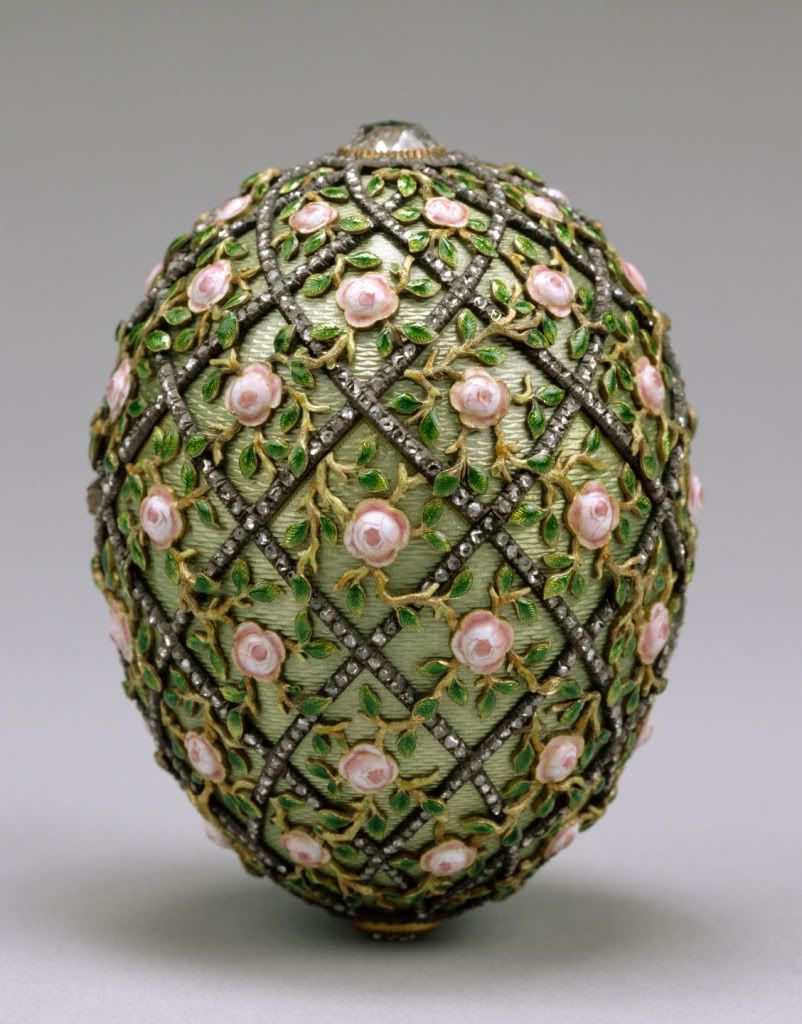
The Rose Trellis Fabergé Egg was acquired by
American businessman Henry Walters in 1930,
and is now at theWalters Art Museum in Baltimore.

-------------------------------------------------------------------------------------

Fabergé eggs were made between 1885 and 1917, and:
[W]ere designed primarily at the behest of Russian Tsars Alexander III and Nicholas II as annual Easter gifts for Tsarinas Maria and Alexandra.
This is the Easter gift that Tzar Alexander III gave Tzarina Maria Fedorovna in 1885, which also marked their twentieth wedding anniversary:
Easter is the most joyful celebration of the Orthodox faith in Russia. After the devout church services, families gather to exchange gifts of decorated eggs, symbols of renewed life and hope. The Easter of 1885 also marks the twentieth anniversary of Czar Alexander III and Czarina Maria Fedorovna, and the Czar needs an exceptional gift for his wife.

So he places an order with a young jeweler, Peter Carl Fabergé, whose beautiful creations have recently caught Maria's eye.

On Easter morning, Fabergé delivers to the palace what appears to be a simple enameled egg. But to the delight of the Empress, inside is a golden yolk; within the yolk is a golden hen; and concealed within the hen is a diamond miniature of the royal crown and a tiny ruby egg – both now lost to history.
Here is what the Walters Art Museum says about the (above) Rose Trellis egg:
On April 22, 1907 [on Easter], Tsar Nicholas II presented this egg to his wife, Alexandra Fedorovna, to commemorate the birth of the tsarevich, Alexei Nicholaievich, three years earlier. Because of the Russo-Japanese War in 1904, no Imperial Easter eggs had been produced for two years. The egg contained as a surprise a diamond necklace and an ivory miniature portrait of the tsarevich framed in diamonds (now lost). Fabergé's invoice, dated April 21, 1907, listed the egg at 8,300 rubles.
Many Fabergé eggs were either sold or taken out of Russia during the Russian revolution. Eight eggs are lost. Ten are now on display in the Kermlin Armory Museum. Sotheby's put up nine eggs for auction in 2004, and the entire collection went (back) to Russia, purchased by Russian oligarch Viktor Vekselberg.

Happy Easter!


Resurrection of Christ
Raphael, 1499–1502
Oil on wood panel

Friday, April 10, 2020

The Taking of Christ


The Taking of Christ, c. 1602
Michelangelo Merisi da Caravaggio
Oil on Canvas
52.6 in × 66.7 in

If ever there is a sign...


I wonder if the Covid-Crew had any idea that they would be interfering with Easter?

If ever there is a sign...

Thursday, April 9, 2020

Spring Leaves


Spring Leaves
[Photo By: KPA]

City Centre Lock-Down


Wednesday, April 8, 2020

"It is Spring!" Sings the Robin


"It is Spring!" Sings the Robin
[Photo By: KPA]


The Jubilee Garden is filled with birds. But the robin has claimed a tree, and a particular branch, from which he sings his song of spring.

Psalm 150
Praise ye the Lord.

Praise God in his sanctuary: praise him in the firmament of his power.
Praise him for his mighty acts: praise him according to his excellent greatness.
Praise him with the sound of the trumpet: praise him with the psaltery and harp.
Praise him with the timbrel and dance: praise him with stringed instruments and organs.
Praise him upon the loud cymbals: praise him upon the high sounding cymbals.
Let every thing that hath breath praise the Lord.

Praise ye the Lord.

Who is Chantal Hebert?


Chantal Hebert: CBC Reporter

This is a comment I got from Tim the Disencahnted via my message box on the side bar on my recent article, posted at the CEC on Theresa Tam:
She's not a lesbian..she's just one of of those old Chinese hags who
dont' care about how they look..
or typical CBC type..perhaps the only network in the world..where
physically unattractive is a prereq for the job. See Swiss Propaganda
Reserach for what a totally contrived scam this is..Real..detailed data.

I reply:
Dear Tim the Disenchanted.

Thank you for your comment!

Yes, Tam does look like those CBC types, like that Chantal Hebert, whom Tam somewhat resembles in her manner and appearance - the unkempt hair, the rarely smiling face, etc.

Hebert has a "conjoint" but we're not told if it is male or female, so we can conjure...

These people have us under their grip.

Theresa Tam: Canada's Coronavirus Expert


Friday, April 3, 2020

Who is Tedros Ghebreyesus

This was originally published at The Thinking Housewife.

------------------------------------------------------------------------

The following points give some background on Ghebreyesus, who is everywhere identified as an Ethiopian, but is actually from Eritrea. (I refer to him by his first name as Tedros in the following):

He may have worked in Ethiopia under various regimes, but I think his Eritirean background identifies his world view, his political background, and his politicization of health care. Hence his post in the WHO.

Here are some interesting points:

- He is the first WHO Director General (DG) that is not a medical doctor, but rather has a PhD in Community Health
- He received his BA (in Biology) from the University of Asmara in Eritrea
- His PhD dissertation was on malaria transmission in the Tigray Region, a province in northern Ethiopia, which further distances him from the "Ethiopian" label, since the Tigray people have fiercely contested the historical leaders of Ethiopia, the Amhara, and often would not recognize this historical Ethiopia in defiance of the Amhara tradition and history as rulers of Ethiopia.
- He worked for the Ethiopian government during the Derg Marxist era of the 1980s in the Ministry of Health
- He left for his PhD studies in London after the fall of the Marxist regime in 1991
- He returned in 2005 to Ethiopia to become Minister of Health, under another Marxist/Totalitarian regime of Meles Zenawi
- Zenawi who as the leader of the Tigray People's Liberation Front - TPLF - (Tigray is the northern province of Ethiopia, south of Eritrea) ruled in coalition with the ultra-Marxist Ethiopian People's Revolutionary Democratic Front, and made it possible for the secession of Eritrea (Tedros' "home" province) from Ethiopia in the 1990s
- During his years as Minister of Health (2005-2012), and as Minister of Foreign Affairs (2012-2016) Tedros developed contacts and relationships with the Clintons (the Clinton WHO HIV/AIDS Initiative, which collaborates with the WHO) and the Gates (Bill and Melinda Gates Foundation, which provides substantial grants to the WHO) in his campaign to win the WHO post in 2017
- As health minister, he was charged with cover-up of three cholera epidemics in Ethiopia, in 2006, 2009 and 2011, mislabeling them as Acute Watery Diarrhea, to downplay their significance
- He chaired the Global Fund to Fight AIDS Tuberculosis and Malaria - a foundation which has been riddled with fraud and corruption
- The largest donors to the WHO are the Bill and Melinda Gates Foundation through the GAVI Alliance for vaccination.
- Tedros was a board member on GAVI, which gave him a warm welcome upon his WHO election
- China was also an important ally of Tedros in the WHO’s DG election in 2017
- Months before his WHO election, Tedros was invited to speak at Peking University where he called for stronger cooperation between China and the Global South on health issues
- Domestic Chinese news coverage featured Tedros’ praise of Xi Jinping and his criticism of foreign governments
- The day after his electoral victory, Tedros confirmed to Chinese state-media that he and the WHO will continue to support the “One China” principle, which recognizes the government in Beijing as the legitimate Chinese government
- Three years later, Tedros’ enduring support of China’s response to COVID-19 shows that their early support for him is still paying dividends
- And China’s WHO contributions have grown by 52% since 2014 to approximately $86 million.
- Despite growing evidence of China’s mishandling of the outbreak and rising domestic Chinese outrage over the government’s censorship, Tedros doubled down on his praise for China
- He politicized his WHO position by calling on nations not to limit travel with China and warned against the “recrimination or politicization” of the outbreak, as he himself politicizes it
- The WHO’s (Tedros') weak response to China’s mishandling of the COVID-19 outbreak has laundered China’s image at the expense of the WHO’s credibility
- John Mackenzie, a member of the WHO executive committee, publicly stated that international action would have been different if not for China’s “reprehensible” obfuscation of outbreak's extent

And here is one final paragraph:
More concerning is Tedros’ delay in declaring COVID-19 a public health emergency of international concern (PHEIC). On January 23, the WHO’s emergency committee was split on whether to declare a PHEIC. With final authority resting with the DG, Tedros decided to wait despite admitting that “this is an emergency in China.” A week later, he declared a PHEIC. By that point, confirmed cases of COVID-19 had increased tenfold with 7,781 cases across 18 countries.
----------------

If I may a personal take:

Tedros has lived most of his adult life as a "revolutionary," against formal, established systems, to destabilize them in a Marxist/Socialist fashion. His primary target, as is the case with contemporary "revolutionaries" is to destabilize the West, western thought, western ideas, western civilization. The WHO is a hotbed for such kinds of appointed officials, clever at garnering huge funds, and stealthy at destabilizing countries and regions which would not follow the line.

In appointing him, the WHO found the perfect blend of a well-trained, and intelligent, leader, who uses his position to realign the geopolitics of the world.

It is an important post.

----------------

I made the points above from the following articles:

Tedros Adhanom
Who Is WHO’s Tedros Adhanom? The Wuhan Lockdown is Unprecedented
Why TPLF is desperately fighting for Dr Tedros to be next DG of WHO?
The WHO and China: Dereliction of Duty
Clinton Foundation HIV/AIDS Initiative
GAVI Welcomes Ghebreyesus' WHO post
Bill and Melinda Gates Foundation
Imperialist powers mourn death of Ethiopia’s Meles Zenawi
Gavi, the Vaccine Alliance
WHO chief's questionable past comes into focus following coronavirus response

Thursday, March 19, 2020

First Day of Spring


First Day of Spring
Photo By: KPA

Winter Garden


Photo By KPA
March 18, 2020


A winter garden, in the lovely Jubilee Garden in Mississauga.

Thursday, February 20, 2020

Here's a great article I wrote on Goethe, Newton, and color. It is unpublished, but you can see my other published and unpublished articles here:


Goethe's Morality of Color

Newton tried to keep color in the realm of an independently provable entity by analysing that light refracted from a prism was separated into a spectrum of colors. He tried hard to maintain objective observations and had an assistant help him make his readings to avoid his own subjective perceptions. He avoided “colors in a dream or what a mad man sees”, and emphasized a quantifiable, objective analysis of color. His works on color and light were published in the much celebrated "Opticks" showing that light was made of colored rays.

It is chemical and physical scientists who have shown the most interest in measuring and studying color, and not the artists who would rather use it rather than analyze it. Yet, alongside the very lucrative paints (and other color industries) which they propagated, these same chemists have realized that the history of color is not just a numerically speculative phenomenon, but involves other values such as emotions and morals to which artists espouse. In fact, the history (or the understanding) of color is closely intertwined with these objective scientists and the more subjective artists.

If one were to place Goethe in this continuum, he would definitely figure at the other end with the artists and other poets of color. Goethe insisted that color should be studied as the human eye perceives it, rather than as instruments measure it. In his unparalleled “Theory of Color Theory”, he spent many experiments trying to show the role our eyes (our perceptions) play in determining the effects of color.

For example, he studied the phenomenon that is now called ‘after-images’ where after looking for a prolonged time at a certain color, when switching to a blank white canvass, we see the ‘contrasting’ color on that white canvass – blue instead of yellow. His premise became that color is not a fixed entity, but depended on many other human and non-human factors in order to be seen. Goethe was convinced that color affects us morally, physiologically, and psychologically; that we react subjectively to color. He eventually started to establish his theory on the ‘morality’ of colors, introducing us to his color polarities starting out with specific colors, and incorporating subjective values on to them: Yellow vs. Blue; Force vs. Weakness; Brightness vs. Darkness; and one is tempted to add Good vs. Evil. Of course, these may only be his subjective views, and another artist may decide that it is red and green that are in such opposition.

Goethe’s emphasis on the perceptions of color, what colors meant, emoted, symbolized, how they affected our senses, feelings and morals influenced the direction and importance of color in painters from there on. Color, up until then, had been give a secondary role to drawing, where line, light and shade dominated. Earlier painters had always delegated a secondary role to color finding no way of equating it with line and form. If Newton were to critic Goethe, I’m sure he would side with these earlier artists and put more emphasis on the straightforward drawing, rather than Goethe’s elusive perceptions of color.

Despite the differences that Goethe found between his and Newton's work, he eventually reconciled these differences, asserting that both objective and subjective views were possible. Newton also had never rejected the idea that color can be a subjective phenomenon. Ultimately, it is this supreme interest in color that unites Newton and Goethe. But Goethe was perhaps more right than wrong in emphasizing the elusive nature of color, and in disagreeing so vehemently with Newton at the beginning of his studies. Color has continued to be as elusive, subjective and ephemeral as he had suspected it to be. Perhaps both Goethe and Newton opened a pandora's box when they decided to put color at the fore-front of their inquiries.

Still , in just a matter of decades, we go from Newton’s predominantly ‘objective’ "Opticks" to Goethe’s ‘subjective’ "Theory of Color". From quantitative measurements to subjective perceptions. How did this come about? Why was Goethe interested in demonstrating the subjective, while Newton insisted on the objective?

I believe it has to do with transcendence. Both Newton and Goethe profoundly understood the human 'will'. Newton wanted it subservient to and Goethe wanted it at the center of man. Newton stressed, in his method of inquiry, that something beyond man determines things. Goethe’s central figure is man himself, and man’s perceptions are the primary factor in his life. It really was a battle between the supremacy of God, and the supremacy of man. In Goethe’s world, man finally wins. By allowing man to focus on his will and whim, Goethe put a stop to this transcendence. Color became the easiest way for artists to win this battle (if they were fighting it in the first place). It was no longer necessary to accurately depict lines and, in Newton’s heroic attempt, colors. Artists no longer had to describe, as best they could, our natural, external world. They could only be expected to personally interpret it, where wilful perceptions finally take over.

Color became a manifestation of the artist’s personal feelings, personal will, personal interpretation and personal desires. Goethe’s "Theory of Color" became the gateway for artists to focus on the much easier human will rather than on Godly transcendence. This led to color being the most important element in painting, and eventually dominating the whole canvass. Later on, this would also result with the distortion of line, form and even content subject to the artist’s interpretation. Color released the artist from any outside commitments, and allowed him to be accountable only to himself. This is essentially the attribute of the modern artist. “What does this mean?” becomes a common question directed at most modern paintings.

Since color is really a manifestation of the modern artist’s personal interpretations, it becomes all about the artist’s feelings. Thus, emotions (or sensations) play a very large part in these paintings. Monet may have attributed his bluish/pinkish haystacks to the time of day, and type of sunlight falling on the dried grass, but it is essentially his subjective and exaggerated interpretation of that particular moment of the day. This later became much more pronounced in his Rouen series, where a blue Cathedral finally exists. This is only a step before Van Gogh’s who tried to “express the terrible passions of humanity by means of reds and greens…” in his Night Cafe. No longer are we subjectively describing a scene, but expressing and interpreting it emotionally as well. Artists even suggested choosing colors "from their palette than from nature".

Feelings are naturally unstable – one is not always happy, or always sad, or always angry. Van Gogh’s deep sense of alienation in red and green could just as soon turn into the calm accommodations of pastels, which he did use in his "Almond tree in Bloom". With nothing to ground these paintings, and focussing on shifting personal sentiments and emotions, artists can say and paint anything they want, and then change their minds about them. Kandinsky, after seeing Montet's variously hued haystacks said, "Deep within me the first doubt arose about the importance of the object as a necessary element in a picture". Now, even the object, the epitome of form, is no longer required as a reference to the external world. The artist can draw anything he wants, and color it anything he desires. Even the title to Kandinsky's paintings is indicative of this belief.

With no external responsibilities, or a sense of transcendence to force these artists beyond the self, this battle of relevance has now raged for more than a century. I think it all started when color, that fickle, deeply personal, ephemeral quality, took precedence over the drawing. When previous attempts at objectivity were superseded by subjectivity. This unwillingness to face the difficult external world, and perhaps humbly attribute it to something greater than oneself, changed the focus of the artist from the external world to his internal landscape. The color field aritsts of the 1960s epitomize this attitude, where nothing but color dominates the whole canvass. This has been the saga of modern art.


References:

Gage, John. Color and culture : practice and meaning from antiquity to abstraction. Boston ; Toronto : Little, Brown and Co., c1993

Goethe, Johann Wolfgang von. Goethe's color theory / Arranged and edited by Rupprecht Matthaei. New York : Van Nostrand Reinhold, 1971.