Showing posts sorted by relevance for query reinhard. Sort by date Show all posts

Wednesday, May 23, 2018

The Goal of The Art Gallery of Mississauga: NOT to Emulate Homer Watson


Installation
Reinhard Reitzenstein
Bonavista Biennale at Knight’s Cove,
Nine upside-down, ochre-stained trees along the water and ATV trail.
Image source: Canadian Art in Newfound Land, Photo By: Lean Sandals
August 23, 2017
(Article By Leah Sandals)


Here is a post I drafted almost a year ago (it is dated September 5, 2017 and I left the draft article in my files). I am pretty sure I didn't post the essay because I was concerned about augmenting the negative interactions I had had with the Art Gallery of Mississauga, which started soon after I attended the Summer/Fall 2016 exhibition and panel discussion on Canadian painter Homer Watson and other contemporary Canadian artists. The exhibition and the panel were titled: Beyond the Pines: Homer Watson and the Contemporary Canadian Landscape. I attended both.

Given the antagonistic nature the gallery continues to take towards me, especially in view of recent events, it is all now par for the course.

The artist I am profiling is Reinhard Reitzenstein, whom I briefly discuss in a recent post about a week ago here. I had heard him speak on a panel on the exhibition Homer Watson: Beyond the Pines, where he also showed some of his work. I discuss him along with some others from his panel and the Homer Watson exhibit in an August 2017 post Reinstating the Artistic Legacy of Homer Watson, about a month after I attended the exhibition.

In this particular draft I published (posted) today - see below, I write about the small interaction I had with him when I asked him a specific question about his work, and the reply I got from him.


In our postmodern era I would be defended as a discriminatee.

My non-White, Third World background would automatically place me in the "victim" pigeonhole where my word against my white "antagonist" would preside, NO MATTER WHAT.

That is, until I start to defend this "white" monster and say he is the one being discriminated against.

Then the wrath, slow though it may come, is full on!

Especially if it is a white women who is regulating the discrimination channel.

This happened to me recently after I attended (and participated in) a lecture at the Art Gallery of Mississauga, where a group of artists were to discuss the works of Homer Watson, a late 19th early 20th century painter from southern Ontario.

I wrote about the exhibition and the panel discussion here: Homer Watson, Native Son. But I left out my questions to the panel.

As wrote in the post:
Last year, I attended a panel discussion on the exhibition Beyond the Pines: Homer Watson and the Contemporary Canadian Landscape at the Art Gallery Mississauga. I had visited the exhibition numerous times, going through Watson's work one by one, to study his technique, his evolution as an artist, his views, his concerns, and his Canada.

The exhibition also displayed works by contemporary Canadian artists to bring this pine "narrative" to the fore. Some were reasonably good, but none reached the overall skill and beauty of Watson's paintings.
I was gong to leave it at that, just a personal observation (not naive or untutored, since I have a solid background in the arts), hoping that I would gain some insight from these artists.

But I should have known better.

The catalogue the AGM produced for this exhibition prefaced with this objective:
Contemporary Canadian artists looking at landscape must also find a way to access the ‘truth’ of a subject that is not only strongly represented in our national artistic history, but one that is both deeply political and personal.
So the "truth" of a subject is now mandated to "represent" not just our nation "objectively" but has to incorporate political and personal views as well.

A tree is not a tree is not a tree, to paraphrase Gertrude Stein .

I asked Reinhard Reitzenstein, one of the panelists, who is a pretty good sculptor (and who is white), if he believes that Homer Watson's standards, and art, set an example for artist in general or if his English (Western) heritage is insignificant. This was of course not what I was asking, as Reitzenstein clearly understood. I was asking him if he thought that Watson's work was good, was superior.

Reitzenstein talked for a bit and finally admitted that he doesn't want to emulate the now archaic art of Watson. We are in the modern age after all!

So, irrespective of technical expertise, artistic beauty, or individual ingenuity, as long as an artist follows the "archaic art" of Watson, his work can not be deemed "good."

This is the tired discussion of art which has reached now such a comical zenith that works are exhibited in museums and galleries simply based on their mockery (and not simple rejection) of this Western tradition. And many artists have become wealthy doing so.

But the public isn't with the program, which is why the Art Gallery of Mississauga has to go through loopholes to get people to visit its exhibitions, including set up committees and workshops to "study" this lack of museum attendance.

I received a "newsletter" email about a year after this exhibition from the AGM, one of the few I have received from them to invite me to participate in two workshops titled: Collections Through The Prism of Diversity Series (here are day one and day two of the schedules).

But I was given about a week's notice for a two day workshop, where would have had to pay $250/day to attend. My first reading of the email, before I saw the dates, was to figure out ways could come up with the sum, including asking for a reduced fee. Soon after, I realized that I was put on the list as a "visible minority" participant.

Here is the email I sent the gallery:
I can only surmise from this late notification that the AGM is getting some kind of monetary benefit from this "email list" which it seems to use haphazardly to meet with its program mandates.

In my case, the mandate appears to be that of a minority female artist who can participate in the discussion on how to add more "diversity" into the art collections of the region.

Through your lack of appropriate notification, you indeed lost the participation of a minority female artist (myself) who would have made a unique and substantial contribution to this discussion.
And the reply I received from Mandy Salter, AGM's newly selected director:
The AGM prides itself on its high professional standards and its strong relational manner. We provide a safe and accountable space for our diverse staff, volunteers, artists and audience. All of this supports the democratic nature of the work we do at the AGM.

Moving forward, if you are able to visit the AGM in a congenial and supportive way I encourage you to do so. If at any point in the future, you visit the AGM and create an unsafe, critical and or threatening space, we will contact security who will request that you leave the premises. If you do not comply they will be entitled to further legal action under the Ontario Trespass to Property Act. I have cc’d senior Security Officers at the City of Mississauga on this and other incidents regarding inflammatory and false statements made by yourself.

The AGM prides itself on embracing diversity and inclusion as a core institutional value. We strive to create an accountable and inclusive space that supports like-minded individuals.
Diversity counts at all costs, even if it means getting the "diverse" complainant out the door!

The irony of the AGM's position of course doesn't occur to its staff: that they are discriminating against me (shutting down my "voice" ) in order that they might continue with their program is exactly what they are accusing the white inheritors of Homer Watson.

This time though, they have found a whole different story: An "ethnic minority" who supports a white tradition, and an immigrant no less!

Wednesday, August 9, 2017

Reinstating the Artistic Legacy of Homer Watson


Art Gallery of Mississauga's exhibition,
in partnership with the Homer Watson House and Gallery

Beyond the Pines
Homer Watson and the Contemporary Canadian Landscape
September 24, 2016 - January 1, 2016


Background wall:
Various paintings by Homer Watson

Foreground Sculpture:
Reinhard Reitzenstein
Thrust
2015
Bronze, granite
63” x 48” x 28”
Olga oppler Gallery

[Photo By: KPA]


--------------------------------------------------------------------------------------------------------------------------------

Last year, I attended a panel discussion on the exhibition Beyond the Pines: Homer Watson and the Contemporary Canadian Landscape at the Art Gallery Mississauga. The exhibition of the same title was going on at the same time and I had visited it numerous times to go through Watson's work one by one, to study his technique, his evolution as an artist, his views, his concerns, and his Canada.

The exhibition also displayed works by contemporary Canadian artists to bring this pine "narrative" to the fore. Some were reasonably good, but none reached the overall skill and beauty of Watson's paintings.

Watson's talent as a painter was recognized by a friend who initially advised him:
...to quit the nonsense of going in for art in a country like Canada. "Quit it and come into the office and become a business man.”[1]
Watson continues with the story:
...on nearing home [some weeks after he had submitted the painting to the Canadian Academy exhibition] I saw this gentleman on the road in front of his establishment reading the Toronto Globe. Seeing me he advanced waving the paper and putting out his hand he exclaimed, “I take it all back. Go ahead and paint. Look here,” and there it was in flaming headlines in the Globe, “Country boy paints picture bought by Princess Louise.” So that was that...
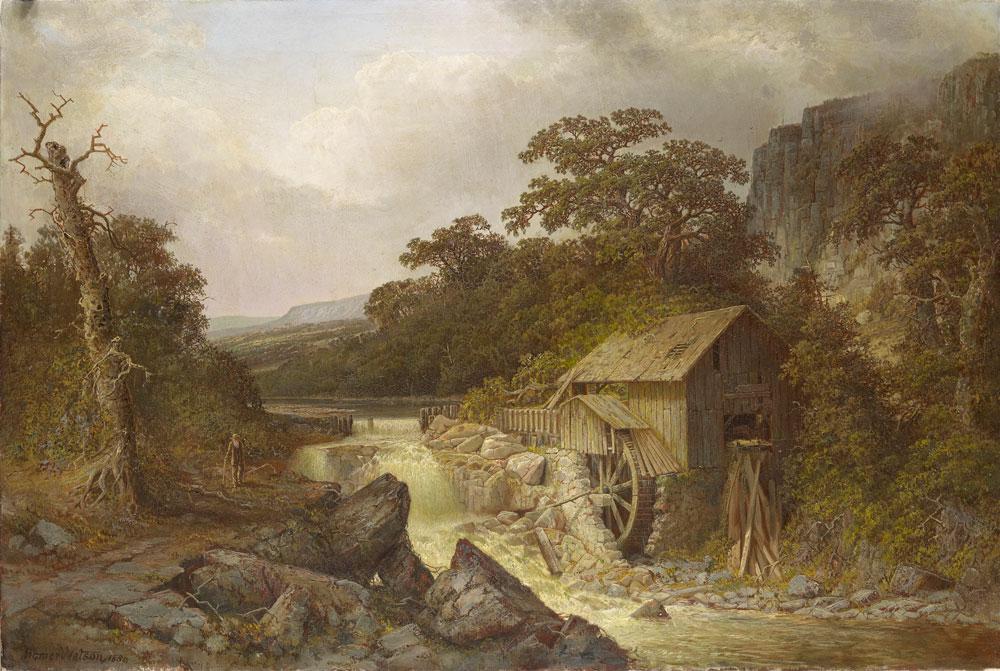
Below is the painting that gave Watson his faith in his art.


Homer Watson,
The Pioneer Mill, 1880,
Oil on canvas,
86 × 127 cm,
Royal Collection Trust.
(Photo: © hm Queen Elizabeth II)


Homer Watson was born in 1855 in Doon, Ontario (now Kitchener). He started to paint as a young child encouraged by his father and his aunt. He never received any formal art training, but acquired his skill and artistic sense through various mentors he sought as he developed his talent. He moved to Toronto and worked at a photographic studio and met some of the prominent Canadian artists of the time. One of which was the British-born landscape painter Thomas Mower Martin, who emigrated to Canada to take advantage of free land for settlers under the Free Grant and Homestead Act. Watson traveled to New York at the Hudson River School, and was influenced by the work he encountered there. He spent two years in Europe living in England and in Scotland. His brief visit to France introduced him to landscape painting through the Barbizon school. He "developed a landscape style marked by honesty of purpose and a focus on the moods of nature."

While in Toronto, he met and sought the counsel of other artists such as the landscape painter Lucius O'Brien, who was the first president of the Canadian painters' society, the Royal Canadian Academy, which formed in 1880. Watson would follow O'Brien's footsteps as president of the society from 1918-22.

Watson was called "the Canadian Constable," and “the man who first saw Canada as Canada, rather than as dreamy blurred pastiches of European painting,” While he holds these noble acclamations, he has nonetheless been overshadowed by the more forceful Group of Seven artists who along with their art had a mission to accomplish. Watson simply showed us the curiously singular southern Canadian landscape, amidst its farms and homesteads, as a civilized part of northern America, as a uniquely separate and independent country. He is the first nationalist Canadian painter.

Part of Beyond the Pines: Homer Watson and the Contemporary Canadian Landscape's purpose was to present Watson's landscapes as though they were infused with ephemeral supernatural beings. The AGM's curators obtained this notion of "spirits" from one aspect of Watson's life: his questions regarding his deceased sister and whether she could be "visiting" him. “Could it have been? Or was it a delusion?” he asks of a "vision."

Nothing is defined about Watson's belief in spirits, but it makes for an interesting exhibition.

The exhibition's other, more subtle, agenda was to place Watson in the background of Canadian art, albeit discreetly, and carefully, as an artist who no longer represents contemporary Canadians and Canada, and reflects only the past, colonial English heritage. Watson can be admired through an historical "prism" who has little relevance in the current Canada. The AGM was ready to give some artistic legacy to Watson, but from a cultural and historical distance.

This second agenda was less easy to discern since the exhibition had many works by Watson and was titled after him, suggesting the presentation was in his honor. But in reality, as the panel discussion proved, and as the carefully worded exhibition title "Beyond the Pines" elucidates, the interest was not in Watson's work - after all, there are endless exhibitions and museums showcasing the English/Western/Colonial art of Canada - but rather in what came to Canada when the English heritage started to wane and a multicultural ethos began to develop in the country.

The gallery's curators were using a phrase full of political innuendos. "Beyond the Pines" is a reference to Canada's Group of Seven painters who ventured out to northern wildernesses, further even beyond those pines, to discover a more rugged and wild Canada as a way to define Canada's identity separate from Britain's and from America's.

Part of going "beyond" is also reaching territory that even these adventurous men wouldn't or couldn't reach. It is part physical and part psychic. It is the land of the "natives" those aboriginals whose spirits are infused n

Kendra Ainsworth, the AGM's curator for contemporary art, and curator of this exhibition, says:
"Contemporary Canadian artists looking at our landscape must also get to the ‘truth’ of their subject. One that is not only strongly represented in our national artistic history, but also one that is both deeply political and personal. Placing contemporary works by emerging and established artists alongside Watson’s speaks to our timeless quest to appreciate and capture the essence of the Canadian landscapes we live in.”
But the "pine" imagery (or mythology) predates this rugged group of painters. "Beyond the Pines" is infused with Canadian aboriginal mythology:
The pine tree is a symbol of longevity to the Algonquian tribes of the north east, and to the Great Lakes tribes such as the Anishnabe and the Potawatomi pine trees represent wisdom and harmony with nature.
And "Beyond the Pines" didn't correctly identify Watson's works since Watson, who was from southern Ontario, painted few pines and mostly depicted the oak, elm, chestnut, and walnut of the region.

Canada has not been this territory of impenetrable wilderness and inhospitable glaciers for generations now, including during Homer's and the Group of Seven's lifetimes of the late 19th and early 20th centuries. This Canada was already a nation of defined European, and mostly British, communities with houses, gardens, farmland, forests of many types of trees.

And, more importantly, these pines of this northern country were associated, at least in the eyes of cultural and social historians, both Canadian and American, more with a land of wilderness and glaciers, sparsely inhabited by groups of aboriginal tribes. Pine forests, and glaciers and wilderness, were much further north than Watson's Doon.

The gallery's website explicitly tells us:
The Art Gallery of Mississauga (AGM) would like to acknowledge and give thanks to the land on which we work. The AGM has the privilege of operating in the territory of the Mississaugas of the New Credit First Nation and traditional homeland of the Wendat, Anishinaabe and Haudenosaunee nations. We are thankful to the many First Nations, Inuit, Métis and global Indigenous peoples who call this region home.

The AGM is committed to recognizing and incorporating diverse Indigenous perspectives within exhibitions and programming, and highlighting the numerous Indigenous artists who have contributed to this gallery. The AGM is dedicated to providing a platform for contemporary Indigenous art and curatorial practices, and hosts events and programs that reflect various cultural topics and identities. [4]
And that is the other "narrative." We are on the land of the Natives.

As this notification from the AGM website informs us:
The Art Gallery of Mississauga’s recently hired Director and Head Curator Mandy Salter this morning made a pair of announcements - both geared towards First Nations inclusion as an essential part of her populist mandate for the AGM.[5]
"Beyond the Pines," besides a geographical description was also a spiritual territory.

There was only one "First Nations" piece, which was a short - looped - video of two men (aboriginals who looked white) walking around barren land ready to "hunt," as a protest against the hunting permits that they, and all hunters, are required to obtain. This is Native land, which has its own laws and regulations. And Salter wants us to watch, powerless, their protests as an expiation for our sins of "colonizers."


Still from Video: Modest Living
By Brian Junger and Duane Linklater
Art Gallery of Mississauga
Beyond the Pines


A group of eight contemporary artists were also part of this exhibition. None made any explicit references to Watson or his era, rather focussing on the exhibition's general themes of the natural and spiritual. But it was Jennifer Carvalho and Reinhard Reitzenstein who most skillfully combined these spiritual and natural worlds in their pieces.

Carvalho studied at the Emily Carr University of Art and Design where she would have obtained some foundational training in the arts. She later went on to obtain her MFA from the University of Guelph. She paints skillfully and confidently. Her trees are in the traditional painting methods skillfully using chiaroscuro techniques. And Reitzenstein works in difficult bronze to tease out intricate trees, although traditional Western bronze works were figurative, using the human body (and animals) rather than the plant world as references.

Carvalho's Unexpected Connectionscraftly renders the pine forest into some kind of impenetrable ghostly space where we're likely to encounter "unexpected" beings:
Its opaqueness sets a tone of exacting anxiety[2a].
At the same time, the trees point up to an open sky with a sun or a moon hidden behind mottled clouds, suggesting some kind of light trying to brighten the darkness, and escape from this ghostly space.


Jennifer Carvalho
Unexpected Connections
Oil on canvas, 22”x28”, 2015

For Jennifer Carvalho the Anthropocene [the “human age”] is not an endgame. “It’s an in-between time,” she says. “I’m not trying to emphasize an end but a line of thought that leads away from ourselves. What does it mean if the world has a will of its own and what is our relationship to that? What would the world look like without us?”
...the mix of olive green and blue in Unexpected Connections produces a colour close to an impenetrable black. Its opaqueness sets a tone of exacting anxiety. [2]
Carvalho's "spirit" connection is rendered urgently apocalyptic with an End Times landscape of burnt trees whose haze of purple fumes envelope the barren land like the devil's burning sulfur whose activity is discernible in the fumes wafting through the background.


Carvalho's Unexpected Connections reminds us of Emily Carr's skyward swirling pines of Metchosinc, although Carr's brighter forest spirits seem more benign and the celestial destination, with the small band of illuminated blue at the top of the painting, more possible[4a].


Emily Carr
Metchosin, c. 1935
Oil on canvas
50.7 x 58.7 cm

Although Carr lived at the other side of Canada in British Columbia, it is not surprising that the Toronto-based Carvalho is influenced by her works, having studied at the prestigious Emily Carr University in Vancouver. And despite her West-coast location, Carr had been allowed into the prestigious and exclusive company of the eastern Canada's Group of Seven based in Ontario, a group of artists to which Beyond the Pines makes references [4b].

While Carvalho's trees appear grand and majestic, Reitzenstein shows us only one tree at the AGM exhibition, which is reduced to a tiny spike at the top of a sinewy vine that winds down and pulls us toward a fungi base.


Reitzenstein's tree makes one of its first appearances not as the bronze-sculpted piece sitting in a gallery but outside in the natural landscape. In 1987, he tells us of his idol worship of the tree in a piece he calls: Tree-Cantations where he has uprooted grown, tall trees and re-planted them upside down. He is not looking heaven-ward for the presence of God instead but digs deep down within the roots the fungi.


No Title
1987

In this subversive work, it is not only spiritual grievance that he is presenting but a cultural one as well. As he explains his title "No Title":
No Title was installed on Topsail Island in the St. Mary’s River between Sault Ste. Marie, Ontario, Canada and Sault Ste. Marie Michigan, U.S.A. It was part of a sculpture symposium called Sans Demarcations. The project refers to the titling of land and ownership. It was realized with the cooperation of chief Dan Pine of the Garden River reserve near the Sault. He helped me site and dedicate the project to the cause of respectful resolution for land claims made by the indigenous nations of this continent generally and his community specifically. The circle of inverted trees draws the viewers’ attention to the state of inverted priorities of the dominant colonial cultures that have stolen native lands and suppressed indigenous cultures on a global scale. No Title also supported the Garden River people in their claim to land now under water, flooded by the process of building locks in the St.Mary’s River and drowning thousands of acres of their ancestral lands.
"Indigenous nations" has been a theme of Reitzenstein's art, and continues to be. He uses it to portray, as does Carvalho, both spiritual and cultural themes. As he usurps the Western traditions, its God and its art, he supplants it with something else: the "forsaken" other. For the time being, it is those "indigenous" groups. I predict that in his next major work, he will betray these natives and he will embark on ethnic immigrants. Perhaps it will be an ode to the Syrian "refugees'. Hs painterly theme will be of those who are subjugated to the colonial racism of the West even as they leave their forsaken homes and come to this land of plenty. His native betrayal will be callous and opportunistic as all his art has been. His "No Title" shows no empathy for natives, the environment, or even those trees which he seems to admire so much. Syrian refugees, like Native Canadians, will be just another issue to take on and to force onto his art. He is not merely an artist, he is also a self-proclaimed saviour! He has no interest in gods or in God except as imagery for his ever-changing idols. He calls out to mother nature only when he needs to form another of his naked bronze trees.

He gave us a glimpse of this dystopia in "A Destructivist performance" where
Gary Nickard and Reinhard Reitzenstein with sound support from Buffalo's legendary 1970's era Post-Punk band The Vores featuring Biff Henrich as well as additional Friends.
"In a 1919 essay, Wyndham Lewis posited Nature and Design as the antipodes of representation. Excessive concern with Nature leads to pure content, to allow Design to dominate is to force the work to surrender to pure form. As he describes it, the artist devours, or conversely, is devoured, as one monster struggling against an equivalent monster.

"Acknowledging a debt to both Raphael Montanez-Ortiz and Richard Hulsenbeck, Monsters is a duet of ritualized violence and stifled catharsis emerging from the dying shrieks of two sacrificial pianos, set against a starkly jagged swirl of throbbing guitar feedback and pulsing percussion. The resulting sound sculpture presents a darkly ceremonial existentialist confrontation that underscores the dissensus of the current historical moment."

His tree has become even more metaphorical in his 2012 installation piece Hanna's Cabinet in St. Anne's Anglican Church in Toronto, where a twig strewn on the floor becomes the sinewy serpent. In this piece, which he presented as his first exhibition work with the Netherworld collective after it re-grouped following a 20-year hiatus (he was one of the group's original members), he shifts ever more farther away away from God, sacrilegiously displaying his collection of idols which this blasphemous church allows him to do so. Where God has been discarded, other spirits rush to intervene. The serpent has made its entrance.

But Reitzenstein's adoration is for is the whole earth Gaia to whom he makes his incantations with these forlorn objects, his most cherished being his tree branches.


Reinhard Reitzenstein
Hanna's Cabinet, 2012
Materials: wood bronze flowers oil ceramic petals
St. Anne's Anglican Church, Toronto

Hanna's Cabinet, depicts a space that speculates on the question I asked myself, where would St. Anne (Hanna) go to be a lone and find solice [sic] and refuge? What would the space look like. In St. Anne's Church there was a tiny secluded space under the stairs which felt like the right site to prepare such an environment.
At a recent exhibition at the Netherworld collective were he presented work he titled Parasite, he
populates the gallery’s walls, corners and columns with realistically rendered fungi made from beeswax.

Collectively titled Parasite, the pieces evoke multiple metaphorical associations that could apply to art — art as sustenance, art as fermentation agent, art as medicine, art as hallucinogenic. The link between fungi and art might also include magic and spiritual enlightenment in the realm of ceremony and ritual. And true to the inverted nature of the pieces (netherworlds...). Reitzenstein uses the beeswax as the main sculptural material, whereas it is traditionally used as a mold for the enduring bronze. Beeswax s also "degradable" which is the man theme, whether explicitly presented or suggested, in all of Reitzenstein's pieces.

...the pieces evoke multiple metaphorical associations that could apply to art - art as sustenance, art as fermentation agent, art as medicine, art as hallucinogenic. The link between fungi and art might also include magic and spiritual enlightenment in the realm of ceremony and ritual.

Left: Artist Reinhard Reitzenstein filled some of the gallery walls
with realistic-looking fungi made from beeswax.
The pieces are collectively called Parasite.

Right: Catherine Heard’s Grave consists of
a grouping of small skulls, which is also
accompanied with a video animation
projected on the wall to make it look like some
kind of scanning device such as a ultrasound or MRI


Reitzenstein never shies away from telling us his true beliefs.

+++

One of hs earliest pieces with the Nether Mind Collective in 1991, Reminiscent of a ...Cell Series, shows twigs and branches with rounded brass balls at their ends suggesting some kind of bomb:
Reitzenstein is represented by his Reminiscent of a ....Cell series, large bronzes in wh9ch a rod or branch sprouts out of an initial ball, suggesting tension between growth and proliferation...

...Nether Mind purposefully sought out a basement space for its work, seeing there a metaphor for the internal world of which their art speaks.

Kate Taylor Globe and Mail May 10, 1991
511 King Street West Basement
511 King Street West, a run-down building in 1991, is now a posh yuppie's destination where these former starving artists such as the Nether Mdn collective's members now have become wealthy to reside.


He finally puts together his Gaia environmentalist shout out in a piece at the Indigo Art Gallery in Buffalo titled Socorro.


Socorro
From the exhibition Tree-Cantations
Indigo Art Gallery
September 2-October 2, 2016
Buffalo, NY


The art gallery's catalogue describes this exhibition thus:
Professor Reinhard Reitzenstein’s work explores the interconnection between nature, culture, and technology. In Tree-cantations, Reitzenstein, a self-described dendrophilliac (lover of trees), features a selection of drawings and sculpture, which are more like portraits in their representation. They celebrate the grace, fragility and strength found in nature, reminding us of our responsibility to respect and protect all living forms.
There is a thin line between a dendrophile and a worshiper of inanimate objects.
"Socorro" means:
...help, relief in Spanish. It is taken from the title of the Virgin Mary María del Socorro meaning "Mary of Perpetual Succour".
Skywards is reaching out for God. Reitzenstein’s tiny shrub of a tree in his AGM piece Thrust may be trying to pull us upwards to the heavens but the fungal forces are stronger and we are being dragged into some netherworld from which even that "thrusting" shrub of a tree cannot save us. We are in the realm of the hallucinogenic fungi, of ritualistic magic, and of the paranormal. We are asked to participate in Reitzenstein's quest to reach the netherworld. It is a communal journey in which the artist alone would be bereft of company. Where God is denied, other supernatural spirits take over.
Reitzenstein’s particular spirit is the earth. His fungi pieces are his cry for the earth. But his mother nature incantations have no respect for the environment that he purports to represent and promises to save. In an extraordinary "Environmental Art" in Topsail Island near Sault Ste. Marie in northern Ontario, in a piece he titled - unimaginatively - "No Title," Reitzenstein:
...upended eight fifty-foot-tall trees, planting them upside down in the ground. The sixty-foot-diameter circle configuration that resulted again refers to the native cosmology, but the circle is likewise a Christian symbol.
Reitzenstein explains in an interview;
The circle is a universal form. This piece, called No Title, referred to the titling of land. I worked in collaboration with Dan Pine, an eighty-eight-year-old medicine chief from the local reserve here, to create a site where the appropriation of land, the ownership of place could be discussed. By inverting the trees and placing their topsoil in the ground I tried to address the inversion of priorities...
When did Reitzenstein realize that "Topsoil" would make an deal location for his dendrophlic work? If he weren't so deep in the deeply serious Gaia world, I would say that he had a sense of humor. But he inhabits a world of ideological dogmas, and while Gaia may be one of them, a recurring theme in his art is the "Native" perspective. The main idea behind No Title is the "Native" connection and land appropriation. He dismisses the Christian symbol of the cross which the interviewer brought up (did he even know about it?) and replaced it with the spiritualism that makes up all of his art. This is the usual arrogant position of all environmentalists, where for the sake of conveying their message, they are willing to dig up the roots of trees, and communities, and civilizations.
His inability to give this piece any title may be a reference to the "voiceless" Natives, but it is more of his subconscious realization of the enormity of his arrogance and hypocrisy where he cannot give a name to these destroyed, dead trees.He has reached a creative block, which is the mind's way of tuning out things he doesn't want to acknowledge.
20 ways to overcome creative block announces this psychology advice:
01. Tap into your unconscious
Strange things happen in a semi-sleep state, when your unconscious takes over," says Shotopop's Casper Franken. "Wake up and write down whatever was happening before you forget it."

Reitzenstein must continually tap into his unconscious, which is why he delves so readily into the "spiritual." The ghosts have taken over to provide the antidote for his "no title." Then the titles and the pieces come to Reitzenstein in droves. He has a prolific portfolio of spirits.

But on the "spiritual" level, which Reitzenstein has made an intricate part of his works, his rejection of Christianity and adherence to the netherworld is made apparent by the skyward-projecting roots of the trees, as though he were taunting God with this world he has turned upside down.
In his 1992 piece Memory Phantom Reitzenstein. continues with his glorification of trees but this time as a commentary on civilization. Hs dead sinewy strands of a tree (or trees?) are curled around a grand piano and in a home full of wood, from the beautifully designed marquetry of the floor to the grand staircase, and of course the piano.


He would rather the primitiveness of nature take over thousands of years of human civilization.
What would he do without his camera and the smart SUV he drives around to get to these project locations?

As the catalogue for the exhibition informs us:
Contemporary Canadian artists looking at landscape must also find a way to access the ‘truth’ of a subject that is not only strongly represented in our national artistic history, but one that is both deeply political and personal. Placing contemporary work by emerging and established artists alongside that of Watson illustrates the universality of the quest to appreciate and capture the landscape in which we live.
"Truth" becomes a subjective quest with a subjective importance placed on one truth above another. The AGM's agenda was bigger than dismissing geographical and cultural truth. What they wanted to do was to dismantle it, destroy it, and replace it with something other than this White European man's vision and depiction of his country.

Beyond the Pines is an ambitious project attempting to encompass, and to unite, several themes of Canada art. This was partly responsible for its failure: trying to be everything to everyone, from European-influenced landscape painting, to spirit-influenced Canadian art and finally to Native Canadians' contributions to the Canadian identity.

Its other failure, although it would be more accurate to say that rather than a failure it is the ideological direction the curators took to present the exhibition, produced a collection of work which was not convincing in presenting its original idea of "moving forward" from the Watson "narrative" to a more "inclusive" multicultural art, where Homer Watson can be slowly and subtly removed from the fore of Canadian artistic tradition


Art Gallery of Mississauga's exhibition,
in partnership with the Homer Watson House and Gallery

Beyond the Pines
Homer Watson and the Contemporary Canadian Landscape
September 24, 2015 - January 1, 2016


Homer Watson
Cows in Grand River
Oil on Board
Collection of Robert Tattersall
[Photo By: KPA]

Wednesday, May 30, 2018

The Evil of the Environmentalists

The spring/summer brings beautiful flowers, cute birds and, actually, some lovely bird songs (including the haunting mourning dove's, and the cardinal's brief visit). But there are "bird parasites" which through man-made accommodations (such as expansive foliage in apartment landscaping and bird seeds left by clueless residents) nest and breed in "safe" places when they should be out in the woods and under the natural control of predators - hawks, foxes, etc.

There are two kinds of people who allows this to happen:

- The "oh they're such lovely birds" apartment dwellers who feed them with bird seed (which should be illegal unless you have a caged parrot)

- And the "environmentalists"

I met the latter at the recent Mississauga City Hall National Public Works Week Family Fun Day:
Do you know what it takes to keep the city moving each day? From providing clean water to building roads and bridges or planning for mass transit, to removing snow on roadways or devising emergency management plans, public works services contribute to a city's quality of life. Join us for Family Fun Day - a celebration of National Public Works Week (NPWW).
I went because I saw all the activity from a distance.

It was generally informative and I showed the Peel Regional Police who were there at the "Square" that I wasn't the demon that I have clearly been made out to be thanks to an email blitz by the administrators and leaders at the Art Gallery of Mississauga. I actually care about the place I live in. The cops were kind and helpful about some questions I had about how to contact them for services.

But it was this woman, Melanie Kramer, whose business card describes her as "Program Coordinator, Residential Outreach at Credit Valley Conservation" who merits attention.

I waited for her to be free from other questioneers, and started gently. I wanted help after all.

I asked about the flood control activities we as residents can get involved in. One of course is to plant species that can help with flood assistance, such as plants with deep roots.

But all this fascinating information (which I also got from other experts at the fair) is for another post.

The woman said: "Well we want to make sure that we protect our wildlife"

"But these aren't wildlife. True wild birds don't get their daily feed from seeds scattered by humans."

She insisted on her perspective.

I got impatient and irritated by this clearly "green" person who believes that all animals are benign creatures who require our help AT ALL COST.

Sounds like those AGM people who believe that all "immigrants and non-whites discriminated against by racist white Canadians require our help" AT ALL COST.

Back to these cute birds. They can carry germs. They can be conduits to all kinds of health problems for humans, for animals, and those precious trees this fascist woman is protecting.

Still she wouldn't budge. "You can call us for educational and other assistance" she said and gave me her business card.

I got furious.

"Well thanks. What I will do is just spray rat poison on the areas where they congregate."

Then I smiled and walked away, leaving her befuddled.

Kramer's education, according to her LinkIn page is:
University of Guelph
Degree: PhD student Field Of Study: Rural Studies - Food systems
Dates: 2012 – 2016

University of Toronto
Master of Landscape Architecture
Dates: 2003 – 2006

York University
Master of Environmental Studies
Dates: 2000 – 2003
And her LinkedIn page has an arrow pointing to "more," and this is what I saw, which led me to a small burst of laughter:
University of Waterloo
Degree: Bachelor of Arts (B.A.) Field Of Study: Philosophy
ALL CONTEMPORARY ENVIRONMENTALISTS ARE FUNDAMENTALISTS: I.E.: THEY RELIGIOUSLY BELIEVE IN WHAT THEY SAY AND DO!!

Of course environmental studies should ring a bell. This isn't the environmental studies I studied when I was a biology student for my undergraduate degree, where we really studied the environment. It was called "ecology" then.

This is a pseudonym for "GREEN," meaning a movement for all those who religiously believe in "climate change" and how we should change our God-given earth to accommodate for this "greening effect" caused by man-made evil. These fanatics change their titles to suit the realty: What was "Global Warming" now is known as "Climate Change." I'm not going to provide any links to these ideological adjustments. Go and find them yourselves.

And of course all modernists are fundamentalist religionists. This is clearly the case with the God-rejecting Art Gallery of Mississauga staff and directors, who have found their god in the "other," the non-white immigrant, the dedicated believer in a supernatural being, something which the can never be.

I should add here that I confronted another "environmentalist," Reinhard Reitzenstein, yet another Art Gallery of Mississauga invitee, when I asked him during and AGM-sponsored panel discussion in 2015 about his "environmentalist" positon.

I said: "People want to preserve their environment. All of us are concerned citizens. How can you get away from the split: "pro-global warming good: anti-global warming bad?

How can we get away from this dichotomy and get together as a concerned citizens who want to preserve our countries, our landscapes, the nature around us, our earth?"

He really had nothing to respond to my question, even in general such as " well we can start citizen committees," and muttered something about environmentalism and the importance of nature.

I left it at that with no comment, no suggestions, and no "solidarity," and left the event soon after.

Such is the hypocrisy of the "environmentalists." Fundamentally what they believe is that our God, who created this nature, is evil and nature is good. And that the Gaia goddess will right all the wrongs of our God.

In the meantime, Reitzenstein cannot do without any of the amenities that the civilization our God has created: his smart car, his complex image recording devices (computer, camera, wifi, digital discs) and the civilization where he can sit on a panel and debate civilly in front of an audience without a riot breaking out or someone throwing a rock at him (of course rock throwing happens, and it is ALWAYS "his side" which is the aggressor).

Welcome to our Post-1984 Brave New World. Orwell and Huxley must be turning in their graves. And Satan would be smiling, with a wide grin!


Reinhard Reitzenstein
Transformer
Transformer was built for the Sculpture Symposium Cime et Racines, held at La Gabelle Park near Trois Riviers, Quebec, Canada. During the site visit to La Gabelle I was instantly inspired by seeing the two abandoned hydro-electric towers at the edge of the escarpment above a hydro dam. My idea for this project immediately entered my mind and I inquired about the possibility of suspending an inverted tree from the two towers. The title Transformer means the same in both French and English and compels the work to be read as a critique of hydro Quebec forestry practices and clear-cut strategies when establishing corridors for their lines. It also references the history of logging and log chutes along the river. The project could be seen hovering on the escarpment from miles away and often lured visitors from the highway to witness the spectacle. [Source: Reinhard Reitzenstein's website]

Wednesday, May 16, 2018

White Discrimination (Against, that is)

Below is a post I wrote in 2017, a year after I attended a panel discussion based around the then on view Homer Watson exhibition at the Art Gallery of Mississauga: Double Whammy Discrimination: Diversity at all Cost Even if it Means Empty Museums.

I had asked a normal, art and culture related question, and I believe this was what was (is) perceived as "being difficult" by AGM's director and curator Mandy Salter, who recently sent me an email with the "clarification" on my ban from the AGM's "premisese":
As you have continued to criticize, defame and generally create an unsafe space for many at the AGM
Here is the pertinent part of the 2017 post:
I asked Reinhard Reitzenstein, one of the panelists [at the AGM function], who is a pretty good sculptor (and who is white), if he believes that Homer Watson's standards, and art, set an example for artist in general or if his English (Western) heritage is insignificant. This was of course not what I was asking, as Reitzenstein clearly understood. I was asking him if he thought that Watson's work was good, was superior.

Reitzenstein talked for a bit and finally admitted that he doesn't want to emulate the now archaic art of Watson. We are in the modern age after all!

So, irrespective of technical expertise, artistic beauty, or individual ingenuity, as long as an artist follows the archaic art of Watson, his work can not be deemed "good."


Double Whammy Discrimination: Diversity at all Cost Even if it Means Empty Museums


In our postmodern era I would be defended as a discriminatee.

My non-White, Third World background would automatically place me in the "victim" pigeonhole where my word against my white "antagonist" would preside, NO MATTER WHAT.

That is, until I start to defend this "white" monster and say he is the one being discriminated against.

Then the wrath, slow though it may come, is full on!

Especially if it is a white women who is regulating the discrimination channel.

This happened to me recently after I attended (and participated in) a lecture at the Art Gallery of Mississauga, where a group of artists were to discuss the works of Homer Watson, a late 19th early 20th century painter from southern Ontario.

I wrote about the exhibition and the panel discussion here: Homer Watson, Native Son. But I left out my questions to the panel.

As wrote in my post:
Last year, I attended a panel discussion on the exhibition Beyond the Pines: Homer Watson and the Contemporary Canadian Landscape at the Art Gallery Mississauga. I had visited the exhibition numerous times, going through Watson's work one by one, to study his technique, his evolution as an artist, his views, his concerns, and his Canada.

The exhibition also displayed works by contemporary Canadian artists to bring this pine "narrative" to the fore. Some were reasonably good, but none reached the overall skill and beauty of Watson's paintings.
I was gong to leave it at that, just a personal observation (not naive or untutored, since I have a solid background in the arts), hoping that I would gain some insight from these artists.

But I should have known better.

The catalogue the AGM produced for this exhibition prefaced with this objective:
Contemporary Canadian artists looking at landscape must also find a way to access the ‘truth’ of a subject that is not only strongly represented in our national artistic history, but one that is both deeply political and personal.
So the "truth" of a subject is now mandated to "represent" not just our nation "objectively" but has to incorporate political and personal views as well.

A tree is not a tree is not a tree, to paraphrase Gertrude Stein .

I asked Reinhard Reitzenstein, one of the panelists, who is a pretty good sculptor (and who is white), if he believes that Homer Watson's standards, and art, set an example for artist in general or if his English (Western) heritage is insignificant. This was of course not what I was asking, as Reitzenstein clearly understood. I was asking him if he thought that Watson's work was good, was superior.

Reitzenstein talked for a bit and finally admitted that he doesn't want to emulate the now archaic art of Watson. We are in the modern age after all!

So, irrespective of technical expertise, artistic beauty, or individual ingenuity, as long as an artist follows the archaic art of Watson, his work can not be deemed "good."

This is the tired discussion of art which has reached now such a comical zenith that works are exhibited in museums and galleries simply based on their mockery (and not simply rejection) of this western tradition. And many artists have become wealthy doing so.

But the public isn't with the program, which is why the Art Gallery of Mississauga has to go through loopholes to get people to visit its exhibitions, including set up committees and workshops to "study" this lack of museum attendance.

I received a "newsletter" email about a year after this exhibition from the AGM, one of the few I have received from them to invite me to participate in two workshops ttled: Collections Through The Prism of Diversity Series (here are day one and day two of the schedules):

But I was given about a week's notice for a two day workshop, where would have had to pay $250/day to attend. My first reading of the email, before I saw the dates, was to figure out ways could come up with the sum, including asking for a reduced fee. Soon after, I realized that I was put on the list as a "visible minority" participant.

Here is the email I sent the gallery:
I can only surmise from this late notification that the AGM is getting some kind of monetary benefit from this "email list" which it seems to use haphazardly to meet with its program mandates.

In my case, the mandate appears to be that of a minority female artist who can participate in the discussion on how to add more "diversity" into the art collections of the region.

Through your lack of appropriate notification, you indeed lost the participation of a minority female artist (myself) who would have made a unique and substantial contribution to this discussion.
And the reply I received from Mandy Slater the director:
The AGM prides itself on its high professional standards and its strong relational manner. We provide a safe and accountable space for our diverse staff, volunteers, artists and audience. All of this supports the democratic nature of the work we do at the AGM.


Moving forward, if you are able to visit the AGM in a congenial and supportive way I encourage you to do so. If at any point in the future, you visit the AGM and create an unsafe, critical and or threatening space, we will contact security who will request that you leave the premises. If you do not comply they will be entitled to further legal action under the Ontario Trespass to Property Act. I have cc’d senior Security Officers at the City of Mississauga on this and other incidents regarding inflammatory and false statements made by yourself.

The AGM prides itself on embracing diversity and inclusion as a core institutional value. We strive to create an accountable and inclusive space that supports like-minded individuals.
Diversity counts at all costs, even if it means getting the "diverse" complainant out the door!

The irony of the AGM's position of course doesn't occur to its staff: that they are discriminating against me (shutting down my "voice" ) in order that they might continue with their program is exactly what they are accusing the white inheritors of Homer Watson.

This time though, they have found a whole different story: An "ethnic minority" who supports a white tradition!

Thursday, June 1, 2017

Double Whammy Discrimination: Diversity at all Cost Even if it Means Empty Museums


In our postmodern era I would be defended as a discriminatee.


My non-White, Third World background would automatically place me in the "victim" pigeonhole where my word against my white "antagonist" would preside, NO MATTER WHAT.


That is, until I start to defend this "white" monster and say he is the one being discriminated against.


Then the wrath, slow though it may come, is full on!


Especially if it is a white women who is regulating the discrimination channel.


This happened to me recently after I attended (and participated in) a lecture at the Art Gallery of Mississauga, where a group of artists were to discuss the works of Homer Watson, a late 19th early 20th century painter from southern Ontario.


I wrote about the exhibition and the panel discussion here: Homer Watson, Native Son. But I left out my questions to the panel.


As wrote in my post:

Last year, I attended a panel discussion on the exhibition Beyond the Pines: Homer Watson and the Contemporary Canadian Landscape at the Art Gallery Mississauga. I had visited the exhibition numerous times, going through Watson's work one by one, to study his technique, his evolution as an artist, his views, his concerns, and his Canada.


The exhibition also displayed works by contemporary Canadian artists to bring this pine "narrative" to the fore. Some were reasonably good, but none reached the overall skill and beauty of Watson's paintings.
I was gong to leave it at that, just a personal observation (not naive or untutored, since I have a solid background in the arts), hoping that I would gain some insight from these artists.


But I should have known better.


The catalogue the AGM produced for this exhibition prefaced with this objective:

Contemporary Canadian artists looking at landscape must also find a way to access the ‘truth’ of a subject that is not only strongly represented in our national artistic history, but one that is both deeply political and personal.
So the "truth" of a subject is now mandated to "represent" not just our nation "objectively" but has to incorporate political and personal views as well.


A tree is not a tree is not a tree, to paraphrase Gertrude Stein .


I asked Reinhard Reitzenstein, one of the panelists, who is a pretty good sculptor (and who is white), if he believes that Homer Watson's standards, and art, set an example for artist in general or if his English (Western) heritage is insignificant. This was of course not what I was asking, as Reitzenstein clearly understood. I was asking him if he thought that Watson's work was good, was superior.


Reitzenstein talked for a bit and finally admitted that he doesn't want to emulate the now archaic art of Watson. We are in the modern age after all!


So, irrespective of technical expertise, artistic beauty, or individual ingenuity, as long as an artist follows the archaic art of Watson, his work can not be deemed "good."


This is the tired discussion of art which has reached now such a comical zenith that works are exhibited in museums and galleries simply based on their mockery (and not simply rejection) of this western tradition. And many artists have become wealthy doing so.


But the public isn't with the program, which is why the Art Gallery of Mississauga has to go through loopholes to get people to visit its exhibitions, including set up committees and workshops to "study" this lack of museum attendance.


I received a "newsletter" email about a year after this exhibition from the AGM, one of the few I have received from them to invite me to participate in two workshops ttled: Collections Through The Prism of Diversity Series (here are day one and day two of the schedules):


But I was given about a week's notice for a two day workshop, where would have had to pay $250/day to attend. My first reading of the email, before I saw the dates, was to figure out ways could come up with the sum, including asking for a reduced fee. Soon after, I realized that I was put on the list as a "visible minority" participant.


Here is the email I sent the gallery:

I can only surmise from this late notification that the AGM is getting some kind of monetary benefit from this "email list" which it seems to use haphazardly to meet with its program mandates.


In my case, the mandate appears to be that of a minority female artist who can participate in the discussion on how to add more "diversity" into the art collections of the region.


Through your lack of appropriate notification, you indeed lost the participation of a minority female artist (myself) who would have made a unique and substantial contribution to this discussion.
And the reply I received from Mandy Slater the director:

The AGM prides itself on its high professional standards and its strong relational manner. We provide a safe and accountable space for our diverse staff, volunteers, artists and audience. All of this supports the democratic nature of the work we do at the AGM.


Moving forward, if you are able to visit the AGM in a congenial and supportive way I encourage you to do so. If at any point in the future, you visit the AGM and create an unsafe, critical and or threatening space, we will contact security who will request that you leave the premises. If you do not comply they will be entitled to further legal action under the Ontario Trespass to Property Act. I have cc’d senior Security Officers at the City of Mississauga on this and other incidents regarding inflammatory and false statements made by yourself.


The AGM prides itself on embracing diversity and inclusion as a core institutional value. We strive to create an accountable and inclusive space that supports like-minded individuals.
Diversity counts at all costs, even if it means getting the "diverse" complainant out the door!


The irony of the AGM's position of course doesn't occur to its staff: that they are discriminating against me (shutting down my "voice" ) in order that they might continue with their program is exactly what they are accusing the white inheritors of Homer Watson.


This time though, they have found a whole different story: An "ethnic minority" who supports a white tradition!

Tuesday, May 16, 2017

Homer Watson: Native Son


On the Grand River at Doon, c. 1880
Homer Watson, Canadian, 1855 - 1936
Oil on canvas
24 x 36 in
Purchased 1952
National Gallery of Canada (no. 5900)


Last year, I attended a panel discussion on the exhibition Beyond the Pines: Homer Watson and the Contemporary Canadian Landscape at the Art Gallery Mississauga. I had visited the exhibition numerous times, going through Watson's work one by one, to study his technique, his evolution as an artist, his views, his concerns, and his Canada.

The exhibition also displayed works by contemporary Canadian artists to bring this pine "narrative" to the fore. Some were reasonably good, but none reached the overall skill and beauty of Watson's paintings.

Watson's talent as a painter was recognized by a friend who initially advised him:
...to quit the nonsense of going in for art in a country like Canada. "Quit it and come into the office and become a businessman.”
Watson continues with the story:
...on nearing home [some weeks after he had submitted the painting [The Pioneer Mill] to the Canadian Academy exhibition] I saw this gentleman on the road in front of his establishment reading the Toronto Globe. Seeing me he advanced waving the paper and putting out his hand he exclaimed, “I take it all back. Go ahead and paint. Look here,” and there it was in flaming headlines in the Globe, “Country boy paints picture bought by Princess Louise.” So that was that...
Homer Watson was born in 1855 in Doon, Ontario (now Kitchener). He started to paint as a young child encouraged by his father and his aunt. He never received any formal art training, but acquired his skill and artistic sense through various artist mentors he sought as he developed his talent.

Watson was called "the Canadian Constable," and “the man who first saw Canada as Canada, rather than as dreamy blurred pastiches of European painting.” While he holds this noble acclamation, he has nonetheless been overshadowed by the more forceful Group of Seven artists.

The AGM’s exhibition showed us Watson’s southern Canadian landscapes, amidst its farms and homesteads, as civilized and vibrant, and as separate from America. He is the first nationalist Canadian painter, earlier even than the much touted Group of Seven painters.

But the exhibitors of Beyond the Pines had a subtle agenda, which was was to place Watson in the background of Canadian art as an artist who no longer represents contemporary Canada, and reflects only the past, colonial English heritage which they believe has little relevance in current Canadian art.

The much described regions of impenetrable wilderness and inhospitable glaciers is not the Canada that most Canadians know and live in, including Homer Watson and the Group of Seven. Their Canada of the late 19th and early 20th centuries was already a nation of defined European, and mostly British, communities with houses, gardens, farmland, and forests.

And that is the other narrative the AGM curators were presenting: the pre-colonial Canada of the aboriginal tribes.

The AGM’s website tells us:
First. New. Next.

The AGM provides platforms for exhibitions, collections and experimentation in contemporary culture with a recent focus on artists and cultural producers from Indigenous, newcomer and youth communities. Through a broad range of educational programs, artist projects and other forms of critical dialogue, the AGM seeks to transcend traditional disciplinary boundaries, foster community, and provide spaces where alternative modes of thought are supported and activated in tangible ways.
The one piece by Natives ("Native" being the commonly used word for Aboriginal) artists in Beyond the Pines is a film (later transferred to video) by Brian Jungen and Duane Linklater titled Modest Livelihood, who document their hunting expedition and challenge Canadian gun laws and restrictions.

Here is Canadian Firearms Act as it pertains to Native Canadians:
Under Canada's Firearms Act, everyone who possesses or acquires a firearm must have a firearms licence, and all restricted and prohibited firearms must be registered. While the Firearms Act applies to everyone in Canada, some provisions of the Act and of the Firearms Licences Regulations have been adapted for Aboriginal people who meet all three of the following criteria:
1.They must be a member of one of the Aboriginal Peoples of Canada (Indian, Inuit and Métis) or a beneficiary under a treaty referred to in section 35 of the Constitution Act, 1982.
2. They must be a member of an Aboriginal community.
3. They must engage in the traditional hunting practices of their community.
These adaptations facilitate the licensing process for Aboriginal people under unique circumstances while maintaining all the safety requirements of the Firearms Act.
We are hard pressed to believe that Brian Jungen and Duane Linklater are indeed hunting for their livelihood, in this age when hunting has become a sport and food for nourishment is abundant. But Jungen’s and Linklater’s purpose is to show us that they have a right to this land as had their aboriginal ancestors, with which the AGM curators fully agree.

A group of eight contemporary Canadian artists were also part of this exhibition. None made any explicit references to Watson or his era, rather focussing on the exhibition's general themes of the natural and the spiritual. But it was Jennifer Carvalho and Reinhard Reitzenstein who combined these natural and spiritual worlds most skillfully in their pieces.

Carvalho’s fir are impenetrable and dense, as though mysterious and macabre forces are hiding behind them. In Unexpected Connections, her trees spiral skyward to a grey zenith, reminiscent of Emily Carr’s west coast giant pines (Carvalho studied in Vancouver’s Emily Carr University of Art and Design), but without the hopeful sky blue of Carr’s heaven-reaching trees.

Reitzenstein reduces his pine sculptures to tiny spikes atop sinewy vines. In Thrust, the vine-like pine, rather than pull us upwards as the title would suggest, drags us down into the underworld of fungi, and we are forced to contemplate the dark and amorphous fungal netherworld of a place without God, without art and without beauty.

Reitzenstein may have obtained his training and perspective from the sculptural traditions of western art, but he has neglected the often hidden but important forces of religion and God present in most of non-modern western art. He desires, and creates with, beauty without the spiritual source of his sculptural discipline.

The AGM catalogue for Beyond the Pines informs us:
Contemporary Canadian artists looking at landscape must also find a way to access the ‘truth’ of a subject that is not only strongly represented in our national artistic history, but one that is both deeply political and personal. Placing contemporary work by emerging and established artists alongside that of Watson illustrates the universality of the quest to appreciate and capture the landscape in which we live.
Beyond the Pines was an ambitious project attempting to unite several themes of Canadian art. This was partly responsible for its failure: trying to be everything to everyone, from European-influenced landscape painting, to spirit-influenced Canadian art, to Native Canadians' grievances, and with an open ended question about contemporary Canadian identity, in which, of course the non-Western immigrant, the antithesis of Homer Watson's world, looms large.

But the deliberate ideological direction the curators took produced a collection of work which was not convincing in presenting its original idea of "moving forward" from the Watson narrative to a more inclusive multicultural art. Astute observers would instead realize that there was an undeclared intention of slowly and subtly removing the legacies of Homer Watson and his artistic heritage from the fore of Canadian fine art tradition to replace it with the contemporary landscape.

We were not told what this contemporary landscape could be other than a mishmash of disparate ideas and a desire for diversity that has become a cultish, spiritual quest oblivious of its fallacies. Whose diversity are we to take on? Will the Indian artist conform to the criteria of Chinese art? Will both accept, objectively and without prejudice, the artistic superiority of Homer Watson’s paintings? Would either attend, with curiosity and interest, the exhibitions of each other’s representative artists? And perhaps to settle this confusion, in December 2016 about a year after the Watson project, the AGM undertook another ambitious mandate, and led two full-day workshops titled: Collections through the Prism of Diversity, [Day 1, and Day 2].

We were informed that through these workshops:
The AGM is engaging in a forward thinking acquisition plan reflecting the cultural diversity of the city, region, as well as the historical diversity of Canada. Public art galleries and art museums are committed to acquiring works of art from culturally diverse and Indigenous communities, however this often requires considering how their acquisition plans are aligned with their missions and mandates.
There is a carefully guarded piece of information that is missing in the public announcements by the AGM. The museum was just approved to receive $325,000 for the 2017 fiscal year by the City of Mississauga's Art and Cultural Grant Program. This is a continuation of the prior seven years of six-digit grant money, starting with $271,000 in 2011, $316,000 in 2012, and $365,000 for the years thereafter upto and including 2017. This is an investment of $2412 million over a seven year period. [Grants and funding reports by the City of Mississauga for the following years: 2011, 2012, 2013, 2014, 2015, 2016, 2017,]

The other missing information was that if indeed there are enough high calibre non-Western artists (museum worthy) living in the Mississauga region who could benefit from such large grant and sponsorship monies.

The question begs to be answered with a no. If indeed there were such artists, then neither the exorbitant public money nor the earnestly planned workshops would have been necessary.

I say “earnest” a little tongue in cheek since for these cultural reformists, western art should not be (and cannot be) the criteria with which to judge multi-ethnic cultural participants. Each community member, each ethnic identity, each hyphenated Canadian, brings unique with him unique abilities and talents. He should be judged by those equality-based criteria rather than the elitist standards of western art.

And without those standards, there would be no Art Gallery of Mississauga and no exhibitions worthy of the public’s visits. And that is the conundrum in which these art and culture leaders find themselves, and the reason why they have to demand, fascistic fashion, that there be some way to allow such art and culture to enter the doors of the gallery.

These workshops had as their primary objective to attract the multicultural, non-Western, non-white, and Native population of Mississauga, a city which, from data from the 2011 census report was 53.74% non-white (described as "visible minority" by the census report). The non-white population can only have increased by the 2016 census, which is not yet available. Yet the 2011 census visible minority report is not reflected in the museum's attendance numbers, even when "ethnic" oriented programs were scheduled. Two billion dollars is a lot of money to invest in satisfying a community's cultural biases. Minority non-white cultures are not interested in attending museums even when the exhibitions represent their ethnic and cultural identities.

The bold, unique and truthful suggestions by these government-funded exploration committees would have been to propose that art galleries continue with their exhibition of western art and culture, partly to continue with the historical role of such arts organizations as purveyors of western art, and also, more importantly, to show the excellent treasures of western art, whether archival or historical like Homer Watson, or current and waiting to be discovered artists in our contemporary society who are true disciples of Canadian artists such as Homer Watson.