Showing posts sorted by relevance for query Mercer. Sort by date Show all posts

Friday, May 1, 2020

The World According to Ilana Mercer: Part Deux

Ilana Mercer, in her biography on her website, writes:
Ilana is a fellow at the Jerusalem Institute for Market Studies (an award-winning, independent, non-profit, free-market economic policy think tank).
She is listed at the JIMS website "team" as a "Media Fellow."

The JIMS states its mission as:
...promot[ing] social progress in Israel through economic freedom and individual liberty.
What is Mercer doing writing for an organization with political roots in Israel?

Which leads me to the following biographical information (on her website):
Ilana was born in South Africa, which her father, Rabbi Ben Isaacson, decided to leave pursuant to harassment by the South African security police on account of his anti-apartheid preaching and activism. (Ilana herself, on return, decades later, fought petty apartheid tirelessly.) The family departed in the 1960s for Israel, where Ilana spent her formative years. She returned to South-Africa in the 1980s, married and had a daughter. The family emigrated to Canada in 1995, and then went on to settle in the US.
And who is Rabbi Ben Isaccson?
Another courageous fighter [against Apartheid] was Rabbi Ben Isaacson. A graduate of Bnei Akiva and some of the finest yeshivot, he understood that the oppressive apartheid regime ran counter to Jewish values. As a rabbi, he felt compelled to condemn such injustices from his pulpit and he did so with gusto. Not all his congregants were sympathetic to these fiery sermons. As he berated successive communities for their compliance with apartheid, they responded by firing him. [Source]
Perhaps Mercer's conflicted cannibal imagery stems from her background as a fighter against Apartheid, which led to her post-Apartheid Apocalypse exposition. Perhaps what Mercer needed was a psychoanalyst!

The South African situation is tragic, and difficult to wrap around. The Boers/Dutch built that beautiful country, which is now reviving somewhat. But they did make an expeditionary risk, traveling hundreds of thousands of miles to find their Jerusalem on a Hill. The American nation is built on such adventurers. At some point, the natives might rebel.

Mercer, adamantly, writes "Yes I am a Jew" and continues on to vilify the author who questioned her, among other things, on the image she chose for her book cover Into the Cannibal's Pot.
Incidentally, double-barreled surnames are largely a feminist affection. “Mathis-Lilley” happens to be male. Or, rather, an excuse for a man. Real men don’t bully, berate and bitch baselessly.
(I forgot Mercer's knack for alliterations!)

Again, sloppy journalism and a little insight into Mercer's unremarkableness. She's not the world connoisseur she purports to be
In British tradition, a double surname is heritable, and mostly taken in order to preserve a family name which would have become extinct due to the absence of male descendants bearing the name, connected to the inheritance of a family estate. Examples include Harding-Rolls and Stopford Sackville.
There you have it, masculine and traditional.


Above: "Yes, I'm a Jew" Ilana Mercer with her Irish Catholic-South African husband Sean Mercer.

How will "Yes, I'm a Jew" Mercer bring up her mixed-marriage Irish-Catholic/Jewish daughter?


And below is Ms. Mercer with VDare's Peter Brimelow, at a Mencken Club conference, which hosted the "usual suspects." Brimelow and Mercer have likely met on many other occasions.

VDare has reviewed her cannibal's pot:
Not surprisingly, no mainstream publisher would have anything to do with this a stunning indictment of the state of affairs in Bantu-ruled South Africa...
There is a wiki-link for "Bantu," in case erudite VDare readers don't know that we're still in the same continent.

Thursday, April 30, 2020

Glib Stuff: The World According to Ilana Mercer


One commentor makes a (clever) observation on Ilana Mercer's article Coronavirus and Conspiracy: Don’t be A ‘Covidiot’ [KPA: Why in scare quotes? Is Merecer trying to soften her blow?] posted on April 16, 2020, at the UNZ Review:
Ilana Mercer is a little too glib here … stylish see-thru top in the video, tho
The image is a screenshot from her video discussing the ways to be or not to be a covidiot.

And how about the stylish background now that "everyone" is "working" from home? I especially like the ethnic throw pillow effect.

The article and the video are also cross-posted at her website.

Mercer writes in her usual condescending, journalistic attack-dog "style," with her clever "Who's the covidiot?" But who needs clever when your bank account is zero?

The article not being enough, Mercer launches into a 2 1/2 minute Youtube video, just in case you are the usual covidiot suspect who doesn't understand written script.

Please read the piece and try and decipher: Is Mercer pro or con - any of it? Mercer has a knack for luminous muddiness.

Here is her book The Cannibal's Pot. I presume the cannibals are the black south Africans who killed, boiled and ate, the whites during those terrible post-Apartheid years.

It must have been a difficult, and exhausting, book to write. None dare to write a "con" for this book. I may do so one day.

Below is the image for the book cover she decided (accepted, Mercer states that she wasn't involved in the choice of image, but she could have refused the editors such a choice).
The cover art, of course, is the publisher’s purview, not that of the author.
Mercer
I guess all those hands are those of the black men who raped that white woman - metaphorically.

She should have called her book, more honestly perhaps, The Rape of South Africa.

But then, Cannibals, Savages, and sub-par black Africans make for a better title with their grubby gorilla hands plastered on a crouching white lady victim.


Writing with style is a talent. Which (style) Mercer doesn't have.

Tuesday, May 19, 2020

"Fellow Feeling": Another Mercer Alliteration

This is hilarious!

Here is my recent post by the indomitable, youthful looking, Ms. Mercer.

"These countries are also not multicultural and quite homogeneous. There is a thing called fellow feeling among people who share A LOT." - Mercer- tweet on May 19. (Below is the tweeter posts).

I wrote to Mercer in 2009, and re-posted the interaction with links to Mercer's various "social media" sites (I know they read those links) :
KPA: On a comment about collective feelings of grief, you made that sound like an impossibility, since only "individuals" feel grief. Yes, nations grieve, nations rejoice. This is not a communist thing. Of course it is composed of individuals, and of course each individual grieves idiosyncratically. But, a collective grief does occur. I was struck by your inability to see this.

Mercer: The other laughable issue is the accusation that I lack a healthy nationalism. Again, bloggers proudly display their absolute ignorance--they have no qualms about never studying the object of their expansive, idiot, smug comments.
Below is Mercer's May 19, 2020, twitter post on "fellow feeling":
The empty libertarian mind is always looking for references. And Mercer found mine just in time. So individuals do grieve collectively after all!

Wednesday, May 6, 2020

Mercer Correspondence Updated for Content and Information:
"Smart" Denegrations, Especially in Emails, Stick Around

Recently, a correspondent emails:
I never read Vdare...Just not interested in it. Are you talking about Ilana Mercer? Oh yeah, she's just a total Jewish shill, like Faith Goldy.
From Wikipedia:
A shill, also called a plant or a stooge, is a person who publicly helps or gives credibility to a person or organization without disclosing that they have a close relationship with the person or organization. Shills can carry out their operations in the areas of media, journalism, marketing, politics, confidence games, or other business areas. A shill may also act to discredit opponents or critics of the person or organization in which they have a vested interest through character assassination or other means.
Here is one of my recent posts on Mercer where I question her alliance with Israel:
Ilana Mercer, in her biography on her website, writes:
Ilana is a fellow at the Jerusalem Institute for Market Studies (an award-winning, independent, non-profit, free-market economic policy think tank).
She is listed at the JIMS website "team" as a "Media Fellow."

The JIMS states its mission as:
...promot[ing] social progress in Israel through economic freedom and individual liberty.
What is Mercer doing writing for an organization with political roots in Israel?
Below is Mercer's attempt to discredit me, albeit through email interaction. I believe she meant to silence me. Below is an excerpt from an email "correspondence" I had with Mercer in 2009, after I questioned her "collective" loyalty to a nation, due to her libertarian "individualism" ideology, regarding her July 4, 2009 article A July 4th Toast to Thomas Jefferson - And the Declaration. She wrote back to me, but with disdain, not acknowledging me, even though she was replying to me!
KPA: On a comment about collective feelings of grief, you made that sound like an impossibility, since only "individuals" feel grief. Yes, nations grieve, nations rejoice. This is not a communist thing. Of course it is composed of individuals, and of course each individual grieves idiosyncratically. But, a collective grief does occur. I was struck by your inability to see this.
Mercer: The other laughable issue is the accusation that I lack a healthy nationalism. Again, bloggers proudly display their absolute ignorance--they have no qualms about never studying the object of their expansive, idiot, smug comments.
This was in 2009. I posted on this on my Camera Lucida blog on July 4, 2009 (her article came a day earlier at World Net Daily). The full interaction is on July 5, 2009, at Camera Lucida.

Well it's now 2020! "Smart" denegrations, especially in emails, stick around.

Tuesday, May 5, 2020

Mercer and Derbyshire have found each other:
Dialogue Between Two Atheists

John Derbyshire, writing as Bradlaugh at Secular Right, commenting on Ilana Mercer's Your Godless Government At Work.
This got me thinking about theology. What’s it for ? It’s obviously tribal in essence, though you have to extend the meaning of “tribal” to include “fictive tribes” like Christianity and Islam. (Well, I think you do.) Any given theology is of zero interest to anyone outside the tribe. If someone tells you he’s making a deep study of Rabbinic Literature, you can be 99 percent sure he’s Orthodox-Jewish; if deep in Thomism, he’s Roman Catholic; etc. 
[...]

It’s all just tribal chanting.

[...]

I don’t really have a conclusion here. I’m just thinking out loud. And trying to get Ilana’s attention.
Well that got Ilana M.'s attention alright:

Mercer rebuts:
As one of the few intellectually honest, brilliant, paleo-conservatives around, Derb, naturally, always has my attention. (There are quite a few brilliant paleos, but not all are intellectually honest.) 
[KPA: There is the indomitable Ilana tooting her own horn, at the slightest opportunity. Although I should be careful with that "indomitable" (= "impossible to subdue"].
Continues Mercer:
A couple of comments from one secular rightist (me) to another (Derb): Although not religious, I’m a defender of the so-called Judeo-Christian tradition. I’m not hostile to religion...
And
I’m of a generation of secular Jews which knows and loves the Hebrew Bible as a tremendous literary, philosophical, and historical achievement.
I commented on this "conversation" in my Camera Lucida blog: Defence of the Judeo-Christian Tradition by Atheists:
It is unprecedented that people come outright and say "I am not religious." Previous generations wouldn't even know how to articulate these thoughts. What is even more irritating is the "but" that many of these people add. "Although not religious, I’m a defender of the so-called Judeo-Christian tradition." What does that even mean? As in "I will abstain from participating in one important element of Western tradition, but I will support it anyway?"

People can be overwhelmed by the beauty and poetics of the Bible, just as one can admire the poetry of Shakespeare. But, how can they, if they are so drawn to this book, not feel the mystery and transcendence of it as well? Where does that "tremendous literary achievement" lead to? Just for us to feel its tremendous literary achievement? Isn't there just something a little more than that?

Such is the ways of our modern world, where atheists sit around talking about the literary achievements of the Bible, as though they are great connoisseurs, and yet not have an ounce of reaction to its bigger picture.

Mercer goes on to quote Paul Johnson, who says:
The Bible is essentially a historical work from start to finish. The Jews developed the power to write terse and dramatic historical narrative half a millennium before the Greeks.
Yes, like the literary achievement, there is no doubt about its historicity as well. But, as usual, these "reasoned" intellectuals go around in circles.

It reminds me of people who endlessly talk about the great champagne they had, or the wonderful cheese you can buy at that high scale market, and who are so engrossed in their ability to discern such wonderful foods.

The Bible seems like such an exercise.

The Old Testament is a historical book. But the New Testament has an odd sense of ahistoricity about it. It is almost as though history has come to an end, or has reached its conclusion. Which is of course what Christ's story is all about; the long line of Jewish history, miracles and prophecy, which produced the Son of God, who became the salvation of mankind.

If the Bible (Old and New) were simply a historical document, then what would they make of the New Testament section of that Bible?

(Here are my recent posts on both: 
Mercer: 12
Derbyshier 1, 2, 3, 4)

Sunday, May 3, 2020

Influencers

Fascinating!

Derbyshire of Radio Derb has his own link at the VDare site, even getting the prime-space main page link.

- John Derbyshire's: VDare's Contract Man
- Where do Derbyshire's Expertise Lie?
- Letter to VDare

I wonder how Mercer didn't get the same with her "Youtube" "reporting?"

- Glib Stuff: The World According to Ilana Mercer
- The World According to Ilana Mercer: Part Deux

LOL!

Thursday, May 7, 2020

Compliment and Insult


Young Jewish and Chinese girls in Harbin, China [Source]

I was complimenting Mercer where I wrote to her during a 2009 email exchange:
At some point, the interactions got really weird. I think one thing that started it off was my criticism of article she wrote equating Jews with the Chinese. I said there is no comparison, Jews are better. This didn't sit too well. Of course, her response had a whiff of "you are racist" to it [Source: Camera Lucida, 2009].
I was actually saying to her that she was better than the Chinese - brainier, at least. I guess racial "criticism" only goes one way - about the "better off."

Mercer's chiseled pen, with her contributions to VDare, still couldn't accept my proposal that Jews are better than Chinese. We could have discussed the implication, the intrinsic details, what it all means. And if that makes the Chinese any less human.

No. I was simply a racist.

Monday, May 18, 2020

The Pseudo-Saviors of the West: The Gifts that Keep Giving

I wrote here about Ilana Mercer's botox, and a not-so-subtle cleavage exposure.

Well, now she has competition. Here is Faith Goldy, a retweeter of Mercer's tweets. Goldy places a cross in front of her own whoppers (visible at her youtube, around the 4:55 point). And Malkin's Facebook page shows her bare naked thighs.

We are on a roll here. Con-Women LIKE to be looked at. And Social Media deviously obliges.

Tuesday, May 5, 2020

Brimelow and the Christophobes and Dooming America


Available on eBay

I wrote about this on my Camera Lucida blog in 2009, around the same time as my other posts on Mercer and Derbyshire. Brimelow's lingerie blog is below, my commentary is below that, also found here.
Peter Brimelow
Victoria's Secret—A Christmas Victory!
VDare
10/29/2009

We can always find bad news to write about at VDARE.COM, so here's some good news: Victoria's Secret, which sells, well, everyone knows about Victoria's Secret, has just come out with a CHRISTMAS 2009 CATALOG! With "CHRISTMAS 2009" RIGHT ON THE FRONT COVER! (Inspect here).

Not only that, but the model on the cover has BLUE EYES and BLONDE HAIR! Isn't that a Hate Crime, now that Obama has indeed signed the Matthew Shepard Free Speech Suppression Act?

Thank Victoria's Secret. Seriously—the Christophobe crazies will be complaining.
Fortunately, I got the gist of the "immigration" "patriots" and just left them to their space soon after. Of course, though, who said that immigration patriotism doesn't pay dividens.

-------------------------------------------------

Why Can't Conservatives Get It Together?
Some passing thoughts

Camera Lucida
Friday, October 30, 2009

Peter Brimelow, founder and editor of Vdare.com, has written a blog on his website about a lingerie company using the word Christmas on their catalog. Not only that, Brimelow graces his blog post with a photo of a woman in Christmas-red underwear.

A group of conservatives (I hate to use that word, because I'm convinced that many of them are variations of libertarians) are attending the The HL Mencken Club 2009 conference. And the conference is titled..."We are Doomed!" with an exclamation mark, no less. It is of course after John Derbyshire new book (with exclamation mark in tact): "We are Doomed! Rediscovering Conservative Pessimism."

Addendum 2020:

Brimelow's point is of course that these Victoria's Secret soft porn lingerie models are blond and blue-eyed. What's showing a little flesh if one advertises those blue eyes?


These people have a knack for picking those perfect - self-destructive - imagery. I already covered that with Ms. Mercer, and, of course, the Derb.

Wednesday, May 13, 2020

New Looks for the New Woman

I wonder if Ilana Mercer, about whom I have written here, in numerous posts (as well as numerous posts some ten years back at my Camera Lucida blog (2005-2013), has had a face lift, is botoxed, whatever?


Left: From a 2019 Video
Right: From a 2016 Video


It follows the Libertarian's "the individual can do whatever he wants, as long as he's doing 'no harm,'" as well as the inherent (closeted) feminists that are most women in our modern age.

Sources:
2019:


2016:


Both from Mercer's Youtube Channel.

Friday, April 24, 2020

Libertarian Aesthetics


I wonder if Ilana Mercer had botox/cosmetic surgery!

LOL


Thursday, April 30, 2020

A Licence to "Do No Harm"


A post from my Camera Lucida blog. Camera Lucida evolved into Reclaiming Beauty.
My understanding is that Brimelow is a libertarian. Libertarians' overriding motto seems to be "don't harm anyone" which gives them license to do whatever they desire, as long as it doesn't violet their sacrosanct motto. I write here [1, 2] about my email interactions with another libertarian, Ilana Mercer, and her sly revelations (they never come out with it directly, do they?) that I had to glean from her abusive emails to me that absolution through the miraculous grace of "not harming anyone" seems to be the way out for libertarians to allow the supreme individual to triumph.

Sunday, January 6, 2019

Killing Off God

It is one thing to go through other people's garbage to fish out junk for "art," although that's the perfect metaphor for the "art" of the contemporary artist, but the "split screen art" requires a little background.

Split Screen is the title of Annie MacDonell's photography piece posted at her website and also exhibited (posted) at the online at site Either/And on August 25, 2013.

From Annie MacDonell's program notes for Split Screen:
The images in...[Split Screen] are scans of found 35mm slides. I came across a box of them next to the trash a few months ago. They were unlabeled, undated, and unsourced. I’ve put together a selection of 15, which now form a slideshow you can click through on your computer monitor. Maybe you will recognize some of the images. Others you may not recognize specifically, but you will certainly be familiar with their sources – art monographs, fashion magazines, notebooks and textbooks, technical manuals.
The gallery's website describes MacDonell thus:
Annie MacDonell is a Toronto-based visual artist working with photography, film, sculpture, installation. Her recent work draws attention to how still and moving images are staged in the spaces of gallery and cinema, creating multi-layered, uncanny and formally elegant meditations on the act of looking. Annie MacDonell received a BFA from Ryerson University’s School of Image Arts in 2000, followed by graduate studies at Le Fresnoy, Studio National des Arts Contemporains, in Tourcoing, France. Recent solo shows include the Art Gallery of Windsor, the Art Gallery of Ontario and Mercer Union Gallery, in Toronto. She has participated in group exhibitions at The Power Plant, Toronto, Mulherin & Pollard, New York, Le Grand Palais, Paris and the 2012 Daegu Photo Biennale, in South Korea. In 2012 she was long-listed for the Sobey Art Award and short-listed for the Grange Prize. She teaches in the photography department at Ryerson University and her work is represented by Katharine Mulherin Contemporary Art.
***Disclosure: MacDonell was a classmate of mine while I was studying Film, Photography and New Media (New Media is now re-named Integrated Digital) at Ryerson University's School of Image Arts. I remember her as perennially perplexed, and even angry. Her projects were labours of, well labour, of precisely this "appropriated" art of which she is now an expert. She would at one time follow my progress with avid, and strange, curiosity, and for reason: I finished my two-year "term" with multiple exhibitions: Film, video and photography pieces. All my work was later exhibited at external venues.***

Don't be fooled by the sophisticated art language MacDonell uses to describe her Split Screen project. Artists are at such want for "topics" that they cling on to any subject which might give them a potential project.

The underlying theme of MacDonell's work, if MacDonell is even aware of it, is simply: destruction.

"...the spine’s interruption of the image reminds us of where they came from in the first place..." writes MacDonell.

And she continues:
The visibility of the spine is what attracts me to them. It marks one of the many transformations these images have undergone since they were produced by the original artist.

[...]

Each one contains an interruption of the image by the spine of the book in which it originally appeared
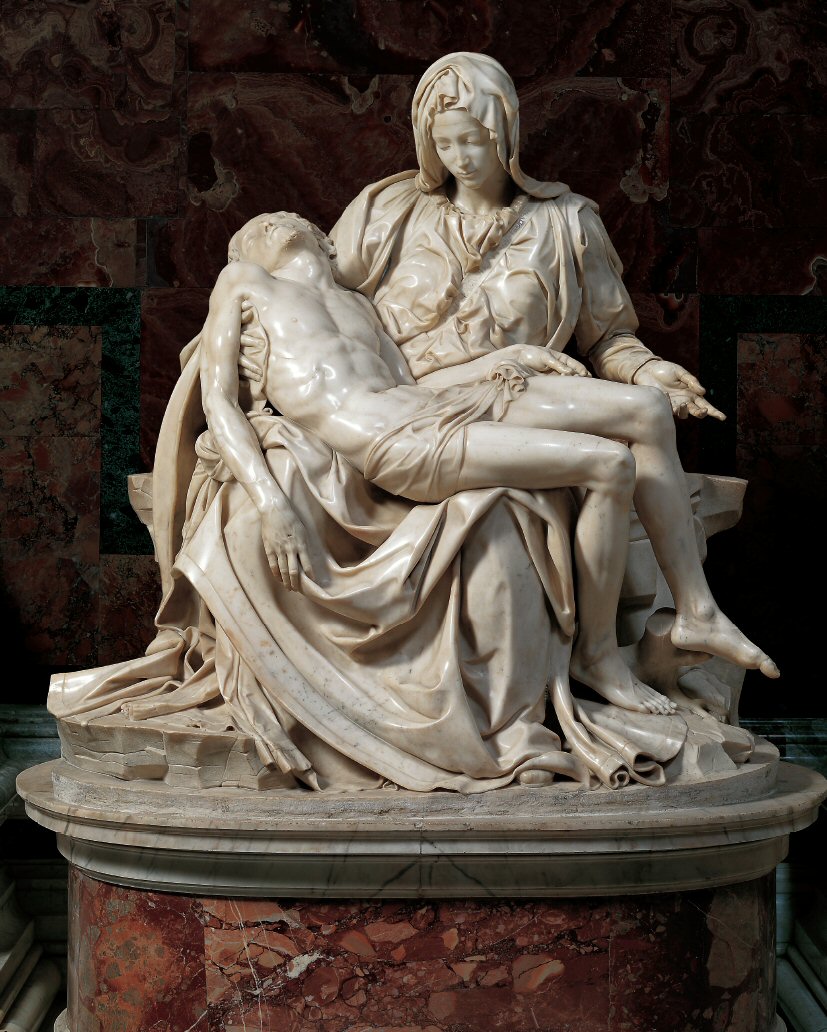
There are a variety of images in Split Screen, all with "naturally" occurring splits: a hospital operation table, a messy room perhaps in a house about to be vacated, a magazine shot of crotches (male? female?), an orgy of legs, the Sistine Chapel ceiling, and the sculptured head of Christ from Michelangelo's Pieta.

Cleverly, MacDonell gives us no background on any of the images. She has a bigger purpose than juxtaposing interesting photographic shots.

The sculptured head seems the least aggressive of her choices. There is a serenity around this head, and the sculptural work is of high quality. And here, MacDonell treads very carefully. She has removed the head from its context and its significance, and it appears to be simply the head of a man sleeping.

MacDonell's "head" is all the more disconcerting because it is at a different angle from which we would be accustomed to seeing it. The photograph was taken from the top rather than the side, thus exposing to us Christ's full face. And it is also flipped to its mirror image.


Untitled piece from Annie MacDonell's Split Screen series presented at Either/And


The Pieta by Michelangelo in St. Peter’s Basilica as it would be visible to visitors


The Pieta in St. Peter’s Basilica

What was a deeply religious work, the head of the dead Christ on his mother's knees after he was taken down from the crucifix, becomes the head of a man.

But why the split screen?

MacDonell is subtly and carefully "dismantling" Jesus. Removing, first his Godliness by presenting him as a mere man, then his intellect, his personality by splitting him, his head, apart. A form of decapitation, worse perhaps than the crucifix. At least after the crucifix, Jesus' body was left intact. But with MacDonell's rendition even Jesus' mind, his Godly intellect, is removed.

Despite its apparent tranquility, this is the most aggressive of the works played on Split Screen, where MacDonell attempts to kill off God permanently: body, mind and spirit.

Saturday, January 12, 2019

Chinese Canadian Veterans' Military Museum asking to receive funds as a Charitable Organization

My previous post, Chinese Aesthetics: Where Harmony and Cohesion Trumps Individuality and Innovation, was my perspectives on what Ricardo Duchesne of The Council of European Canadians wrote in an article he titled The Transcendental Mind of Europeans Stands Above the Embedded Mind of Asians

Recently, I watched The Cable Public Affairs Channel present a November 5, 2018 meeting of The Special Senate Committee on the Charitable Sector to:
"...examine the impact of federal and provincial laws and policies governing charities, nonprofit organizations, foundations, and other similar groups; and to examine the impact of the voluntary sector in Canada."'
Here is the transcript to that session.

Senator Terry M. Mercer, chair of the committee introduced the panel, including
"...from the Chinese Canadian Military Museum Society, King Wan, President"
I have posted below the full presentation by King Wan, and below that excerpts from the Q&A session with him and the senate.

The whole session is an eye-opener on how specific ethnic groups demand governmental funding to advance their very specific ethnic organizations. In this case, it is Chinese Canadians who served in the Canadian military. This particular session is about the funding source for a museum for Chinese Canadian veterans requested by The Chinese Canadian Military Museum Society.

A normal country would say: All veterans who served in the Canadian forces are Canadian Veterans and will receive their pensions and charity funds from such a general pool.

But guilt is the great weakner. One of the arguments to allow the Chinese Canadian Military Museum Society charitable status presents is by indirectly referencing the Chinese railway workers who came to Canada's west coast at the turn of the 20th century to start building the cross-country railway system. When they remained in Canada after the work was done, the Canadian government took many years before establishing their Canadian citizenship. That was never the government's plan, but rather to expedite their return to China. This is seen as a great "racist" affront by all Chinese Canadians, and is part of their lore.

All other special interest requests and interactions with the government as an ethnic body is colored by this background. And the government more often than not concedes.
King Wan, President, Chinese Canadian Military Museum Society: Thank you very much, Mr. Chair. The Chinese Canadian Military Museum Society is a nonprofit organization consisting entirely of volunteers. We have no paid staff, and I am just a volunteer. Thank you for the opportunity to come here to talk to the senators about our situation.

I am not as eloquent as Mr. McRae in that, as a volunteer and in terms of our time committed to the museum, it is all in our spare time. Most recently, we had a big dinner last Saturday night, which is our annual fundraising event where our main funds come from for operations.

I would like to talk about a few things. One is that we would like to share with the senators on the committee here that we would like to see broader cultural giving in our society to provide funding for smaller organizations like ours. We are a small organization. Our only funding is through donations from our members and then sponsors. As I was saying before, the major proceeds that we receive in the year is from our annual fundraising dinner. We are fortunate to have had a large crowd of people attend our function.

We looked at the tax credit that is given to charities, and I found that the current CRA tax credit given to donors is adequate from our perspective because we are a small organization. Those who give us funds will get their normal percentage of tax credit. However, that doesn’t mean that it cannot increase to provide them with a further incentive to donate to smaller organizations like ours.

I would like to see more government programs to support smaller organizations like museums. I know for a fact that there are multiple departments in the government that would provide funding for different charities, foundations and so on, and I think there is opportunity for more, be it from Veterans Affairs Canada, Canadian Heritage or other departments, where they could spend additional funds to provide that incentive for the smaller community museums to pursue their particular objectives.

One of our objectives, again, is narrowly focused. The Chinese Canadian Military Museum Society is mainly to promote and preserve the legacy of the Chinese Canadians who served in the Canadian military. I personally served in the military myself. At the same time, there are not many left of those who served in World War II. We have post Cold War era veterans that also need to have their stories told. Most recently, Afghanistan veterans coming home should have their say and their stories preserved for prosperity for our fellow citizens.

Some of the reporting requirements in the CRA are somewhat cumbersome. I also belong to a number of other organizations where, because they are national in scope across the country, their filings of T3010s and other forms are somewhat of a challenge. When you are dealing with volunteers, people may not be as responsive as people who are paid staff, so sometimes the timing of those reporting requirements is somewhat onerous for those who are working on a voluntary basis.

I also agree with Mr. McRae on a number of issues he mentioned. I learned something from him, as well, this evening, which is the whole concept of charity in our current setup in Canada. I read a lot of submissions that were sent to us earlier through your website. We are fairly progressive, but there are countries like the U.K. and the U.S. that have certain features we should consider emulating or learning from. I am not an expert in those charities. At the same time, I do share some of the more advanced charity-giving policies and procedures.

Again, I want to thank you for giving me the chance to come here to speak to you. I appreciate any comments and questions from you.
---------
Q&A

[About the museum]
Mr. Wan:
We are located in Vancouver — Chinatown. The Chinese Cultural Centre of Greater Vancouver has a building, and we are a lodger of that building. We occupy a hallway and a small room. Fortunately, since I look over as president a few years ago, we believe in the museum, not only to present something on a one-time only basis, but I believe it has to be refreshed on a regular basis. If you have seen the museum once, you may not go back if there is nothing new to show. For a number of years, we have been changing our theme and focus of displays on a fairly regular basis. To do that requires funding. Although our volunteers are very active and passionate about what they do, at the same time, it requires a lot of effort and funds to create those new displays.
[About the museum's funding sources]
Senator Omidvar:
...You talked about government grants and donations. On an average year, what is the level of charitable contributions you receive from individuals?

Mr. Wan:
We have been fortunate in the last year or so to have one or two major benefactors. For that, we are thankful that we received maybe $20,000 to $30,000 over the last few years.

We have been also receiving some grants from the government. That was back in about 2011-12. We got funding from the Canadian Heritage group. There was a historical community fund that came out, and we were able to get about $50,000 or $60,000 that year to hire someone to help us create some exhibitions, and we were able to use that to get to the Canadian War Museum for a short time.
[About charitable organizations' reporting standards]
Senator Omidvar:
Thank you. If you in an average year get $20,000 in charitable donations from individuals and you have to make a pretzel out of yourself to report on it, do you think that there should be a change in the law that requires variable reporting and depth of reporting based on the levels of contributions you receive? Why should a small organization like yours have to go through the same hoops as the SickKids Foundation, which gets millions of dollars every year?

Mr. Wan:
Exactly. We are small potatoes in terms of the big picture, but we have also been fortunate. When I say $20,000 or $30,000, that is strictly through individual donors and through membership, and we were able to get a bit more the last couple of years. But it is quite correct that small museum charities should not have the same standard of reporting as someone like the hospital foundations that get $60 million or whatever the case is.
[About the uniqueness of Mr. Wan's organization: The Chinese Canadian Military Museum Society]
Senator Martin:
Mr. Wan, it is nice to see you here in Ottawa. It is fitting, with Remembrance Day coming up and Veterans’ Week, that you are representing a unique society in Canada. In terms of the society, is it quite unique in Canada? Are there other such societies? You have a very specific mandate, as you explained. Does that limit your access to funding? I want to understand whether funding opportunities are available to you, or, with a specific mandate, whether it is more challenging?

Mr. Wan:
Yes, it is more challenging because we are narrowly focused on veterans and on a certain ethnic group as well.

The major government funding would come from Veterans Affairs Canada or Canadian Heritage. Those are the two main ones we can get money from. Sometimes the procedures are more onerous, and we are competing against other veterans organizations as well. That is the challenge we have.
[About the bias and decrease in diversity in the approval of charitable organizations]
Don McRae, Charity Researcher:
The research that I have done shows that, over the past couple of years, the number of charities in Canada has remained stagnant. Since January, we lost about 200 charities. When I was going through my career, the number of charities increased every year. I wanted to find out about that.

CRA is being more restrictive in terms of their approval rate of registrations. I like numbers, so give me a minute. From 2002 to 2006, the approval rate was 74.5 per cent for charities. That changed and went to 44.8 per cent from 2014 to 2017-18. The rate has gone down approximately 30 applications per 100.

The revocations have increased in terms of how many charities lose their registration. If you fail to file your T3010, you lose your registration. You can get it back with a $500 penalty, but the rate of re-registrations has gone down. I did a study that looked at it from 2002 to 2014, and it went down by about 10 per cent. It is decreasing that way.

I also go through and see who the new charities are. By and large, the new charities are not as diverse as our Canadian society. I find that problematic. It hasn’t changed that much from when I was doing my job.
[On the national benefits of a localized (or ethnic) organizations, and why they need government grants]
Mr. McRae:
The problem with the [Canada Revenue Agency] regulator is that it keeps on reinterpreting some things like public benefit...I would say that one of the reasons why CRA thinks they are not charities is because of perceived personal [as opposed to public] benefit but, in a country like Canada, we can’t look at philanthropy as one whole thing. There is a spectrum of philanthropy. When you have newcomers coming to Canada, the first thing they want to do is support their family. The next thing they want to do is support their clan, to use a Scottish term...There is a spectrum of philanthropy, and people move. My research, when I was working in Canadian Heritage, showed that ethno-specific organizations move their philanthropy from local and focused on their own to being greater, and that takes time. In order to get them to that greater thing where there is no perceived personal benefit, we need to help them along the way. If we can get rid of restrictive agency agreements, that’s one way, but we need to try to move the definition so that some of those people are not seen as outsiders.

Senator Seidman:
Mr. Wan, I saw you nodding, so I will ask if you want to add to that.

Mr. Wan:
I think Mr. McRae was quite right in saying that. The museum has been established for 20 years, so we are somewhat mature in terms growth. Initially, it was the Chinese Canadian veterans. As I mentioned, we expanded to include other veterans activities, such as the Battle of Hong Kong. Canadian soldiers went overseas to help. We talk about Indigenous veterans. As they grow and have that foundation, they can build on expanding it to encompass all Canadians.
[On the government's obligation to fund organizations like the Chinese Canadian Military Museum Association]
Mr. Wan:
Better access to greater funding would certainly help our organization, being a small museum, to grow and expand. I think that is very important. At the same time, it would require some effort from the government or some other organizations to make those things happen for us in order for us to gain access to this funding.
[Senator Duffy on "every Canadian" and moving beyond ethnic groups]
Senator Duffy:
Thank you both for coming. Fascinating. I would encourage our viewers to visit Mr. Wan’s museum online. I’ve had a look. The stories that you tell there are amazing, about amazing Canadians, including Douglas Jung, who was a war hero and a spy. They are phenomenal stories about how this country was built, and every Canadian, not just those of Chinese descent, should hear about these amazing people.

Tuesday, April 15, 2014

Art Thieves

Image from Either/And Exhibition
Annie Macdonell
"The images in this series are scans of found 35mm slides. I came across a box of them next to the trash a few months ago. They were unlabeled, undated, and unsourced. I’ve put together a selection of 15, which now form a slideshow you can click through on your computer monitor. Maybe you will recognize some of the images. Others you may not recognize specifically, but you will certainly be familiar with their sources – art monographs, fashion magazines, notebooks and textbooks, technical manuals." [Annie MacDonell, Interview in Either/And] on her work Split Screen
[Note: Addendum below]

MacDonell was a former classmate of mine at Ryerson University, where she received a BA in photography. She went on to get a Master of Fine Arts in Lefresnoy, a university in France. Here is more on her statement of her work Split Screen in Either/And:
The slides were produced on a copy stand which, before the flatbed scanner, was the simplest means of reproducing images. Each one contains an interruption of the image by the spine of the book in which it originally appeared. The visibility of the spine is what attracts me to them. It marks only one of the many transformations these images have undergone since they were produced by the original photographer or artist. But in doing so, it places the histories and genealogies of these images in the foreground. The slides were shot for pedagogical purposes, to be projected large in front of a classroom and discussed as a group. Before that, they were published in books and magazines, to be purchased and leafed through by individuals. And before that they were, perhaps, images matted and framed behind glass on a wall. Now we may be browsing effortlessly through them, each on our slick backlit monitors. But the spine’s interruption of the image reminds us of where they came from in the first place, and how our ways of encountering them continue to shift along with the technology that delivers them to us.
That is a lot of words for simply showing pictures from magazines which spread across two pages (split by the spine of the book).

Such is the verbose nature of contemporary "artists" who have a lot to say about their vapid works.

MacDonell's Master of Fine Arts thesis was "about representation itself, which has always seemed to me a more interesting conversation," as she explains in the Either/And interview.

What this means is that MacDonell, for all her "artistic" vision, is not an artist. When tested, she's probably not very skilled at any of these artistic fields either: Film making (taking out the camera, shooting images, editing those images, producing a coherent whole), painting, drawing, or sculpture (she's big on "installations" which to her probably constitutes sculpture). All her works are borrowed, which I term as stolen, from various sources. And of course, not from real artists, which would have given her some exposure, and eventually something to emulate, but from the photographs and films she finds in people's garbage bins.

What a macabre and nihilistic way to represent the world! And it shows in her disjointed, cut ups, collages and installations.

Art for this conceited individual is about talking about art, rather than making art. And these "found objects" have been her means of "conversation" rather than creation.

Below is a photograph I took about two years ago which is around a similar theme of displaying cultural and sexual messages through contemporary cultural signs. The original post, with my commentary is in Camera Lucida under The Sexy Escape.

The Sexy Escape, 2010
Kidist P. Asrat

Here is how I see the superiority of my work:
a. My photograph shows:
- Context
- Humanity - how ordinary people look next to these iconic images
- Architecture - how images are placed in or on buildings
- Real life - the images show ordinary people juxtaposed with the images, mannequins and shop windows
- Poetry - I try to reference these views to come up with some kind of visual poetry

b. Macdonell's images show:
- Disjointed images, shapes and forms: Her cut-off hands of the mannequin, her burlesque dancer revolving in a few frames of a film, have no connection to the real world, and rotate within the image's confines
- Focused on phallic: Almost all her work, at some point, narrows in on the male or female sexual organs
- Cut off from real life: Even though she says she finds these "objects" in people's trash, she isolates them from the owners, and creates her own, insulated world out of them
- Morbid: Her objects form a collection of "found" items which have been thrown away, and which had no use for their owners. She doesn't salvage them and bring them back to their original use (building a new mannequin to of the hand, for example), or elevate them by creating something worthwhile, but uses them to further degrade them.
- Nihilistic: She says in an interview: "The work becomes about representation itself, which has always seemed to me a more interesting conversation [than talking about the work]." The objects, the images, the sculptures no longer count, which means what they represent does not matter either.

Macdonell, and the string of "artists" of her era, are clever wordmongers. They have not talent in art, but somehow decided that they wanted to work in art. This proved difficult, and their way out is to "have conversations about representation," as they spitefully malign art and creation.

Here are links to Macdonell's works and interviews:

- Cinema and Visual Pleasure at the 2006 Viennale

- Interview at the Mercer Union: Originality and the Avant Garde (on Art and Repetition)

- Grange Prize short-list

- Macdonell's website

Addendum:

Here are other strange, hard to locate, image reconstructions where MacDonell references Canadian photographer Roloff Beny:

The images are embedded in the 1967 collection of Roloff Beny's work: To Everything There is a Season: Roloff Beny in Canada, Essayd, Poems and Journals, Edited by Milton Wilson. It is not clear how much of the photographs are "collaged" additions to her work, if she retook photographs of the locations that Beny photogrpahed, or, what!

Here is one site which tells us this about the following photograph credited to MacDonell (and which doesn't appear on her website) The photo is for sale (!) for US$2,000:


This conceptual landscape by Annie MacDonell references the 1967 book, To Everything There is a Season, Roloff Beny in Canada. Beny, a world travelling artist/socialite obsessed with natural beauty sought to mythologize the Canadian landscape in a year that marked the country's centennial anniversary of confederation. MacDonell's interventions fracture and reconstruct Beny's mystical photographs, giving the soft, poetic imagery threatening edges that redress parallel social histories that existed (and still exist) in our society. Deceptively straightforward, these prints of reconfigured photographs layer our contemporary concerns on top of perspectives and sensibilities of past eras.

"Interventions?" "fracture and reconstruct?" "redress parallel social histories?" What does this all mean? No-one so far has given me a satisfactory explanation in my email queries.

And the tiny "53" (visible in the "original") at the bottom left hand I guess makes up for lack (absence) of information regarding this clearly appropriated work.
 
More to come.

-------------------------------------------------------------------------------------------------------------------------------------------------------------
Posted By: Kidist P. Asrat
-------------------------------------------------------------------------------------------------------------------------------------------------------------