

Charles Pachter
Bon Echo, 2000
Acrylic on canvas
20.1" x 24"
Est. $11000/13000
Starting Bid $4,000
(Image from The Batteredbox’s Weblog)
I suppose Charles Pacther painted Bon Echo as an homage to the Group of Seven. All his paintings appear to be some kind of hommage. The Queen and the Moose come to mind.
His depictions of Canada's head of state and our favorite animal attempt at some kind of humor. But I would call them mockery. Pachter is not benignly teasing the Queen, that formidable head of Canada, nor is he seeing the humor in that lumberingly graceful giant deer - the moose - Canada's national animal (why couldn't we have had a haw to parallel that American Eagle?). He is making fun of them, as I believe he has mocked Canada throughout his life.
But Bon Echo enters darker territory. Pachter appears to have painted the cliff as a the silhouette cliff - he is an expert in cartoonish silhouettes. But the glisten of the light on the cliff's side give it a three dimensionality, rendering it a more realistic portrait than moose's or queen's. Still, once again, Pachter's main design strategy is his flat canvass style, where the full glare of the morning (or evening) pink has scant shadows or highlights to give us any semblance of ripples of life. And what would be a small islet of sand is colored a dull blue monochrome.
But Pachter has a purpose, as always. To make us concentrate on the queen or on that moose, he cuts out any extraneous (artistic) embellishments. And the same with that ridge. We don't get the green and brown shrubs that other painters have placed on that cliff, nor do we get the marvel of nature carved carved stone that actually compose the encline. We simply get a flat edge with a few strokes of dark pink and light blue, which merely echo the surrounding unnaturally rendered pink water and blue sand. No plants, no water, no life. All we have is the imposing dark and ominous form floating on a diluted bath of pink.
What is that black form? What are its viscous pink and blue bases?
Pachter painted this piece in 2000. He had seen (and continued to see although less frequently) many of his friends die of AIDS. Pachter is a homosexual, and his paintings in the 1980s and 1990s show that he was active in the cultural and artistic movements of that group.
Bon Echo is an homage to them, a funereal gift to the dead and those still alive, after the world had recognized and generously acknowledged this deadly disease which almost exclusively affected his group of people. AIDS became a amoral and cultural connection and perhaps dd more for the homosexual "cause" than any other .....
But I don't think Pachter has such a generous spirit. Bon Echo could simply be a dark angry mockery of his predecessors (and ancestors): The Canadian Group of Seven, those Western men, sure, virile, and dependent, who pushed through brambles and forests, crossed rivers and lakes, and fended off predators and Indians and showed Canadians the land they had inherited. Pachter was simply copying the feat and with the knowledge that everything around him was safe and taken care of, brambles had been cleared and ndans tamed. Much like AIDS was taken care of by these progeny of The Group: those doctors, social workers, television newscasters, and an endless army of fundraisers who could magically create millions out nothing.
And now Pachter can be generous. He has passed those treacherous times of doubt, fear, and even disclosure. AIDS s now a "treatable" disease. And preventable too!
The eulogized "other" become the "artists and cultural producers from Indigenous, newcomer and youth communities," tells us Mandy Salter, director and curator of the AGM, in the auction catalogue....

Ryan McGilchrist
Bon Echo Provincial Park
Photograph

Jason Bouwman
Bon Echo Morning
9" X 12"
Oil on panel
SOLD
Jason Bouwman
Southern Ontario, Niagara Falls
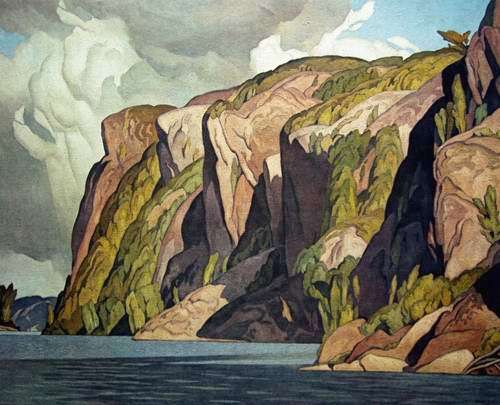
Alexander Young (A.Y.) Jackson
Mazinaw Lake, March, Bon Echo
1924
oil on canvas 25" x 32.25
Sold: $619,500

Arthur Lismer
The Big Rock
1922
Oil on canvas
36 x 40"
National Gallery of Canada

Tom Smith
Photographer
Landscapes
Bon Echo Canoe

Carla Miedema
The Meeting Place,
Acrylic on canvas
36"x 24"